Locked Up For Life

LWOP

Mark Perry highlights a report on life without parole (LWOP):

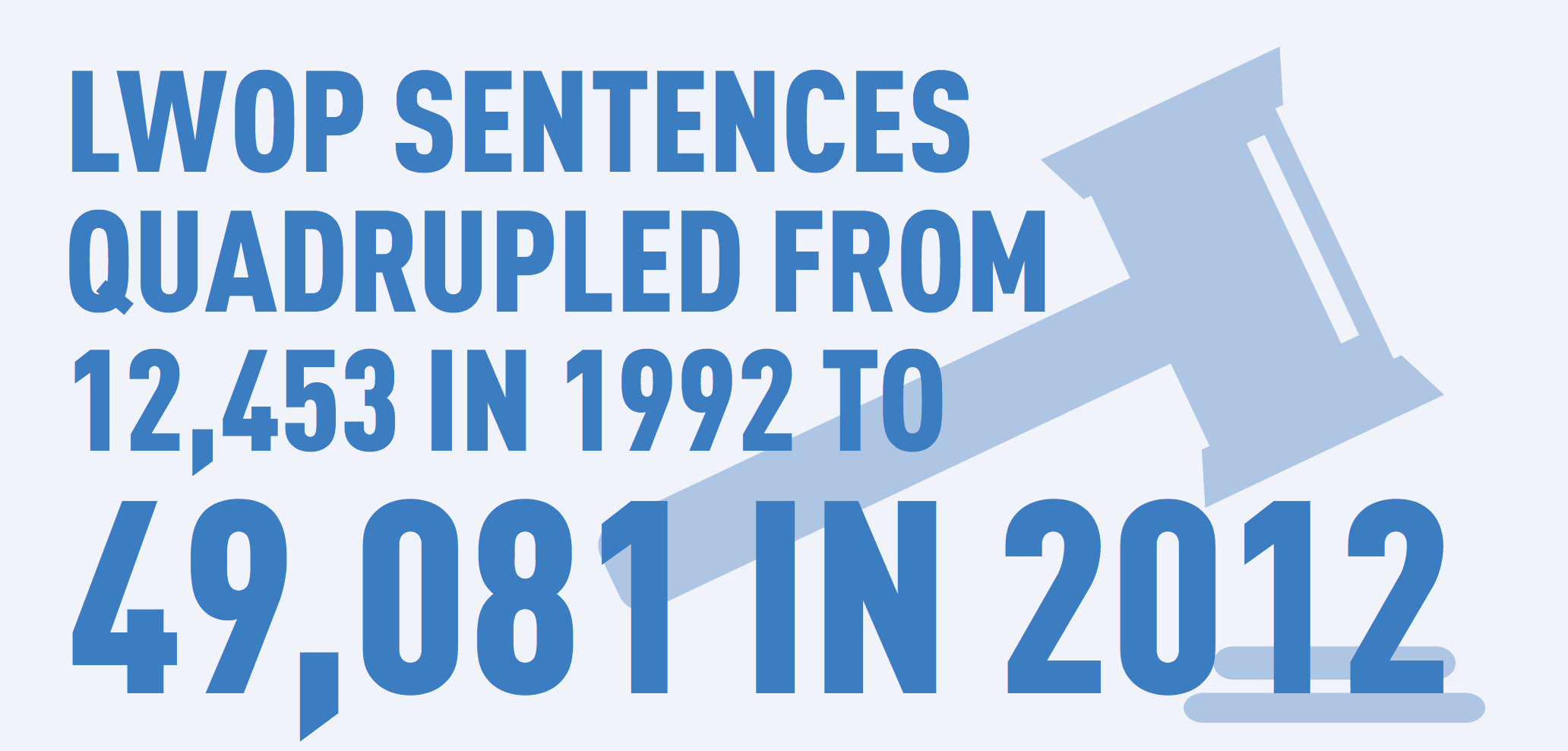
A new report released this week from the American Civil Liberties Union ”A Living Death: Life without Parole for Nonviolent Offenses” examines a very disturbing trend that contributes to America’s notoriety as the World’s No. 1 Jailer – the increasing number of nonviolent offenders in the US who are being sentenced to life in prison without parole. As Reason.com reported “The ACLU found, perhaps unsurprisingly, that the War on Drugs, mandatory minimums, and “tough-on-crime” policies are to blame” for the more than 3,000 prisoners in America serving life sentences without parole (LWOP) for nonviolent drug and property crimes. 

Kleiman comments:

[T]hough I can understand the politics of the situation, I can’t actually justify President Obama’s failure to commute a bunch of these sentences. If the pardon process is too opaque, then appoint three while male conservative Republican retired federal judges as an unofficial “clemency committee,” with a pre-commitment to commute any sentence for which they unanimously recommend commutation.

“The Other Half Of OCD”

Olivia Loving illuminates it:

Compulsive tics steal most of the limelight when it comes to Obsessive-Compulsive Disorder. Comparatively less attention, meanwhile, is given to the obsessive thoughts that characterize the other half of OCD. The content of these obsessions can range from pedophilia to homicide to sexual identity crises; compulsions “atoning for” the thoughts sometimes follow. For example: A woman, distraught by visions of murdering her child, wakes up several times in the night to check on her daughter.

In discussions about OCD with family and friends, I’ve observed that it is easier for others to adjust to compulsions they can see rather than obsessions they can’t. It is easier for them to understand repetitive hand­-washing than, say, the fear of murdering your parents.

Science Shouldn’t Be Partisan

Mischa Fisher, “a former Republican science-policy staffer and legislative director in the House of Representatives,” insists that “Republicans, conservatives, and the religious are no more uniquely ‘anti-science’ than any other demographic or political group.” Why he wants to depoliticize science funding:

Science’s political constituency is too small and the coalition supporting it is not powerful enough to protect research budgets against other priorities. Supporters of federal science funding, a group of which I am a card-carrying member, can ill afford to lose Republican support for science. But if it is perceived as a partisan litmus test, it will not continue to exist in its current state as the government’s other financial obligations continue to grow. This may be stupid or petty and perhaps it ought not to matter whether or not it’s perceived as a partisan issue, but I’ve been on the Hill and this is how politics works.

If we do not expand the pro-science coalition, instead of shrinking it, it will be the death knell for American leadership in science. Every American will be worse off as a result. Science funding will not just shrink as a percentage—it will shrink in absolute terms, as it did under the sequester.

Oswald Killed Kennedy, Period

Fred Kaplan, a former believer in JFK conspiracy theories, debunks some of the most popular ones:

For many years, long after I’d rejected most of the conspiracy buffs’ claims, the “magic bullet”—as critics called it—remained the one piece of the Dealey Plaza puzzle that I couldn’t fit into the picture; it was the one dissonant chord that, in certain moods, made me think there might have been two gunmen after all.

Then, in November 2003, on the murder’s 40th anniversary, I watched an ABC News documentary called The Kennedy Assassination: Beyond Conspiracy. In one segment, the producers showed the actual car in which the president and the others had been riding that day. One feature of the car, which I’d never heard or read about before, made my jaw literally drop. The back seat, where JFK rode, was three inches higher than the front seat, where Connally rode. Once that adjustment was made, the line from Oswald’s rifle to Kennedy’s upper back to Connally’s ribcage and wrist appeared absolutely straight. There was no need for a magic bullet.

The End Of Trans Fat?

The FDA is preparing to ban partially hydrogenated oils (PHOs), the major source of trans fats in processed food. Jonathan H. Adler spots an irony:

[T]here was a time when groups like the Center for Science in the Public Interest were urging fast food chains and others to replace animal fats with PHOs. So while CSPI today praises the FDA for targeting trans fats, it also celebrated decisions by fast food chains like Burger King to start using trans fat-heavy PHOs. In other words, had it not been for the food nannies, American consumption of trans fats might not have been so high in the first place.

David Harsanyi has questions:

The question you usually get in this debate goes something like this: Isn’t it government’s job to protect people from corporate malfeasance and dangerous products? Sure. But how far should government go to protect people from themselves? Trans fats are unhealthy, they aren’t hazardous. That’s a vital distinction that has been persistently muddled by groups that have spent decades trying to normalize the idea that someone else should be controlling what you eat.

Ira Stoll sees inconsistencies:

The FDA says the “trans fat” in old-fashioned margarine causes heart attacks. But plenty of other things also cause heart attacks that the Obama administration has not yet prepared to ban.

Television causes heart attacks by encouraging sitting around on the couch and watching it rather than exercising. Cigarettes cause heart attacks. The Burger King Triple Whopper Sandwich meal will give you a heart attack. Too much Ben & Jerry’s Chocolate Fudge Brownie ice cream will give you a heart attack.

Yet the FDA has it in for margarine, not for hot fudge sundaes or television or even Triple Whoppers, all of which would, under the FDA’s proposed action, remain legally available for sale, unlike margarine. … Beyond the inconsistency of it, there’s the failure to accommodate individual preferences. Margarine use in my family was a consequence in part of the Jewish religious prohibition on mixing milk and meat. If you wanted a baked potato with your steak or a chocolate chip cookie for dessert, using margarine rather than butter was the kosher approach. Other margarine consumers may be vegans for philosophical reasons involving animal rights.

Denmark imposed a strict limit on trans fats in 2003. For perspective on the current debate in the U.S., Scientific American talked to Steen Stender, a Danish trans-fat expert who lobbied for the law:

How did industry respond?

Some bakers said that what you call a “Danish” can’t be made in the right way anymore, that we can’t get it to flake in the right way. Then one baker from one of the supermarket chains found that if he used a very meticulous scheme of temperature control during incubation of the fat and other ingredients at just the right temperature and time, he could make Danishes without any trans fat. This company put up a big poster saying “Have a Danish, we are baking for your heart without trans fat.” And in no time other bakers put up signs in their windows saying, “We are baking for your heart without trans fat.” So the industry went along with this initiative.

Face Of The Day

Toronto City Council Meets To Limit Powers Of Embattled Mayor Rob Ford

Toronto Mayor Rob Ford stands amid the media at City Hall on November 15, 2013. The City Council today voted to strip the embattled Ford of authority during emergency situations, the ability to hire and fire the deputy mayor, and the ability to appoint members of the executive committee. By Aaron Vincent Elkaim/Getty Images.

Lipitor Can’t Carry Big Pharma Forever

The industry is increasingly focused on developing treatments for uncommon ailments:

There’s good reason for big pharma’s attraction to rare disease treatments. Revenue from these products has been outpacing sales of mainstream drugs for the last decade, a trend that’s expected to continue for the next 30 years, continuing a trend from last decade. So-called “orphan drugs” (given this moniker because they are for diseases that historically were overlooked by the big drug companies) are protected against competition from generics for seven years in the US, compared to five years for non-orphan products.

The approval process for orphan drugs is also often fast-tracked, lessening the risks of lengthy, expensive and failed developments. Since 1983, when these advantages and generous tax credits for orphan drugs were introduced in the US, an estimated 350 drugs for 200 rare diseases have been approved by the US Federal Drug Administration.  No doubt this has improved countless lives, even if Botox (originally a treatment for uncontrollable blinking and spasms, but now largely used for Cosmetic purposes) and Cialis, the erectile dysfunction product, were both originally awarded orphan status.

But John McDuling warns that trouble may lie ahead:

Insurance companies in the US are typically willing to reimburse the costs of orphan drugs, because they are by definition rarely used, they tend to address life threatening treatments, and they are often prescribed to children and young adults, two groups that are predominantly healthy and therefore usually covered. But this policy could change as more money flows into the sector, attracted by the fat profits on offer, and more rare disease treatments are unearthed.

The are rising concerns that orphan drug treatments could be driving up the costs of healthcare for everyone. Already in Europe, where health care is universal, but public finances are stretched, governments are questioning high reimbursement rates for rare disease treatments.  As the world’s biggest economy struggles to reform its own absurdly expensive healthcare system, orphan drugs could soon be in the line of fire in the US as well.