Poseur Alert

“The McRib is like Holbein’s skull: we experience it as (quasi-)foodstuff, as marketing campaign, as cult object, as Internet meme, but those experiences don’t sufficiently explain it. To understand McRib fully, we have to look at the sandwich askew. … The McRib’s stochastic return mcdonalds-mcribmakes visible the relationship between the eater and the McDonald’s menu. It produces a stain, a tear in the order of things that reveals the object-cause of desire for McDonald’s, but only briefly before it evaporates like faux-cartilage. The fragile conditions that make the McRib possible also insure that desire for McDonald’s food more generally speaking is maintained.

Desire is a delicate system. For Lacan, the lover “gives what he does not possess,” namely the objet a that incites desire rather than sustaining it. Likewise, McDonald’s sells what it does not sell: the conditions of predictability, affordability, and chemico-machinic automated cookery that make its very business viable. … Industrialism is also a kind of magic, the magic of the perfect facsimile. Eating at McDonald’s—eating anything whatsoever at McDonald’s—connects us to that magic, allows us to marinate inside it and take on its power,” – Ian Bogost, contemplating the return of the McRib. Update from a reader:

Does the Bogost piece really belong in that category? Seems pretty tongue-in-cheek to me.

Chart Of The Day

Approval Caucus Lost

Trende created the chart above on “the relationship between presidential job approval in the final Gallup poll before midterm Election Day and the share of the president’s party’s congressional delegation that went down to defeat”:

This isn’t a perfect relationship, but presidential job approval is still the most important variable for how his party fares in midterm elections, explaining about half of the variance. The relationship is highly statistically significant: For every point in job approval the president loses, his party loses 0.6 percent of its caucus. (The chart doesn’t measure drop in job approval; just job approval.) So, at 60 percent, the president should lose 5 percent of his caucus; at 50 percent, it is around 12 percent of his caucus lost; at 40 percent, it’s about 18 percent of his caucus lost — which would be 36 seats.

Now the latter is highly unlikely to happen. To pick up 36 seats, the GOP would have to win every seat that Obama won with 56 percent of the vote or less in 2012. Right now the GOP only holds five seats the president won with 54 percent of the vote or more, and only one seat he won with over 56 percent of the vote.

A Shadow Tax In The Spotlight

Barro hopes that the political blowback from Obamacare rate shock will teach future politicians “that shadow fiscal policy is not necessarily politically easier than explicit fiscal policy, and take their future expenditure programs on-budget”:

Obamacare’s explicit funding sources are mostly new taxes on people with high incomes and cuts to Medicare provider payments. But some of the “shadow fiscal policies” in Obamacare are effective tax increases on people with moderate incomes; these people didn’t expect to face a tax increase under Obamacare, and now that they’re discovering they are, they’re getting angry.

This is another example of the closing wonk gap: Members of the general public figuring out facts about Obamacare that policy wonks on both sides of the debate have known for years.

Obamacare relies heavily on cross-subsidies as it greatly expands the market for individually-purchased health insurance. Premiums in this market will be tightly regulated so young and healthy people pay more than they’re expected to get back in claims and older and sicker people pay less. This is a tax, of sorts, on a subset of young and healthy people that goes to finance health care for people who need more of it. And the individual mandate is designed to make sure they pay the tax, one way or another.

The Reality Of Serious Weight Loss, Ctd

The thread continues:

Excess skin is also a reality for most women after pregnancy – even if you didn’t experience excessive weight gain. I am trim and fit otherwise, but my stomach and breasts are saggy and loose and covered in stretch marks. It definitely affects intimacy. My husband says he doesn’t care; that he doesn’t even notice, but I care and I notice. I have a hard time relaxing during sex and I find myself contracting away when my husband touches my belly. My youngest child is almost 15 years old and I still feel shame and embarrassment about my post-pregnancy body. The feelings haven’t gotten any less intense, even after all this time.

The Moonies Crater

Mariah Blake chronicles the collapse of the Unification Church:

[I]n recent years, [Rev. Sun Myung] Moon’s plans to remake America and salvage humanity had run into trouble. Followers had drifted away; his political influence had ebbed. With his ninetieth birthday approaching, he increasingly looked to his children to preserve his life’s work.

In Jin, Moon and his wife’s fourth child, seemed suited for the task. She had a modern American upbringing and a master’s degree from Harvard. In 2009, she took over the Unification Church of America and introduced a bold modernization program. Her aim, she said, was to transform the church into one that people – especially young people – were “dying to join.” She renamed the church Lovin’ Life Ministries, shelved the old hymn books, and launched a rock band, an offshoot of which played New York clubs under the moniker Sonic Cult. She also discarded the old Korean-inspired traditions: bows and chanting gave way to “Guitar Hero” parties, open mics, concerts, and ping-pong tournaments.

And then, early last year, she disappeared:

After several months passed with no sign of her, some parishioners began pressing for information on her whereabouts. They were blocked at every turn. Even the highest circles of church leadership couldn’t – or wouldn’t – say what had happened to In Jin Moon. Before long, it became clear that the House of Moon was crumbling and In Jin had become caught up in its downfall. But her disappearance was only one part of a much more complicated saga – one that involved illegitimate children, secret sex rituals, foreign spy agencies, and the family of Vice President Joseph Biden. Even by Moon’s famously eccentric standards, the collapse of his American project would turn out to be spectacular and deeply strange.

Previous Dish on the Moonies here and here.

(Video: From the Washington Times’ 15th anniversary dinner, in 1997)

When Killing The Pain Does Harm

Prescription painkillers now kill more Americans than heroin and cocaine combined, according to the CDC. Physician Celine Gouder confesses that she, like other doctors, often struggles to make the right call when patients request painkillers:

Doctors have a duty to relieve suffering, and many of us became doctors to help people. But giving that help isn’t straightforward, especially when it comes to chronic pain. Try explaining the downsides of narcotics to a patient while declining to give him the medication he wants. He might accuse you of not understanding because you’re not the one in pain; he might question why you won’t give him what another doctor prescribed; he might give you a bad rating on a doctor-grading Web site. He might even accuse you of malpractice. None of this is rewarding for doctors: we’re frustrated that we can’t cure the pain, and that our patients end up upset with us. …

I sometimes think of the patient who asked me for OxyContin early in my career; I continued to prescribe the drug. But I also referred him for physical therapy and helped him get bariatric surgery to lose the weight that was putting extra stress on his spine and joints. Unfortunately, even after he lost about a hundred pounds, he wasn’t able to stop using narcotics or go back to work.

Are Dolphins Just Not That Into Us?

Justin Gregg considers whether there’s reason to believe in a special dolphin-human bond. On the plus side:

The phenomenon of lone sociable dolphins — for whom human contact appears to substitute for the company of their own kind — is documented extensively in the scientific literature. Among the better-known examples are Pita from Belize, Davina from England, Filippo from Italy, Tião from Brazil, and JoJo from Turks and Caicos. One report from 2003 described 29 lone sociable dolphins that were regularly observed by scientists, and a number of scientific articles have been published since then on new ones. There is no doubt that these animals are exhibiting inquisitive behaviour, which lends weight to the idea that dolphins do in fact seek out human contact with some regularity.

On the other hand:

The marine mammal researcher Toni Frohoff, director of TerraMar Research in California, reported an incident in which dolphins suddenly fled the scene as soon as a shark was spotted, leaving her to fend for herself. There’s even a news report from 2007 of an intoxicated man who was attacked by a group of bottlenose dolphins after falling into the Black Sea in Ukraine. The animals allegedly tried to drown him, prompting the Russian news agency Interfax to declare that they ‘lack the reputation of friendliness and love of humans enjoyed by dolphins in wealthy nations’. Perhaps the homicidal-dolphin phenomenon is more prevalent than we know. As Kathleen Dudzinski, my research supervisor at the Dolphin Communication Project, used to say: ‘You never hear from the people that the dolphins didn’t save.’

Previous Dish on dolphins here, here, here, and here.

How To Profit From Boring Subcommittee Hearings

Tim Murphy examines the growing market for political intelligence:

As Wall Street has pursued ever more complex ways to make a buck, the political intelligence industry has boomed, bringing in $402 million in 2009, according to Integrity Research Associates, which tracks the PI sector. That’s still small potatoes compared to the $3.3 billion lobbying industry, but it has caught the eye of critics who worry that it amounts to selling special access to the public’s business.

The political intelligence industry began to take shape in the early 1980s.

As federal regulatory power expanded, big business wanted to know what happened in obscure subcommittee hearings—and didn’t want to wait for the next day’s papers to read about it. In 1984, investment banker Ivan Boesky hired lobbyists to attend committee hearings about a big oil merger and report back to him. It paid off: Boesky made a cool $65 million just by finding out first and buying low. “Investors started to realize that there was money to be made by knowing what was going on in Washington and knowing it as quickly as possible,” says Michael Mayhew, the founder of Integrity Research Associates.

As Wall Street put an ever-greater premium on speed, investing in supercomputers to place orders milliseconds before the competition, the industry took off. The biggest known score came in 2005, when Congress was weighing approval of a $140 billion trust fund for asbestos liability claims. … A few days before then-Senate Majority Leader Bill Frist (R-Tenn.) announced a vote on the plan, hedge funds snapped up stock in companies that would be shielded from lawsuits if the fund were set up. The Securities and Exchange Commission suspected that advance notice of the vote had leaked from the senator’s office to lobbyists who then tipped off their political-intelligence clients. That the asbestos fund ultimately never came to be was beside the point; the hedge funds had already made their money.

The Young And The Homeless

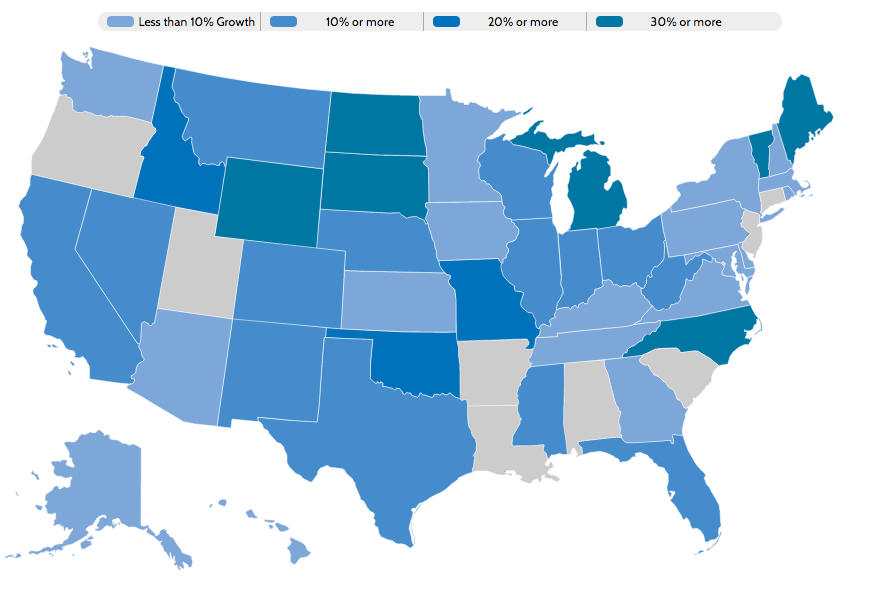
A map showing “where is childhood homelessness getting worse”:

Screen Shot 2013-11-12 at 12.45.12 PM

While overall homelessness rates have fallen, more and more of kids are unhoused:

[T]he National Center for Homeless Education (NCHE) released an annual survey that found that since 2007, the beginning of the global recession, the number of homeless youth enrolled in K-to-12 public schools has increased by a whopping 72 percent. Between 2010 and 2011 alone the number increased by 10 percent. The largest concentration of homeless youth in school are in California, which has about 35 percent of the national homeless youth population, followed by Florida, Texas and New York.

Some 1.2 million public school students were homeless in the first half of 2012, according to the most recent DOE count. That’s out of a total of 50 million.

Recent Dish on homelessness here.