Where there’s a dog, there’s a way:
Update from a reader:
It ended with a “tripawd” … I see what you did there :)
Where there’s a dog, there’s a way:
Update from a reader:
It ended with a “tripawd” … I see what you did there :)
(The video below is NSFW!)
We knew that already, of course. His instinctive, reflexive recourse to homophobic slurs is now well established. Let us review the previous evidence. This is what he said about a vile Daily Mail dirtbag who offended him:
“George Stark, you lying little bitch. I am gonna fuck you up … I want all of my followers and beyond to straighten out this fucking little bitch, George Stark. @MailOnline … My wife and I attend a funeral to pay our respects to an old friend, and some toxic Brit writes this fucking trash … If put my foot up your fucking ass, George Stark, but I’m sure you’d dig it too much … I’m gonna find you, George Stark, you toxic little queen, and I’m gonna fuck … you … up.”
Staggeringly, Baldwin insisted that that rant was not a sign of his homophobia. That’s how entitled he thinks he is. Now we have an almost identical outburst against another indefensible photographic stalker – but after Baldwin won a suit against another stalker. The video is here. The key expletive is the term “cock-sucking fag” which Baldwin utters under his breath as he is walking away from the hack who was harassing him, his child and his wife.
Look: Baldwin’s anger in both cases was thoroughly merited. But he continually resorts to this kind of homophobic poison when he’s angry. Just as Mel Gibson revealed his true feelings about Jews in his drunken rant, so Baldwin keeps revealing his own anti-gay bigotry. These outbursts reveal who he actually is.
I should add that this is a free country and he has an inviolable right to use these words. But he has no right to pretend in any way to be a tolerant liberal when he is anything but, when it comes to gay people.
So many liberals, of course, give him a pass when they would never dream of doing so with anyone who was conservative or Republican. Even after his bigotry was on full display, MSNBC hired him for a new show as a liberal pundit. For too many of them – especially gay establishment liberals, like the tools at GLAAD or the terminally naive like Hilary Rosen – there is a glaring double standard here. It seems to me that this double standard cannot stand any more. And this raging, violent bigot cannot be defended any longer.
A reader writes:
Thank you for pointing me to Ariel Levy’s account of her baby’s stillbirth. But as I read it, I think it’s important to say it’s a stillbirth, not a miscarriage … a minor change in language, but it better expresses the pain and grief she experience. To say this is not to trivialize miscarriage – which is incredibly painful, and a loss often ignored – but to pick up on the details of her experience. Actually, it’s not even a stillbirth, as the baby was briefly alive. But we don’t have words for that experience. And maybe that matters.
Another:
My wife and I have four wonderful kids, but I can still see the image in my mind from the doctor’s office of the blank ultrasound screen where a very small baby used to be.
That’s what Cass Sunstein concludes after looking at new research:
When people are assured of anonymity, it turns out, a lot more of them will acknowledge that they have had same-sex experiences and that they don’t entirely identify as heterosexual. But it also turns out that when people are assured of anonymity, they will show significantly higher rates of anti-gay sentiment. These results suggest that recent surveys have been understating, at least to some degree, two different things: the current level of same-sex activity and the current level of opposition to gay rights.
Consider one study of 2,500 people involving a standard “best practices” survey and an anonymous “veiled” survey:
In the best practices survey, 11 percent of the population said that they didn’t consider themselves to be heterosexual. In the veiled report, that number jumped to almost 19 percent – an increase of 65 percent.
Did participants believe that discrimination on the basis of sexual orientation should be illegal? In the standard survey, only about 14 percent said no. That number increased to 25 percent in the veiled report.
In best practices, only 16 percent of participants said they would be uncomfortable having a manager at work who was lesbian, gay, bisexual or transgender (LGBT for short). The number jumped to 27 percent in the veiled report.
However, there’s one more reason to think the kids are fine:
The effect of assuring anonymity varied significantly across demographic groups. The veiled survey had no effect on the answers of young people to questions about their sexual orientation, apparently because social norms don’t much discourage young people from revealing the truth.

Beijing, China, 3 pm
What Avik Roy advocates in his new book, How Medicaid Fails The Poor:
Start by paying a primary-care physician $80 a month to see each patient, whether he is healthy or sick. That’s what so-called concierge doctors charge, and it would give Medicaid patients what they really need: first-class primary-care physicians to manage their chronic cardiovascular and metabolic conditions. …
Then throw on top of that a $2,500-a-year catastrophic plan to protect the poor against financial ruin. The total annual cost of such a program would be $3,460 per person, 42 percent less than what Obamacare’s Medicaid expansion costs. Heck, you could put the entire country on that kind of plan, along with giving people the opportunity to use health savings accounts to cover the rest.
Aaron Carroll spots problems with this plan:
I think this misses a huge part of care. Physician time shouldn’t be minimized. But this plan would involve a huge deductible for everything else. So how would preventive care get paid for? Things like colonoscopies, mammograms, and laboratory panels aren’t cheap. How would maternity care get paid for? One third of births occur on Medicaid.
Would we expect people below the poverty line to have thousands of dollars to pay for deductibles for this stuff? Cause they won’t have it. A baby will bankrupt them.
Listening closely to the president’s noontime presser, I couldn’t help but be reminded of Ronald Reagan’s famous address to the nation in March 1987. Reagan had been caught in a lie – his declaration that he had never traded arms for hostages in his attempt to reach out to Iran (yes, neocons – he was trying to reach out to Iran!). For months, he languished as investigations revealed that he had indeed done such a thing, and his credibility – long his strong point – was at stake. Here’s the address:
The most famous line – addressing his clear statement to the American people that he “did not trade arms for hostages” – was the following:
My heart and my best intentions still tell me that’s true. But the facts and the evidence tell me it is not.
Today, Obama said something very similar about his statement that “if you like your plan, you can keep it, period.” I love the guy, as I loved Reagan, even though I have not exactly held back when I thought he was screwing things up. And the yawning discrepancy between that unequivocal statement and the “facts and the evidence” of the cancellation of individual market insurance policies these past few weeks was startling, to say the least. Had I misjudged the man? Had he unequivocally peddled a focus-group line that he perfectly well knew was untrue, in order to overcome resistance to healthcare reform? Was he a bullshitter – or something worse, a liar?
As I heard him today, he explained it this way. He says he was focused on the large majority of Americans who get their insurance policies through their employer. And for them, the statement is true, even though, of course, insurance policies are fluid and subject to change. What he ignored was the 5 percent of people in the individual market, whose plans did not meet the standards of the ACA. He said he believed that the grandfather clause would help the majority of those people and that those whose policies could be canceled would see, once the website was up and running, that they now had access to better plans at a similar cost. He also says he believed that the constant churn in the individual market – which cancels or changes policies dramatically and unpredictably all the time – would make cancellations due to the ACA seem like business as usual. He now says he realizes his statement was wrong and irresponsible but that he didn’t fully grasp that at the time, as focused as he was on the 95 percent, and as he believed the grandfather clause would help the rest.
So the key question remains: Is this plausible?
I can’t answer that for you. But it was to me, just as it was plausible to me that Reagan basically did not absorb the full consequences of what he was doing in the Iran-Contra affair, and so lied without really meaning to lie. I think that’s what Obama is trying to say as well: he lied without really meaning to lie. In both cases, the two presidents had to come clean at some point in a very messy situation. Many dismissed the Reagan line as hooey, and a further deception. I didn’t and still don’t. But the important fact is that both Reagan and Obama took ultimate responsibility for the de facto deception. “It’s on me,” the president said today. Reagan, of course, couldn’t do much to redress it, except cooperate in investigations. Obama has offered a temporary administrative fix for a year to retroactively make his promise valid, while retaining the core of the ACA.
The other difference? Reagan had a better grasp of theater. His speech was intimate, direct, and his confession not mediated by a journalist or a press conference. Obama – under acute pressure from the Congress – had to act quickly. But in my view, his mea culpa would have been better served by exactly the kind of personal televised address that Reagan made. Americans are ready to forgive presidents who cop to their mistakes. To break through the chatter, Obama should, in my view, have used the Reagan approach – and still can, of course.
But some other context. Obama’s approval ratings have tumbled because of this credibility gap. They have declined, in Gallup’s measurement, from 45 percent approval to 41 percent in a few weeks. What people forget is that Reagan’s slide was much more dramatic. His approval rating collapsed from 63 percent to 47 percent in one month. That’s the biggest collapse in approval for any president since Gallup began polling. And after that, Reagan came back to the historical average approval rating for all presidents, which is where Obama now is as well. That dotted line is the average for all presidents:
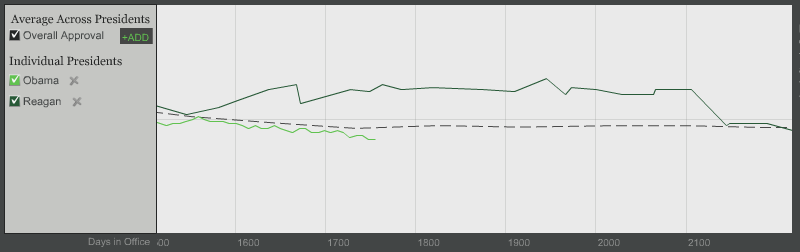
Obama now is where Reagan was – but sooner in his second term. But Obama, unlike Reagan, can still do something tangible to improve his position: he can make the ACA work and he should soon begin to make a much more aggressive, positive case for the reform. He has an administrative task right now. But he must soon also engage in a critical political task: to get off the defensive and onto the offensive; to make the case for the good things the ACA can do, and is doing; to remind people of the radical uncertainty of the past, and to demand that the Republicans offer more than just cynical, partisan spitballs to address the unfair, unjust and grotesquely inefficient mess that the ACA was designed to reform. That was the gist of his presser today. It needs to become a stump-speech. He needs to get out of his White House administrative mode as soon as he gets a grip on the reform, and launch a campaign mode against a return to the wild west of the past in healthcare and to expose the Republicans as cynical, opportunist critics who refuse to offer any alternative and any constructive reform.
But soon he needs to channel the core argument of this presser into a face-to-face talk with Americans. He needs to be as crisp and candid as Reagan was:
“I screwed up. I’m sorry. I didn’t think it was a lie, but it was. And I’ve changed the law to address the false promise. Now let’s make this reform work.”
Yes, he can.
“If you can’t take some joy, some modicum of relief and mirth, in the unprecedentedly spectacular beclowning of the president, his administration, its enablers, and, to no small degree, liberalism itself, then you need to ask yourself why you’re following politics in the first place. Because, frankly, this has been one of the most enjoyable political moments of my lifetime. I wake up in the morning and rush to find my just-delivered newspaper with a joyful expectation of worsening news so intense, I feel like Morgan Freeman should be narrating my trek to the front lawn,” – Jonah Goldberg.
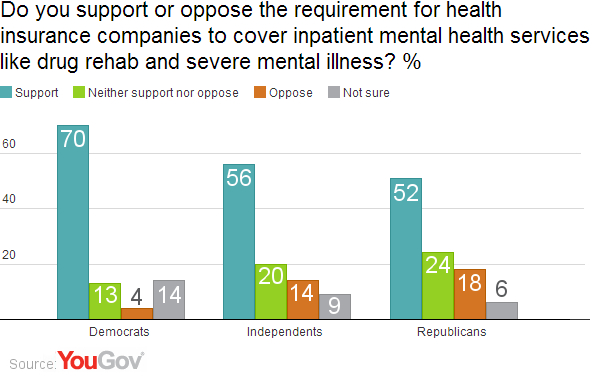
A YouGov poll finds that “that a majority of all Americans (59%) support requiring health insurance companies to cover inpatient mental health services”:
J.D. Tuccille examines the price-tag on Obamacare’s mental health coverage requirements:
The costs that mandates add to health coverage are no mystery. [T]he Council for Affordable Health Insurance estimates that, while each individual mandate might elevate costs by only a small amount, in aggregate “mandated benefits currently increase the cost of basic health coverage from slightly less than 10 percent to more than 50 percent, depending on the state, specific legislative language, and type of health insurance policy.”
Mental health parity—which “ensures that health plans features like co-pays, deductibles and visit limits are generally not more restrictive for mental health/substance abuse disorders benefits than they are for medical/surgical benefits” in HHS terms—is among the more expensive mandates, raising costs by five to 10 percent (PDF), all by itself.
Relatedly, Reihan digs up this quote from Harold Pollock from 2011:
Progressive supporters of health reform disagree about how expansive the essential health benefit (EHB) should really be. An overly restrictive design will leave important therapies uncovered, as happens every day across America. Yet a package designed with too little emphasis on cost (either because too many marginal services are covered, or because prices grow too fast) would be disastrous. This will prove too costly, and thus unsustainable as a platform for near-universal coverage.
 The Dish