“A Warren candidacy would bring a fresh level of scrutiny to both Hillary and Bill Clinton’s relationships with Wall Street, and they will have to deal with that. There is a clear tension between what the Clintons say and what lines their pockets. They have become fabulously, unimaginably wealthy” – an anonymous “progressive Democrat” noting the Clintons’ many well-paid speeches to banking groups.
Year: 2013
The Eleven States Of Violence
Poring through the cultural, historical and genealogical attributes of America’s regions and states is not a new phenomenon. But it’s always fascinated me. The different brands of religion that colonized different parts of the country in stages, the interaction with existing institutions, and the very different approaches to politics help explain why this fantastically diverse country comes close to being ungovernable as a whole. What Colin Woodward has done is create eleven states of North America and focus on their attitudes toward violence. Here’s the map:
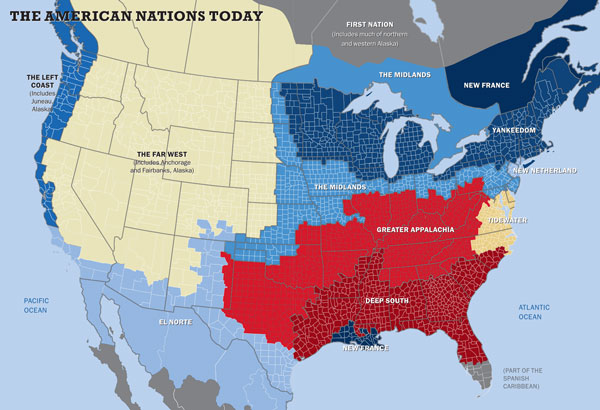
He has a book out explaining his analysis – but here’s the essay’s money quote:
Most scholarly research on violence has collected data at the state level, rather than the county level (where the boundaries of the eleven nations are delineated). Still, the trends are clear. The same handful of nations show up again and again at the top and the bottom of state-level figures on deadly violence, capital punishment, and promotion of gun ownership.
Consider assault deaths. Kieran Healy, a Duke University sociologist, broke down the per capita, age-adjusted deadly assault rate for 2010. In the northeastern states—almost entirely dominated by Yankeedom, New Netherland, and the Midlands—just over 4 people per 100,000 died in assaults. By contrast, southern states—largely monopolized by Deep South, Tidewater, and Greater Appalachia—had a rate of more than 7 per 100,000. The three deadliest states—Louisiana, Mississippi, and Alabama, where the rate of killings topped 10 per 100,000—were all in Deep South territory. Meanwhile, the three safest states—New Hampshire, Maine, and Minnesota, with rates of about 2 killings per 100,000—were all part of Yankeedom.
It’s this regional disparity that helps explain the impossibility of federal gun control of any bite. And on many issues, like stand-your-ground laws and the death penalty, deep cultural legacies about the permissibility of violence still propel the debate:
Of the twenty-three states to pass stand-your-ground laws, only one, New Hampshire, is part of Yankeedom, and only one, Illinois, is in the Midlands. By contrast, each of the six Deep South–dominated states has passed such a law, and almost all the other states with similar laws are in the Far West or Greater Appalachia …
The pattern for capital punishment laws is equally stark. The states dominated by Deep South, Greater Appalachia, Tidewater, and the Far West have had a virtual monopoly on capital punishment. They account for more than ninety-five percent of the 1,343 executions in the United States since 1976. In the same period, the twelve states definitively controlled by Yankeedom and New Netherland—states that account for almost a quarter of the U.S. population—have executed just one person.
The North-South rubric is way too crude. And the reality shows why federalism is the only workable system for this deeply divergent congeries of religion, culture and history.
Club Tripod

Many members are welcoming Bowie and me:
Congrats on the new family member. You said about the missing leg: “it is, of course, the first thing you notice about her”. Not necessarily. We have a three-legged labrador. Time after time, we’ve had people over for dinner, only to have them exclaim at the end of the evening, “Wow, I just realized your dog has three legs!”
Another:
Congratulations on finding Bowie, who “runs like the wind.” Shortly after adopting our three-legged dog, Ceiba, my wife and I were walking with Ceiba and our other dog, Chloe, along the C&O Canal towpath outside D.C. Both dogs were off leash. When a deer ran past in the nearby woods, it was Ceiba who led the charge, leaping over fallen trees and crashing through the brush. Both dogs were soon out of sight, their barking growing ever fainter. So much for the handicap.
Fortunately, the deer was faster than the dogs. On another walk along the canal, Ceiba charged into the brush and reappeared with a freshly caught squirrel between her jaws. Hopping along ahead of us (there was no way she was going to give up that rodent), she proceeded to devour the animal, starting by crunching into its skull.
Dog paddling seems to be the only thing our girl can’t do; it’s tough when you’re missing a front leg. At the local park, she’s got dozens of fans, especially kids – “Look, the three-legged dog!” Ten years on, she remains a joy and an inspiration.
Another:
Welcome to the three-legged beagle club! Jake came to my wife Sharon and me via a beagle
rescue organization near Nashville (where we live) several years ago. His previous owners had him tied to a chain in the yard. While they were mowing the yard, the chain had become wrapped around the shaft of the mower and Jake was pulled under, mangling his left front leg beyond saving. Afterward, they were planning to turn him over to a shelter before the rescue organization took him in.
The two things that are most amazing about Jake (it’s hard to narrow down to just two!) are that his default setting is happy – he wakes up wagging his tail every morning – and, as you note about Bowie, he is utterly oblivious to his handicap. Nobody has ever told Jake that missing a leg is a problem, so for him it isn’t. He digs massive holes in the yard, he runs after squirrels and plays with his “sisters” – our two other dogs – and never gives a thought that there is some sort of problem with his curious, hoppy gait.
He is also, of course, nothing but trouble. As Bowie will be.

Another:
One of our older greyhounds got bone cancer in his right rear leg. Instead of putting him down as everybody suggested, a vet surgeon removed his leg and he happily lived for three more years as a tripod … until the cancer returned with a vengeance. But those three years were glorious and happy for him. He could go for long walks and run on the beach and splash in the water and swim though waves. He was also one heck of a draw (and a ham); people would cross the street to say hello to him and give him an ear rub.
And another:
Welcome to the world of a 3-legged rescue dog. We got Lego (formerly Rambo, but he’s no Rambo) about a year and a half ago. A lab mix, he is the sweetest, most joyful dog I’ve ever known. I couldn’t be happier that my wife took him in.
Another asks:
Who is rescuing whom?
The GOP’s Alternative To The ACA
Eloquent after a fashion:
“The plan is to allow those things that had been proposed over many years to reform a health-care system in America that certainly does need more help so that there’s more competition, there’s less tort reform threat, there’s less trajectory of the cost increases, and those plans have been proposed over and over again. And what thwarts those plans? It’s the far left. It’s President Obama and his supporters who will not allow the Republicans to usher in free market, patient-centered, doctor-patient relationship links to reform health care. “
Er, that’s it.
Is Bloomberg Caving To Communist China?
The news agency is under fire for allegedly killing stories that would upset the Chinese government. Gwynn Guilford and Gideon Lichfield have details:
The New York Times reported last week that Bloomberg had scrapped an investigative report linking China’s richest man with top party officials, as well as another article on children of Chinese leaders working at foreign banks. The Financial Times followed up today (paywall) with similar allegations. According to both papers, Matt Winkler, Bloomberg’s editor-in-chief, spiked the reports after they had already been fact-checked and vetted by lawyers; he allegedly told reporters on a conference call that if Bloomberg ran stories of that nature, it risked being “kicked out of China.” Winkler and other senior executives say he made no such claim, and suggested that the stories had not been scrapped but merely weren’t yet good enough to publish.
CJR’s Dean Starkman fears the worst:
News “employees” (as the Times calls them) don’t usually put their jobs on the line to talk about stories they feel are being spiked (or “postponed,” as Bloomberg puts it), no matter how bitter the internal arguments. …
There is rarely a “smoking gun” in such matters, so to speak, and it’s a difficult argument to win outright, so most frustrated reporters don’t go public on such matters, even through leaks. Plus, generally there aren’t that many people involved in an internal controversy like this, so sources are more vulnerable to exposure than they might be in your usual inside-the-newsroom stories, like, for instance, Politico’s gossipy piece on Jill Abramson. The allegations there were so vague and catty that anyone could have been the source. That’s not the case in the Bloomberg affair. And yet whomever the sources were leaked the dispute anyway, in some detail and at considerable career risk – with little upside. That’s unusual and, in my opinion, it tips the scales in their favor.
Fallows thinks through the company’s motivations:
The less-damaging rationale for this decision is Bloomberg’s concern that its reporters might be kicked out of China. The more-damaging suspicion is that the company was worried that it would lose subscribers in China for its cash-cow Bloomberg financial terminals.
But he adds that the real story here is China itself:
[L]et’s not lose sight of the larger point: Bloomberg is (apparently) wrong for acquiescing, but the real problem is obviously with the parts of the Chinese government that are afraid of what domestic and international reporters would say. Which brings us to the day’s second bit of downbeat news: the Chinese government’s refusal to renew a visa for Paul Mooney, a well-respected reporter who has spent his career covering Asia. Apparently the government didn’t like his tone about Tibet. This is part of a much more widespread pattern of making it hard for international journalists to get into China.
This is not the way a confident, big-time government behaves.
The View From Your Window

Houston, Texas, 5 pm
The Tea Party’s Greatest Weakness
Its inability to field strong candidates:
There’s nothing about being conservative, even extremely conservative, that would necessarily generate bad candidates. But it’s a mistake to interpret Tea Partyism as simply about being more conservative than mainstream Republicans. Instead, in practice, it’s basically turned out to be a cross between radicalism for the sake of radicalism, along with an extreme suspicion of elites. Which in turn has made it rather easy for hucksters and scam artists to convince Tea Party voters and activists that solid conservatives are really squishes and RINOs. There are no issue positions one can cling to that will prevent those charges; accusations of being insufficiently “conservative” in this atmosphere, to these voters, are impossible to refute.
Indeed, as we’ve seen with Ted Cruz, the very reaction to crazy things that Tea Party politicians say really is the best proof that they are actually True Conservatives.
Which doesn’t mean that Democrats are about to win a Senate seat in Mississippi (although they would be smart to at least get a plausible candidate on the ballot, just in case). But it does mean that we can expect more of the same from Tea Party candidates – perhaps even worse, since by this cycle, perhaps, raving against rape will be too old hat to get condemned by Rachel Maddow, and therefore not sufficient to establish one’s True Conservative credentials.
Drawing The Wrong Conclusion
Noah Berlatsky suspects that artist David Trumble’s efforts to satirize Disney princess imagery – by depicting real-life feminists in that style – may have the opposite effect:
The point here is supposed to be that, contrary to what Disney might be suggesting, strong, inspiring women—female role models—don’t need to be princesses, and that turning them into
princesses trivializes them. Heroes don’t need sparkles, and sparkles distract from the heroines. In fact, though, Trumble’s drawings don’t so much satirize princesses as, rather wonderfully, validate them.
In some cases the satire works. Turning Anne Frank into “The Holocaust Princess” (later changed to “Diary Princess”) is, baldly tasteless, as Trumble intends. The princess narrative of wealth, prestige, and gutsy triumph sits very uncomfortably next to the persecution and mass tragedy of the Holocaust. The cute, sparkly, flowery dress and big-eyed cheer comes across as inappropriate, ghoulish irony; her blank cheer almost seems to mock Frank’s real life. …
But, as it turns out, making Gloria Steinem a princess is not silly and artificial. Instead, it is awesome. Which suggests, first of all, that femininity is, or can be, awesome. It can be smart, or fierce, or courageous, just like masculinity can. In his caption for Princess Malala Yousafzai, Trumble writes, “She risked all for what she believed in, for education and equality for young girls everywhere! But never mind that … Look! Sparkles!” In the drawing itself, though, those feminine sparkles don’t make Yousafzai less determined. On the contrary, they seem part of the determination and the commitment. Gloss them as cynically as you will, but if you put stars on Malala Yousafzai’s dress, those stars mean hope.
(Image courtesy of David Trumble)
A Handmade Handout
Amanda Hess unravels Etsy’s call for more government assistance:
Etsy sellers may be collectively swapping $895 million annually, but most of them aren’t seeing much of that cash, and they’re not passing it on to any employees, either. The report, based on an online survey conducted last year with 94,000 sellers who had made a sale in the previous 12 months, found that Etsy sellers, who are mostly women, “report higher levels of education and lower household income than the general population.” The majority of respondents— 52 percent—are college educated, yet average median income for Etsy sellers is just $44,900, 10 percent lower than the national average. Twenty-six percent of Etsy sellers earn under $25,000 in annual household income.
… Etsy emphasizes that, in terms of seller motivations, “personal reasons outweigh business and income considerations.” More people start up Etsy shops to express their creativity than to generate income. That’s fine, but it doesn’t explain why the U.S. government ought to encourage more people to take up knitting in return for fun times and minuscule paychecks (particularly when many of them are recruiting other people to work for free). Etsy bizarrely knocks the government focus on creating “good-paying jobs,” instead suggesting they invest more in poorly-paying hobbies.
Does Global Warming Cause Extreme Weather?
Last week, John Vidal connected super-typhoon Haiyan to global warming. A NASA climate scientist cuts through the spin:
Brad Plumer is on the same page:
Last year, three researchers at the University of Colorado and the Naval Research Laboratory did their best to reconstruct a worldwide database for hurricanes or typhoons that made landfalls between 1970 and 2010.
Their conclusion? “The analysis does not indicate significant long-period global or individual basin trends in the frequency or intensity of landfalling [tropical cyclones] of minor or major hurricane strength.” … The Intergovernmental Panel on Climate Change (IPCC) came to a similar conclusion in its recent report: As best anyone can tell, tropical storms aren’t getting any more or less frequent worldwide: “Current datasets indicate no significant observed trends in global tropical cyclone frequency over the past century and it remains uncertain whether any reported long-term increases in tropical cyclone frequency are robust.”
The IPCC adds that there has been an increase in intensity for the very strongest tropical cyclones in the North Atlantic since the 1970s, but it’s unclear what’s causing this. And there’s little data to indicate a change in cyclone intensity elsewhere in the world. It might be happening, but it’s difficult to detect as of yet.
 The Dish