Go Big, Mr President

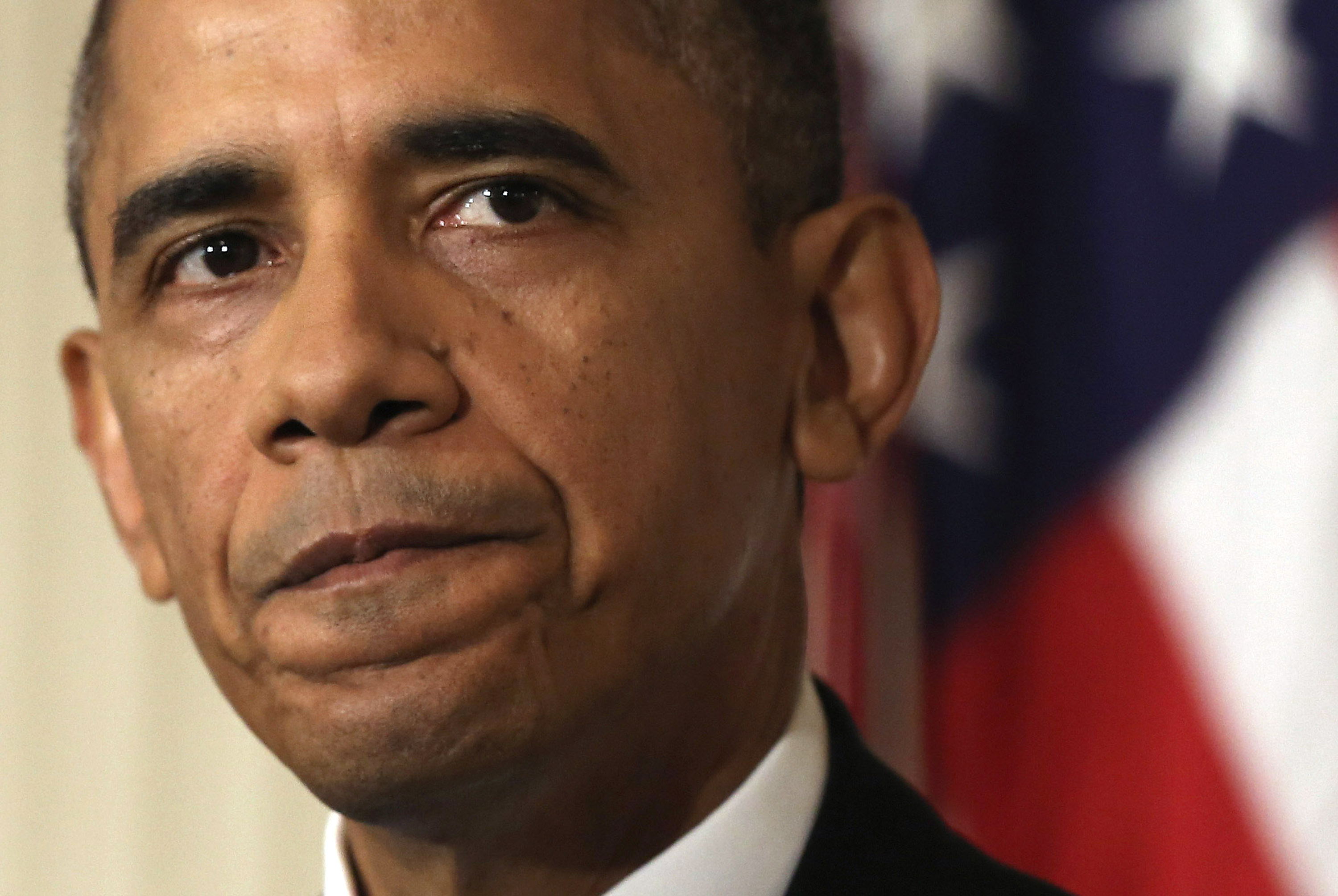
President Obama Delivers A Statement

Tomasky is highly skeptical that new negotations over the budget can result in any different outcome next time:

The position of the chaos caucus is going to be: Okay Obama, you give us entitlement cuts, and we’ll give you…uh, what? No revenues. They’re inflexible on that point. No programs (outside maybe of defense, and even that’s a maybe) funded at levels above sequestration. So actually, they’ll give nothing.

Beutler’s view:

[T]here’s a high likelihood that these negotiations will end the same way as all the others that preceded them did: no agreement. An agreement is only compatible with the GOP’s anti-tax absolutism if Democrats drop their demand for tax parity and agree to pay down sequestration with other spending cuts. Possible, but unlikely.

One way out of this would be for Obama to go big, to propose in these new talks a Bowles-Simpson-style deal in which major tax reform and entitlement cuts are exchanged for much higher revenues. If the GOP were a genuinely conservative party, actually interested in long-term government solvency and reform within our current system of government, they would jump at this. They could claim to have reduced tax rates, even if the net result were higher taxes. And the brutal fact is that, given simply our demographics, higher taxes are going to be necessary if we are to avoid gutting our commitments to the seniors of tomorrow. They could concede that and climb down from this impossibly long limb they have constructed for themselves.

I’ve long favored a Grand Bargain, but recognize its huge political liabilities without the leadership of both parties genuinely wanting to get there. But for Obama, it seems to me, re-stating such a possibility and embracing it more than he has ever done, is a win-win.

He may alienate Democrats – but after his cold-steel resistance to Tea Party blackmail, he has surely won some chips to his left. With independents and moderate Republicans, now reeling from the last month’s brinksmanship, it would signal centrist leadership that could bolster his political standing, even if the GOP turns him down. If his political standing improves, then the chances for a Democratic wave in 2014 increase.

But it means taking a real risk now. And this president has shown in his second term a much greater propensity to risk than in his first.

Think of the boldness of his response to Assad’s chemical weapons attack and agility in roping in Putin to deal with it (so far successfully). Think of his steadfast refusal to budge right up against the threat of default. He has earned new cred and could bolster it some more with a new, bold reach for the political center he can still represent. I believe it would be the most politically effective domestic policy agenda the president can plausibly move forward, if the GOP maintains its rigidity against immigration reform past the next Congressional elections. It would also help bring back the core coalition that gave him such a huge victory in 2008. It would mean the president has not given up on the long-term fiscal health of the country. And it is vital that no president gives up on that, especially one elected on the principle of hope as well as change.

Resignation to gridlock is perfectly rational. But changing that dynamic is never impossible. It’s what we elect presidents to do. And this one still could, if he swiftly exploits the opening this near-catastrophe has presented to him.

(Photo: U.S. President Barack Obama makes a statement at the State Dining Room of the White House October 17, 2013 in Washington, DC. Obama said the American people are completely fed up with Washington and called on cooperation to work things out. By Alex Wong/Getty Images.)


Headline Of The Day

Screen Shot 2013-10-17 at 2.33.55 PM

Update from a reader:

It’s good to know Drudge has caught up to 1992:

“New Mainstream: Hot Dogs, Apple Pie and Salsa”
March 11, 1992

KETCHUP, long the king of American condiments, has been dethroned. Last year, salsa — a retailing category that includes picante, enchilada, taco and similar chili-based sauces — took the condiment crown, outselling ketchup by $40 million in retail stores.”

Another goes Seinfeldian:

And an update from Drudge lui-meme:

Screen Shot 2013-10-17 at 4.46.41 PM

Amazing who reads the Dish, innit?

Whom The Shutdown Hurt Most

Americans like John Anderson:

He is a line cook at the American Indian Smithsonian Museum on the National Mall. Anderson is not a government employee. He’s a contract worker – the government hires his company to make the food for visitors to the museum. When the shutdown closed the museum, Anderson lost his job. He’ll now presumably be able to go back to work, but unlike federal workers, he won’t get back pay. And he could use that back pay: Anderson is a divorced father of two who usually brings home about $350 a week after taxes and child support. His 16-year-old son lives with him in Washington but commutes by bus and train to high school in Maryland every day.

Anderson has no savings – his wages don’t leave much cushion for savings – and struggled through the shutdown to pay his rent, put food on the table and pay for his son to travel back and forth to school.

When you think of the actual Americans that the Tea Party is playing with, like so many pawns on a chessboard, the repulsiveness of the ego of Ted Cruz and the fanaticism of Erick Erickson becomes even clearer. For them, for all their protestations to the contrary, this was a game. And nameless, struggling Americans were the losers.

Where’s Boehner’s Backbone? Ctd

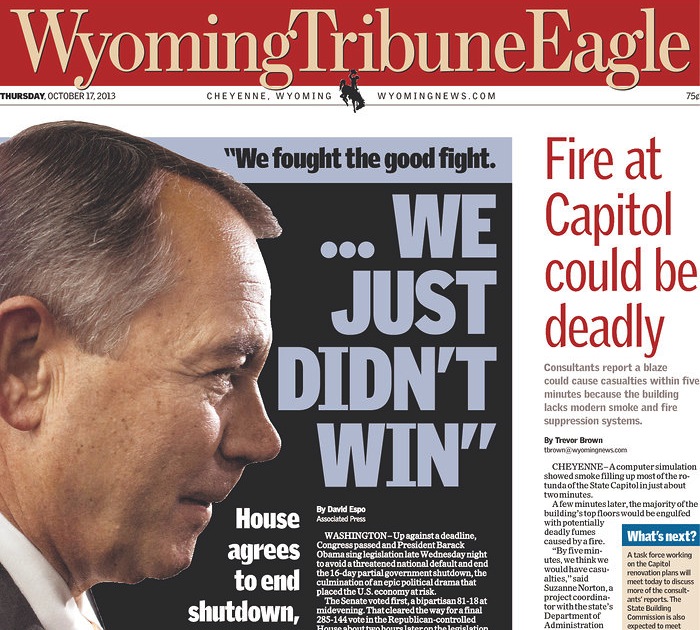
WY_WTE

A reader writes:

The fact is, John Boehner has made a deliberate choice all along in his speakership. You can moan all day about leadership and and herding cats, etc. But he has made the choice that his slavish devotion to the Hastert Rule is more important than anything else … more important than the financial health of the country, even the globe.

His choice of requiring a majority of the majority on every single vote continues to give unprecedented power to a relatively small minority in his party. He’s made a choice letting roughly 12% of the House drive the entire government. That’s all it is – a choice. There’s no law, rule or even recognized precedent for that. He’s taken the (occasional) practice of one of his predecessors and turned it into something more important than the law of the land. All he needs to do is stop, and everything immediately goes back to normal but for the screaming.

Another is far too generous to the Speaker:

I’ve never to be politically sophisticated but I did have a manipulative mother whose upbringing required me to develop survival skills in interpreting the underlying motivations of others.

Regarding John Boehner’s recent handling of the debt crisis, it seems to me by having the balls to let the extremist Republican element in the House play out their power play, while appearing to support them, has resulted in their demise.  This  greatly enhances his ability to control them in the future, which he managed without appearing to undermine their effort and, thus, gives him a much stronger hand in dealing with Democrats and puts the balance of power within their party back in the hands of their establishment.  The biggest winners in this show are Boehner and Mitch McConnell, who for his part and all at once, just neutralized his primary Tea Party opposition and his his eventual Democrat opponent, Allison Grimes, who has based her campaign on his perpetuation of gridlock.  These guys didn’t get to where they are by lacking in Machiavellian skills!

Another fumes:

I just can’t believe that this Speaker and his party will move on from this with no resignations, no apologies and no responsibility. This is an utterly disastrous event for the Republican party and the stories we read state that the Speaker’s position is not in question? WTF?

Previous Dish discussion here.

A Breakthrough With Iran?

This week’s talks in Geneva have been unusually productive:

In a rare joint statement, the nations called the discussions “substantive and forward-looking” and formalized the next round of negotiations in Geneva on November 7 and 8. The United States and the European Union depicted the talks as “substantive,”“very important,” and “positive.” One senior Obama administration official beamed with excitement. “I’ve been doing this now for about two years, and I have never had such intense, detailed, straightforward, candid conversations with the Iranian delegation before,” said the official. “I would say we really are beginning that type of negotiation where one could imagine that you could possible have an agreement.”

Kaplan is similarly hopeful:

First, the chances for a truly historic breakthrough are pretty good – which, at this stage in talks of such magnitude, is astonishing. Second, the Iranians’ main demands—at least what we know of them – are pretty reasonable. … Not only that, but after the first day of meetings, the U.S. and Iranian delegations broke away for an hourlong bilateral session, which American officials described as “useful” in clearing up ambiguities.

After the second day, another meeting was set for November 7 – 8. Some said it would be at the “ministerial” level, which, if true, would mean Secretary of State John Kerry would head the American delegation. A U.S. secretary of state doesn’t usually become so visibly involved until much closer to the end of a negotiation, suggesting that maybe we’re closer to the end than anyone could have imagined.

This is remarkably fast work for any set of nations negotiating any issue—much less for nations that haven’t had diplomatic relations in 34 years, and on an issue that ranks among the globe’s most perilous and contentious.

Cole is cautiously optimistic:

Can a breakthrough be had? I believe so. The sticking points will be the extremists on both sides. In Iran, the Revolutionary Guards and Leader Ali Khamenei think the negotiations are another imperialist US trick, and getting them to sign on the dotted line of an agreement won’t be easy. On the US side, the Israel lobbies and Israel itself will accept nothing less than the mothballing of the whole Iranian enrichment program, which is highly unlikely to happen. A settlement would therefore have to be one that could be accomplished by Presidents Rouhani and Obama despite the carping of the right wings of their countries.

Colin H. Kahl and Alireza Nader wants the US to be realistic:

Instead of pushing for an impossible goal, the United States and other world powers should push for a possible one: an agreement that caps Iranian enrichment at the 5 percent level (sufficient for civilian power plants but far away from bomb-grade) under stringent conditions designed to preclude Tehran’s ability to rapidly produce nuclear weapons, including restrictions on Iran’s stockpile of low enriched uranium, limitations on centrifuges, intrusive inspections, and halting the construction of a plutonium reactor that could open an alternative pathway to nuclear weapons. Such an accord would allow Khamenei and Rouhani to claim Iran’s “rights” had been respected, giving them a face-saving way out of the current nuclear crisis. Even this might be difficult for the Iranian regime to stomach. But if paired with meaningful sanctions relief, it has a much better chance of success than insisting on the complete dismantling of Iran’s program.

Walt agrees:

Iran had zero centrifuges in operation in 2000 and only a handful in 2005, the last time the Iranians offered to freeze their program. The United States rejected all these previous offers, and now Iran has some 19,000 centrifuges, a plutonium program, and a larger stockpile of uranium that could in theory be enriched to make a bomb if Iran ever decides it wants one. In short, the hard-line position of issuing threats, imposing sanctions, and insisting that Iran give in to all our demands has backfired and put us in a worse position today.

Which is why I support engagement of exactly the kind we’re now doing and believe it is the sanest way to achieve peace and stability in the Middle East – and, ultimately, democracy for the people of Iran. Getting Iran more fully into the international economy, rewarding the reformists, increasing bilateral contact and communication all reinforce each other. We have a chance for a virtuous cycle rather than a vicious one. As Reagan ended the first cold war by engaging moderates, so Obama can end the Iranian version by rewarding Rouhani. Because, like Gorbachev, he’s the best hope we’ve got now that sanctions have almost achieved their goal.

The Sabotage Of The American Economy

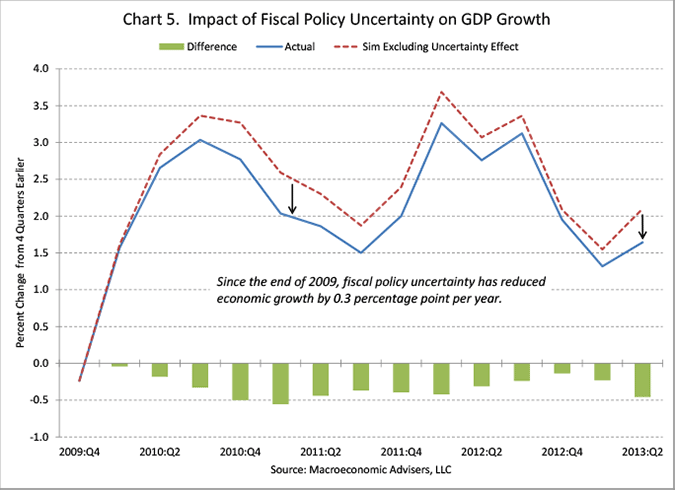
Fiscal Uncertainty

Derek Thompson puts the GOP’s economic damage in more perspective:

Counter-factual accounting is guess-work by definition, but a few research firms have tried to attach a number to the shutdown. Macroeconomic Advisers put the figure at $12 billion. S&P estimate the cost was twice as high, at $24 billion. Split the difference, and you’re talking about $18 billion in lost work.

What’s a good way to think about that kind of money—a sliver of the entire $15 trillion U.S. economy, but still, you know, $18 billion? In July this year, NASA funding was approved at around $17 billion for the fiscal year. So, there: The shutdown took a NASA-sized bite out of the U.S. economy.

But that’s just a nibble compared to the total cost of the budget showdowns stretching back to 2010. According to Macroeconomic Advisers, the total cost of Congress’s assault on the economy going back to 2010—including the budget cuts, including sequestration, and fights around the budget cuts—was about 3 percent of our entire economy. That’s $700 billion. That’s not just NASA. It’s one year’s entire defense budget.

Krugman thinks the number-crunchers at Macroeconomic Advisors are underestimating the fiscal drag:

The combination of the payroll [tax] hike and the [unemployment] benefit cuts amounts to about $200 billion of fiscal contraction at an annual rate, or 1.25 percent of GDP, probably with a significant multiplier effect. Add this to the effects of sharp cuts in discretionary spending and the effects of economic uncertainty, however measured, and I don’t think it’s unreasonable to suggest that extortion tactics may have shaved as much as 4 percent off GDP and added 2 points to the unemployment rate.

In other words, we’d be looking at a vastly healthier economy if it weren’t for the GOP takeover of the House in 2010.

What The Shutdown Accomplished

The one concession Republicans got is meaningless:

There’s nothing about the income verification measures that passed Wednesday night that will change Obamacare, aside from a few staff members at Health and Human Services devoting some hours to gathering the data and writing up these reports. And that probably explains why Democrats were okay with passing this language in the first place.

Gleckman sighs:

Congress has just shuttered much of the federal government for more than two weeks and risked a market-shattering federal default in order to convene a meeting of budget negotiators.

And at the cost $24 billion in lost economic output. Sheer vandalism.

The Benefits Of Quiet Diplomacy

SWITZERLAND-IRAN-NUCLEAR-POLITICS-DIPLOMACY

Joshua Keating is, like me, grateful the shutdown has been drowning out coverage of our negotiations with Iran:

Thanks to the government shutdown and the looming default, the news cycle this week has skewed heavily domestic, and understandably so. Somewhat lost in all this has been what is actually a pretty big foreign-policy story, the restarted Iran nuclear talks in Geneva. It’s still early to say, but while nobody’s been paying attention, the talks have been going surprisingly well. Those two things may be connected.

[Neither lifting sanctions or allowing some uranium enrichment on Iranian soil is] popular on Capitol Hill. And as Yochi Dreazen and John Hudson of Foreign Policy report, some members of Congress – some Democrats, in particular – are already signaling opposition to a deal involving lifting sanctions. But Congress has also had its attention elsewhere this week. As Rep. David Price told FP, “We’re in such a weird situation on the Hill with the shutdown and all the oxygen is pretty much going to that fight.”

It’s easy to imagine an alternative-universe scenario in which the government is not shut down, the Iran talks are front-page news, and this is a major focus of attention from Capitol Hill. It still may be tough to the White House to sell Congress on lifting sanctions, but it has to have helped lead negotiator Wendy Sherman that Congress hasn’t been setting the terms of this debate before she even sat down with the Iranians.

And as I noted last night, the talks have been remarkably cordial so far. A distracted Congress and relative quiet about the Israel-Palestine peace process is also helpful, as the invaluable Roger Cohen notes today:

For almost three months now Israelis and Palestinians have been negotiating peace in U.S.-brokered talks. They have been doing so in such quiet that the previous sentence may seem startling. Nobody is leaking. Because expectations are low, spoilers are quiescent. There is a feeling nobody opposed to a resolution need lift a finger because the talks will fail all on their own. This is good. Absent discretion, diplomacy dies.

I think we’re going to get a deal that precludes a war against Iran and begins a period of constructive engagement and detente with the theocracy in Tehran. There’s still a lot to get nailed down and verified, and there are powerful forces in both countries determined to prevent a deal (the Revolutionary Guards, AIPAC and religious fanatics in Iran’s and America’s reddest states among them) but both recently elected governments in Washington and Tehran have a huge amount riding on success.

Avoiding another war in the Middle East – and the wave of murderous Jihadism and polarization that would provoke – is, to my mind, the most important foreign policy goal of the next three years. The second most important? A two-state solution in Israel/Palestine. Domestic drama – and a new constellation of forces in the Middle East, as Cohen explains – may help Obama secure both.

Am I delusional? Maybe. But the coalition of countries behind the negotiations with Iran, combined with the unexpectedly successful chemical weapons suppression and destruction in Syria, has isolated Netanyahu even more acutely in the world, as his political position at home remains tenuous.

You know who he reminds me of – threatening to upend global peace and break the US-Israel alliance by a unilateral attack? Ted Cruz.

(Photo: US Under Secretary for Political Affairs Wendy Sherman (right) smiles at the start of two days of closed-door nuclear talks in Geneva October 15. By Fabrice Coffrini/AFP/Getty Images)

The Wave On The Horizon?

3875705476_f5a3b5ef7e_b

Republican Congressman Charles Boustany worried recently that actions by House Republicans “could trigger a wave of discontent that could wash out our Republican majority in the House if we’re not careful.” Nate Cohn continues to insist that the Republican majority is safe:

[E]ven if public outrage with the GOP persists at today’s levels, there good reasons to question whether the wave will endure through November 2014. Unlike real waves, electoral waves shrink as they approach the shore. Political scientists have found that the generic ballot overestimates the president’s party this far from an election. That’s part of why Alan Abramowitz estimates that Democrats need a 13 point Democratic edge on September 1 to win the 17 seats necessary to retake the chamber in November.

Enten disagrees and argues that “Abramowitz’s forecast is a good starting-point for understanding how uphill is the Democrats’ task in taking back the House, but it is far from perfect.” Furthermore:

The thing is that expert ratings (like most polling) are not all that predictive a year out from an election. At this point in the 2006 cycle, there were 17 Republican seats in the lean or tossup categories (pdf). That’s well short of the 30 seats that Democrats would ultimately take from Republicans. At this point in the 2010 cycle, there were 28 Democratic seats in the lean or tossup category. Republicans, of course, went onto gain 63 seats in 2010.

It’s not until later in the cycle when individual seat rankings become quite useful. That’s when potential challengers and incumbents read the national environment and decide to run or not. Chances are that if the 4-5pt Democratic lead holds, the individual seat rankings will reflect that edge. For now, individual seat ratings probably aren’t all that helpful to understanding which way and how hard the wind is blowing.

My view, for what it’s worth, is that this event has the potential to deeply shape public attitudes about the GOP’s fitness for public office and change the shape of the next Congress decisively. I mean, here’s Ross today:

However you slice and dice the history, the strategery, and the underlying issues, the decision to live with a government shutdown for an extended period of time — inflicting modest-but-real harm on the economy, needlessly disrupting the lives and paychecks of many thousands of hardworking people, and further tarnishing the Republican Party’s already not-exactly-shiny image — in pursuit of obviously, obviously unattainable goals was not a normal political blunder by a normally-functioning political party. It was an irresponsible, dysfunctional and deeply pointless act, carried out by a party that on the evidence of the last few weeks shouldn’t be trusted with the management of a banana stand, let alone the House of Representatives.

And the key thing for responsible actors in the next year is to remind voters again and again about what this crew voted for: a second great depression to appease their ideological purity. They nearly got away with it. The lesson should not be relief and moving on; it should be continued outrage at this vandalism and brinksmanship and a demand for accountability. That means voting Democrat next year even if you disagree about many aspects of their policy proposals. Because this is not about mere policy. It’s about a party threatening to break apart the country if they do not get the rest of us to bend to their minority will and their apocalyptic vision.

If that message can sink in with independents and moderate Republicans, then of course the Democrats can regain the House – and finish the job of the Obama presidency.

I don’t like partisanship. But if it is an indispensable means to ending this level of blackmail of the entire system, then it is a necessary, short-term price to pay.

(Photo by Miguel Teixeira)

Quote For The Day

“Even at the bitter end, on the last possible day to defuse the crisis before the debt ceiling was breached, over 60% of House Republicans voted to push the US government into default, with incalculable but almost certainly catastrophic consequences. This is a very important point, with very ominous implications, that shouldn’t be forgotten or obscured.

Is it unfair, one-sided, or exaggerated to suggest that the national Republican Party has become a dangerous menace to the republic, with no clearly visible redeeming features? I don’t think so,” – Jeff Weintraub. Me neither.