Contemplating Cool

The genesis of the classic American term:

Cool has come a long way, literally. In a 1973 essay called “An Aesthetic of the Cool,” art historian Robert Farris Thompson traced the concept to the West African Yoruba idea of itutu—a quality of character denoting composure in the face of danger, as well as playfulness, humor, generosity, and conciliation. It was carried to America with slavery and became a code through which to conceal rage and cope with brutality with dignity; it went on to inform the emotional textures of blues, jazz, the Harlem Renaissance, and more, then percolated into the mainstream. [Scholar Peter] Stearns argues that cool’s imperatives of flexibility and fluidity helped Americans escape rigid Victorian morality into modernity and developed along with mass production and mass media as a new individualist ethos.

Carl Wilson continues with a meditation on its meaning:

To be cool is to have cultural and social capital, and most urgently it is to be not uncool—a hang-up most of us pick up in adolescence that’s damnably hard to shake even if it mellows with age. Cool is an attitude that allows detached assessment, but one that prizes an air of knowingness over specific knowledge. I think that’s why it doesn’t become dated, unlike hotter-running expressions of enthusiasm like groovy or rad. As Stearns says, cool is “an emotional mantle, sheltering the whole personality from embarrassing excess. … Using the word is part of the process of conveying the right impression.”

Slate continues its month-long series on the meaning of cool with Mike Vuolo delving deeper into the etymology and Mark Joseph Stern focusing on the coolness of Cary Grant.

Who’s Responsible For Bad Code?

Jane Chong takes a look at efforts to make software developers liable:

[S]oftware insecurity can be likened to a public health crisis. The fact that a single vulnerability can give rise to untold numbers of compromised computers and harms that are difficult to cabin makes dumping costs entirely on end users unreasonable as a policy matter. To borrow the words of law professors Michael Rustad and Thomas Koenig, the current paradigm is one in which “[t]he software industry tends to blame cybercrime, computer intrusions, and viruses on the expertise and sophistication of third party criminals and on careless users who fail to implement adequate security, rather than acknowledging the obvious risks created by their own lack of adequate testing and flawed software design.” A more reasonable and balanced system should be possible.

On the other hand, any attempt to systematically hold vendors accountable for vulnerabilities must build in realistic constraints, or risk exposing the industry to crushing liability.

Where Republicans And Democrats Agree

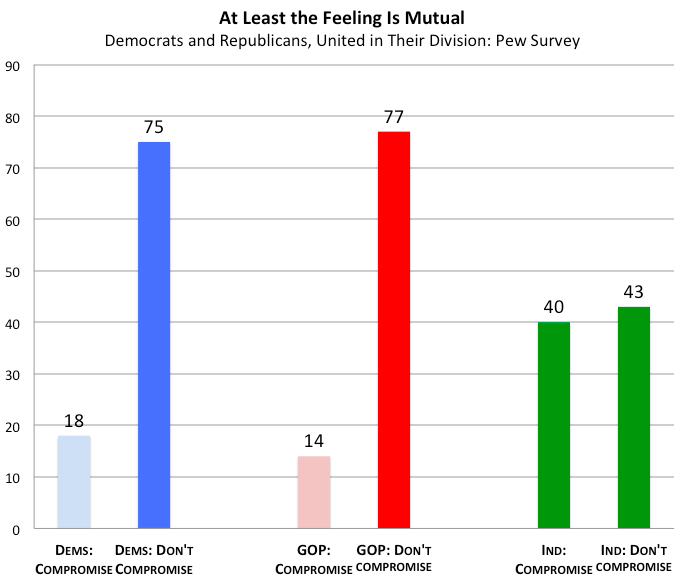
Neither want to back down to end the shutdown:

Don't Compromise

Derek Thompson sees it as “another reason why this shutdown isn’t likely to end any time soon”:

As Molly Ball reported today, Democrats told pollsters for The Economist that they value compromise, much more than Republicans conceded. But in this specific debate, at least one poll has Americans practically perfectly divided on the issue of compromise.

Collender bets that the shutdown will continue for some time:

I see the shutdown lasting at least another week…and two or three more weeks after that are becoming increasingly likely. I’m also raising the likelihood of the debt ceiling not being raised by October 17 — the date Treasury says it will be needed — to 1 in 3 instead of my previous estimate of 1 in 4.

Betting On The Nobel

Zach Schonfeld checks in with the bookies monitoring the literature contest:

The critically acclaimed Japanese writer Haruki Murakami currently leads the pack, boasting projected odds of 3/1, while American author (and frequent tweeter) Joyce Carol Oates follows closely behind with 6/1 odds. (Bob Dylan, if you’re wondering, drags behind with a 50/1 chance of winning, by Ladbrokes’ count.)

Recent Dish on Dylan’s chances here. In a come-from-behind twist, the odds for Norway’s Jon Fosse has shot from 100/1 to 9/1:

What gives? As we’ve previously covered, the bookmakers’ methods have little to do with the actual quality of the literature.

They’re just thumbing through blogs and mainstream media outlets in a mad dash to figure out which authors are getting the most buzz in the weeks leading up to the announcement. This method, however unscientific and fraught, has provided Ladbrokes with an impressive accuracy rate in past years. … Fosse’s temperature is pretty hot right now. Ladbrokes cut its odds on the playwright dramatically after noticing several surprisingly large bets on him in his home country of Norway. According to the company, “Fosse has come from out of nowhere to become the hottest writer, and it’s not inconceivable that he could become favorite to win before the announcement is made.”

Track the latest odds here.

The Best Of The Dish Today

vqm8exxuhcor92y3loen

I tried to make sense of the Republican position in the fiscal hostage-crisis in the capital. I failed. Beutler tried to make sense of the latest GOP spinning. He failed. The world tried to figure out why a minority of one party that just lost the election in the US is threatening to blow up the entire global economy and precipitate the second Great Depression. They failed. The answer? Perhaps race is one aspect; the far right’s view of compromise as total defeat is yet another.

But say this for American conservatism: they’re the only conservatives on the planet who want to destroy their own credit.

Readers pushed back on my somewhat Straussian reading of Machiavelli; this otter just needs a bear; and the polls began to tilt further against the tactics of the GOP.

The most popular post? “There Is No There There.” Second? “This Revolutionary Pope.”

See you in the morning.

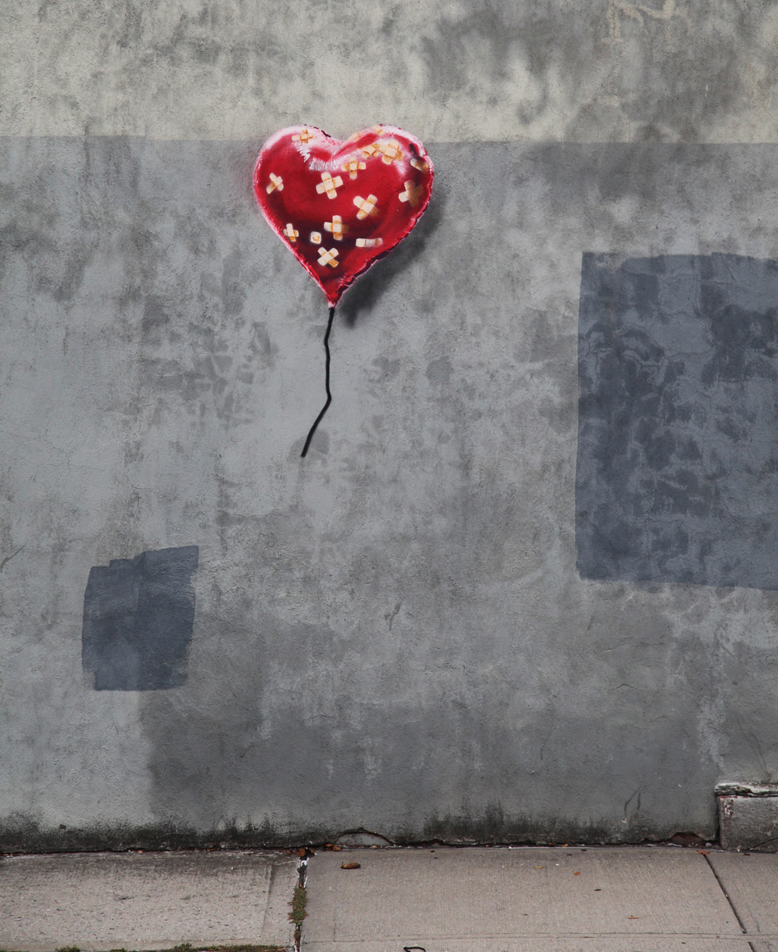
(Photo: Banksy in Brooklyn, via Banksy.co.uk. Related post here.)

Face Of The Day

IRAQ-UNREST

A wounded Iraqi girl with her head bandaged sits on a hospital trolley after receiving medical care at a hospital in the northern Iraqi city of Dohuk. Yesterday bombers detonated vehicles at a police station and a primary school, collapsing the roof of the building. According to local official Abdulal Abbas, the attacks wounded 44 people and killed 15, consisting of five policemen and 10 children. By Safin Hamed/AFP/Getty Images.

The View From Your Shutdown

Stories for our popular series continue:

I’m a federal employee furloughed from my job teaching at one of the military academies. Our academy leadership decided to keep classes running while the 30% of our faculty who are civilian had to stay home. That means not only that civilian faculty like me have no work and no pay, but military faculty are teaching two or three sections of cadets combined. Some upper-level classes have been suspended, and fourth-year cadets who need these classes to graduate may be in danger of not meeting their course requirements for graduation. But pretty soon it will be hard to give them credit for the courses.

Another:

I am yet another furloughed employee in the DC area. I am frustrated. I am sick of being demonized. I have had to turn off the news because I just get a lump in my throat every time someone asks why the government even has nonessential employees or a Congressman says he is keeping his paycheck because he earned it. I felt like Congressman Neugebauer was talking to me when he was yelling at that poor park ranger. Since when was doing your job something to be ashamed of?

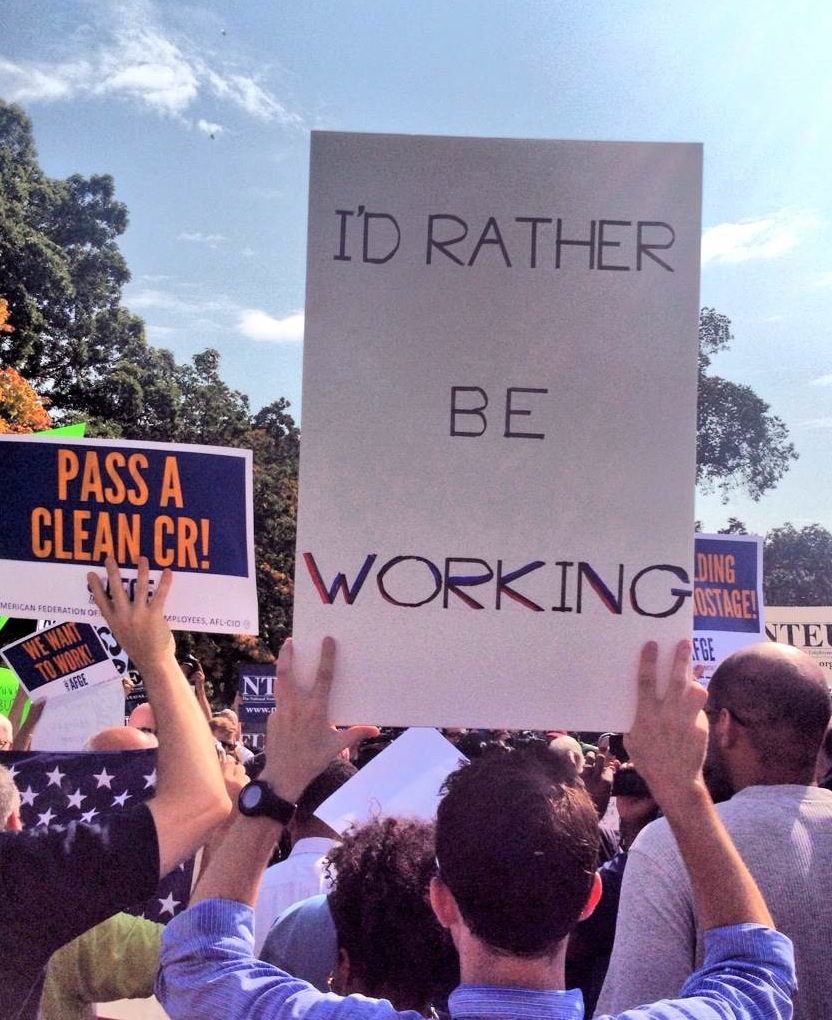
Yesterday I got an email from my employees union saying they would be rallying at the Capitol photo (27)today. Since I can’t be at work, I wandered down there this morning. I saw hundreds of employees from the various federal employee unions chanting “We want to work!” and “Let them vote!” I’m a little embarrassed to say it, but I teared up. I’ve been a union member for years, but it wasn’t until this year that I realized just how important they are. They are looking out for us when no one else is. There were numerous members of Congress out at the rally, too, expressing support. I didn’t see one Republican though. Not one. They hate us. For doing our jobs. And their behavior has just made a big union supporter out of me!
I read to my son every night. Lately he has been asking for us to read a children’s Bible he got for his Baptism. Last night I read the story of how Jesus was so kind to Zacchaeus the tax collector. I know the federal government isn’t perfect, and I fully support making improvements. I just wish these nominally Christian right-wingers would stop demonizing all of us and start looking at the logs in their own eyes.

Another:

My husband is a real estate agent and recently sold a house that was owned by a federal government employee.  The government was paying for the relocation, but as a result of the shutdown, the payment of the real estate commission is being held up.  In his case, it is $14,000 he was expecting at the first of this month, but won’t get until the shutdown is over and then know who knows how long after that.

One of several more readers:

I do not now work for the federal government and am following my usual schedule, but the environmental change in DC is huge.

It took me less than 30 minutes to get to my destination in downtown DC today, unheard of for a Monday morning even when Congress is not in session. At Union Station, most of the restaurants have substantial amounts of their dining areas closed off and the remainder sparsely populated – they have to be hurting.  The Starbucks, whose line usually extends at least 20 feet out into the station, had half a dozen people waiting. The whole place was hushed – and it’s usually a three-ring circus on weekdays at lunch hour.  Dupont Circle looks dead.

But I had to smile this weekend.  Some roads in Rock Creek Park have been left open as they really are major traffic routes, but most are blocked off, as are all picnic and recreation areas.  But on this sunny Sunday, cars were parked right up against those barriers and on nearby level grass, and people were having picnics, playing frisbee with dogs and otherwise enjoying THEIR park.  I saw one young woman in riding clothes exit her car near a barrier and stride off defiantly in the direction of the stable.  The parks belong to the people.  Dammit, the whole country belongs to the people.  This is a farce.  Just hope it ends before becoming a tragedy.

Another:

A point yet to be brought up is that American students living abroad are coming to that time of having to pay for their terms. I’m currently an overseas student, who thanks to school support and financially well-off parents, does not have to worry about this. But I have more than a few friends who are currently abroad with ZERO loan money being disbursed out, even though it’s being reported that this should not be a problem for a majority of loan programs.

This is not only an issue from an education standpoint, but a livelihood one,as well. These people are having to rely on infrequent, and expensive money wires or close friends to get by. Furthermore, if you want to talk about US prestige in the eyes of the international community, nothing looks worse than the government being a deadbeat dad and failing to pony up funds for education. All is not lost, as some universities are developing schemes of directly loaning American students money against what they say they will pay. But this is still deplorable state of affairs being largely ignored by those most responsible.

Another:

As I read these stories of the effects of this shutdown on employees of the federal government and the businesses like hotels adjacent to national parks, and how the effects cascade down to the people who depend on those employees and businesses for their livelihoods, the phrase “trickle-down economics” keeps coming to mind. It would seem that “trickle-down” actually works after all, but not in a very good way.
Big-Ass Brass

Elizabeth Eshelman, hailing from a long line of tuba players, pens a love letter to the instrument. She understands its perception of a clunky background horn:

[I]n truth, you put up with a lot of boring musical parts. While the rest of the band or orchestra minces away with eighth notes, you befriend the whole note. Play just about any march or polka and you’ll see where the oom-pah stereotype comes from (though I will say, Sousa marches, like “The Stars and Stripes Forever,” also afford some real challenges). Further, the Ohio State University equivalent for Chinese water torture could well be the tuba part to “Hang On Sloopy”: Everyone else goes on with “Haaaang on Sloopy, Sloopy hang on!” but the tubas are stuck hanging on to the same introductory pattern for the entire song.

Yet the payoff is worth it:

It’s easy to joke about tacet markings and the predictable bass lines that tubists must bear, but when a tuba takes the melody, or even a counter-melody, it’s ineffable. The tuba’s tone can be so dark and haunting, like the relief of a thick patch of shade on a sunny day. I encourage you to listen to the first phrase of Holst’s “Suite No. 1 in E Flat.” Go ahead, YouTube it. Several bass voices play that opening line, but listen to the one on the very bottom—that’s the tuba. The piece is for military band, but for some reason, when I hear that line, the tuba voice makes me think of how the ocean was once known as “the deep,” that lovely, lulling undertow.

The Physics Of Gravity

Neil deGrasse Tyson tore into the new blockbuster with a series of tweets. An example:

Marsha Ivins, an astronaut, had mixed feelings about the movie:

I can almost forgive the liberal use of artistic license in violating the laws of physics because they got some things very right. The views of the Earth and the sunrise, the lighting on Sandra Bullock’s face (light in space is so different from light in the atmosphere)—perfect. Her body positions inside the spacecraft, the astronauts’ tether protocol during the space walks, the breathing in the helmet, even the real life, excruciatingly slow movement of the Soyuz undocking from the Space Station—spot on. These things made me happy.

The massive, fatal, horrific, total destruction of every single spacecraft? Not so much.

I guess I take spacecraft destruction personally, movie or not. For me, it’s just too hard to watch. The scene in which debris is falling through the atmosphere, breaking up into streaking balls of white finality brought slamming back to mind the real life image burned there forever of the last moments of the Columbia Shuttle. And I had to look away.

Scott Parazynski, another astronaut, gives the movie much higher marks. On the reality of space debris:

[W]e have taken lots of orbital debris. In fact, every shuttle flight that we flew, there would be dings on the windows, as well as to the Shuttle’s tiles. I actually have experience seeing debris damage when floating by a radiator panel. I was at the very tip of the space station; it was a much larger piece of debris, but it went all the way through the panel, and it looked like a bullet had been shot through it. There were curved metal ridges that showed the spiral pattern. It was probably just a washer from a spent booster or something that ended up crossing the station’s path. These things have incredible energy. Even a fleck of paint traveling at those kinds of speeds could wreak havoc for a space walker.

More Dish on the dangers of space debris here. Meanwhile, in the following video from Gravity director Alfonso Cuarón and re-recording mixer Skip Lievsay, the latter discusses how they “split the difference in terms of the science” between the need for sound effects and the lack of air (and thus sound) in space, relying heavily on the vibrations that the astronauts would hear through their spacesuits:

This embed is invalid

SoundWorks Collection: The Sound of Gravity from Michael Coleman on Vimeo.

Tuning Up Television

Spurred by the use of Badfinger’s “Baby Blue” in the Breaking Bad finale, Ben Greenman explores the increasingly sophisticated use of pop music in TV shows:

Pop music has been a valuable part of film for years, but television, as a result of smaller budgets and the repetitious nature of a series mentality, tended to make its own music—theme songs, composed scores. Sometimes that music has been memorable (“Hawaii Five-O,” “Sesame Street”), but it has tended to take the form of brand reinforcement rather than editorial content or commentary, and those series that made music part of their charter (“Miami Vice,” “Gilmore Girls”) did so overtly. …

[B]oth “The Sopranos” and “Mad Men” imagined a relationship between their characters and the music onscreen. Tony Soprano and his crew hung out at their nightclub, listening to music constantly; one of his lieutenants was played by one of the most famous musicians ever to take a television acting job, the Bruce Springsteen stalwart and garage-rock historian Steve Van Zandt. And “Mad Men” planned its song placements meticulously, illustrating how changes in pop tastes were mirroring, or outrunning, changes in the characters. The show famously paid a quarter-million dollars for the rights to the Beatles’ “Tomorrow Never Knows” [heard above] — and then squandered the song, arguably, by dashing it against Don Draper’s impenetrable aloofness.