The Republican Rift, Ctd

Dickerson delves more into the GOP’s divisions:

In most epic battles with a Democratic president, Republicans would swallow their own internal differences and close ranks against their common foe. But that’s not the case in this showdown: Many Republicans are personally invested in their previous argument that the party was headed toward ruin if it shut down the government over Obamacare. Put it this way: If Republicans emerge victorious from this struggle, McCain will have to admit Sen. Ted Cruz was right.

Jonathan Cohn emphasizes the Democrats’ unity:

That [unity] reflects effective leadership, for sure. But it also reflects something else: a shared sense of disdain and outrage over what the Republicans are doing. So add this to the list of ironies about the shutdown: By pushing so hard, Republicans have offended all Democrats, from both houses and both ends of the ideological spectrum. Republicans, in other words, have made their own job even harder.

Earlier Dish on Republican disunity here.

The Passion Of Anti-Abortion Protesters

In our latest video from the young indie filmmakers behind After Tiller, Martha and Lana recall the most memorable reactions from people opposing their project:

The film is now playing in New York, and on Friday it will open in Los Angeles and Toronto, followed by many more cities. Trailer here. Martha and Lana’s previous videos are here. A reader responds to yesterday’s dissent:

Is abortion ever immoral? This pro-choice advocate says: Of course it is.

But there are many immoral things that are not illegal, and imposing the blunt instrument of the law on a complex moral decision is not going to help people make better choices. The sooner pro-life activists take legal bans off the table, the sooner we can have productive talks about effective programs to help people make better moral choices about abortion and reproductive issues generally.

The Rise Of The Tech Villain? Ctd

Felix Salmon rips into Dave Eggers’ “dystopian fantasia about social media,” The Circlewhich was just featured in the NYT Magazine:

The mag’s editor, Hugo Lindgren, gushes about how the book walks “the line between satire and bracing details that feel all too real” – but the fact is that, at least judging by the excerpt, Eggers strays so far away from verisimilitude that his book barely even feels like satire. Instead, Eggers is preaching to a group of people which has already made up its collective mind that social media is dangerous, and who love to one-up each other when talking about where the slippery slope might lead.

One problem? Too much villainy:

There are problems with Silicon Valley and with technology – don’t get me wrong. But they’re invidious, rather than being overt … The Circle is a malign organization; you can almost see its CEO, Eamon Bailey, stroking a white cat in his suburban Palo Alto lair, dreaming of Global Domination. In reality, however, the open protocols of the World Wide Web led naturally and ineluctably to our current loss of privacy. Tim Berners-Lee is no evil genius; he’s a good guy. And the Eggers novel I’d love to read is the one dominated by the best of intentions. Rather than the one which thinks that if technology is causing problems, then the cause must always be technologists with maleficent ulterior motives.

Recent Dish on tech villainy here and here.

Where’s Boehner’s Backbone?

Boehner, House Leaders Speak To Press After Republican Conference Meeting

A reader writes:

Why is there not more coverage of the Hastert Rule? The speaker chooses to be bound by this rule – which explicitly makes compromise unwelcome – when a full majority of the House would be happy to pass the clean CR and move on. Boehner could lift the Hastert Rule and move the CR to the floor, where Democrats and many members of his own party would pass it.  If he were challenged as Speaker, he could conceivably extract support from the Democrats – especially Democrats in safe districts – to support him against a Republican challenge as Speaker.  Surely the Democrats would rather have Boehner than someone to his right?  The Speaker is elected by the full House!

But Boehner lacks creativity and is trapped in a cage made from his own cowardice.

Another scenario from a reader:

What if John Boehner were a man of principle – well, let’s pretend – and when it came time to raise the debt ceiling and his very right-wing party members refused, he does the truly unexpected. Instead of giving up on the Hastert rule and having to have Democrats come to his rescue, fueling more right-wing scorn, what if he resigned?

That would allow the extreme right wing Tea Partiers to take the blame for the ramifications – whatever they might be – of not raising the debt ceiling. Who would they point their fingers at then?  I’m assuming, of course, that there would be considerable fallout to going over the cliff, but most every reasonable person I have read expects some kind of negative impact on the economy. This might lance the boil that has infected the Republican Party for too long.

If he is so afraid that he won’t be re-elected Speaker that he is giving into demands that he knows are wrong – not just bad politics, but plain wrong – it might be the only way he could regain any sense of being a man with a conscience.

From that Costa interview we linked to earlier:

EK: This may be a bit of an odd question, but why does Boehner want to do his job like this under these circumstances? From the outside, it seems like a miserable existence. 

RC: I think John Boehner is frustrated by leading the Republicans in the House but I think he very much loves being speaker. To understand him you have to understand that. He gets to the Capitol early. He relishes the job and the position but he doesn’t relish being at odds so often with his members. He loves being a major American political figure, but he’s not a Newt Gingrich-like figure trying to lead the party in a certain direction. He’s just trying to survive and enjoy it while it lasts.

(Photo from Getty)

When Will The Republican Fever Break?

Steinglass isn’t holding his breath:

There is no equivalent on the moderate-Republican side to the organisational muscle and rhetorical elan that propels the party’s tea-party wing. No one is lining up to back moderate primary challengers to tea-party candidates. Establishment figures from previous Republican administrations who have found themselves transformed into voices of caution and moderation, such as Mr Gerson, most of the writers at National Review Online, and even (mutatis mutandi) Karl Rove, appear to have little ability to affect the party’s course anymore.

Waldman’s view:

Their fever will never break. Never.

The only thing that will give it a temporary respite is if a Republican becomes president, at which time they’ll decide that crises aren’t such a great tool after all. Their nihilistic rage will be put away, behind a glass door with the words “Break in case of Democratic president” written on it. And then it will start all over again

Drum wonders how we arrived at this state of affairs:

There’s always been a faction of right-wing craziness in America. It’s part of our DNA. But how did it become so widespread? The usual answer involves the rise of conservative think tanks, conservative talk radio, Fox News, the Christian right, and racial resentment toward a black president. And maybe that’s it. Somehow, though, it doesn’t feel quite sufficient. But if it’s not, then what’s going on? What’s happened over the past decade or two to spin up so many Americans into a blind rage?

Complaining about tea party congressmen misses the big picture. The problem is the people who voted them into office. What happened to them?

Is The Shutdown Racist?

Mitt Romney Attends Tea Party Rally In New Hampshire

Joan Walsh nods:

On the day the Affordable Care Act takes effect, the U.S. government is shut down, and it may be permanently broken. You’ll read lots of explanations for the dysfunction, but the simple truth is this: It’s the culmination of 50 years of evolving yet consistent Republican strategy to depict government as the enemy, an oppressor that works primarily as the protector of and provider for African-Americans, to the detriment of everyone else. The fact that everything came apart under our first African-American president wasn’t an accident, it was probably inevitable.

I’d say it came apart during the impeachment of Bill Clinton, the first sign of madness when the Democrats first truly wielded power after the Southern Strategy bore fruit under Reagan. Remember that Clinton was from the beginning regarded as illegitimate because he didn’t get more than 43 percent of the vote. Let us recall Bob Dole’s words after Clinton’s 1992 clear electoral college victory:

There isn’t any Clinton mandate. Fifty-seven percent didn’t vote for him. I’ll represent the 57 percent.

Or Tommy Thompson with an equally surreal view of the Constitution:

Only 43 percent of the people voted for Bill Clinton — that is not much of a mandate. . . . Republicans won nine legislative houses across the country. . . . Republicans have just as much of a mandate as the Democrats.

When you compare this with the Republican view of the 2000 election when George W Bush lost the popular vote and, undeterred by any sense of restraint, doubled down on massive unfunded tax cuts and pre-emptive wars along with budget-busting new entitlements, you get a better sense of who feels entitled to rule in this country, and who is routinely regarded as “illegitimate.”

Now, of course, this merely suggests that it is simply being Democrats that render the last two Democratic presidents inherently illegitimate – since only one was African-American. But remember how Clinton was regarded as “the first black president” by many, including those on the left? Remember his early days fighting for civil rights in Arkansas? You think a white Southerner overturning the success of the Southern Strategy would be deemed acceptable to the Southern right which increasingly dominated the GOP?

Nonetheless, Charles C. W. Cooke rightly notes:

Gerald Ford, Jimmy Carter, Ronald Reagan, Bill Clinton, and George H. W. Bush, all of whom presided over fractious shutdowns, might find this insinuation rather perplexing. In the last 40 years, only President George W. Bush was spared such a conflict.

The one president whose legitimacy was actually in some actual doubt escaped the revolt entirely. Hmmm. Quod erat demonstrandum.

More to the point, the other shutdowns were not about demanding the repeal of an already-enacted, constitutionally-approved signature achievement of a re-elected president – only a few years after a massive financial crisis and during a global recession. They were bargaining positions in which both sides had something to offer and a compromise to reach. All the GOP has to offer this time is … shutting down the government. This is not negotiation; it’s blackmail. And blackmail after all the proper avenues for stopping, amending, delaying and reforming the health bill have been exhausted. I mean they repealed the bill 41 times already – proof positive that all constitutional means for opposition have been exhausted. That‘s what makes this different. It’s not about playing hard by the rules. It’s losing and throwing the board-game in the air and threatening the destruction of the US and global economy in consequence. It’s unbelievable.

But when I mention race, I should unpack my point. It’s not a simple one, and I do not mean to be glib or too casual in throwing that word around.

I’m talking about the difference between opposition to a president’s agenda and a belief that he is somehow an impostor, illegitimate, and a usurper for reasons that seem, in the end, to come down to racial and cultural panic.

Do I have to recount the endless accusations against Obama of such?  No president has been subjected to endless litigation of his birth certificate or his religious faith (as if the latter mattered anyway). No president has been heckled in a State of the Union address with the words “You lie!” as Obama was. There was no claim that George W Bush was illegitimate because he muscled through a huge Medicare expansion as he was destroying this country’s fiscal standing having lost the popular vote to Al Gore. The Democrats didn’t threaten to shut the government down to stop anything he did. And no Republican, facing a major economic crisis, has received zero votes from the opposition in his first year. Both Bushes and Reagan won considerable Democratic support for tax cuts and tax hikes in their early years. The opposition accepted the legitimacy of the election. That’s the difference.

But Clinton was nonetheless regarded as illegitimate despite being what in any other era would be called a moderate Republican. Ditto Obama, whose stimulus and healthcare law were well within conservative policy consensus only a decade ago. I supported both presidents as a moderate small-c conservative (until Clinton revealed himself as sadly lacking the character not to self-implode). So I have long been puzzled not by legitimate opposition to various policies but by the frenzy of it. Call it the education of an English conservative in the long tortured history of American pseudo-conservatism.

In the end, I could only explain the foam-flecked frenzy of opposition to Clinton and Obama by the sense that the Civil Rights Revolution of the 1960s was the defining event for a certain generation, that the backlash to it was seen as a restoration of the right people running the country (i.e. no minorities with real clout), and that Clinton’s and even more Obama’s victories meant this narrative was revealed as an illusion. This is compounded by racial and cultural panic – against gays, immigrants, Muslims, Latinos etc – and cemented by a moronic, literalist, utterly politicized version of Christianity. This mindset – what I have called the “fundamentalist psyche” – is what is fueling the rage. It’s what fueled the belief that Romney was on the verge of a landslide. It is inherently irrational. It knows somewhere deep down that it is headed for defeat. But it will take down as much of the country, economy and constitution as it can while doing so.

For this time, as they surely know, Reconstruction will not be on their terms. They have no agenda because the multi-racial, multi-cultural, moderate-right country they live in is a refutation of their core identity. So race and culture fuel this – perhaps not explicitly or even consciously for some, but surely powerfully for many. And we are reaching a perilous moment as their cultural marginalization intensifies and their political defeat nears. After that, the rage could become truly destabilizing, unless some kind of establishment Republican leadership can learn to lead again. America and the world need to batten down the hatches.

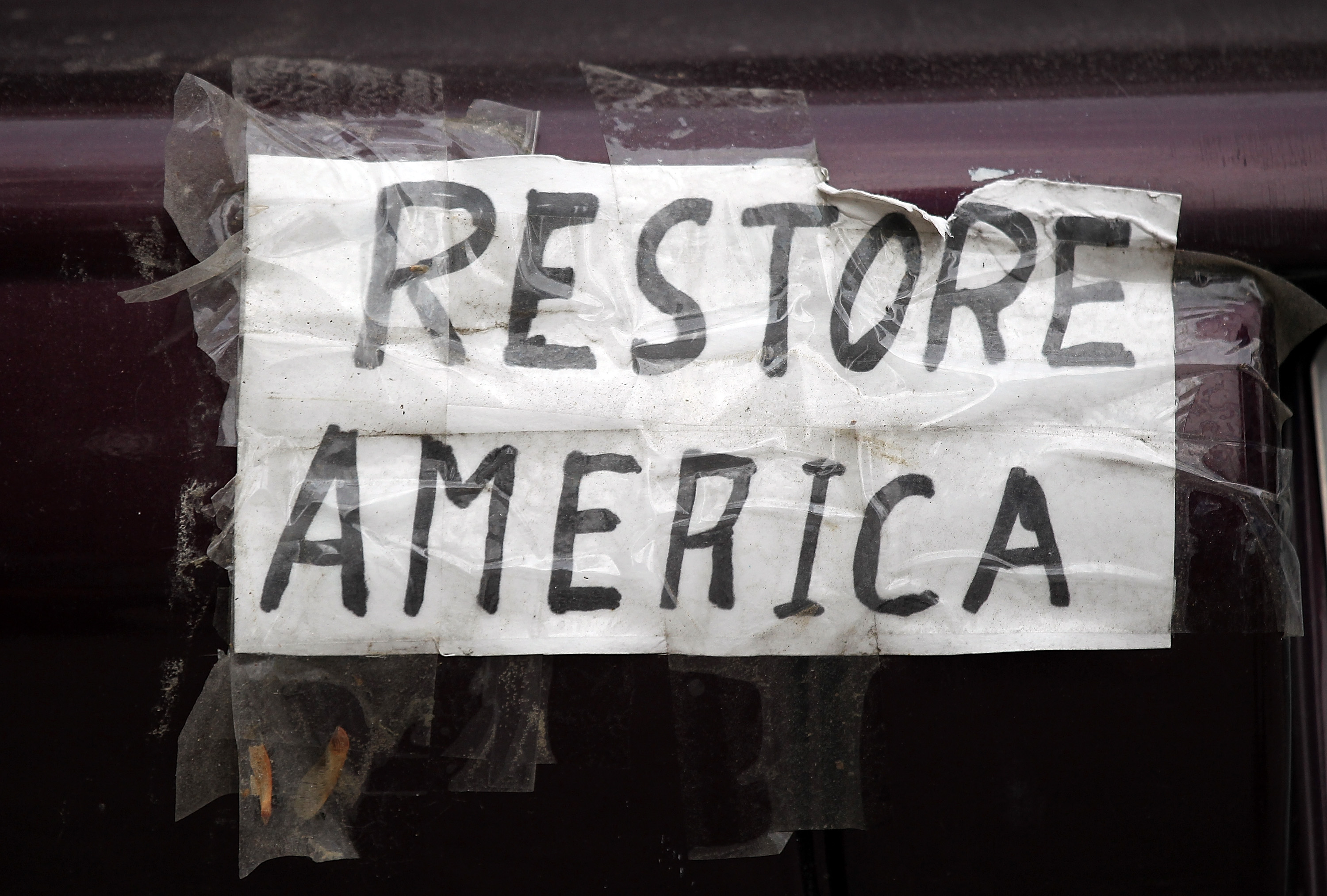
(Photo: A homemade bumper sticker is seen on the back of a car during a Tea Party rally on September 4, 2011 in Concord, New Hampshire. By Justin Sullivan/Getty Images)

Why Would The Tea Partiers Back Down?

Reihan sighs:

Basically, I think we’re screwed, at least for now. We need members of the defund caucus to step back from the brink. But they have every reason to believe that their stance will redound to their political benefit in their districts. The Republican leadership has few if any tools with which to discipline members of the defund caucus, as individual members have their own fundraising networks and there are no earmarks to be parceled out. The only way out of this trap appears to be a long, slow learning process.

Robert Costa echoes:

When you hear members talk candidly about their biggest victory, it wasn’t winning the House in 2010. It was winning the state legislatures in 2010 because they were able to redraw their districts so they had many more conservative voters. The members get heat from the press but they don’t get heat from back home.

Mark Schmitt goes into more detail:

[T]he modern Republican Party is not strong. It’s something more like a loose association of independent forces, including Tea Party–backed members, those with their own sources of campaign money from ideological backers, many with seats so safe that they can happily ignore all their non-conservative constituents, and outside agents like Heritage Foundation President Jim DeMint, who Businessweek recently described as the de facto Speaker of the House. Many of its politicians have deliberately cut themselves off from all the incentives that traditionally moderate and stabilize politics—earmarks, constituent service (many offices say they won’t help constituents maneuver the ACA), and infrastructure spending. With safe seats, and hearing little dissent at home, they are able to do so. Cutting themselves off from the incentive to build and maintain a strong and viable party is part of the same story.

How Painful Should The Shutdown Be?

A reader writes:

I saw some faux rage on HuffPo about the fact that Fox News call the shutdown a slimdown. Now, while the motives of Fox News are known, they are not incorrect. Yes, 800,000 people have been sent home. But 1.3 million are still at work. And on top of that, the count of active military is about 1.5 million. So, only about a fifth of all government employees have been sent home. That is not a shutdown, even if the effects will be very annoying, especially over time.

The problem is that, once again, the government has exempted itself largely from feeling the effects from shutting down.

Congress gets paid. The judiciary power, including the Supreme Court, is largely open. I understand we can’t close down national defense, but why do we need 1.3 million people on active duty? Congress did pass a quick law to keep them paid. With the government down, can’t that shrink down to much, much less – basically only base protection?

And then the government has made weird choices on what is “essential'” Apparently, the FAA and TSA are essential. But curing cancer patients is not. So, members of Congress can fly home, while they do not have to turn patients away from the NIH. All national parks are closed, they say. But not the “highway” parks in DC such as the BW Parkway and the GW Parkway, even though the park parts of those parks are closed. Nor is the White House, which is technically a National Park, closed. DC gets to declare itself essential. You can even wonder why combat troops are essential. In the old days, wars were lost because there was no pay.

Now, it is understandable that honorable civil servants want to minimize the damage by the shutdown. But on the other hand, isn’t it the point of a shutdown to cause hurt? And isn’t the damage supposed to put pressure on Congress to get its act together? So shouldn’t the pain be pointed at Congress the most?

But “essential” employees, even though they must go to work, aren’t paid until the shutdown ends. Yglesias points out that this can’t last forever:

Walking around today you might notice that despite the shutdown hype, life is basically going on as normal. That’s because all those essential workers are still on the job. But they’re not getting paid. If you’re not essential, you aren’t allowed to work even if you’re willing to work without pay. If you are essential, you have to work even though you won’t be paid.

… These are patriotic people who will keep doing their jobs, but they obviously can’t work for free forever. Realistically, as a shutdown drags on there will be political pressure to appropriate funds to pay certain people. The president already signed an ad hoc bill that assures soldiers will get paid. Given a long enough shutdown, FBI agents and the people feeding the animals at the National Zoo might also get special bills for them. In practice, though, a fall 2013 government shutdown has a rather short potential lifespan. That’s because even with the government shut down we’re still going to breach the statutory debt ceiling around Oct. 17-20 at which point the lack of discretionary appropriations will be subsumed by a larger and more cataclysmic issue.

Through The Looking Glass

The governor of Texas, Rick Perry, just called executive enforcement of the law – which is part of any president’s constitutional duty – a felony:

If this health care law is forced upon this country, the young men and women in this audience are the ones who are really going to pay the price. And that, I will suggest to you, reaches to the point of being a felony toward them and their future. That is a criminal act, from my perspective, to put that type of burden on them, to mortgage their future like that. America cannot stand that. America cannot accept that.

At its core, the current GOP is a truly revolutionary movement, dedicated to the eradication of the very things it preposterously claims to care about. Look at this sentence and its Orwellian surrealism. It’s a crime to enforce a duly-enacted, Supreme Court-approved law? Why are we even treating these people as if they are anything but know-nothing constitutional vandals?