Just The Money Shots

Amanda Hess explores the growing phenomenon of microporn, “explicit photos, videos, and GIFs that are as short as winks”:

Today, the full-length film experience has been subsumed by short clips that can be chopped, remixed, and compiled into endless sexual combinations. [Novice pornographer] David distills his exploits into six-second loops. Amateur editors cut professional porn flicks into even shorter animated GIFs, then Tumblr curators like Kayla shoot them to all their followers. It used to be that people would “watch porn by fast-forwarding through most of it to get to their favorite parts,” says Fleshbot founder and editor Lux Alptraum. But GIFs “hone in on the hottest part of the action” — on “that perfect cum shot, or those breasts bouncing, or the moment of insertion, or whatever it is that really drives you wild.” And they repeat instantly — no hands necessary.

But it’s causing problems for social networking sites:

Because microporn is so simple to shoot, edit, and share, it’s escaped the seedy bounds of the tube sites and found a home on mainstream social-networking sites. … Platforms like Vine, Tumblr, and Instagram aren’t exactly accepting microporn with open arms. Mainstream social networks are constantly inventing new strategies for blocking users from finding porn through their channels. Search for “NSFW” on Vine, and you’ll find zero results. Tumblr recently caught flak for sweeping the “gay” and “lesbian” tags from its mobile app along with more explicit filters like “porn”; Tumblr founder David Karp publicly lamented the decision, but said those identity tags are just steeped in too much sexual material to keep them active. Facebook — along with its image-sharing site, Instagram — bans nudity entirely.

Look At The Kidneys On That One

estienne_p279

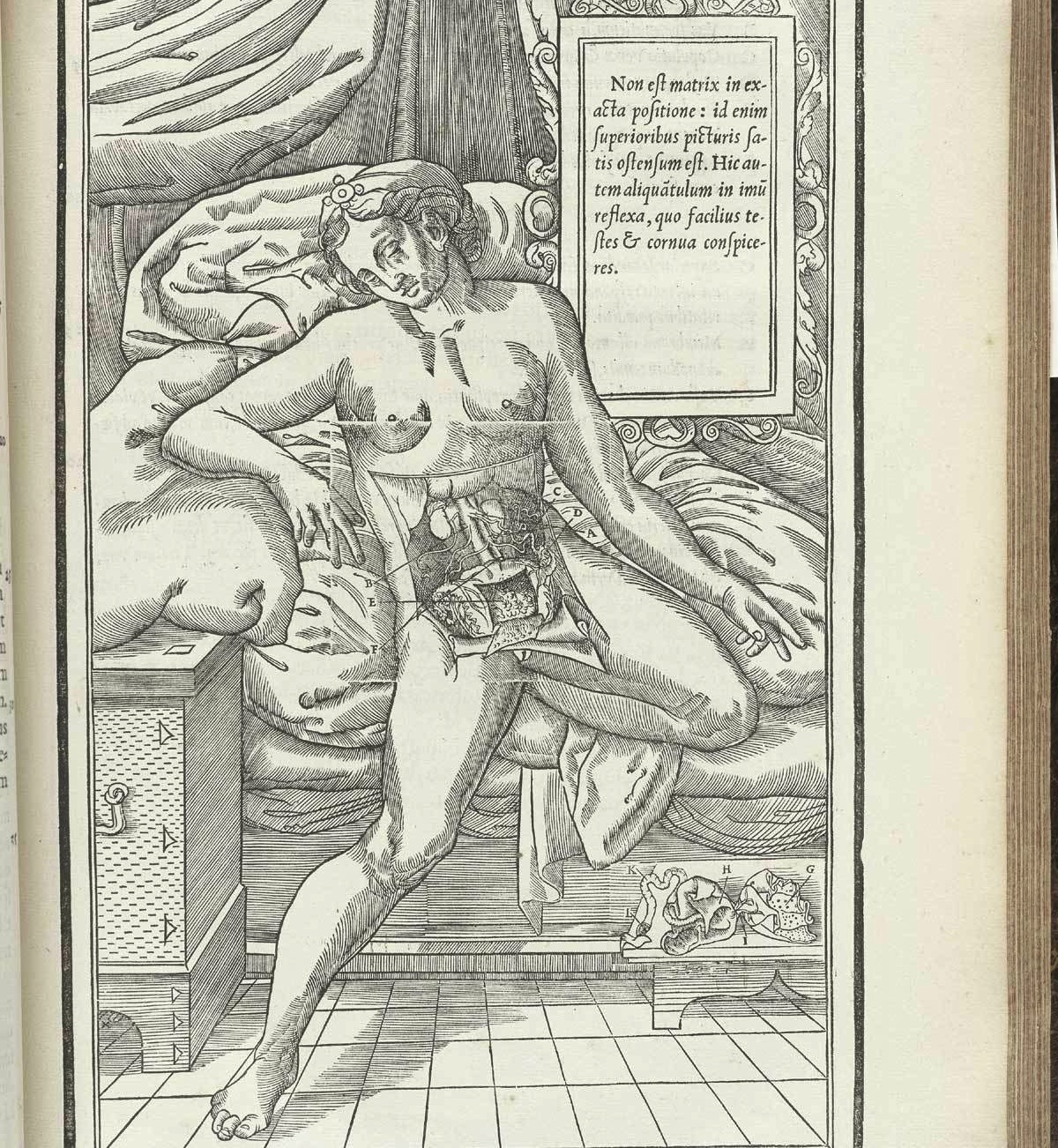
If this 16th-century woodcut print seems a little racy to you, you’re not alone. It offers a fascinating glimpse at the history of medical illustrations and pornography:

[It is possible] that the engraver of the female nude woodcuts did not have access to a model, and for the sake of expediency copied the general outlines of the female nudes from “The Loves of the Gods,” eliminating the male figures from the erotic illustrations. Another wood engraver, perhaps [Etienne de la] Rivière, would then have prepared the anatomical insert blocks showing the internal organs. Still another explanation might have been that in an era in which there was little graphic erotica available the author and the publishers deliberately exploited the erotic undercurrents of this anatomical work as a way of expanding the market beyond medical students. Perhaps because of the erotic undertones the book sold unusually well for a dissection manual and anatomical textbook, causing the publishers to issue an edition in French only one year later, in 1546.

(Hat tip: Joanna Ebenstein)

Brewing Your Own Beer … In Your Belly

Recently a man “stumbled into a Texas emergency room complaining of dizziness,” claiming that he had consumed no alcohol despite a blood alcohol concentration of 0.37 percent:

[T]he simplest explanation was that he was drinking when nobody was looking. So doctors put him in an isolated room for 24 hours, watching his blood alcohol level. Sure enough, without a drink, the alcohol level in his blood rose 0.12 percent. Turns out the man’s own stomach, colonized by brewer’s yeast, was brewing beer—a condition doctors call “auto-brewery syndrome.” The doctors described the case in the International Journal of Clinical Medicine:

Gut Fermentation Syndrome also known as Auto-Brewery Syndrome is a relatively unknown phenomenon in modern medicine. Very few articles have been written on the syndrome and most of them are anecdotal. This article presents a case study of a 61 years old male with a well documented case of Gut Fermentation Syndrome verified with glucose and carbohydrate challenges. Stool cultures demonstrated the causative organism as Saccharomyces cerevisiae. The patient was treated with antifungals and a low carbohydrate diet and the syndrome resolved. Helicobacter pylori was also found and could have been a possible confounding variable although the symptoms resolved post-treatment of the S. cerevisiae.

Oktoberfest Über Alles

oktoberfest-beer-inflation-3

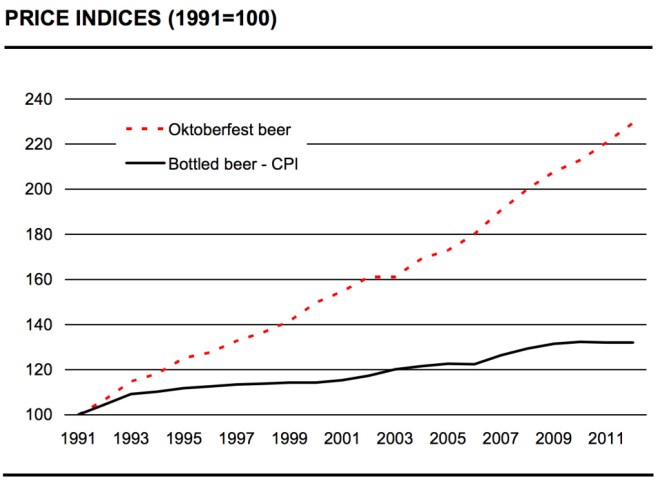
Roberto Ferdman finds that the annual beer festival – which started today – follows its own economic rules: 

Beer is what economists call an elastic good; the more it costs, the less of it people buy. But at Oktoberfest, Germany’s debaucherous annual beer festival in Munich, the rule doesn’t exactly hold. In fact, it gets flipped on its head. …

“On average, a 1% increase in the price of beer triggers a roughly .3% decline in the demand,” according to [the UniCredit Research’s 2013] report. But Oktoberfest, it appears, is anything but average. Dating all the way back to 1980, a 1% increase in beer prices at the event has, rather incredibly, corresponded with a 0.3% increase in demand. Oktoberfest beer, the report explains, falls into the category of what economists call a Giffen paradox, whereby the demand for and price of a good increase simultaneously.

Sex Ed In Russia

It doesn’t exist:

“I am against any kind of sex education among children,” said [Russia’s child rights commissioner Pavel Astakhov] in a television interview. “It is unacceptable to allow things that could corrupt children.” Despite one of the world’s fastest-growing HIV epidemics, Russia has no sex education in schools, owing to the influence of the Russian Orthodox church and conservative social forces. Astakhov, a powerful official who reports directly to the president, Vladimir Putin, now wants to enforce a ban legally, so as to ensure sex education does not sneak on to the curriculum in certain schools. Instead, he suggests reading the classics.

“The best sex education that exists is Russian literature,” said Astakhov. “In fact, literature in general. Everything is there, about love and about relationships between sexes. Schools should raise children chastely and with an understanding of family values.”

In other news of sexual denial:

Russia’s culture minister has denied that composer Peter Tchaikovsky was gay, discarding what has long been regarded as historical fact. Vladimir Medinsky claimed that there was no evidence to suggest the 19th-century composer was anything other than a lonely man who failed to find a suitable woman to marry.

Franzen vs The Internet: Round 37

In an excerpt from his new book on Austrian satirist Karl Kraus, Jonathan Franzen reveals his quasi-apocalyptic take on modernity:

If I’d been born in 1159, when the world was steadier, I might well have felt, at 53, that the next generation would share my values and appreciate the same things I appreciated; no apocalypse pending. But I was born in 1959, when TV was something you watched only during prime time, and people wrote letters and put them in the mail, and every magazine and newspaper had a robust books section, and venerable publishers made long-term investments in young writers, and New Criticism reigned in English departments, and the Amazon basin was intact, and antibiotics were used only to treat serious infections, not pumped into healthy cows.

It wasn’t necessarily a better world (we had bomb shelters and segregated swimming pools), but it was the only world I knew to try to find my place in as a writer. And so today, 53 years later, Kraus’s signal complaint – that the nexus of technology and media has made people relentlessly focused on the present and forgetful of the past – can’t help ringing true to me. Kraus was the first great instance of a writer fully experiencing how modernity, whose essence is the accelerating rate of change, in itself creates the conditions for personal apocalypse. Naturally, because he was the first, the changes felt particular and unique to him, but in fact he was registering something that has become a fixture of modernity. The experience of each succeeding generation is so different from that of the previous one that there will always be people to whom it seems that any connection of the key values of the past have been lost. As long as modernity lasts, all days will feel to someone like the last days of humanity.

Jennifer Weiner takes exception to the part of Franzen’s writing that disparages “‘Jennifer Weiner-ish’ self promotion”:

In his essay, Franzen reserves his respect for “the people who became writers because yakking and tweeting and bragging felt to them like intolerably shallow forms of social engagement,” the 20101119-obc-franzen-ats-640x360ones who “want to communicate in depth, individual to individual, in the quiet and permanence of the printed word.” But as long as there have been books, there have been writers who’ve preferred yakking and bragging to quiet and permanence. In the 1880s, there was Oscar Wilde on lecture tours. In the 1960s, there was Truman Capote on “What’s My Line?” … Other literary writers have won prizes, or Oprah’s endorsement. Other writers have appeared on Time’s cover, or have been able to shun social media, but only Franzen’s done it all. From his privileged perch, he can pick and choose, deciding which British newspaper gets the honor of running his 5600-word condemnation of self-promotion that ends with an unironic hyperlinked invitation to buy his new book. Few—no—other writers have it so good. For the rest of us—commercial and literary alike—there is social media for fun, ads and tours for publicity, billboards and book trailers only if we’re lucky.

Kevin Pires details how “Jonathan Franzen Is Wrong Again: Why Twitter Is Great for Writers.” Mic Wright belittles the novelist as “the non-thinking person’s thinker, a snap, crackle and pop insight peddler trying to do a Malcolm Gladwell”:

Franzen thinks technology and those who build and use it are what’s wrong with the modern world. The real problem with the modern world? The veneration and promotion of tedious bores like Jonathan Franzen. The short conclusion is that Franzen hates technology and hates those of us who don’t. … Here is Franzen on Jeff Bezos, a man who has done more to keep good writing alive in his purchase of The Washington Post than Franzen’s literary novels ever could:

In my own little corner of the world, which is to say American fiction, Jeff Bezos of Amazon may not be the antichrist, but he surely looks like one of the four horsemen. Amazon wants a world in which books are either self-published or published by Amazon itself, with readers dependent on Amazon reviews…and with authors responsible for their own promotion.

Oh shock! Oh horror! Strip away the paranoid tone and what you’re left with is this: Amazon is a business. It wants to serve its customers and shareholders. It likes making money and it will assist writers without the traditional publishing industry acting as intermediaries. It also thinks that writers promoting themselves and broadly controlling their own careers is a good thing. What monsters. Birching is clearly too good for the devilish Mr Bezos.

Maria Bustillos suggests that such Franzen-hate has gone into overdrive, “since the most pointed of Franzen’s claims in the essay are so obviously true, or, at the very least, worthy of serious consideration”:

How come everyone got so sore, then? I believe part of the answer is that Franzen’s critics, cool kids almost to a man, from Mic Wright in the Telegraph to Dustin Kurtz at Melville House, were hit in a tender spot by this essay. Because what Franzen is railing against is not mere tech obsession but, rather, the intellectual and spiritual poverty, the weakness and the obedience, of soi-disant “creatives” who buy what they’re told rather than rage against the machine, who are too infatuated with their wonderful little toys even to look up from them while the world burns. Very few of us aren’t at least a little guilty of that.

Dustin Kurtz offers advice to those confronting “the horrors of agreeing with Jonathan Franzen.” If you’re not one of them, click here to test your ability to distinguish between Franzen’s gripes about technology and YouTube rants against saggy pants. Previous rounds of the novelist raving against the Internet here, here and here.
The Gay Wrestlers Of Mexico

Eric Nusbaum explores the evolving culture of the exótico:

Mexico’s professional wrestling tradition, known as lucha libre, is a deeply ingrained part of the national culture. Exóticos have long been a part of that tradition: wrestlers who dress in drag and kiss their rivals, never quite revealing whether the joke is on their opponents, themselves or conservative Mexican society at large. Most working today are gay members of an often ostracized minority for whom lucha libre is a statement of pride, or at least a campy, unrestrained extension of self. …

The old-time exóticos had been straight men harping on tired gay clichés. In the mid-1980s, that began to change. A new generation of openly gay wrestlers reveled in the exótico’s sexuality, coyly tweaking stereotypes to confront the audience with the idea that being gay could be something more than a stage joke. They also ushered the exótico out of villainy.

Lucha libre’s organizing principle is good vs. evil: técnico contra rudo. Técnicos are graceful, honorable and skilled wrestlers. Rudos win with brute strength and by cheating when the referee’s back is turned. Where the early exóticos had been exclusively rudos, some of the new generation began to assume the role of técnico.

It’s not always an easy sell. Today, gay marriage is legal in Mexico City, but the overwhelmingly Catholic country still has one of Latin America’s highest rates of antigay hate crimes, and casual homophobia is deeply ingrained. Even progressive people throw around slurs like puto and maricón without a second thought, and when [star exótico] Maximo steps into the ring, he’s subjected to a string of insults. Observers suggest that lucha libre serves as an outlet for people to shout away their stress and anxieties, to let go of a long, hard week or month or life by drinking beer and engaging in the show. That chance for spectators to lose themselves in the action has been part of lucha libre since the earliest days. “Such catharsis,” Mexican poet Salvador Novo wrote of luche libre in the 1940s, “is not only hygienic, not only psychologically healthy, but profoundly Catholic.”

Update from a reader:

For an example of a “good” exotico, look no further than Lucha VaVoom and its star wrestler Cassando. He is a high-flying luchador known for his entertaining entrances. He has been, and is currently, a Champion, which is supposedly a first for an exotico.

The Feel Of Books

The all-digital Bexar County Bibliotech Library opened in Texas this week. Jenny Davis wonders how reading culture will change as digitization becomes more dominant:

A traditional library … has a quite distinct sensory profile. Scents of Freshly vacuumed carpets mix with slowly disintegrating paper and the hushed sounds buzzing fluorescent bulbs. The 1373675085-0 lightly dusted, thickly bound books align row after row, adorned with laminated whitestickers with small black letters and numbers, guiding readers to textual treasures organized by genre, topic, author, and title. These sensory stimuli may evoke calm, excitement, comfort, all of these things together. Indeed, being in a library has a feel. To fear the loss of this somatic experience, this “feel” is a legitimate concern. With a new kind of library, and a new medium for text, a particular sensory experience will, in time, be lost forever.

The new space, constituted by a new medium, will not, however, be without a “feel” of its own. The glowing screen; the smell of plastic mixed with cheap screen cleaners; the sound of softly clacking keys; the visual effect of a slightly warped screen against the faded grey of an old kindle; the anticipation of an hour glass or repeating circle, accompanied by the excitement of a pop-up: “your document has arrived.”

In the course of a couple generations, if digitized libraries become the new norm, new sensory profiles will reshape the somatic nostalgia of an entire population. This historical moment is at once terribly sad and incredibly sociologically interesting. We are at an intersection of somatic transition. Many will experience great and legitimate loss, unable to pass down some of their most meaningful sensory experiences to their children and grandchildren. Perhaps, at some point, losing the sacred spaces in which they get to revisit these sensory experiences themselves. Meanwhile, the young are in the midst of a great construction, building the sights, sounds, and smells of future whimsy.

(Photo from the Public Library of Cincinnati and Hamilton County)