Obama Wants A Little War

by Patrick Appel

SYRIA-CONFLICT

Fisher outlines what appears to be the administration’s Syria plan:

[W]hat the Obama administration appears to want is a limited, finite series of strikes that will be carefully calibrated to send a message and cause the just-right amount of pain. It wants to set Assad back but it doesn’t want to cause death and mayhem. So the most likely option is probably to destroy a bunch of government or military infrastructure – much of which will probably be empty.

Drum labels this course of action “useless”:

All the evidence suggests that Obama is considering the worst possible option in Syria: a very limited air campaign with no real goal and no real chance of influencing the course of the war. You can make a defensible argument for staying out of the fight entirely, and you can make a defensible argument for a large-scale action that actually accomplishes something (wiping out Assad’s air force, for example), but what’s the argument for the middle course? I simply don’t see one.

Franklin Spinney argues that this plan relies on the “marriage of two fatally-flawed ideas”:

1. Coercive diplomacy assumes that carefully calibrated doses of punishment will persuade any adversary, whether an individual  terrorist or a national government, to act in a way that we would define as acceptable.

2. Limited precision bombardment assumes we can administer those doses precisely on selected “high-value” targets using guided weapons, fired from a safe distance, with no friendly casualties, and little unintended damage.

This marriage of pop psychology and bombing lionizes war on the cheap, and it increases our country’s  addiction to strategically counterproductive drive-by shootings with cruise missiles and precision-guided bombs.

Fallows seconds Spinney:

For 20 years now we have seen this pattern:

1. Something terrible happens somewhere — and what is happening in Syria is not just terrible but atrocious in the literal meaning of that term.

2. Americans naturally feel we must “do something.”

3. The easiest something to do involves bombers, drones, and cruise missiles, all of which are promised to be precise and to keep our forces and people at a safe remove from the battle zone.

4. In the absence of a draft, with no threat that taxes will go up to cover war costs, and with the reality that modern presidents are hamstrung in domestic policy but have enormous latitude in national security, the normal democratic checks on waging war don’t work.

5. We “do something,” with bombs and drones, and then deal with blowback and consequences “no one could have foreseen.”

Larison suspects that a bombing campaign will quickly escalate:

Since almost everyone concedes that the planned strikes are virtually useless, it is hard to believe that the administration won’t feel compelled to launch additional attacks on the Syrian government when the first strikes fail to change regime behavior. There will presumably be increasing domestic and international pressure for an escalation of U.S. involvement once the U.S. begins attacking Syria, and once Obama has agreed to take direct military action of one kind he will have greater difficulty resisting the pressure for even more. There is also always a possibility that Assad and his patrons could retaliate against U.S. forces or clients, in which case the pressure to escalate U.S. involvement will become much harder to resist.

And Gregory Djerejian, who is conflicted over whether or not to intervene in Syria, argues that we “should not simply bomb for 36 hours, and then go away again”:

This would likely prove worse than doing nothing. We need to re-engage in a holistic Syria policy that squarely grapples with broader regional dynamics and that ultimately leads to a negotiated solution, a task we’d shirked, but where Assad’s use of [chemical weapons (CW)] appears to have forced a reluctant President to more forcefully engage. So if we are going in, we’re going in for more than a few Tomahawks so everyone can get a late August pat on the back that ‘something was done’. It’s not quite Colin Powell’s old so-called Pottery Barn rule: ‘you break it, you own it’. It’s perhaps more here, ‘you bomb it, the breakage is yours too’. Are we up to this? Our national security team? The strategic follow-through? The countless hours of spade-work with allies and, yes, foes? I just don’t know.

I am straddling the fence and unsure, but it is one man ultimately who will decide. My thoughts are with him, this may be a more momentous decision than he may wholly realize. I would not begrudge him standing aside, if he feels the ‘roll-in the cavalry’ noises to date have caused Assad to blink already creating a sufficient enough deterrent impact (though this is dubious). He must also ask himself, when he thinks honestly taking his private counsel, whether he believes he and his team really have the appetite and abilities once embarking on this course to actually succeed in it. These are not easy questions. Yet they demand answers and realistic appraisal. As part of that analysis, one must honestly reckon too with the emerging school of thought that we can bifurcate a military action aimed purely to deter on CW, but without enmeshing ourselves in the conflict and attempting to influence broader outcomes. One doubts it could play out so neatly, and such assumptions should be amply stress-tested.

(Photo: A Syrian man reacts while standing on the rubble of his house while others look for survivors and bodies in the Tariq al-Bab district of the northern city of Aleppo on February 23, 2013. Three surface-to-surface missiles fired by Syrian regime forces in Aleppo’s Tariq al-Bab district left 58 people dead, among them 36 children, the Syrian Observatory for Human Rights said on February 24. By Pablo Tosco/AFP/Getty Images)
Adopting An Embryo, Ctd

by Chris Bodenner

A reader strongly considered donating:

My wife and I went through the process of in vitro. (And when I say “we”, I mean she endured all the work and physical suffering while I became an expert masturbator. Little known fact: if you have not donated sperm for fertility procedures, you are still a novice. Yes, this means you should keep up your practice.)

The second implantation was a success. We started discussing using the final three embryos for another child when she became pregnant the old fashioned way. Positive we don’t want to implant any more of the remaining embryos, my wife and I face the decision of what to do with them. I struggle with the idea of donating them to another set of parents, mostly because I know how fragile I am at 38 and believe some part of it sprouts from my genetic code. And my family and I are experts in dealing with our brand of crazy. I know my two-year-old needs me, and I guess I just don’t trust anyone else with that responsibility. It is a mix of selfishness and insecurity (and an odd dose of self-righteousness) that makes me believe donation to medical research is the right alternative.

I thought we had made the decision, but the paperwork sits on our kitchen counter and the cryogenic freezer bills still show up every quarter. With all the effort and mental anguish over 3+ years, whatever we decide, it seems like something I will think deeply about for the rest of my life.

Another couple made a different decision:

My husband and I have twins via donor-egg IVF and we had 16 embryos left over. We assumed we’d donate them to science – after all, it was science that enabled us to have our twins in the first place. But after a few years of paying for the freezing fees – for our boys’ “potential siblings on ice,” as we called them – we were pushed to make a decision; the fee was going up and we realized we were sitting on a bounty. Why not give another family a chance at parenthood?

My husband was hesitant initially.

He was the one with the DNA connection to our boys’ frozen siblings. But he pretty quickly came around – no emotional toil! We both felt: Hey, wouldn’t it be cool for our boys to have siblings we didn’t have to potty train and send to college? I will admit that we wanted some level of “control” over who did get to raise our kids’ fro-bros. We are Jewish atheists (not an oxymoron, as you know), and we posted a Match.com-type ad on a website stating, essentially: Republicans and Christianists need not apply. Does the world need more children raised by the likes of Rick Santorum? We felt not.

We got seven takers and chose a non-religious, pro-Obama couple in another state. We drove three hours to meet them and had a lovely chat. We decided that we’d stay in touch and eventually would have our children meet each other.

Unfortunately, the wife miscarried twice with our embryos and blew through 13 of the 16 with no child to show for all the money and heartache. They then turned to the Czech Republic (much cheaper) for a fresh cycle (higher success rate than frozen) and now have a newborn daughter. We don’t know if they’ll try again with our three remaining embryos.

My motivation in this whole endeavor had nothing to do with the embryos or their “right” to life. All of the fertility treatments I’ve been through have only confirmed my belief that life does not begin at conception. Conception doesn’t mean shit. Neither does implantation. Walking out of a hospital with a newborn in a car seat – that’s life.

YouTube In The War Room

by Patrick Appel

Matt Steinglass thinks the “decisive factor” propelling America’s to intervene in Syria is “the rapid availability of mesmerisingly horrifying video imagery of the gas victims” (such as the video above):

In Iraq, video imagery of Saddam’s Kurdish gas victims ultimately came out, but it took years; there was no sense of urgency or an ongoing threat. Even so, the imagery of the massacres ultimately seeded a longstanding American sympathy for the Kurdish cause and remained the clearest indictment of Saddam as a mass murderer. The impact of such video images rests partly on the unique horror of poison gas in the Western imagination.

Waldman makes an important point about these images:

If you’ve watched the coverage of these events on television, you’ve no doubt heard the warnings from anchors: “The images we’re about to show you are disturbing.” And indeed they are, particularly the ones of children—a child being washed down in a dingy hospital while crying out in anguish, rows upon rows of dead children’s bodies, and so on. But it’s precisely because chemical weapons leave no visible injuries that these images can be shown. If the same number of children had been blown apart by bombs, you’d never see the pictures at all, because the editors would have considered them too gruesome to broadcast. And not having seen the images, we might be just a little less horrified.

Erik Voeten identifies one reason the taboo against chemical weapons exists:

Historically, chemical weapons have been heavily associated with poison; the quintessential weapon of the weak, which undermines proper battles for political power based on physical strength. This makes chemical weapons usage easy to associate with cowardice.

Earlier Dish on chemical weapons here.

Does America Plan To Oust Assad?

by Patrick Appel

Micah Zenko asks:

Even a limited cruise missile strike will not be merely an attack on Assad’s chemical weapons capabilities, but an attack on the regime itself.

Subsequently, the United States will be correctly perceived by all sides as intervening on behalf of the armed opposition. From there, it is easy to conceive how the initial limited intervention for humanitarian purposes – like Libya in 2011 – turns into a joint campaign plan to assure that Assad is toppled.

If this is the strategic objective of America’s intervention in Syria, President Obama should state it publicly, and provide a narrative of victory for how the United States, with a small number of partner countries, can and will achieve this.

Bret Stephens, for one, wants Assad eliminated:

The world can ill-afford a reprise of the 1930s, when the barbarians were given free rein by a West that had lost its will to enforce global order. Yes, a Tomahawk aimed at Assad could miss, just as the missiles aimed at Saddam did. But there’s also a chance it could hit and hasten the end of the civil war.

Larison pushes back:

One of the persistent flaws in hawkish thinking about foreign conflicts is that the foreign strongman is treated as the embodiment of everything wrong with the country, and consequently hawks tend to think that by removing the strongman the country’s problems will be remedied very easily. Killing off the leadership of the regime likely wouldn’t hasten the end of the conflict.

Would killing Assad prevent the U.S. from being drawn into the conflict? That seems implausible. If the U.S. killed regime leaders, it would probably invite retaliation that sooner or later would make U.S. involvement in the conflict almost unavoidable. Having taken the dramatic step of striking at the top levels of the Syrian government, would the U.S. then be content to leave Assad’s successor in peace? Not very likely. Stephens’ proposal is a recipe for sucking the U.S. deeper into an intense sectarian conflict.

Gillespie :

I don’t doubt Stephens desire to kill Bashar Assad; indeed, the world would not weep a single tear over that tyrant’s death, or the demise of his regime. But the cavalier attitude toward war is stunning, isn’t it, as is the foam-flecked invocation of “civilization.”

Indeed, if the best case for a U.S. war with Syria is that “the future of civilization” is at stake, it’s clear that pro-war forces have no argument other than overheated rhetoric. The simple fact is that Syria’s civil war (and that’s what we’re facing here) is not the test case for civilization, Western or otherwise.

Performances We Love To Hate

by Chas Danner

The fallout from Miley Cyrus’ hathos-intensive VMA performance has reached the Schraders:

Rich Juzwiak tries to put Cyrus’s performance in perspective:

Cyrus’ showing was essentially incorrect—physically, visually, politically. Her entire aesthetic was awkward. But that kind of awkwardness is something our hate-watching, mess-celebrating culture values. Something that Lady Gaga tried to unsuccessfully touch on with her own mess of a performance of “Applause,” which began with canned boos. But Cyrus outperformed Gaga on that front. I can’t remember the last time I saw a pop star throw herself around a stage like that. Watching Cyrus with a simultaneous sense of delight and horror, I thought of the sage words of Throbbing Gristle’s Genesis P-Orridge in the 1998 electronic-music documentary Modulations: “When in doubt make no sense. No sense is good. And nonsense is good.

As far nonsensibility is concerned, no one even came close to touching Cyrus. Sexual coming out is a grand tradition in pop, and I’ve never, ever seen it done like this before. This is one of those awards-show performances that only the Video Music Awards seems to be able to spawn—like Britney’s “Gimme More,” or the Madonna-Britney kiss, or Prince in assless pants. We’ll still be talking about what the fuck was going on with Miley Cyrus last night for decades to come.

Kevin Fallon thinks America relishes the chance to overanalyze events like this:

[S]ometimes a VMA performance is just a VMA performance. We may be a nation clutching our pearls, collectively raising one eyebrow, and asking in hushed whispers over our cubicle walls, “Did you see Miley last night?” but all that means is that we got exactly what we wanted from the VMAs. We want unpredictability. We want provocation. We want Miley Cyrus to stick her face into a large woman’s butt crack because we want to be talking about it the next morning. That’s why we engage in heated debates over whether Miley Cyrus is racist based purely on a overly busy, tacky VMA performance. We look forward to overthinking it. We look forward to feigning outrage.

The Appeal Of Used Bookstores, Ctd

by Matt Sitman

Gracy Howard visits the pleasantly ramshackle Capitol Hill Books, which claims on its website that “[e]very bit of space in the store has a book, and there really is one here, somewhere, for you”:

The store’s sections are handwritten notes taped to the shelves, often with special “directions.” So often, these little notes anticipate my own thoughts. As I searched the fiction’s “D” section for Dostoevsky, I met this paper note Scotch-taped to the shelf: “If you’re looking for Dostoevsky” – with a friendly arrow pointing to a special section just a few shelves away. The whole store is like this: with unanticipated rabbit trails and person recommendations, all footnoted with a personal touch. If you want to discover a new unknown author, this bookstore is a perfect place to browse.

And those aren’t the only notes in the store:

One of my favorite notes in his bookstore offers the “Rules,” i.e. words prohibited on the premises: “Oh my God (or gosh),” “neat,” “sweet,” “like” (underlined several times in emphatic permanent marker), “you know,” “totally,” “whatever,” “perfect,” “that’s a good question,” “Kindle,” “Amazon,” and “have a good one.” [Owner Jim] Toole says when people use these words, he tells them to “get a thesaurus and stop being so mentally lame.”

Recent Dish on used bookshops here.

Interior Monologue Of The Day

by Patrick Appel

George Packer’s argument with himself over Syria is worth reading in full. It begins:

So it looks like we’re going to bomb Assad.

Good.

Really? Why good?

Did you see the videos of those kids? I heard that ten thousand people were gassed. Hundreds of them died. This time, we have to do something.

Yes, I saw the videos.

And you don’t want to pound the shit out of him?

I want to pound the shit out of him.

But you think we shouldn’t do anything.

I didn’t say that. But I want you to explain what we’re going to achieve by bombing.

Continued here.

Why Do Chinese Tourists Have Such A Bad Rep? Ctd

by Chris Bodenner

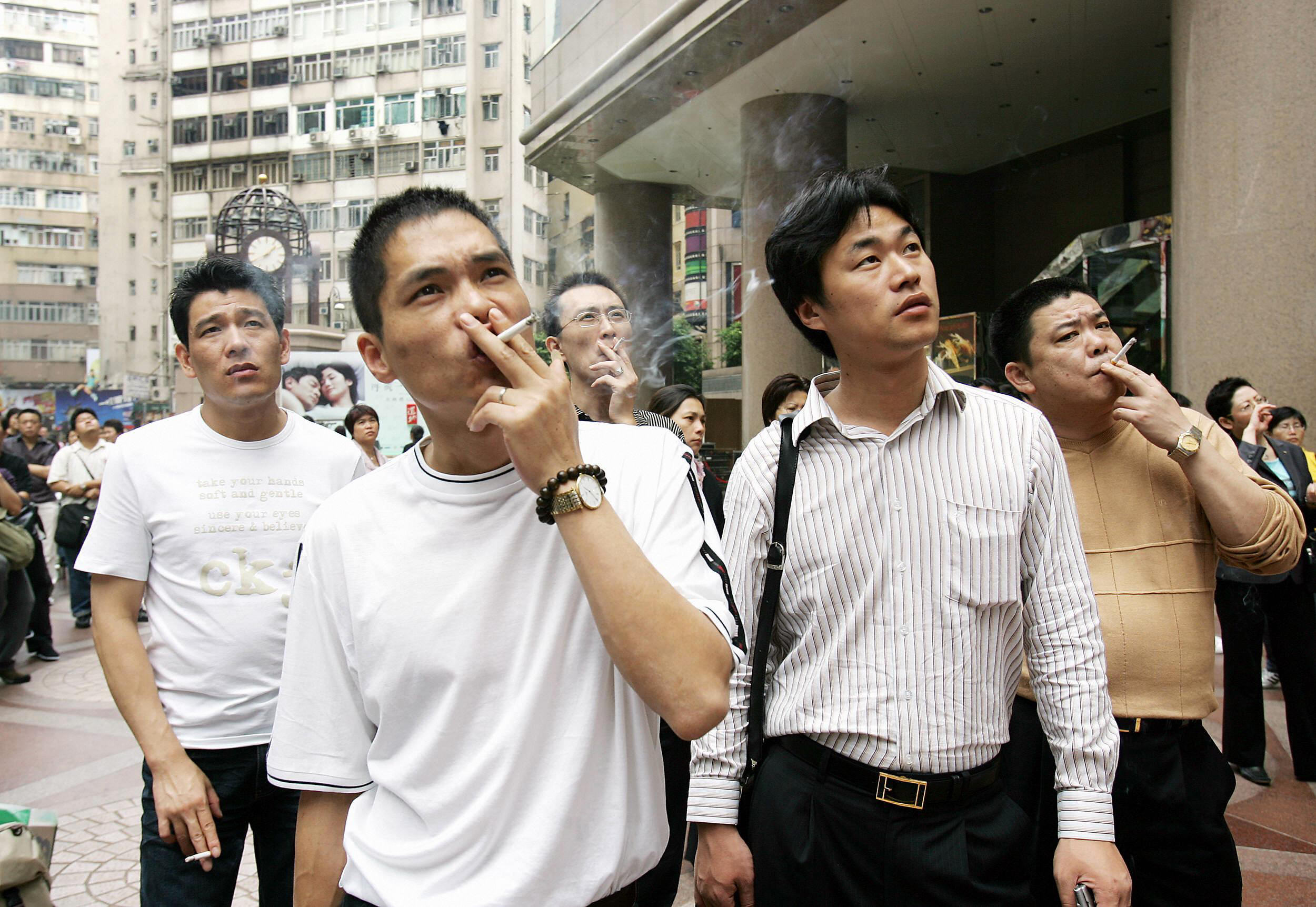
A group of men enjoy a smoke as they joi

A reader keeps the thread going:

One issue we’ve encountered is the lack of respect for No Smoking sign/rooms/hotels by Chinese and other Asian tourists. That is beyond annoying, as I react horribly to cigarette smoke and will be ill for days and even weeks after being forced to breathe it (sometimes even through hotel ventilation in the wee hours of the morning).  One time we were outside DC and a busload of Chinese tourists arrived after midnight to our completely non-smoking hotel.  They made a loud ruckus settling in on the floor above us, and within minutes we could smell smoke in our room.  Calls to management resulted in demands to stop smoking, which I can assure you were followed for maybe 10 minutes.  Headaches, coughing, and bad sinus congestion were my reward for the next four or five days.

That anecdote brings to mind a Dish post from a few years ago:

China is the world’s largest producer and consumer of tobacco. The 2010 Global Adult Tobacco Survey, conducted by the Chinese Centers for Disease Control in partnership with the US CDC and the World Health Organization, estimates that China has 350 million smokers, or more smokers than the entire population of the United States.

(Photo: A group of men in Hong Kong enjoy a smoke as they join a crowd of people watching a large video screen showing footage of the landing of China’s astronauts back to Earth on October 17, 2005. By Samantha Sin/AFP/Getty Images)

A Short-Lived Victory For The Homeless?

by Brendan James

Stephen Lurie calls the recent drop in homelessness – 17 percent from 2005 to 2012 – “nothing short of a blue-moon public policy triumph.” But it’s all reversible:

In the next few years, as Washington looks to cut spending across the board, the public’s aversion to homelessness could contribute to its return. We have seen that some constituents have successfully lobbied to overturn some parts of the sequester, such as the FAA cuts. But the homeless population has notoriously low voter turnout, and certainly has little money to spare for campaign contributions. They are unlikely to have much power in an age of austerity and there seems to be little recognition or reward to be gained for politicians by serving the homeless.

As quietly as homelessness has fallen, so too it will go up quietly – unless there is major intervention.  The United States Department of Housing and Urban Development estimates that sequestration cuts from homelessness programs are set to expel 100,000 people from a range of housing and shelter programs this year. That’s nearly one sixth of the current total homeless population. Far from gently raising the homeless rate, it would undo a full decade of progress.