Detroiters Should Move To Israel

by Tracy R. Walsh

NextCity_Detroit_FINAL_1300_janik_860_1782

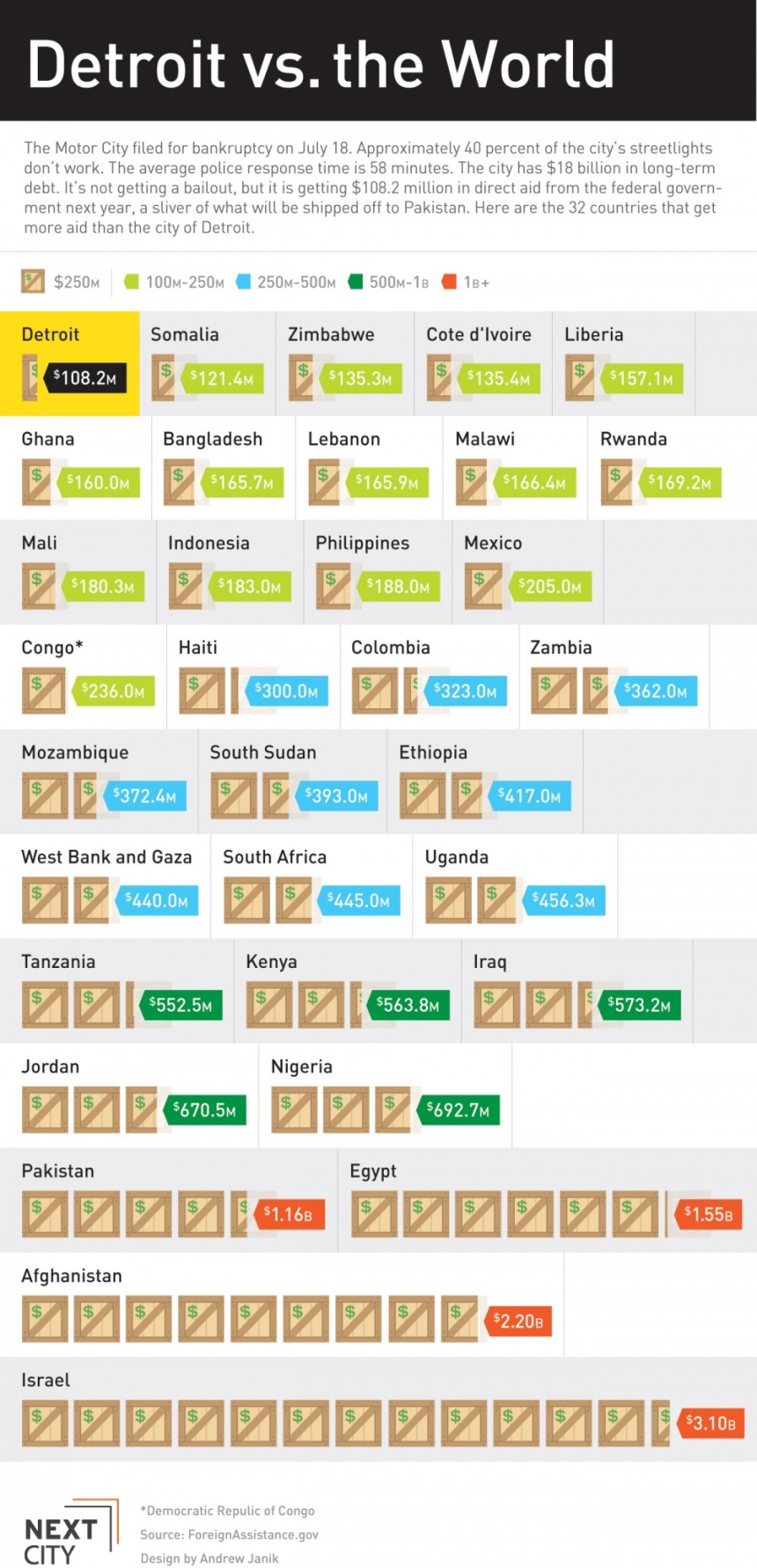
Bill Bradley compiled a list of countries that receive more more federal aid than Detroit:

Oftentimes, the first thing people say when they see Detroit’s hulking ruins and blight is, “It looks like a third-world country.” It’s not unsavory to imagine how more money injected into depopulated cities and struggling urban cores, from New Orleans to East New York, instead of struggling countries might benefit the economy and country as a whole.

The Group Effort

by Jessie Roberts

Bill McKibben thinks that climate science has risen to prominence “not despite its lack of clearly identifiable leaders … [but] because of it”:

For environmentalists, we have a useful analogy close at hand. We’re struggling to replace a brittle, top-heavy energy system, where a few huge power plants provide our electricity, with a dispersed and lightweight grid, where 10 million solar arrays on 10 million rooftops are linked together. The engineers call this “distributed generation,” and it comes with a myriad of benefits. It’s not as prone to catastrophic failure, for one. And it can make use of dispersed energy, instead of relying on a few pools of concentrated fuel. The same principle, it seems to me, applies to movements.

In the last few weeks, for instance, 350.org helped support a nationwide series of rallies called Summerheat. We didn’t organize them ourselves. We knew great environmental justice groups all over the country, and we knew we could highlight their work, while making links between, say, standing up to a toxic Chevron refinery in Richmond, California, and standing up to the challenge of climate change.

From the shores of Lake Huron and Lake Michigan, where a tar-sands pipeline is proposed, to the Columbia River at Vancouver, Washington, where a big oil port is planned, from Utah’s Colorado Plateau, where the first U.S. tar-sands mine has been proposed, to the coal-fired power plant at Brayton Point on the Massachusetts coast and the fracking wells of rural Ohio—Summerheat demonstrated the local depth and global reach of this emerging fossil fuel resistance. I’ve had the pleasure of going to talk at all these places and more besides, but I wasn’t crucial to any of them. I was, at best, a pollinator, not a queen bee.

The Best Of The Dish Today

by Chris Bodenner

European Tourists Flock To Ibiza For Their Summer Holidays

Another slow news day in the late summer doldrums. Tracy outlined the president’s new push for a college ratings system and Patrick checked in with the far right’s latest racial obsession. We also examined the dangers that Chelsea Manning could face in prison and debated the renewed push for intervention in Syria. A top Canadian pol talked openly about smoking pot and a conservative Catholic came out in favor of same-sex marriage.

This observation of the omnipresence of tattoos was popular with readers, and now even animated tattoos are starting to emerge. As “bullshit jobs” are on the rise in the information economy, so are virtual assistants. Language weirdness rankings here and the sunnier side of the Internet here. Major beardage here and here.

Happy weekend!

(Photo: A group of tourists sunbathe at Platja d’en Bossa beach on August 21, 2013 in Ibiza, Spain. The small island of Ibiza lies within the Balearics islands, off the coast of Spain. For many years Ibiza has had a reputation as a party destination. Each year thousands of young people gather to enjoy not only the hot weather and the beaches but also the array of clubs with international DJs playing to vast audiences. By David Ramos/Getty Images)

Animals Can’t Take An IQ Test

by Brendan James

Jessica Love complains about the way we rank animal intelligence:

The problem is that though some animals laze in Chicago apartments, others dwell in rural pastures or factory farms or rainforest canopies or 1,000 feet underwater. Some animals live in small groups, others in solitude, and still others in flocks thousands strong. Just last week I learned that a limiting factor for tool use—the smoking gun of animal intelligence—may well be physical dexterity: the dumb, lucky ability to clamp or poke or push things around with some precision. Ranking the intelligence of animals born into such different environments, family units, and bodies is as futile as it is irresistible.

Nor is it unproblematic that we humans have a complete monopoly on IQ test design and implementation. As the Emory University primatologist Frans de Waal recently described, this has led to a number of anthropocentric mishaps: testing whether elephant-sized elephants could identify their own reflections inside human-sized mirrors, or investigating facial recognition in primates using human faces rather than primate ones. Whoops.

Assistants Can’t Be Outsourced, Ctd

by Chris Bodenner

A reader begs to differ:

I’d like to share a contrasting virtual assistant experience from that of Manjoo’s.  For six years, I have worked with a VA who does a great job at a remarkable number of tasks.  Travel planning apple-siriand booking? Check. Complicated, multi-city itineraries to be billed to different clients? Check.  Finding the jacket I accidentally left in the overhead by seat 7A?  Making all of my appointments, including conference calls with casts of thousands?  Fixing my PowerPoint?  Trouble shooting tech problems?  Doing my expense reports?  Sending flowers to a sick relative?  Being trusted with my Amex account, all of my travel accounts, my web domain?  Check, check, check, check.

We communicate every day five days by email and, when urgent, text or phone call.  The only thing that troubles me about our relationship is that, after six years of working together, we have never met (although we have pieced together the basic facts of our respective family lives and interests).  My friends are divided between those who say “Isn’t it a little creepy not to meet her?” and those who say “Why fix something that isn’t broken?”

I’ve read several times about people experimenting with virtual assistants in India – as if VAs are available only in India.  That’s not true.  Mine is in Gainesville; I’m in Cambridge (Mass).  There are excellent VAs in the US who can provide an amazing array of services on an as-needed basis.  They are perhaps the most interesting use of remote-office technology I’ve come across.  People shouldn’t be scared off.  A good one is a gamer-changer.

And of course in the not-too-distant future we’ll start outsourcing VAs away from humans altogether.

Faces Of The Day

by Chris Bodenner

BRAZIL-TEACHERS-STRIKE

Teachers and school workers on strike rejoice after getting a favorable proposal from city mayor Edwardo Paes during a rally in front of the city hall in Rio de Janeiro, Brazil, on August 23, 2013. The city schools have been closed due to the strike since August 8. By Yasuyoshi Chiba/AFP/Getty Images.

The Golden Age Of TV Criticism

by Chas Danner

Matt Zoller Seitz heralds it:

I’ve been a film critic for over twenty years, and a film and TV critic simultaneously for fifteen. I have never seen anything as innovative and thrilling as what a lot of my TV critic colleagues have been doing since the mid-aughts. The flowering of modes and styles and the willingness to experiment is always engaging and sometimes amazing.  … If TV is, as I’ve argued, an adolescent medium — not in terms of artistry, but timeline development, meaning it’s only been given carte blanche to be daring for maybe fifteen years — TV criticism is an even younger phase of its development.

He goes on the highlight numerous examples of present-day critics he admires:

When you read The Hollywood Reporter’s Tim Goodman, Time’s James Poniewozik, Grantland’s Andy Greenwald, NPR’s Linda HolmesUSA Today‘s Robert BiancoEric Deggans of the Tampa Bay Times (soon to be NPR’s first TV critic), and the AV Club’s Donna Bowman and Todd VanDerWerff, you always get the sense that the writers aren’t just doing consumer guide work. They grind axes, float theories, tilt at windmills. And they all do it in their own distinctively personal way.

But these are all variations of what we traditionally think of as Serious Criticism, whether or not the writers crack jokes. Look beyond this mode and you get a sense of TV criticism’s variety. The landscape is as dazzling and sometimes confounding as any young ecosystem’s. The dedicated TV-watcher surveys it as Darwin might. How did that strange creature come into existence? What’s the point of the plumage? Why five legs instead of four?

It’s customary to decry much TV writing, recaps especially, as plot summary plus snark; I’ve done it myself. But as television criticism has evolved, this catch-all insult has started to seem as lazy and out-of-touch as cinephiles writing off the whole of television as an idiot box.

I wholeheartedly agree. What I love about the current TV criticism scene is that it feels like I’m never just watching a show by myself, but in the midst of a large community of thoughtful, trusted people who I can consult at the end of every episode. When those credits roll, I instinctively want to know what my favorite critics thought or noticed that I maybe hadn’t, and that process of review and analysis enriches my experience as a viewer immensely. Also, in this era of Netflix binge-watching, sometimes it’s nice to be able to slow down the pace of consumption a bit, to stop and savor rather than become a plot-obsessed insomniac.

Body Art For The Indecisive

by Tracy R. Walsh

Alexis Madrigal heralds the first animated tattoo:

Anthony Antonellis marked another milestone for the body-hacking movement, implanting an RFID chip encased in glass into his hand. The tiny chip can transmit an animated GIF that he’s stored in it through a tiny antenna. He can swap out the image it carries and transmits, but here’s what he’s currently got in the one kilobyte of memory his implant stores:


Marina Galperina explains further:

The NFC / RFID chip is the size of a grand of sand. It’s equipped with a tiny antenna and encased inside a glass capsule to keep it from being disrupted by its fleshy environment. This chip stores 1KB of data and is readable like a key fob by compatible phones, tablets, card readers and the Arduino microcontroller. … It’s read-only, but changeable when Antonellis decides to upload new works. These could be GIFs, JPGs, Midi files, favicons, [or] ASCII art.

How Gay Is Russia? Ctd

by Chris Bodenner

Anecdotal evidence from readers this week suggested that there is more acceptance of gay life in Moscow than there is in St. Petersburg. That contrast is further evident in the first two of “eight horrific and uplifting stories about being gay in the new Russia” from Julia Ioffe:

In Moscow, one of my closest friends is Mike, a gay American journalist. In 2010, he met Fedya, a Russian seven years his junior. Mike called the next day to tell me he had met “the one,” and soon they were living together—nesting really. They made a conscious decision not to hide their sexuality. They held hands in the streets, they kissed in public, and, amazingly, no one seemed to mind.

One day, Mike and Fedya went to a party for Fedya’s older brother, a soccer fanatic. “We pull up to the house, and there is heavy-metal music playing, a bunch of dudes swilling cognac and vodka out of plastic cups. And we walk in and all heads snap in our direction,” Mike recounts. One of the friends, who had clearly spent most of the afternoon drinking, was watching with a wary, slanting look. Later that evening, he approached Mike: “I was sure he was going to try to pick a fight. Instead, he thrust a cup of cognac in my hand, raised his glass, and said, ‘It doesn’t matter what kind of love it is, as long as it’s true love.'”

A much less heartening scene from St. Petersburg:

Maria Kozlovskaya is a lawyer and she was asked to resign from her previous job at the Russian branch of a Western tobacco distributor. “My boss said we don’t align on certain core principles,” Kozlovskaya says. “She thought that gays are all pedophiles who corrupt children.” Kozlovskaya came out to her mom about seven times, and, each time, her mom pretended it was news.

Kozlovskaya works in gay advocacy in St. Petersburg, where there has been a spike in anti-gay violence. (There are no official statistics, but Kozlovskaya’s group, the LGBT Network, estimates that 15 percent of LGBT people were assaulted last year.) “People are changing their behavior to protect themselves,” Kozlovskaya says. “They don’t wear rainbow pins anymore, they don’t hold hands outside.”

Recently, when Kozlovskaya and a client—an assault victim—arrived at the courthouse, they were met by a group of skinheads. “They egged me and beat up the victim,” Kozlovskaya says. “We called the police, but they didn’t come.”

Julia’s six other vignettes – some truly horrifying – are here.