Hillary Isn’t Too Old To Run

by Patrick Appel

Nate Cohn reviews the actuarial tables:

A 65-year-old white woman has the same odds of dying the following year as a 60 year old white male. That puts her in roughly the same place as George H.W. Bush when he sought the presidency. She probably has a better chance than Ronald Reagan did. It would seem to give her much better odds than vice president Joe Biden, who’s a male and already older: eight percent of 69-year-old white males will die before the 2016 presidential election.

Christie has worse odds than Clinton

The New Jersey governor is just 50 years old, but studies show that obesity reduces life expectancy anywhere from six to ten years. According to the University of Pennsylvania life expectancy calculator, Christie’s life expectancy is 73 years, with a median of 74. That gives Christie the worst odds of any candidate: he has a 96.6 percent chance of living to the 2016 presidential election and only has an 84.2 percent chance of surviving until January 2025, when he might be concluding his second term in the White House. In comparison, Hillary Clinton gets a 93.8 percent chance—which lines up nicely with the 92 percent of white female senators, cabinet secretaries, and first ladies who have survived to age 78.

All Eyes On Egypt

by Brendan James

PAKISTAN-EGYPT-UNREST-PROTEST

Madawi Al-Rasheed observes how the Saudi theocracy is keeping its own Islamist opposition in order as Egypt burns nearby. King Abdullah recently set the tone, declaring full support for the junta in Cairo:

The king’s message was clear: zero tolerance for all those who use Islam to pursue political agendas, sort of an oxymoron in the Saudi context as the state itself had been manipulating, co-opting, and promoting Islam for agendas that are nothing but political. The foundation of the state itself is a process of instrumentalizing Islam to revive the Al-Saud control of vast territories, under the pretext of purifying Arabia from blasphemy, innovation, and atheism. The Muslim Brotherhood and its likes appear to be latecomers to the project of politicizing Islam.

King Abdullah’s message, supposedly meant for Egyptians, did not go unheeded among the many Saudi Islamists who abhorred their government’s support for the Egyptian coup. Since July 3, they have turned into defenders of Morsi and the Brotherhood, issuing statements on social media condemning their own government for backing the coup.

A small group of activists launched an online petition to gather signatures against the aid that had been promised to Egypt immediately after the coup. Following the circulation of the petition, a couple of veteran activists such as Mohsin al-Awaji were briefly detained while many other Islamists remain banned from travel, most famous is Sheikh Salman al-Awdah whose television program “you have Rights” was abruptly stopped on an Islamist independent television channel. The government is carefully watching the hyperactivity of Islamists and their statements on television and online, which have so far strongly condemned the Egyptian coup and their own government’s unequivocal endorsement of General Sisi.

Michael Koplow notices that Turkey’s government is alarmed for the opposite reason, as an Islamist party supportive of the Brotherhood:

[T]he specter of crowds massing in the streets and the military overthrowing the government hits a little too close to home for Erdoğan given what he was dealing with in June and the history of Turkish military coups. Erdoğan’s biggest claim to fame is his defanging of the military, and even after demonstrating that Turkish civilian control (and undemocratic intimidation) over the army is complete with the Ergenekon verdicts a couple of weeks ago, no Turkish prime minister – and certainly no Turkish prime minister with Erdoğan’s background – is ever going to feel completely safe from the long arm of the military. Erdoğan looks at what is taking place in Egypt through a distinctly Turkish prism, and in many ways his views on the Egyptian coup are actually a complex psychological projection of his fears about his own position. …

Erdoğan sees the army removing an elected government amidst accusations of policy overreach and undemocratic behavior, and he imagines a nightmare alternate universe where the same could happen to him.

Previous Dish on the region’s reaction to Morsi’s ouster here and here.

(Photo: Islamic political party Jamaat-e-Islami activists march in support of ousted Egyptian president Mohamed Morsi in Karachi, Pakistan on August 20, 2013. Supporters of Morsi announced new demonstrations as Egypt grew increasingly polarised and the death toll in four days of violence topped 750. By Asif Hassan/AFP/Getty Images)

The Puritanism Of Progressive Parents, Ctd

By Tracy R. Walsh

Keith Humphreys thinks the phrase “progressive Puritans” is unfair to both progressives and Puritans:

A Puritan would be delighted to meet a fellow member of the faithful, but that is not what I see in these parents. If they are vegetarian and meet another vegetarian, they are unhappy and commit to becoming a vegan. If they then meet another vegan, they become unhappy and commit to becoming an ovo-lactic vegan. They don’t want other people to share faith in a community of peers; they want to outrank their lessers within a hierarchy. This is also why they are not truly liberal or progressive. They are not trying to save the world, they are trying to get an edge in life for themselves and for little Hayden and Sawyer too.

Rather than surrender the terms liberal or progressive so easily to the domain of lifestyle and shallow issues of personal identity, I suggest we let those terms retain their political meaning by not describing panicky, entitled, hierarchy-obsessed, materialistic strivers as “liberals.” Likewise, let’s not throw theology and history to the side and call them “Puritans” either. If we need a shorthand term for them, I suggest that someone with literary skill invent an entirely new one, as long it isn’t very polite.

Any ideas? More of the popular thread here.

The Worst Chemical Weapon Attack In Decades?

by Chas Danner

https://twitter.com/michaeldweiss/status/370216269804367872

https://twitter.com/lizobagy/status/370209257569804288

Syrian rebel groups claim that hundreds have been killed in what may have been a chemical weapon attack by Assad on the suburbs east of Damascus. The attack may be the beginning of a larger offensive by regime forces. David Kenner gives his summary:

The information coming out of the Ghouta region, where the rebels enjoy significant support, is still unconfirmed by independent observers. But videos allegedly taken Wednesday in the area showed Syrians lying on the floor gasping for breath, medics struggling to save infants, and rows of bodies of those who had reportedly died in the attack (warning: the footage above is graphic). Syrian state media denied that chemical weapons had been used, attributing such stories to media channels that “are involved in the shedding of the Syrians’ blood and supporting terrorism.”

The opposition Local Coordination Committee, however, reported that at least 755 people had been killed in the attack. If that figure is true, what is happening on the outskirts of Damascus today is the worst chemical weapons attack since then-Iraqi President Saddam Hussein unleashed poison gas on the Kurdish town of Halabja in 1988, killing an estimated 5,000 people.

One report even says the death total could be over 1,300. Chemical weapon expert Ralph Trapp compares this attack to previous ones:

It is possible a gas was involved, but the images I’ve seen were not clear enough to see other symptoms beyond difficulty in breathing and suffocation. It certainly looks like some sort of poisoning. … [But] this is one of the first videos I’ve seen from Syria where the numbers start to make sense. If you have a gas attack you would expect large numbers of people, children and adults, to be affected, particularly if it’s in a built up area.

Jean Pascal Zanders’ analysis:

I am not sure whether the claims of nerve agent use accompanying the footage and images are correct. The people are not convulsing (except for one man shaking his legs while shouting out, but the remainder of his body does not suffer from involuntary contractions) and I have not seen anybody applying nerve agent antidotes. Nor do medical staff and other people appear to suffer from secondary exposure while carrying or treating victims.

It is clear that something terrible has happened. The scenes could not have been stage managed.

Jeffrey Goldberg weighs in:

Two questions are raised by reports of this attack. The first, of course, is whether or not it happened the way Syrian rebels said it happened. That is why immediately dispatching the UN team, already in-country, to the affected areas is so vital. If this process worked the way it should, they would be there already. If the Syrian regime denies the UN inspectors permission to visit these areas, well, that is kind of an answer in itself.

The second question is, why would the Assad regime launch its biggest chemical attack on rebels and civilians precisely at the moment when a UN inspection team was parked in Damascus? The answer to that question is easy: Because Assad believes that no one – not the UN, not President Obama, not other Western powers, not the Arab League – will do a damn thing to stop him.

There is a good chance he is correct.

Guardian live-blog here. A Reddit page is collecting information and videos here.

The Resistance To Republican Rebranding

by Patrick Appel

Chait wonders whether House Republicans will prevent the GOP from nominating a candidate who can rebrand the party:

Republicans can escape the damage inflicted by its Congressional wing by nominating a candidate who runs against it in 2016. That’s what the party did in 2000: George W. Bush made a few comments distancing himself from Congress, and that was enough to clear him of all the branding damage the Republicans Revolutionaries had done for a half dozen years and position himself as a moderate. It didn’t stop Bush from governing hand-in-glove with the selfsame Republican Congress once in office.

So the danger for Republicans isn’t that they’ll lose the House. It isn’t even that they’ll irrevocably poison their own brand. It’s that they’ll create an intra-party orthodoxy so strong it will prevent them from nominating a candidate who can distance himself from Steve King’s racial ideology and Paul Ryan’s economic ideology. In the meantime, they can inflict an awful lot of damage to the country at very little cost to themselves.

Humphreys thinks that the GOP has stopped listening:

As Mark Kleiman has noted, the American left lost on the crime issue starting in the 1960s and 1970s because it stopped listening to the public (not unlike how the left later lost the public education issue).

The extraordinary surge of crime that began in the 1960s caused enormous suffering. And when Americans are suffering, they get very angry when politicians tell them their suffering is no big deal (“Many neighborhoods are as safe as ever!”), or is really due to something else (“We don’t have a crime problem, we have a poverty problem!”), or that the public should apologize for being upset (“Complaining about crime is just coded racism”). Americans who feel unheard often express their anger by voting for some politician — any politician — who seems to be listening. And when it came to crime, for many years most of those politicians were conservative.

Liberals were in shock on crime policy for a long time afterwards. They had been talking amongst themselves when they should have been listening to people outside the bubble. California Republicans made the same mistake when they decided to go anti-immigrant in the 1980s. The Tea Party is committing the same blunder right now as they plan out where they will store all the roses the public will supposedly buy them if the federal government is shut down on October 1. Failure to listen isn’t a left or right thing. Rather, it’s a thoroughly human weakness about which political parties should be constantly vigilant.

Ask Kate Bolick Anything: The Porn Effect

by Chas Danner

In today’s video, Kate shares her perspective on how the widespread availability and consumption of pornography has affected gender relations:

Kate is currently working on her first book, Among the Suitors: On Being a Woman, Alone, to be published next year by Crown/Random House. She is also a contributing editor for The Atlantic and writes regularly for ElleThe New York Times, The Wall Street Journal, and Slate. Her 2011 Atlantic cover story, “All the Single Ladies”, addressed why more and more women are choosing, as she has, not to get married. The Dish debated the piece here and here. Kate’s previous videos are here and readers have been debating the fate of sick singles here and here. Our full AA archive is here.

Not From The Onion

by Chris Bodenner

Wow:

The latest survey from Democratic-leaning Public Policy Polling, provided exclusively to TPM, showed an eye-popping divide among Republicans in the Bayou State when it comes to accountability for the government’s post-Katrina blunders. Twenty-eight percent said they think former President George W. Bush, who was in office at the time, was more responsible for the poor federal response while 29 percent said Obama, who was still a freshman U.S. Senator when the storm battered the Gulf Coast in 2005, was more responsible. Nearly half of Louisiana Republicans — 44 percent — said they aren’t sure who to blame.

Update from a reader:

This is clearly an opinion poll designed by liberals to generate headlines. If the poll question was written in good faith, there would have been more than two options and those options would have only included people who were directly involved with the response to Katrina, including the governor and the mayor. As stated, the question amounts to “Whose fault is it that New Orleans was devastated: A guy you like or a guy you don’t like?” I would assume that most of the people who answered “Obama” either meant “Democrats in general” or “screw you for asking such a slanted question.”

It still shows how partisan hatred trumps everything else.

Antiheroes Everywhere, Ctd

by Brendan James

A reader challenges this post:

Walter White may be cut-throat, he may be a murdering, lying, cheating asshole, but he is the show, and we very much care what happens to him. Personally, I’d love to see him beat cancer, ditch that wife of his and unearth the millions in the desert to retire peacefully in Belize, or Russia, leaving Hank to fume and foment. Walter set out on a course that was rooted in good intentions. He wanted to care for his family. The road to hell, as they say… so in the process he lost his soul.

Take it all the way, Walt. You are the devil now. Live like it. We’ll have sympathy for the devil.

Another reader agrees that the antihero market is overcrowded but that the good finds are worth it:

Your post reminded me of how good and sick I got of movies featuring anti-heroes when I was young. Butch Cassidy, Bonnie and Clyde, Easy Rider – you could go on and on. But then came the ultimate anti-hero film: The Godfather.

That one I loved! I can still remember how delightfully shocked I was to find myself admiring Don Corleone, and, even more astonishing, rooting for Michael to follow in his father’s footsteps, instead of becoming the “good” Corleone that his father wanted him to be. The last scene, where we see the various capi kissing Michael’s hand through the horrified eyes of Michael’s wife, and were pleased for Michael, was glorious. I have never even bothered to watch The Sopranos – from what I hear, it is a latter-day attempt to equal the Godfather, and that is impossible.

Todd VanDerWerff put it well when he wrote “where The Godfather succeeds in (relative) succinctness, The Sopranos succeeds in accumulation.” There’s an argument that the serialized format of TV is better geared toward winning our sympathy for the bad guys. I wonder if the first reader above would be so supportive of Walter White if we only got to know him over two hours. (Incidentally, Sopranos showrunner David Chase actually wanted his pilot to be spun into film, now an odd and unappealing thought.)

What Happens If We Cut Off Egypt?

by Patrick Appel

Noah Millman is unsure:

America already has had the experience multiple times of cutting off clients who have crossed a red line of one sort or another. For example, we abandoned the Shah when he had plainly lost the support of his people. This did not win us any goodwill once the Iranian revolution brought to power a profoundly anti-American regime – because the Iranians had not forgotten America’s longstanding support of the Shah, and because the Ayatollahs had their own reasons for setting themselves up in opposition to America.

For another example, in response to Pakistan’s escalating program of nuclear weapons acquisition – and, not incidentally, in response to the collapse of the Soviet Union – beginning in 1990 the United States increasingly distanced itself from Pakistan. Over the course of the next decade, Pakistan still developed a nuclear arsenal, a generation of Pakistani officers grew up without relationships with the United States, and Pakistan became deeply involved in the Taliban regime in Afghanistan. We all know what happened next.

His larger point:

On a relative basis, Egypt is much less-influential than it was fifty years ago. On an absolute basis, though, it’s a much, much bigger country. If we decide that Egypt doesn’t much matter to us, I think we can safely say that we’ve decided that the Middle East doesn’t much matter to us.

Which it well might not. But I am not shocked that the American government is reluctant to decide on the fly and under the pressure of rapidly-changing circumstances in one country to significantly reorder its priorities in this part of the world.

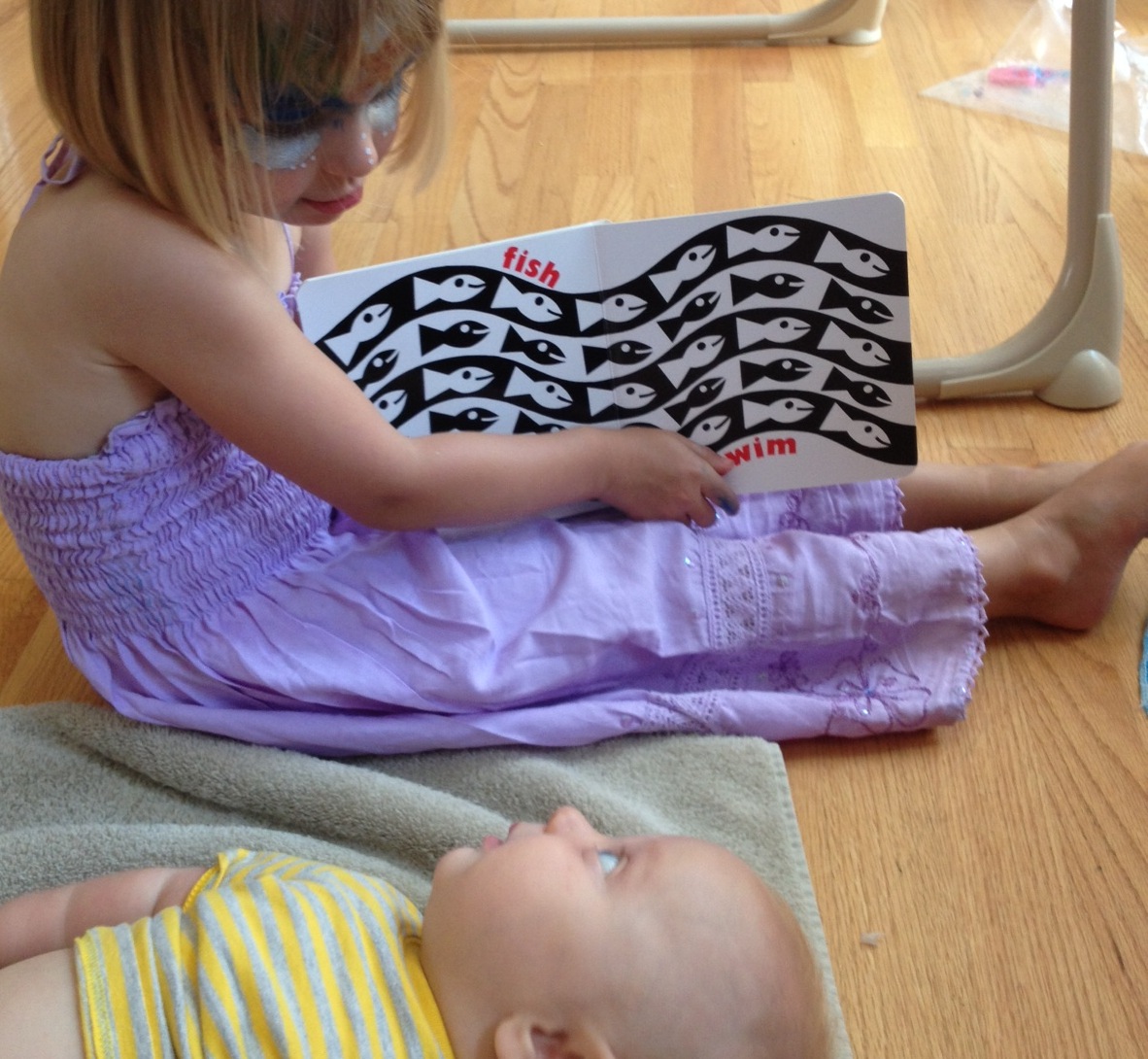
Does Birth Order Matter? Ctd

by Chris Bodenner

freya-readingto-henry

A reader responds to a recent post:

I can’t cite a source, but during my pediatric residency, I was taught that younger siblings learn a lot from their older sibs.  For example, a 12-month-old girl watches her 3-year-old brother walking and figures out how to walk. Oldest children don’t have anyone to pattern that behavior (adults don’t count), so they have to figure everything out on their own.  This makes for enhanced brain development and thus higher intelligence.

Another reader:

I recently read in Jena Pincott’s Do Chocolate Lovers Have Sweeter Babies? about a nature, rather than nurture, explanation for why first-borns tend to be more intelligent. Apparently, women store omega 3 fats in their hips and ass throughout their lives. When their first baby is gestating, the baby absorbs a lot of these stored fats to help make their brains plump and active. The first baby gets the most, as the mother usually doesn’t have enough time to accumulate that much more in omega-3s between children. (This also may be one explanation for why “mom butts” tend to be a little flatter).

I relay all this as a second-born sibling (whose older brother is certainly smarter in many ways) and a pregnant woman (who is eating her weight in omega-3-rich fish during pregnancy).

(Photo of my niece and nephew by Betsy Bodenner)