The Best Of The Dish Today

dish_octophant

Five recommendations: Snoopy meets Morrissey; another round in the debate on testosterone, culture and rape; how Chris Christie could win the Republican nomination; evidence that the Republican party is getting even more radical in the wake of their electoral defeat; and a pragmatic, conservative defense of Obama’s pragmatic economic policies.

The most popular posts were the same as yesterday’s: my takedown of Maureen Dowd on Obama and of the latest crazy conspiracy theory – FDR was controlled by Stalin, just as Obama is controlled by the Muslim Brotherhood – on what’s left of the intellectual right. I’ll have an update on that debate tomorrow. The most popular post of the last month remains “The GOP Calls Its Own Bluff.” Our full, live coverage of the Egyptian bloodbath and coup is gathered here.

See you in the morning.

(Image of Alexis Diaz‘s work via Colossal)

Sunset Burnout

sunset-instagram

Katy Waldman considers the deeper significance of Instagram users’ obsession with sunset photos:

The genre has turned into a commonplace—a grab at easy beauty. My friend, an amateur photographer, likened shooting sunset pictures to “eating Lucky Charms for breakfast.” “What do you mean,” I pressed, speaking as someone who faults Lucky Charms only insofar as they aren’t Fruit Loops. She elaborated: “They’re sweet and anodyne. The effect is like a sugar rush that disappears.”

Buried in her objection is the hoary philosophical distinction between the beautiful and the sublime, between prettiness that doesn’t challenge us and sights that fill us with awe and terror. Romantic writers expressed a preference for sublimity over attractiveness in the late 18th and 19th centuries. Edmund Burke wrote, “For sublime objects are vast in their dimensions, beautiful ones comparatively small: beauty should be smooth and polished; the great, rugged and negligent … beauty should not be obscure; the great ought to be dark and gloomy: beauty should be light and delicate; the great ought to be solid, and even massive.”

The experience of watching a sunset usually counts as sublime. The scene unfolds on a grand scale, loud with color and radiance; you get a shivery feeling of time passing as you sip your G&T; death draws just a bit nearer. Sunset pictures, though, reduce and tame that sublimity. Instead of your mortality rising to meet you, you see pretty colors, locked in a small and tidy moment.

The photographer of this sunset writes:

Sunsets are such a cliche. [But] how can you resist the temptation to run and get the camera before the light fades? The impulse of trying to hold onto the moment just takes over. It’s an illusion – all you hold onto is a picture, not a sunset – but it’s a powerful one. I plead guilty.

Previous Dish on Instagram and its discontents here and here.

(Instagram of a sunset in Cobh, Ireland from BlackieWarner)

Face Of The Day

LEBANON-UNREST-BLAST-BEIRUT-HEZBOLLAH

A boy and his mother are seen at the site of a car bomb between the Bir el-Abed and Roueiss neighborhoods in the southern suburb of Beirut on August 15, 2013. A powerful car bomb killed at least 14 people and more than 200 wounded in a Beirut stronghold of Shiite movement Hezbollah, an army source and Lebanese Red Cross said. By AFP/Getty Images.

Time To Cut Off Cairo’s Aid, Ctd

Jeffrey Goldberg writes that there is “no good reason to continue funding the Egyptian armed forces”:

The aid obviously hasn’t provided the White House with sufficient leverage, and it makes the U.S. complicit in what just happened and what will undoubtedly continue to happen. One argument for continued aid is that it encourages the military to maintain Egypt’s peace treaty with Israel. But the military will do so whether or not the U.S. provides money and weapons, because it has decided that Islamist extremism, and not Israel, is Egypt’s main enemy. And it will be too busy persecuting Egyptians.

We are united again! Plumer suggests one reason to continue aid:

Earlier this year, Secretary of State John Kerry warned that cutting off aid could send Egypt’s already-struggling economy into a tailspin. “A hold up of aid might contribute to the chaos that may ensue because of their collapsing economy,” he said. If it seems odd that military aid has become so crucial to Egypt’s economy, consider this: The Egyptian military is utterly gigantic, one of the largest in the world, “controlling between 10 and 30 percent of the economy and employing hundreds of thousands of Egyptians.”

Lynch remains in favor of cutting aid to Egypt:

[I]t’s really symbolic more than anything. But it’s a powerful symbol. And you can see that the administration is still waffling. I’m not a believer in the idea that we absolutely have to take clear stands all the time, but this is one of those times when we have to. It’s not even just the 500 dead. The Egyptian military did what we explicitly told them not to do. How can we still pretend that this aid is giving us influence?

Fisher lists reasons for and against cutting aid. Earlier Dish on the subject here, here, and here.

Building A Nationalist Narrative

Macedonia

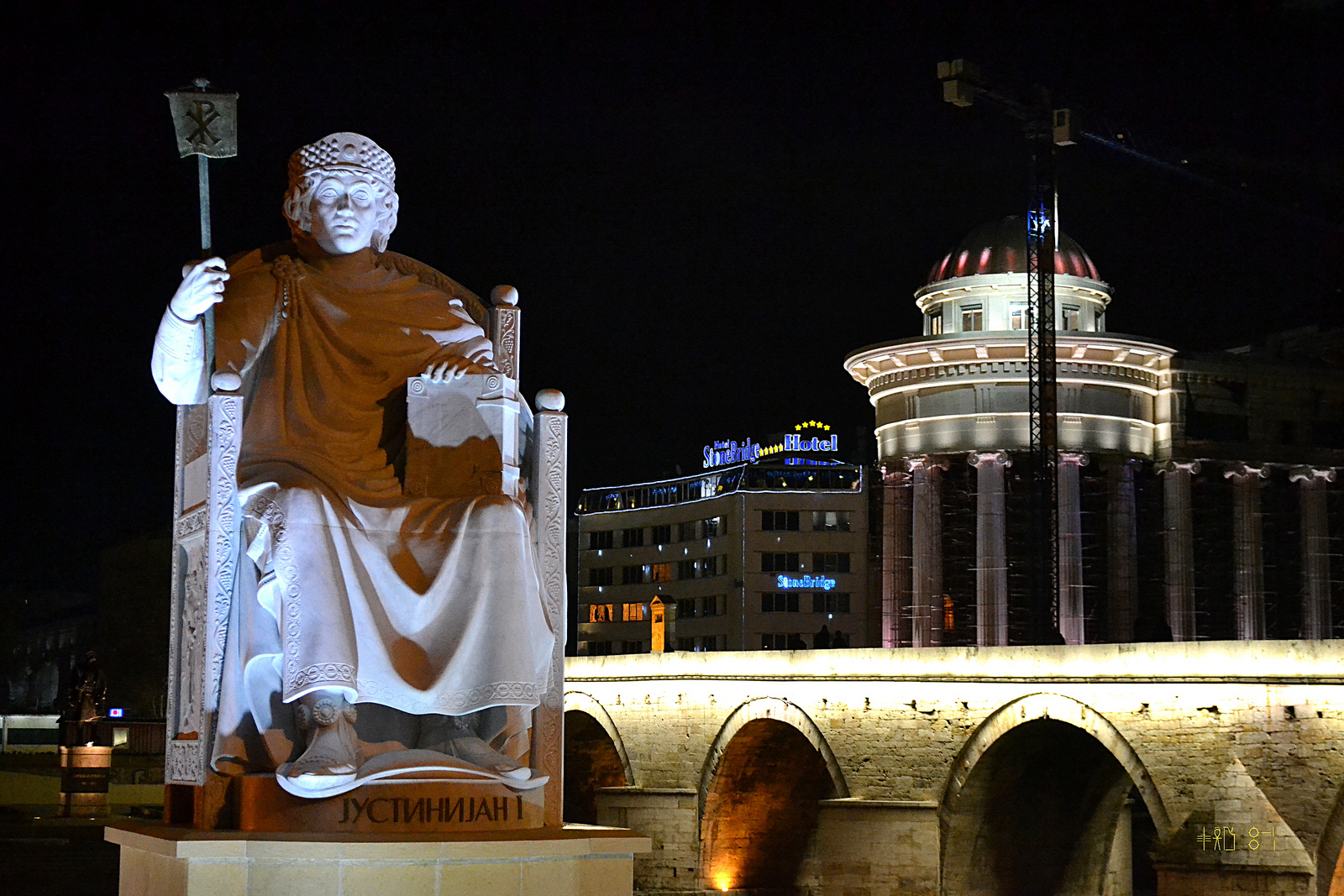
The Macedonian government is pushing through “a single, straightforward, and unapologetically nationalist narrative in marble and bronze”:

An explosion of recent, government-directed building in Skopje’s downtown, a project called Skopje 2014, is a heavy-handed, Vegas-esque attempt to impose both historical and aesthetic unity where there is none [since only 64 percent of Macedonia is ethnically Macedonian]. It includes dozens of statues, enormous new government buildings, and ornamented bridges, fountains, and archways. It’s a project of the ruling Macedonian Party for National Unity, which claims its origins in the late 19th century revolutionary movement against the Ottoman Turks. … Skopje 2014 wants to settle Macedonian history once and for all: to root an ethnically diverse, 21-year-old modern state in a unifying and uncomplicated vision of the past. Whether it succeeds or not, the attempt has left a deep mark on an already-dizzying cityscape.

(Photo of Skopje’s Justinian I monument by Stelios Zacharias)

Thinking Through Stop-And-Frisk, Ctd

Readers sound off on the controversial policy:

What I would like someone to ask Bloomberg at the next press conference: “Would you support the IRS specifically targeting the tax returns of Jewish Americans for audit, if the practice proved to be more effective in catching tax fraud than random audits?”  I mean, Bloomberg has said recently that he thinks the police should be targeting MORE minorities than they already are. And his sole defense of this practice is that it is effective.  So let’s turn that around: would you accept the targeting of Jews if it was more effective at stopping crime than random sampling?

(I of course am not suggesting such a policy would be effective, having no earthly reason to believe that Jews cheat on their taxes more than Christians or members of any other faith or ethnicity.)

Another reader:

On the one hand, as a life-long liberal New Yorker, I am bothered by how un-bothered I am by the stop/frisk debacle. Profiling seems like a terrible consequence of certain realities. Gang violence in certain neighborhoods is a huge issue that needs solving, but I can’t really argue with the fact that the best way to find illegal guns is to stop young, black men from certain socioeconomic backgrounds.

It boils down to priorities: the mayor has decided (and rightfully so, if you ask me) that gun violence is something he and his team are committed to staunching. For example, if you wanted to crack down on cocaine and molly, stop and frisk all the wealthy club kids buying $800 bottles of vodka in the Meatpacking District on a Friday night. It would be silly to pat down all the bus riders near a project in the Bronx to look for illegal Adderall pills. But the city doesn’t really give a damn about fancy kids and their fancy drugs. It is interested in guns and related violence.

And therein lies the reason why Bloomberg, whom I generally respect a great deal, is so full of shit.

If stop/frisk was really about guns and violence alone, let them pat down each and every person they “suspect” of having guns – and then, when they find a bit of weed on an otherwise harmless teenager, LET HIM GO. You want to send a message that you are seriously trying to combat gun violence? Show how important it is by letting pot possession slide. At least then your motives will match up with your outcomes.

Furthermore – and this is what bugs me – have a little fucking compassion. I’ve seen young Arab-looking men profiled in airports often. Ironically, I’ve seen the least of this in Israel (which knows everything about you before you even step foot in Ben Gurion) and America (which just puts everyone through the ringer, like complete idiots). But in Europe I have seen some pretty targeted treatment of some Arab men. And I noticed in Denmark that the search was done apologetically, with an heir of “sorry, I need to feel your testicles for a bomb, this is ridiculous but you know how it is, right?” In Croatia, the agents acted as if they had caught a terrorist and just needed to find the damn evidence. And the response that the Croatian incident prompted from myself and others around me was irritation and shame at the treatment of this dude. The response in Denmark, however, prompted shame – at the situation in general, and annoyance at the actual terrorists out there who were, in essence, ruining this man’s reputation and morning, by tarring their ethnicity with such stigma.

Now I know the NYPD fighting gun violence is way different than the TSA fighting terrorism. But a little humility, a little apology, a touch of “Listen, it sucks we have to do this” would at least somewhat focus more of the rage on the actual scum who terrorize parts of Brooklyn and the Bronx. A stop/frisk by a cop trained to assume that this is likely just a precaution, trained to apologize for the intrusion, trained to ignore angry feedback from those being searched would be a whole different ballgame. From what I have seen, these stop/frisk situations are rather confrontational, and usually involved being bent over a car hood like a criminal. Why? What is gained from that? Why show animosity towards the young black men being stereotyped (maybe justifiably), instead of sympathy?

Another refers to the chart in this post:

Mother Jones’ overall stops-per-seizure numbers are masked by the drug seizures on whites (which was interesting to me that you find a significantly higher number of whites carrying drugs – but that’s a question for another day). But, to the point, if you run the seizure numbers just for guns, you are 2.4 times more likely to find a gun on a black than a white. That’s significant. I’m white, but if I were black and lived in some of the tougher NYC neighborhoods, I might carry a gun too. That doesn’t mean I’m a criminal, but it might mean the neighborhood is dangerous, which circles back to the underlying premise of the argument.

By the way, I am biased towards maintaining stop-and-frisk, as I was held up at 1 am as I walked into the lobby of my NYC apartment in Chelsea.  Yes, he was black, but I would feel the same no matter what his skin color.  I was afraid during the holdup and angry afterwards.  I’m sure there are abuses by the police, as there are with all public officials, but in general I’ll give them the benefit of the doubt.  The police actually caught the guy within 15 minutes of the holdup and he went to jail.  If they had stopped and frisked him before the holdup, it would have been better for both of us.

Another also speaks to his own experience:

The NYPD and police union are pushing back against the ruling in the stop-and-frisk case requiring officers to be equipped with cameras. I am entirely unsurprised, and that specific reaction is likely prima facie proof that the judge was right about the fact that stop-and-frisk was probably, without regard to the race component, done without a “reasonable and articulable suspicion,” as required by the Terry case. The defense by the mayor, saying the Terry case allows stop and frisk, seems to ignore the fact that Terry has constitutional requirements beyond a raw hunch by a police officer.

The reason many police are not equipped with cameras, increasingly cheaper technology, is that a tool that would in many instances conclusively show very relevant facts, paradoxically makes their job of the officer harder, not easier. Take, for example, the job of a stock broker. SEC rules require all calls with clients to be recorded so everyone has a clear record of what occurred. When something goes wrong, those calls can be really helpful, or really bad. This does not work for police. The innocent reason is that cameras will not capture everything, so what is on film can be misconstrued, and if the equipment fails for some reason, a nefarious reason would be ascribed to the police. The less innocent reason is that a clear and accurate record of what occurred is in many cases not a good thing.

The criminal justice system works in a sense with a wink and a nod – that unless the officer honestly reports a sequence of events that is constitutionally infirm, or screws up embarrassingly in lying about the sequence of events, an officer’s version as to what occurred is almost always accepted as fact in evidentiary hearings on Fourth Amendment issues no matter how much everyone in the room suspects something else happened. That is part of the unspoken societal price for safer streets. As with the national security debate, the issue is what level of invasion of privacy are we willing to accept or ignore for safety (except that in the national security context it is largely Middle Eastern; and in policing, Black or Latino).

The proliferation of cameras makes the wink and nod harder. Famously in South Florida, following a traffic accident involving an off-duty police officer, the police arrested a woman who was involved in the accident for DUI and causing the accident. However, the off-duty officer may have been inebriated and actually had caused the accident. Caught on the audio from one of the police vehicles at the scene was the supervising officer directing the other officers that they would have to do “a little Disney” on the accident report, which was then partially fabricated and used for the arrest of the woman.

As a lawyer, I have encountered, on numerous occasions, law enforcement aversion to cameras. My first was as a prosecutor years ago in NJ when the State Police first installed dashboard cameras in Trooper’s vehicles. The NJ State Police have a reputation for being extraordinarily professional, even militaristically disciplined, including testifying in courtrooms. After a particularly contentious motion to suppress evidence that focused on the videotape, the cameras disappeared from all patrol vehicles, for a time while the agency tried to assess what the agency gained and lost from the use of cameras. The issue of cameras in patrol cars remains an issue in NJ as in other states.

As a defense attorney, I have encountered other examples of police aversion to cameras, including a case where my client was arrested in an undercover drug sting and was charged as a co-conspirator; the police alleged he was a lookout. The police department had a surveillance van and about 15 officers for the takedown. The surveillance van, an expensive piece of equipment with cameras, boom microphones and recording equipment, was on the scene and monitored by two of the agents. The police had used the same location, and same cocaine, about 10 times over the course of a number of months to arrest a large number of people.

However, when the attorneys received the evidence, there was a video that ended before the transaction and arrest. At depositions it became clear that some of the officers were confusing one arrest from others that had occurred at the same location. When it came to the agents in the surveillance van, the lawyers asked if there was a surveillance van there for the purpose of the arrest and capable of recording everything, why was there no recording of the most important part. The answer was “for safety of the officers.” Asked over and over again what that actually meant, the agent finally settled on, “we had to be ready to jump out and assist other officers if something happened so there would be no one to monitor the equipment.” When then asked why they didn’t just go there in a car for all the use the surveillance van provided, the answer was, “I don’t know.”

The NYPD do not want stop-and-frisk monitored by videotape because then practice would likely not stand up to factual scrutiny.

A Robot In Need Of Groupies

The music-making, fame-seeking robot Cybraphon will soon join the National Museum of Scotland’s permanent collection. The museum explains:

Inspired by early 19th century inventions such as the nickelodeon self-playing piano, Cybraphon is an interactive version of a mechanical band in a box. Image conscious and emotional, Cybraphon behaves like a real band, obsessively Googling itself every 15 seconds to see how popular it is. The results affect its emotional state (on a scale of ‘delirium’ to ‘desolation’), which in turn affects its playing style. Cybraphon consists of a number of instruments, antique machinery and found objects from junk shops operated by over 60 robotic components, all housed in a modified wardrobe. Volume is controlled by opening and closing the wardrobe door, while its hidden computer ‘brain’ resides in one of the drawers. Using custom software, the ‘brain’ monitors the web and updates Cybraphon’s emotions according to the rate at which its popularity is changing over time.

Katie Collins reports on the social media reaction to the robot:

Cybraphon has its own social media account and regularly tweets updates about its own moods.

As a result, people from all over the world – many of whom will never actually see Cybraphon in all its wood and brass glory – have gone above and beyond to cheer it up when it’s been down in the dumps. Some people have even gone so far as to send it Facebook gifts and write it poems, which obviously has no more effect than would a simple mention. “We ended up with this totally unexpected dialogue between the fans and this machine. The thing that really struck is me how much people want to suspend disbelief about it. They obviously know its not a real sentient being,” says [co-creator Simon] Kirby.

Screen Shot 2013-08-15 at 1.52.11 PM

How Christie Could Break Through

Hurricane Sandy New Jersey Relief Fund Press Conference

The CW right now is that Chris Christie has been too pally with president Obama and is too socially liberal for the Christianist GOP. And there’s a lot of truth in that. He remains an unlikely nominee for those reasons, as well as being another Northeasterner in a Southern party. But Southern white voters love the Jacksonian rhetoric of violence and, whatever the substance, they will love this big fat guy beating up Hillary Clinton. Today, in a speech he gave to the RNC in Boston, we got a flavor of the kind of language that comes as second nature to Christie:

“You got two choices as a governor. You either sidle up next to [the teacher’s unions] and whisper sweet nothings in their ear or try to hope they don’t punch you. Or your second alternative is you punch them first.”

The key aspect of Christie’s strategy is also surely this: the current Congressional GOP is deeply unpopular and the right is increasingly enamored of its concoction of pure “constitutional conservatism” of the Mark Levin variety. The Randian discourses of Paul Ryan will not really rally the Republican gut in 2016. So Christie will portray the exploration of these ideas – good and bad – as a waste of time. And so he did today:

“I think we have some folks who believe that our job is to be college professors. Now college professors are fine I guess. Being a college professor, they basically spout out ideas that nobody does anything about. For our ideas to matter we have to win. Because if we don’t win, we don’t govern. And if we don’t govern all we do is shout to the wind. And so I am going to do anything I need to do to win.”

He even threw a few barbs at Jindal – along with, by implication, Paul and Cruz. And the crowd was wowed:

“It was really great,” said Indiana committeeman Jim Bopp. “Successful politics is a matter of heeding your principles, implementing them, but also being pragmatic about what you can accomplish and need to win. You can’t govern if can’t win.”

Cindy Costa, a national committeewoman from South Carolina, called the speech “amazing.”

“It was impressive. I forgot about the Obama bear hug,” said Tennessee GOP Chairman Chris Devaney, referring to Christie’s tour of the New Jersey coastline with President Obama just days before last year’s presidential election, a moment of bipartisan harmony that rankled GOP activists and top members of Mitt Romney’s presidential campaign.

That’s how he threads the primary needle: by pugnacity eclipsing differences in substance, and by appealing to the party’s raw desire to win back power. The drawback is obvious: speeches like these reek of self-love and contempt for anyone who differs with him. Some dissenters observed that he came off like “a pompous ass.” And that irascible, take-no-prisoners rhetoric does not come off as presidential to me. It works as a governor in a Democratic state, but not at a national level.

Nonetheless, I don’t believe anyone should under-estimate the core appeal of this man to a party desperate to regain the initiative after being foiled brilliantly and repeatedly by Obama in his cool way. Hillary will be a far less formidable opponent because the wingnuts get under her skin in a way that they don’t under Obama’s. So remember today what Christie’s telling us about the future:

I am going to do anything I need to do to win.

And believe it.

(Photo: New Jersey Governor Chris Christie attends the Hurricane Sandy New Jersey Relief Fund Press Conference at Sayreville Borough Hall on July 8, 2013 in Sayreville, New Jersey. By Michael Loccisano/Getty Images.)

Comics And Chromosomes

avengers_1920x10801

Recently, Alyssa picked a bone with comic creator Todd MacFarlane over his claim that superhero comics are destined to be dominated by males because the form is inherently testosterone-driven:

McFarlane’s arguments, of course, ignore that superheroes don’t actually exist, and that the production of superhero comics is not actually a biological function determined by whatever bodies we’re born with. A lack of equality in the nobility’s ranks in the medieval military hasn’t kept Tamora Pierce from writing dozens of fantasy novels involving female knights, because that is a thing that you can do in fiction. If superheroes actually existed, and their ranks were exclusively male, writing fantastical fiction to consider how women might handle that sort of power, and how the world might react to their use of it would be a perfectly legitimate subject for superhero fiction to explore.

And having two X chromosomes hasn’t actually kept women like Gail Simone from writing wonderful characters of both sexes for decades–nor has possession of a Y chromosome kept men like Dan Slott and Jeff Parker from doing well by characters like She-Hulk and Red She-Hulk. The decision to stay within the narrow lanes of your own fantasies is a choice, not biological determinism.

Noah Berlatsky takes on MacFarlane’s suggestion that feminist comics “makes for boring stories that drive people away”:

If you want to restrict the discussion to comic books, the two most successful female superhero comics–and for that matter, two of the most successful superhero comics period–were both feminist.

Sailor Moon was all about sisterhood, girl power, and women triumphing over evil together while wearing frilly outfits. It just about single-handedly transformed the comics market in the U.S., so that suddenly the biggest growing sector was girls, and the biggest growing series were Japanese. (The decision of comics critic and small manga publisher Erica Friedman to learn Japanese just to read Sailor Moon is telling, if not exactly typical.)

The original Wonder Woman comics were even more politically engaged. Creator William Marston believed that women were better suited than men to rule, and his comics were devoted to explicit feminist moralizing. In one issue, Wonder Woman becomes the president of a future utopia. In another, she teaches girls that they can perform amazing feats of strength and skill if they only believe in themselves. In a third, Wonder Woman has to dispel an ectoplasmic doppelganger of George Washington who attempts to convince the United States that women should not be allowed to contribute to the war effort. Back in the 1940s, these issues moved hundreds of thousands of copies each — dwarfing sales of all those present-day non-ideological superhero comics that Todd McFarlane draws.

(Image by Fan Art Exhibit)

What Hookup Crisis?

Millennials appear to be having less sex than Gen Xers did. Allie Jones summarizes the claim:

A new study presented at the American Sociological Association on Tuesday shows that the “hookup culture” narrative might be a myth. Martin A. Monto, a professor of sociology at the University of Portland, found in the comparative study “no evidence of substantial changes in sexual behavior that would support the proposition that there is a new or pervasive ‘hookup culture’ among contemporary college students.”

Daniel Stuckey digs into the numbers:

Martin Monto and Anna Carey looked at data from the General Social Survey which included 1,800 18 to 25-year-olds who had graduated from high school and completed at least one year of college. The researchers compared results from 2002-2010 with 1988-1996, and found that 59.3 percent of college students from today’s cohort reported having sex weekly or more often in the past year—while 65.2 percent of their predecessors had reported such frequencies.

Molly Redden wonders about all the “hook-up culture” stories in the media:

Monto has illuminated, definitively, that the real trend driving these stories is not an actual change in student behavior. What is driving them?

Perhaps, as Kathleen Bogle, a LaSalle University sociologist, suggested to the Chronicle, these stories are the natural result of a culture that merely talks about casual encounters more than we used to. Young peoples’ ability to order up a booty call via text message has certainly proved alarming to their elders, even though booze probably remains the real culprit behind hookups—as I imagine it was in the ‘80s and ‘90s.

Tracy Clark-Flory is skeptical of the study:

These are compelling findings, but keep in mind that this study has yet to be published, peer-reviewed or substantiated with further research — so, yeah. Another major consideration: The survey looks at students in college and doesn’t take into account the number of partners that one can accumulate post-college, which is especially relevant as the age of first marriage continues to skyrocket. Also important are ever-changing and inconsistent definitions of what constitutes sex, a sexual partner or a hookup.