If you’ve taken a film studies course, you’ve almost certainly seen the work of Georges Méliès. His 1902 short A Trip to the Moon, at the top, which some cinema scholars cite as the picture where special effects as we know them began,has a particularly important place in cinema history. Nobody who watches that fourteen-minute production ever forgets the image of the moon’s consternation after the protagonists’ spacecraft crashes into it. And the rest of the movie, if narratively shaky, still has an impressive visual power. If anybody had both sufficient imagination and sufficient know-how to commit such a voyage to that cutting-edge medium known as motion film over a century ago, the theater owner and seasoned illusionist Méliès did. Charged by the cinematic pioneering of his countrymen the Lumière brothers, he began doing it in 1896, and continued until 1913, which makes A Trip to the Moon a mid-career highlight.
Kera Bolonik eloquently unpacksBreaking Bad‘s nods to Walt Whitman. She describes a scene in which Walter White’s lab assistant, Gale, recites “When I Heard the Learn’d Astronomer”:
“When I Heard the Learn’d Astronomer” is, among other things, a declaration of disillusionment with convention, and of liberation, of emerging from the passive seat and propelling oneself into the world to participate and engage with it:
When I was shown the charts and diagrams, to add, divide, and measure them,
When I sitting heard the astronomer where he lectured with much applause in the lecture-room,
How soon unaccountable I became tired and sick,
Till rising and gliding out I wander’d off by myself,
In the mystical moist night-air,…
How the poem applies to White:
Though Walt initially gets into meth cooking for what he thinks will be quick and easy money, he soon discovers that it gives him a second chance: not only as Jesse’s teacher, not only to redeem his legacy as a legendary chemist (if only in an illicit universe), but as a way of embracing life full throttle. The lessons of the “Learn’d Astronomer” apply to Walter White too. He has been a consummate underachiever, trying to impart in vain his vast wisdom on unappreciative, disrespectful students, including Jesse, whom he flunked out of high school chemistry years before.
The Walter White we first encounter in the pilot is a shell: hapless, mild-mannered, self-effacing, a public high school chemistry teacher struggling very hard to support his pregnant wife, Skyler, and his teenage son with cerebral palsy. It takes a diagnosis of inoperable lung cancer just after his 50th birthday to breathe life into a man who’d been hiding behind “the charts and diagrams,” cleaving to his resignation. Getting a death sentence and subsequently turning to meth production (ostensibly, he first does it to build a nest egg for his family) thrusts Walter out of the “lecture-room” and into the “mystical moist night-air.” As he declares to an incredulous Jesse, who can’t believe that this is his former straight-and-narrow teacher: “I feel … awake.”
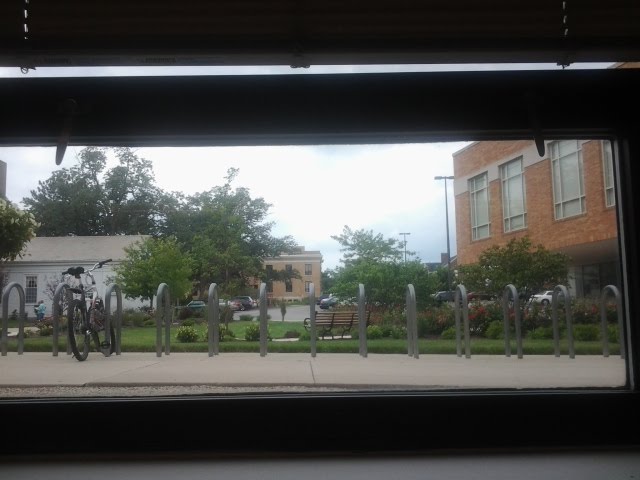
You have until noon on Tuesday to guess it. City and/or state first, then country. Please put the location in the subject heading, along with any description within the email. If no one guesses the exact location, proximity counts. Be sure to email entries to contest@andrewsullivan.com. Winner gets a free The View From Your Window book or two free gift subscriptions to the Dish. Have at it.
James Oliphant profiles Ken Feinberg, a lawyer who determines compensation for victims of national disasters:
Feinberg works hard not to be swayed by emotional appeals—and he tries as best he can to keep some distance. “You sob in private,” he says. “Never in front of a victim.” As a rule, he does not visit the sites of the tragedies to which he has been connected. He avoided the marathon finish line and the Sandy Hook campus. He didn’t inspect Ground Zero in Manhattan until after the claims process was finished, and he never returned. Nor does he make a habit of visiting claimants in the hospital; he makes them come to an office, to keep himself from becoming entangled in their despair.
He broke his rule in Boston when he visited two victims at a rehabilitation facility—and he regrets it now. The first man, he says, greeted Feinberg with bitterness: “You’re going to give me a million dollars or more,” he said. “I’ve got a better idea. Give me my leg back.” The second victim’s legs were stippled by shrapnel and gangrene, but he still had them. He had been lying in bed doing the math, and he had a simple question for Feinberg. Should he have his legs amputated before the July 1 deadline for determining his award? The difference in his payout would have been more than $1 million, tax free. Feinberg didn’t know what to say. The man decided to keep his legs—and received $948,300. The first man, who lost one leg, received $1,195,000. Feinberg walked out of the facility that day and vowed: Never again. “There have to be limits,” he says.
Neuroscientist Sebastian Seung wants to develop a better picture of the human brain – with your help. EyeWire is a browser-based game developed by Seung’s lab at MIT that invites players to map the connections between retinal neurons:
[Creative director Amy] Robinson says it currently takes the lab around 50 hours to reconstruct one neuron, even with help from artificial intelligence. Multiply that by the 85 billion (the approximate number of neurons in a human brain), and you can see how they might need some help.
Turns out, citizen scientists are very good helpers. Humans are more adept at spotting the patterns of neuron connectors than most machines are, which is why every player’s moves are recorded and fed to artificial intelligence to help machines get better at this very task. Since EyeWire’s public launch in December, more than 70,000 people have played the game. In total, they’ve colored in more than a million 3-D neuron cubes (each cube represents a tiny chunk of brain), resulting in the mapping of 26 whole cells.
“It takes players about three minutes on average to complete a cube,” says Robinson, “So they’ve spent an equivalent of six years of time on EyeWire since the launch.” In the grand scheme of the brain, 26 cells might not seem like much, but that’s a testament to the game’s emphasis on accuracy (anywhere from five to 25 people will trace the same set of connectors before it’s deemed valid).
Laura Bogart discusses how the emotion informs her writing and life:
In some ways, anger has been my saving grace. The ability to get good and pissed-off at the ways I’ve been mistreated—and not just by my family—is life affirming. The whisper of my roiling blood tells me that I matter, that I don’t deserve what I’m getting (or not getting). My current therapist actually has made a very potent distinction between anger and rage. Anger, she says, is that affirming force. Rage, she says, is a kicked dog that bites the first person that tries to pet her. My work in nonfiction and fiction examines the often hairline difference between the two, which has made me very aware of whether what I’m experiencing is anger or rage. That is to say, whether what I’m feeling is a legitimate reaction to a genuine slight, or just an excuse to bare my teeth.
A perfect example:
So, I’ve moved below a woman with a teenage son, and on occasion, they can get a little loud. I’m a quiet-loving introvert who, if I had my preferences, would live inside a hermetically sealed bubble. My initial reaction to the first bit of dubstep (and why is it that the people with the worst tastes always blare it the loudest?) was to become a human volcano. How dare they intrude on my solitude? Don’t they know I need quiet to write? So I got out my broomstick (if I’d had curlers in my hair and pink fuzzy slippers, my transformation into cranky hausfrau would have been complete) and I banged on the ceiling like I was trying out for a job as a sound effects specialist in the new Thor movie. The woman came down, immediately apologetic, almost tearfully apologetic, and told me that her son was just sharing his new favorite song with her. That’s when I what our lady of Oprah would call a “light bulb” moment: The music hadn’t rattled the cupboards; it had only lasted a moment; and, oh yes, other people have a right to enjoy life in their apartments.
This weekend we’re featuring poems from The Chameleon Couch, the eighth and newest collection by the Pulitzer Prize-winning poet Yusef Komunyakaa. His many awards during his distinguished career include the Wallace Stevens Award from the Academy of American Poets and the Shelley Memorial Award from the Poetry Society of America. In Poetry Magazine, David Wojahn praised him as a poet with “a near-revelatory capacity to give himself over to his subject matter and to the taut concision of his free verse.” Here’s Komunyakaa’s “A Voice on an Answering Machine”:
I can’t erase her voice. If I opened the door to the cage & tossed
the magpie into the air, a part of me would fly away, leaving only
the memory of a plucked string trembling in the night. The voice
unwinds breath, soldered wires, chance, loss, & digitalized im-
pulse. She’s telling me how light pushed darkness till her father
stood at the bedroom door dressed in a white tunic. Sometimes
we all wish we could put words back into our mouths.
I have a plant of hers that has died many times, only to be revived
with less water & more light, always reminding me of the voice
caught inside the little black machine. She lives between the Vale
of Kashmir & nirvana, beneath a bipolar sky. The voice speaks of
an atlas & a mask, a map of Punjab, an ugly scar from college days
on her abdomen, the unsaid credo, but I still can’t make the voice
say, Look, I’m sorry. I’ve been dead for a long time.
We can credit Dickens with the “scary clown” meme. In 1837, the young writer was tasked with editing the memoirs of Joseph Grimaldi, “the Homo erectus of clown evolution”:
Dickens had already hit upon the dissipated, drunken clown theme in his 1836 The Pickwick Papers. In the serialized novel, he describes an off-duty clown—reportedly inspired by Grimaldi’s son—whose inebriation and ghastly, wasted body contrasted with his white face paint and clown costume. Unsurprisingly, Dickens’ version of Grimadli’s life was, well, Dickensian, and, [scholar Andrew McConnell] Stott says, imposed a “strict economy”: For every laugh he wrought from his audiences, Grimaldi suffered commensurate pain.
Stott credits Dickens with watering the seeds in popular imagination of the scary clown—he’d even go so far as to say Dickens invented the scary clown—by creating a figure who is literally destroying himself to make his audiences laugh. What Dickens did was to make it difficult to look at a clown without wondering what was going on underneath the make-up: Says Stott, “It becomes impossible to disassociate the character from the actor.” That Dickens’s version of Grimaldi’s memoirs was massively popular meant that this perception, of something dark and troubled masked by humor, would stick.
Vaughan Bell flags an important definitional shift in the DSM-5 that alters how psychiatrists approach patients’ unusual beliefs:
[M]ental health professionals are often required to decide if someone’s thinking indicates a disturbance in their understanding of the world, and this is where the new DSM-5 definition of a delusion may usher in a quiet revolution in psychiatry. No longer are psychiatrists asked to decide whether the patient has “a false belief based on incorrect inference about external reality that is firmly sustained despite what almost everyone else believes and despite what constitutes incontrovertible and obvious proof or evidence to the contrary”. A wordy and unhelpful definition that has so many logical holes you could drive a herd of unicorns through it.
Instead, the new definition of delusions describes them as fixed beliefs that are unswayed by clear or reasonable contradictory evidence, which are held with great conviction and are likely to share the common themes of psychosis: paranoia, grandiosity, bodily changes and so on. The belief being false is no longer central and this step forward makes it less likely that uncomfortable claims can be dismissed as signs of madness.




 The Dish

