Reyan Ali defends Kidz Bop, the CD series featuring bowdlerized Top-40 hits:
Loads of frivolous, materialistic pop songs have no beneficial messages, and rewriting their lyrics while keeping the tune doesn’t deprive young listeners of a worthwhile experience. The Kidz Bop version of “Thrift Shop” retains the track’s closest thing to a positive thesis (i.e. be thrifty and engage in a smarter kind of conspicuous consumption) while extracting references that have little to no effect on that song’s message. Are the rewritten results corny? Certainly, but they’re also there to be consumed by children who’ll accept, laugh at, or entirely overlook the new turns of phrase.
But not all the songs are so benign:
In 2011, Rich Albertoni a writer at the Madison, Wisconsin, alternative weekly Isthmus, pointed out that the Kidz Bop version of Lady Gaga’s “Born This Way” excluded the song’s key verses about inclusivity.
The passages, “No matter gay, straight or bi/Lesbian, transgendered life/I’m on the right track, baby/I was born to survive” and “No matter black, white or beige/Chola or Orient/I’m on the right track, baby/I was born to be brave” had both been axed in their entirety entirely. “Funny,” he wrote, “because for this parent, that’s one of the few meaningful lines this collection of pop songs might have had to offer.”
Removing those verses deprives listeners of one of the best elements found in pop music: its ability to create positive cultural change. As an LGBT anthem that nonetheless makes it a point to champion all sorts of subcultures, “Born This Way” carries a message that shouldn’t be discarded out of the fear that overzealous parents might be offended by mentions to any of these groups. And if such parents are offended, then a message of love and understanding is the sort that’s worth offending them over.
“The chapter which attempts to account for the time of plants – their specific hetero-temporality – brilliantly guides the reader through the various seasonal rhythms of vegetal life, which unfolds within the continuity of nourishment and the discontinuity of germination. Agro-business is figured here as the commodification of the plant’s other-directed time and radical passivity, a blithe betrayal of the headless heeding of pure potential: ‘the plant, with its non-conscious affirmation of repetition, prefigures the affirmative movement of the Nietzschean eternal return, with its acceptance of the perpetual recommencement of life,’” – Dominic Pettman, reviewing Michael Marder’s Plant-Thinking: A Philosophy of Vegetal Life. Dish debate on Marder’s plant ethics here and here. Update from a dissenting reader:
I posted a somewhat hostile view of your Poseur Alert posts over at my blog, Critical Animal, inspired recently by your calling of Dominic Pettman a poseur. I just thought I would let you know. I generally like your blog, and I enjoy the inclusion of various intellectual pursuits in your blogging. But calling people I like and respect poseurs really wears on me.
The express bus lines in York Region, Ontario (north of Toronto) uses the system suggested by Yglesias. Transit Enforcement officers usually board the bus right before the doors closes or two-three stops down the line to inspect tickets and see if they’re valid. Drivers have nothing to do with tickets and don’t even inspect. The fine is $155 for not having a valid ticket or monthly/weekly pass. From a report last year, the enforcement and security manager said about the system: “‘Now, we’re ingrained in transit,’ he said. ‘People call us now. They take great offense to those who would try to abuse our system.'”
In Vancouver, the subway (Skyline) has a similar system – no gates, just validation stations. Then, once you’re in the waiting area, an officer comes up to you asking to see your ticket. The fine is $173 and if you don’t pay, they can stop renewing your driver’s license. My experience is that it’s faster and better, but I’ve seen people who obviously didn’t pay (didn’t validate ticket at stop and just boarded the bus) and I’ve seen people getting caught.
Several more readers weigh in with examples:
Finally a subject on which I am an expert. I work at an international research center on Bus Rapid Transit in Santiago, Chile, but am currently in India looking at their examples.
The problem with getting rail level capacity out of bus systems instead the engineering (that we can do), it is the political will. Bogota didn’t start BRT, but developed a model system due to the leadership of its mayor Enrique Peñalosa. He famously said, “An advanced city is not a place where the poor move about in cars, rather it’s where even the rich use public transportation.”
It is politically difficult because it usually requires taking space away from car users and giving it to bus users. Even in a city like Delhi (where I am now) where the majority of the population don’t have cars, this has proven to be politically unpopular. Now imagine in a US city where even a bicycle lane can prompt accusations of a “war on cars.” Since there is a set amount of space for surface mobility conflict over whose needs should be met or prioritized is inevitable. Clearly historically in the US the needs of car users have been prioritized. But if we think about it democratically priority for buses is not only fair, but make sense in terms of efficient use of limited resources.
The funny thing about the Delhi BRT corridor is that while there is congestion on all the major streets people complain about it more there because they can look over and see the buses moving faster… and that makes it unfair. The trick is making it make them want to take a bus.
Another:
“Worst of all, even though a bus is a much more efficient use of crowded space than a private car, it ends up stuck in the same traffic jam as everyone else.” I’m sure there are other examples (I think the idea came from Bogota), but in Mexico City, the buses have their own lane in the centre of the road, and there are regular bus stops which basically work like train stations. This makes the buses much faster than in other cities. I read somewhere that setting up a subway-like system that uses public roads instead of building an underground network costs less than 5% of what an underground, train-based equivalent would, and I can attest to the fact that the system is very popular and works well.
Another:
Saw this post and thought of Chicago’s plan for 16 miles of Ashland Ave, a major north-south corridor. Due to the setup of Chicago’s “L” trains, my boyfriend has to take a train into downtown and then another out to get to UIC, where he works. The idea is almost exactly as Yglesias recommended: remove a lane of car traffic and use it exclusively for bus travel, removing the traffic component that my drives my boyfriend into such a rage (seriously, don’t even mention buses to him if you don’t want an earful).
Since Chicago is nowhere near able to afford more above-ground train lines, which may not be feasible anyway due to a shrinking population, this seems like a wonderful (and MUCH cheaper) alternative. I even caught my boyfriend, who told me about the plan, mentioning it as an alternate way for him to get to work. Here’s the link to an overview of the project.
Update from another:
I’m surprised no one has emailed yet about the Bus Rapid Transit system in Curitiba. It was the first large-scale system with buses in separated rights-of-way (1974) and is still a model across the world. The system was designed by architect Jaime Lerner, who would go on to be the mayor. Here’s a great TED Talk he gave. It’s cheaper than a subway, with decent capacity. Not as high as a subway, but if designed correctly similar to many light rail at a fraction of the cost. The issue is with design: the places where a bus needs rights-of-way most – in narrow, congested sections – are the places where it’s most costly to place them. So a lot of systems wind up with bus lanes where there isn’t traffic, and mixed lanes (slow) where there is.
James Coyne challenges a recent story suggesting that living meaningfully is healthier than living happily, concluding, “Press coverage for this story is pure hokum.” Here he examines the study questions:
Participants completed online assessments of hedonic and eudaimonic well-being [Short Flourishing Scale, e.g., in the past week, how often did you feel. . . happy? (hedonic), satisfied? (hedonic), that your life has a sense of direction or meaning to it? (eudaimonic), that you have experiences that challenge you to grow and become a better person? (eudaimonic), that you had something to contribute to society? (eudaimonic); answered on a six-point frequency metric whereby 0 indicates never, 1 indicates once or twice, 2 indicates approximately once per week, 3 indicates two or three times per week, 4 indicates almost every day, and 5 indicates every day]
These questions are odd, vague, and unlikely to be encountered in everyday life unless someone happens to be Barack Obama or Bill Gates. I don’t know about you, but my wife has not recently asked me at dinner nor have I been asked another friend at a happy hour get together, “hey Jim, what did you do today to contribute to society?” “Did you happen to run into any problems that challenge you to grow and become a better person?”
It’s not surprising that research participants requested to answer these questions came up with something vague and affectively toned, i.e., related to their mood at the moment. I’m sure that if investigators had done a cognitive interview, it would’ve revealed that respondents struggle with trying to find answers and the basis of the answers vary widely…. This is a particularly poorly constructed assessment instrument. And whatever solid biomedical science was done, it is sustained or falls on an empirically indefensible distinction derived from poor assessment of what people have to say about themselves on the Internet.
Andrew popped on the blog today to praise the better-late-than-never endorsement of medical marijuana from Dr. Sanjay Gupta. And his hope in the Francis-led Vatican deepened following the resignation of one of its most homophobic Bishops. A few more quotes in honor of Dusty here and here.
During today’s slow news cycle, we weighed the pros and cons of boycotting the Olympics in the face of Russian anti-gay laws and kept tabs on the diplomatic rift between Putin and Obama. As the demand for journalists actually increases these days, bloggers continued to envision what a Bezos-led WaPo could look like. The last post of the day, on the beliefs of scientists, is already taking off on Facebook. And just when you thought US prison statistics couldn’t get more startling, they do.
Get your latest fix of airplane views from readers here. Today’s regular VFYW – from the Wadi Rum Desert in Jordan – was anything but ordinary. And we marked the end of Ramadan with a boy’s quizzical face.
Steven Pinker says scientists are guided by two fundamental precepts:
The first is that the world is intelligible. The phenomena we experience may be explained by principles that are more general than the phenomena themselves. These principles may in turn be explained by more fundamental principles, and so on. In making sense of our world, there should be few occasions in which we are forced to concede “It just is” or “It’s magic” or “Because I said so.” The commitment to intelligibility is not a matter of brute faith, but gradually validates itself as more and more of the world becomes explicable in scientific terms. The processes of life, for example, used to be attributed to a mysterious élan vital; now we know they are powered by chemical and physical reactions among complex molecules.
The second ideal is that the acquisition of knowledge is hard.
The world does not go out of its way to reveal its workings, and even if it did, our minds are prone to illusions, fallacies, and superstitions. Most of the traditional causes of belief – faith, revelation, dogma, authority, charisma, conventional wisdom, the invigorating glow of subjective certainty – are generators of error and should be dismissed as sources of knowledge. To understand the world, we must cultivate work-arounds for our cognitive limitations, including skepticism, open debate, formal precision, and empirical tests, often requiring feats of ingenuity.
David McRaney observes that the scientific method is totally unlike how humans naturally make sense of the world – which is why it’s so effective:
Your natural tendency is to start from a conclusion and work backward to confirm your assumptions, but the scientific method drives down the wrong side of the road and tries to disconfirm your assumptions. …. You prefer to see causes rather than effects, signals in the noise, patterns in the randomness. You prefer easy-to-understand stories, and thus turn everything in life into a narrative so that complicated problems become easy. Scientists work to remove the narrative, to boil it away, leaving behind only the raw facts. Those data sit there naked and exposed so they can be reflected upon and rearranged by each new visitor.
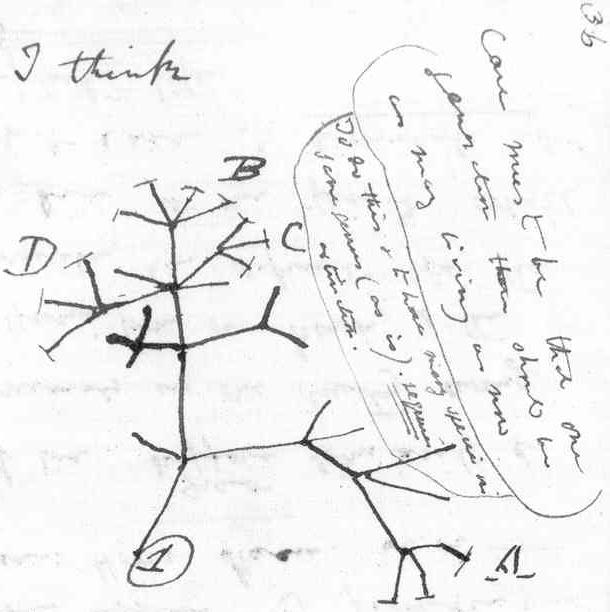
(Photo: Charles Darwin’s earliest extant sketch of an evolutionary tree, 1837)
Writing on the final day of Ramadan, Sajida Jalalzai notes the absurdity of Guantánamo Bay officials accommodating religious fasters while cracking down on hunger strikers. In fact, she says, both types of hunger are “intimately connected”:
[They] push and pull together: one hunger, mandated in religious texts and traditions, and limited by clearly demarcated temporal bounds; the other, undertaken in protest of injustice, and theoretically as indefinite as the prisoners’ detentions. The military respects the detainees’ refusal of food on religious grounds, but refuses to honor their choice to hunger strike. Taken together, these two types of hunger point out the military’s confusion about just what to do with the prisoners at Guantánamo, not only in terms of where or for how long to keep them, but also in terms of the bases and ways in which to honor or deny their rights and autonomy. The military’s divergent responses to the same action, namely, the detainees’ refusal of food, underlines the irony of paying lip service to the religious rights of indefinitely detained prisoners of war.
A reader can relate to our post on civil asset forfeiture laws:
I’m an attorney living in Indiana. My sister-in-law was recently arrested for calling in a prescription for herself (impersonating a doctor’s office) for a pain killer. She was an addict and needed treatment (which she is receiving now, thank goodness). She was in her car when she picked up the prescription at the drive-thru window of the pharmacy. After her arrest, they began civil forfeiture proceedings to take her car (her dead mother’s car, by the way – with great sentimental value). I read the statute and couldn’t believe how broad it is.
She was lucky; she had money to rent a car for the four months it took her expensive attorney to fight to get her car back. I told her that my reading of the statute made the prospects look awfully grim. As far as I can tell, she got her car back just because they felt like being nice. There was nothing anywhere in the law saying that she had to get it back. I have no faith in our state legislature, of course, but it would be nice if these laws could be re-written to make some kind of sense – only taking property away from the really bad criminals. Someone who has an addiction shouldn’t be in that category.
Update from another attorney:
Here’s where I get pissed about civil forfeiture: It is damn near only used in drug crimes. The don’t forfeit the car when someone commits DUI. But what I wonder is, why not financial crimes?
When HSBC got indicted for laundering money for drug cartels, on day one the justice department should have frozen accounts, seized buildings, phone systems, computers, bank branches, everything that in any way touched on the scheme. CITI? You committed massive mortgage fraud? JP Morgan, you bribed officials in Birmingham? That’s racketeering; we’re taking your computer systems, and seizing accounts that are at all traceable. If there’s a place where civil forfeiture actually makes sense, it’s fraud and financial crimes (what with money being the goal of such crimes), yet forfeiture is never pursued in those cases, and jail is not an option for a corporate defendant, so we are left with a peanuts fine and it’s off to the next scam for the peep.
A young Saudi boy looks up during the morning Eid al-Fitr prayer at Turki bin Abdullah grand mosque in Riyadh, on August 8, 2013. Muslims worldwide observe the Eid al-Fitr prayer to mark the end of the fasting month of Ramadan and the beginning of the new month of blessing, Shawwal. By Fayez Nureldine/AFP/Getty Images.
Daniel Engber thinks that lab-grown meat is nonsensical. He notes that the world’s first test-tube burger began “yellow-white, so [creator Mark Post] colored it with beet juice, caramel and saffron”:
[L]aboratory meat only seems “real”—it only matches up with the taste you know and love—when mixed with additives to improve its color, flavor, and mouthfeel. But if that’s true, then what’s the point? Does a base of cultured cow cells really get us any closer to a perfect substitute for flesh than soy or wheat or mushroom? Last year, Slate’s Farhad Manjoo raved about the latest veggie form of “chicken,” a product made from extruded soy paste that, in the words of its founder, gets “the proteins to align in a way that makes them almost indistinguishable from animal proteins.” Sounds like dopey marketing to me, but Farhad swears Beyond Meat is “90 to 95 percent as realistic as chicken.”
The whole idea, of course, is that lab-made meat can do much better because it’s made from bovine stem cells: Instead of 95-percent authenticity, it will get to 99 percent or even higher. But there’s little reason to be hopeful. It’s true that scientists can make synthetic versions of natural products—much of the vanilla flavor in our food supply, for example, comes not from the vanilla orchid but a process of industrial fermentation. (Either way, the ingredient tastes pretty much the same.) Meat is a far more complicated substance, though—a mix of muscle, fat, tendons, ligaments, and blood—and one that doesn’t lend itself to “nature-identical” formulations. (The life history of an animal also affects its taste, and makes it harder to recreate that taste by hand.)
Earlier Dish on Post’s test-tube burger here and here.



 The Dish