The Economics Of Wife-Beating

Looking at Europe, Olga Khazan highlights one silver lining to upticks in male unemployment – a significant drop in domestic violence toward females:

The results showed that the 3.7 percentage point increase in male unemployment during the time caused a decline in the incidence of domestic abuse by 12 percent. Meanwhile, the 3 percentage point increase in female unemployment increased domestic violence by 10 percent. The correlation held for all kinds of abuse, but it was stronger for physical violence.

Though it’s not proven, the theory that Jonathan Wadsworth, a University of London economist and study co-author, suggested to explain the phenomenon is that when male unemployment in an area is high, more men — having either lost their jobs or fearing job loss — are likely to try to stick with their partners in order to ensure some semblance of income stability. And to keep their partners from leaving them, those that have abusive tendencies are more likely to abstain from violent behavior. Meanwhile, when female unemployment is high, women might similarly be less likely to leave men who are predisposed to abuse, and so reports of domestic violence would rise.

Meanwhile, Papa Kwaku Osei notes that in the US, the current dip in labor force participation is likely due to millennial women turning toward college.

The Puritanism Of Progressive Parents, Ctd

The thread continues:

Thanks so much for posting my response.  It’s one of the many things I truly appreciate about your site, the airing of both sides. You posted an update from another reader immediately Fourpetal_St._Johns-wort_(Hypericum_tetrapetalum)_(8460154764)after mine:

True, some herbs have medicinal properties, but unless one has run a double-blind test, then you truly don’t know if the herbs do anything beyond the placebo effect. The US government has spent over a billion dollars trying to prove non-Western medical claims, and guess what? The herbs and other items very rarely do anything positive, occasionally show mild effects, and often have undocumented side effects.

I have to take issue with this comment as well.  I happen to work in the dietary supplement industry, specifically selling botanical extracts in raw material form to dietary supplement manufacturers and contract manufacturers.  I’ve worked for some of the largest German Botanical Extract companies that are at the forefront of research for botanical medicines.

I’m all for running double-blind tests, but the design of the study is incredibly important.  I’ll give you an example: St. John’s Wort.

You may recall in the late 1990’s that St. John’s Wort was discussed as an exciting way to treat depression and anxiety.  Historically it’s been used to treat various nerve conditions and disorders, as well as mild to moderate depression.  There was a huge explosion of sales of St. John’s Wort after Barbara Walters did a 20/20 special on the herbal extract that aired in early July of 1997.

Naturally the NIH decided to do it’s own double-blind placebo controlled study, but they decided in spite of little evidence, to research St. John’s Wort for treatment of moderate to severe depression.  However, most materia medica’s and botanical monographs for St. John’s Wort suggest it for mild to moderate depression.  So the study moved forward, and guess what? The results showed that it gave little to no effect for treating severe depression.  This was no shock to those of us in the industry but the general public and media response to the news was that yet another herbal medicine was proven to be ineffective.

Another great example is to think of the deaths we have in the U.S. each year by those who forage for wild mushrooms.  You inevitably hear about someone who picked and ate the wrong species and dies from liver toxicity.  In Germany they use an IV treatment of milk thistle extract, which is kept stocked in hospitals, and their outcomes are much better.  There have been a few instances of doctors in the U.S. using the IV therapy with promising results and there have been discussions with the FDA to approve the use of this therapy.

I’d be much more inclined to listen to studies on botanicals that come out of Europe because they actually use botanical medicine in their medical system much more than we do in the U.S., and their herbal therapies are often treated as drugs requiring a prescription.  They also integrate herbal therapy into their medical schools so medical doctors know how to properly use them and treat their patients.

Here’s the thing.  Botanical/herbal medicines are a great when used preventatively, or as a first line of defense against common illnesses and ailments, if you know how to use them properly and use them at the required dose.  If they don’t do the trick, you bring out the big guns, prescription medicines and more invasive surgical interventions.  I’m starting to sound like a broken record, but to take the either/or approach is to ignore centuries of successful historical use for botanical/herbal therapies.

(Photo of St. John’s Wort via Wikimedia Commons)

Quote For The Day

“Dogs are minor angels, and I don’t mean that facetiously. They love unconditionally, forgive immediately, are the truest of friends, willing to do anything that makes us happy, etcetera. If we attributed some of those qualities to a person we would say they are special. If they had all of them, we would call them angelic. But because it’s ‘only’ a dog, we dismiss them as sweet or funny but little more. However when you think about it, what are the things that we most like in another human being? Many times those qualities are seen in our dogs every single day — we’re just so used to them that we pay no attention,” – Jonathan Carroll.

The Most Faked Type Of Art

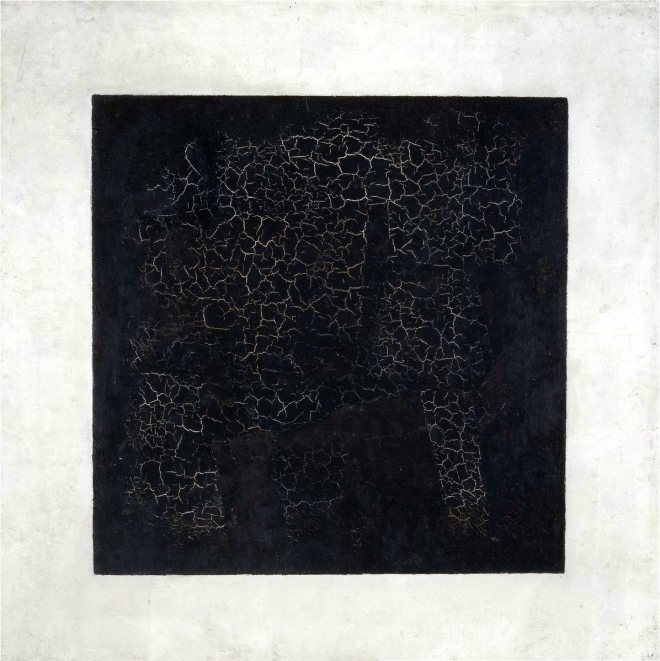
Чёрный_супрематический_квадрат._1915._ГТГ

Daniel Estrin says it’s Russian modernist painting:

Art works of the Russian avant-garde, the transition period between Imperial Russia and the Soviet Union which gave birth to painters like Kandinsky and Malevich (some also group Chagall into the genre), are the hottest category of paintings on the international forgery circuit. Lists of painters’ works are incomplete, and a number of lost paintings from the period have resurfaced, making it easy to claim you’ve found a Kandinsky in your grandmother’s attic. What’s more, it turns out it’s easier to mimic the squiggly lines of Russian avant-garde works than to copy the Mona Lisa. And it’s still possible to buy the same exact canvas and paints that Russian avant-garde artists used.

Another reason for the forgeries: demand for Russian modernists has skyrocketed since the fall of the USSR, according to Amar Toor:

When Joseph Stalin came into power in the mid-1920s, he cracked down on Malevich and other artists, excoriating their work as “bourgeois” and confiscating many paintings. Once Russia liberalized its economy in the 1990s, Malevich and his contemporaries assumed a more lofty status among Moscow’s ultra-rich oligarchs, and prices shot skyward. By [auction house director William] MacDougall’s estimates, prices for avant garde works have increased by “800 or 900 percent” over the past 20 years.

(Photo: Kasimir Malveich’s “Black Square on a White Ground”)

Obsess For Success

Joshua Kendell views obsessive-compulsive behavior as a productive trait held by many of America’s iconic innovators:

Many people will say, “Oh, I have to clean up my kitchen now because I have a little OCD.” But by “obsessive,” I don’t mean people who have obsessive-compulsive disorder (OCD). OCD can be incapacitating, and those who suffer from this disorder are unlikely to start Apple or fly across the Atlantic on a piece of wood like Charles Lindbergh. These people are haunted by thoughts that just won’t go away; someone with OCD might be constantly worried that the house will burn down; as a result, he or she might be afraid to go out even after checking a thousand times that the burner on the stove is off.

The icons covered in my book are saddled (or blessed) with a related condition called obsessive-compulsive personality disorder (OCPD). While the obsessions and compulsions in both disorders can revolve around the same things—such as cleanliness or order—OCD is an anxiety disorder and OCPD is a character disorder. Rather being impaired by their intrusive thoughts, those with OCPD celebrate them. Like Steve Jobs, Henry Heinz prided himself on his company’s clean factory; for decades, his plant in Pittsburgh was a must-see destination for tourists. My icons were productive obsessives; they found a way to channel that which they couldn’t stop thinking about into some spectacular achievement. As a boy, Ted Williams thought of nothing else but hitting. As he once said, “When I wasn’t eating or sleeping, I was practicing my swing.”

The End Of The E-Book Boom?

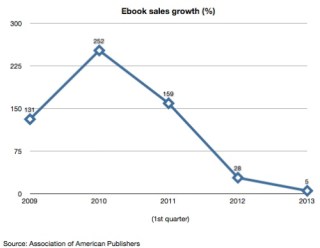
Nicholas Carr flags a report from the Association of American Publishers that shows just a 5% increase in e-book sales during the first quarter of 2013:

[T]he anemic growth of the electronic market calls dish_ebooksalesinto question the strength of the so-called “digital revolution” in the book business. E-books now represent about 25 percent of total book sales, a healthy share but still a long way from dominance. The AAP findings are backed up by a new Nielsen report indicating that worldwide e-book sales actually declined slightly in the first quarter from year-earlier levels.

Carr wonders:

[I]ntriguing, to me, is the possible link between the decline in dedicated e-readers (as multitasking tablets take over) and the softening of e-book sales. Are tablets less conducive to book buying and reading than e-readers were?

Previous Dish on e-books here, here, and here.

Are We Failing At Grading Schools? Ctd

Indiana’s recent school-grading controversy has led some to question the wisdom of ranking public schools on an A-to-F scale. Fifteen states do so, and several, including Indiana, use those grades to make decisions about school funding. Charter school advocate Nina Rees defends the A-to-F system:

In this era where we can go online and get rankings of hotels, restaurants, doctors and dog walkers, offering some sort of easy-to-understand metric for a school’s performance shouldn’t be counter-intuitive. Wouldn’t most parents rather have state education officials offer this information and explain its meaning than to have to rely on a real estate agent or next door neighbor to figure out whether a school is good or bad? … And giving parents an easy way to understand how schools are doing is critical; an A-to-F grading scale is something we are all familiar with and understand.

But edublogger RiShawn Biddle thinks the framework isn’t helpful:

It’s seductively simple. … But it doesn’t provide families the information they need to be able to make decisions. If you’re a parent, you want to know growth over time. Are they providing AP courses? How are they doing in algebra? If you’ve got young black sons, you want to know: Can this school serve your son well? You can’t get that from a letter grade.

Diane Ravitch agrees:

No state has gotten it right because it is too simplistic to label a complex institution with a single letter grade. There are too many variables, too many moving parts, too many different components that make up a school to say that it can be rated like a tomato or a pumpkin.

Meanwhile, accountability advocate Michael Petrilli says reformers are open to new ideas:

When you get results back and they don’t match up with reality, you’ve got a problem. I think there’s going to be a good conversation about whether boiling it all down to a single grade makes sense.

But Education Week‘s Andrew Ujifusa says changes won’t come overnight, if at all:

[L]awmakers might be able to confine the story in their minds to one misguided (or worse) individual. In that case, they may not be willing to roll back what they’ve done in their states because of the publicized actions of one man in one state. Organizations like the Foundation for Excellence in Education, which lobbies for states to adopt A-F accountability and had close links with Bennett, might at least in theory be just as willing to defend existing A-F systems in states, if they come under serious political attack. The subsequent question is, just how effective would such lobbying be?

More Dish on the grading scandal herehere, and here.

When Awe Turns Awful

A reader writes:

If you haven’t had a chance to yet, I highly recommend you watch a new HBO documentary, The Crash Reel.  It’s the story of former professional snowboarder, Kevin Pearce, who suffered a traumatic brain injury after crashing in the half-pipe during a training run.  The movie does an amazing job showing exactly why we need to demand that if the people in charge of running the Olympics, the X-Games, the NFL, etc, won’t implement safety measures to protect these athletes from themselves, then we’re going to need the government to step in.

The specific issue for snowboarding competition is the ever increasing height of the half-pipe walls.

They allow for crowd-pleasing amplitude but has turned bumps, bruises, and the occasional broken bones into paralyzations, traumatic brain injuries, and deaths.  It took Kevin Pearce over two years to recover enough from his injury to realize that he could never snowboard professionally again, but if he hadn’t had the support of a truly amazing family, he would have been back on the slopes and had a very high chance of re-injuring his still-damaged brain.  His father draws the perfect analogy when he says something along the lines of, “NASCAR had to step in and limit the size of the engines in the race cars because, if they hadn’t, more and more drivers would be smashing into the walls.”

These athletes are conditioned to go bigger and it is up to us, as a society, to make sure rules are in place so they know they don’t need to maim or kill themselves to entertain us.

A related, long-running Dish thread: Is Football The Next Big Tobacco?

A Two-Child Policy For China?

Lily Kuo relays new developments:

China’s national health and family planning commission is considering allowing any couple where one parent is an only child to have two children. This would effectively suspend the one-child rule for many more urban couples, the largest group affected by the policy. Some anticipate the reform will be announced in the fall at the National People’s Congress, when key economic reforms are often unveiled. Chinese media report (link in Chinese) that authorities are also considering allowing all couples to have two children after 2015. If that happens, China’s population would increase by an estimated 9.5 million more babies (link in Chinese) each year over the first five years, according to Bank of America Merrill Lynch in a note over the weekend.

But it may already be too late to fix the economic damage:

China’s approximately 930-million-person labor force shrank last year for the first time in decades, and will decline further as a population bulge of people now in their 40s and 50s pass into retirement. Here’s how that looks:

population-bulge-china

A baby boom would help compensate, and increase the number of people who can support that aging population. However, it may be too little too late, given that the labor force is estimated to begin declining by as much as 10 million a year starting in 2025, and it will take at least 16 years for the effects of a baby boom that starts today to be felt in the workforce. The authorities may be unable to avoid unpopular measures like raising the country’s retirement age—55 for women and 60 for men.

Previous Dish on China’s demographic woes here and here.

The Best Of The Dish Today

sidewalk-heart

Hey this is Chris, filling in for Andrew on the wrap tonight. To understand why, read about the passing of his beloved Dusty here and here. Thanks to the hundreds upon hundreds of you who emailed condolences this week. There’s no way we can post them all, but you can read similar sentiments on our Facebook page. And thanks to the readers who provided moving quotes about dogs here, here, and here – please keep them coming.

Foreign policy fueled the big news of the day: Obama cancelled on Putin over the Snowden affair – something Andrew had called for – and the Egyptian interim president pulled the plug on reconciliation talks. We also provided a rundown on the latest analysis of the al-Qaeda alert and kept tabs on the initial moves of the new Iranian president. The healing of the ozone layer offered a silver lining for the day.

Our most popular post on Facebook was a fascinating view of our lawns and how we abuse them. If you still need a Weiner fix, have at it. And he’s not a mermaid, but a merman!

(Photo by Chas Danner)