Contaminated By Wealth

Christopher Mims flags a UK study revealing that the rich absorb different toxins than the poor:

People who can afford sushi and other sources of aquatic lean protein appear to be paying the price with a buildup of heavy metals in their bodies, found Jessica Tyrrell and colleagues from the University of Exeter. Using data from the US National Health and Nutrition Examination Survey, Tyrrell et al. found that compared to poorer people, the rich had higher levels of mercury, arsenic, caesium and thallium, all of which tend to accumulate in fish and shellfish.

The rich also had higher levels of benzophenone-3, aka oxybenzone, the active ingredient in most sunscreens, which is under investigation by the EU and, argue some experts, may actually encourage skin cancer.

Ben Richmond notes the toxins more common at the bottom of the social ladder:

Those of lower socioeconomic status had higher levels of lead, cadmium and three types of phthalates—compounds commonly found in plastics.  The reasons for these disparate chemical levels point to disparate lifestyles and environments. [Also], lead and cadmium come into those of lower socioeconomic status via cigarette smoking and their jobs.
The Geography Of Milk

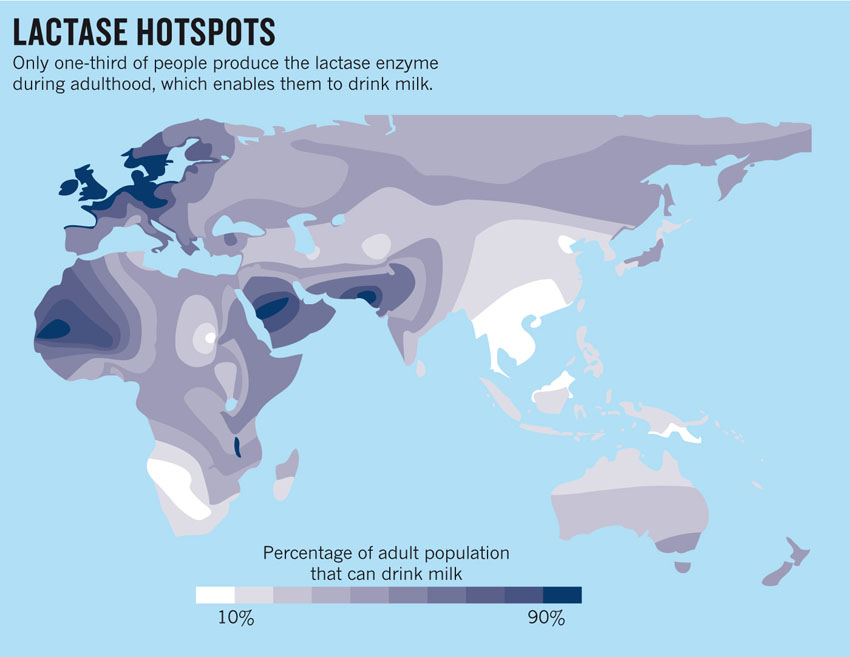
lactase-hotspots2

If you had milk with your coffee this morning, thank evolution:

During the most recent ice age, milk was essentially a toxin to adults because – unlike children –they could not produce the lactase enzyme required to break down lactose, the main sugar in milk. But as farming started to replace hunting and gathering in the Middle East around 11,000 years ago, cattle herders learned how to reduce lactose in dairy products to tolerable levels by fermenting milk to make cheese or yogurt. Several thousand years later, a genetic mutation spread through Europe that gave people the ability to produce lactase – and drink milk – throughout their lives.

The remnants of that pattern are still visible today. In southern Europe, lactase persistence is relatively rare – less than 40 percent in Greece and Turkey. In Britain and Scandinavia, by contrast, more than 90 percent of adults can digest milk.

(Map from Nature, based on figures from International Dairy Journal)

The Illegal Cigarette Trade

Keith Humphreys worries that high cigarette taxes encourage black markets and drug-war excesses:

In New York City, a legal, fully taxed pack of cigarettes costs $10-15; Chicago prices are only slightly less. Working class and poor addicted smokers (i.e., most smokers) thus face great temptation to enter into the black market. Columbia University Professor Shelley Cantrell documented that “the $5 man” – a street seller of untaxed black market cigarettes – is now a pervasive feature of life in low-income New York City neighborhoods.

He thinks the federal government should push states to adopt moderate cigarette taxes:

If one imagined for the sake of argument that [a tax of] $1.50-$2.50 a pack were the initial chosen range for receiving federal tax largesse, that would give the 28 states below that range an incentive to hike state taxes. Citizens in those states would smoke substantially less, improving public health and more fully reimbursing the public purse for the costs of smoking. And out-of-state gangs of tobacco smugglers would have far less incentive to maintain a presence in the state. High-tax states (e.g., Washington, New York, New Jersey) would reap little net revenue from that part of their tax which was over $2.50 a pack because of the loss of the federal tax rebate. This would give them an incentive to stop further increases or even cut back. This could have the lamentable effect of reducing the frequency of price-driven smoking cessation, but those same states would benefit in terms of shrinking black markets.

When Rulings On Human Rights Work

Last year, Erik Voeten and Laurence Helfer found that international institutions can effectively push countries to protect gay rights – but only where popular support for gay rights is low and the government is secular or urban. Voeten elaborates:

In countries with high levels of public acceptance and an urban and non-religious government, policy change [toward recognizing civil rights] happens without international legal action. Rural, religious, and nationalist governments tend to resist liberalization regardless. Yet low public support but a government that is not necessarily ideologically opposed to liberalization creates an opportunity for an international intervention to make a difference. We estimate that a substantial number of countries, especially in Eastern and Southern Europe, have more liberal LGBT rights laws than we would have expected in the absence of international court action.

He adds that court rulings have the greatest effect in countries where homophobia is widespread, “suggesting that the institution matters where it is needed most”:

There is little evidence that the legal changes in these European countries have noticeably changed public attitudes or that they have eliminated discrimination in society. Nonetheless, it matters that you cannot be thrown in jail for consensual sex.

Luck Of The Draw

Adam Piore examines the psychology of playing the lottery:

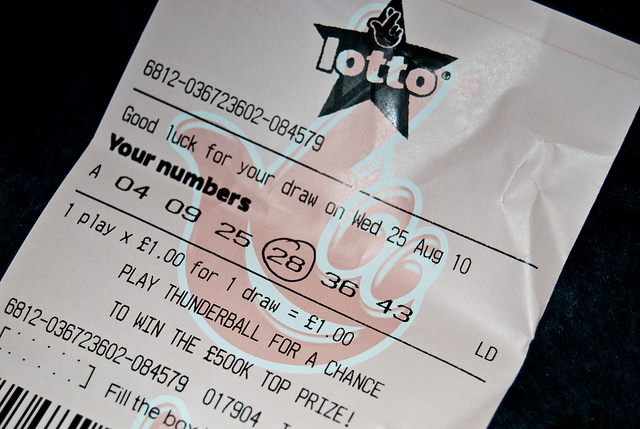
Carnegie Mellon’s [Professor George] Loewenstein and colleagues demonstrated it’s possible to change how many lottery tickets people will buy by making them think dish_lotto —or not think—about their purchase in a larger context. The researchers gave one group of study participants $1 at a time, five times, and asked them if they wanted to buy a lottery ticket. They gave a second group $5 and asked how many tickets they wanted, while a third group received $5 and was told they had only two choices: they could spend it all on tickets or not buy any tickets at all. The people in the first group purchased twice as many tickets as those asked explicitly what percentage of the $5 they wanted to spend on tickets. Members of the all or nothing group opted for no tickets 87 percent of the time.

One of the things the experiment shows is that lottery players are often “thinking myopically,” says Romel Mostafa, who co-authored the 2008 study with Loewenstein, and is now an Assistant Professor of Business, Economics, and Public Policy at Ivey Business School, Western University. “We think about these purchases in one or two at a time. But when the decisions aggregate over time, it adds up. And if I were to bracket the spending over a longer period of time, I would not have bought it in the first place.”

(Photo by Flickr user DaGoaty)

How The Presidency Hurts The Party

Sabato’s Crystal Ball observes that the president’s party tends to suffer in down-ticket races. This applies not just to Congress but also to state government:

Since World War II, the president’s party has gained a net number of state legislative seats in just one of 17 midterms: George W. Bush’s 2002 midterm. (This election was a rare positive for the president’s party across the board — the exception that proves the rule, given the unique impact of Sept. 11.) The loss of power by the president’s party can be particularly damaging in election years at the start of the decade. For instance, Republicans had total control of 25 out of 50 state legislatures after the 2010 elections, which was their highest mark since 1952. …

This is not to suggest that the presidential trophy is some sort of cursed, booby prize, like wearing Sauron’s “One Ring” in Lord of the Rings or being named the drummer of Spinal Tap. The American presidency is immensely powerful, and the person who holds it has wide latitude to craft national policy; ladle out immense portions of patronage and powerful lifetime appointments; and, effectively, start and end wars abroad. But winning the presidency has its downsides, too — if not directly for the person who holds the office, then certainly for his or her party.

Finding The Words For Unspeakable Acts

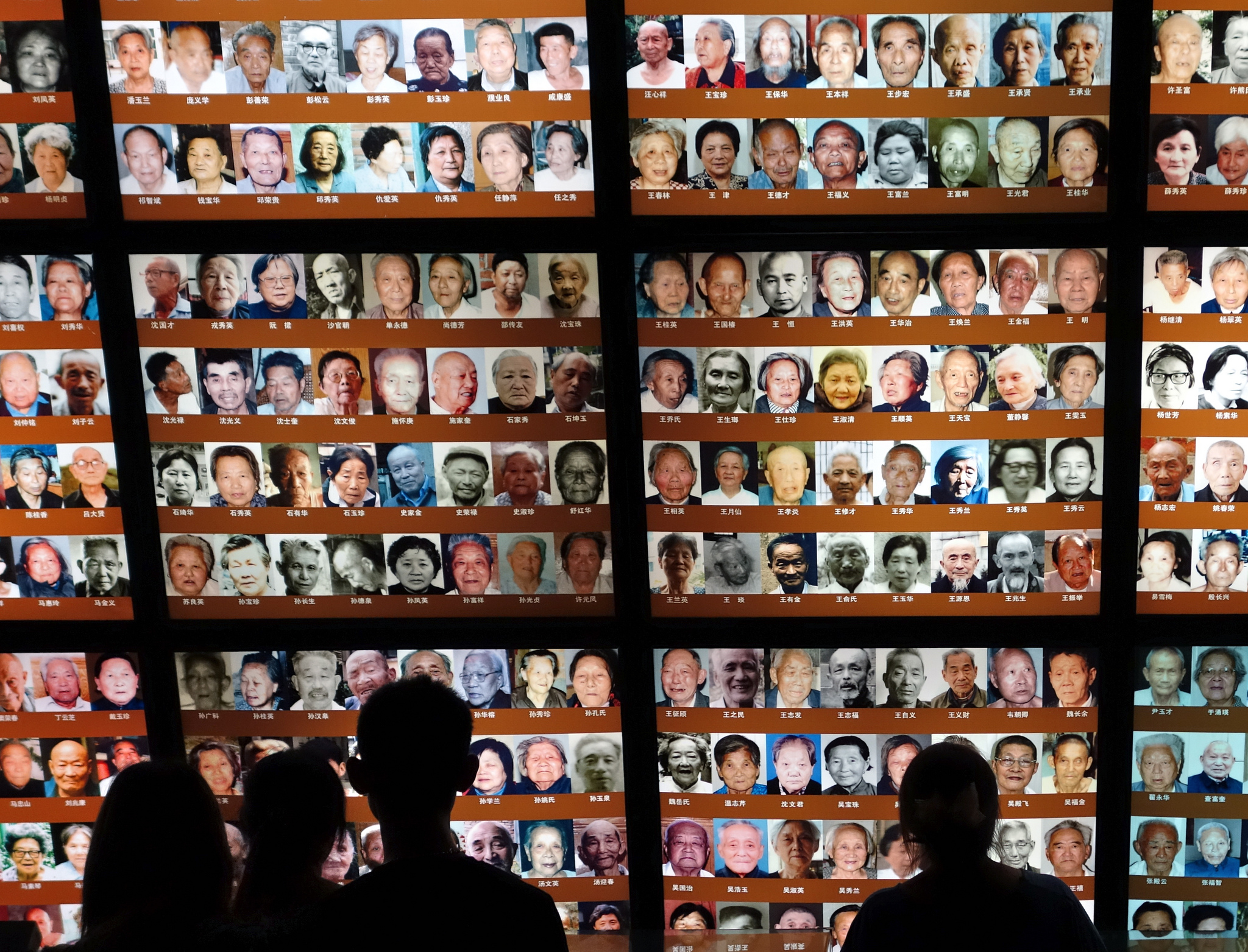
Discussing his latest book, Evil Men, a collection of interviews with war criminals from the Second Sino-Japanese War (1937-1945), James Dawes shares what he learned about the limits of our rhetoric regarding evil:

Talking about evil is hard. It involves at least two paradoxes. Here’s the first. On the one hand, to denounce evil is an ethical act. It is to affirm our deepest values and to commit ourselves to preventing acts that dehumanize others. On the other hand, to denounce evil can be an unethical act. It is a way of demonizing; it is, precisely, to dehumanize another. Here’s the second paradox: On the one hand, we need to the concept of evil to philosophically and ethically distinguish acts that shock our consciences, acts that are not adequately encompassed by words like bad, wicked, or wrong. The concept of evil clarifies. On the other hand, the concept of evil confuses, prevents thinking. We imagine evil is other than human, beyond understanding, almost mystical. This lets us off the hook, lets us deny our own capacity for evil, and stops us from analyzing the very human, very common causes of it.

(Photo: Young people view images of survivors of the Nanjing Massacre in the Nanjing Massacre Memorial Hall in China. By Kevin Dooley)

The WaPo Changes Hands

Amazon CEO Jeff Bezos has bought the Washington Post for $250 million. Fallows hopes for the best:

The money required to run a news organization is, for this era’s new wealthy, relatively modest. I haven’t stopped to do the comparisons, but I bet that the investment Jeff Bezos is making (and will need to increase, if he wants to revive the paper) is modest compared with what a previous era’s Rockefellers, Carnegies, and Fords decided to put into their universities and foundations. So let us hope that this is what the sale signifies: the beginning of a phase in which this Gilded Age’s major beneficiaries re-invest in the infrastructure of our public intelligence.

Ezra Klein sizes up his new boss:

The case against Jeff Bezos — if you’re a reader of The Post — is that Bezos owns one of the largest and most influential companies in America.

Amazon’s political interests extend across everything from state sales taxes to the minimum wage to trade with China. It’s doubtful that Bezos intends to aggressively use The Post to advance Amazon’s legislative goals. But over time, who knows? The Post has had to navigate similar tensions in recent years with our Kaplan division, but this will be of a new scale.

Marc Tracy doubts Bezo’s politics will matter very much:

In the end … the combination of Bezos’ business interests and his lack of prior political commitments (he is no George Soros or Sheldon Adelson) probably militate against him doing too much. If he turns the Post into a far-left or far-right newspaper (or, more likely, an annoyingly libertarian-ish one), he risks alienating Amazon consumers who will not bother with the distinction between that company and its CEO.

Yglesias admits that “we have no real idea what he intends to do with the paper”:

Journalism-as-vanity-project-for-rich-guy has a long and storied tradition in America, but it’s a bit of an odd fit in the sense that Bezos has no personal ties to the city of Washington. His memo to Post employees confirms that he has no intention of moving to D.C. to run the paper on a day-to-day basis, and he says the Post “already has an excellent leadership team.” Beyond that, he doesn’t give much hint as to his plans.

The Latest In Hamburger Technology

The world’s first lab-grown burger – a $330,000 patty created using stem cell technology – was unveiled at a public tasting in London today. Dashiell Bennett describes the scene:

The researchers chose to show off their project in an odd press conference-infomercial hybrid, streamed online, complete with an attractive host and a chef cooking the burger up live in front of the cameras. The volunteer tasters said it was good to eat and a close approximation of a real hamburger, but is still missing some of the qualities of a true burger. One of tasters, an Austrian nutritionist, said that in a blind taste test she should be able to tell the difference, but it’s still “very close to meat.”

Peter Singer is thrilled:

My own view is that being a vegetarian or vegan is not an end in itself, but a means towards reducing both human and animal suffering, and leaving a habitable planet to future generations. I haven’t eaten meat for 40 years, but if in vitro meat becomes commercially available, I will be pleased to try it.

Waldman expects the price to come down:

I could be wrong of course, but this is one of those technologies that I think is a matter not of if but of when.

It may not be possible in 10 or 20 years, but I can’t imagine that a couple of centuries from now our descendants will still have huge pens full of millions of cows and pigs milling about as they await their appointment with the brain hammer. At that point, I suspect they’ll look back at this time in history, when we slaughtered hundreds of millions of animals for food every year, and wonder how we could have tolerated such a thing.

Avi Roy adds:

Compared to conventionally grown meat, cultured meat would require up to 99 percent less land, 96 percent less water, 45 percent less energy, and produce up to 96 percent less greenhouse gas emissions.

Michael Specter’s 2011 article “Test-Tube Burgers” offers a primer on the science behind lab-grown meat. More Dish on the subject here, here, and here.