Victorian Marriages

Their portrayal in fiction is hardly something to aspire to:

But if you really think about Victorian marriage plots, something doesn’t add up. Jane Eyre boasts one of the most appalling marriages in fiction, between Rochester and Bertha, before its happy ending. David Copperfield miscalculates drastically in his first marriage. The two main marriages in Eliot’s Middlemarch are disastrous. Catherine Earnshaw is hardly happy in her union with Edgar Linton. One could go on. In fact, as scholar Kelly Hager has recently noted, the “failed-marriage plot” is actually more common than the happy marriage one.

Even more intriguing, some of the happy marriages don’t look at all like the romantic love matches we expect today.

In fiction by Charlotte M. Yonge, who was wildly popular in the nineteenth century, characters seem to marry for companionship, mutual caretaking and affection, but never seem to feel anything like desire. (One of Yonge’s biographers even wondered if she knew how babies were made.) The odd thing is that these kinds of companionable matches exist everywhere in Victorian literature, once you start noticing them. For instance, David Copperfield ends up married to (ewww!) his foster-sister, and Fanny Price to her adoptive brother. And there is hardly a Victorian novel without cousin marriages – cousin marriages that seem to promise reliability, kindness, and safety, rather than passion.
Dating On Steroids

Minutes before going on a third date, Viola Gad dosed herself with oxytocin, a drug released during physical contact that makes you “feel calm, safe, and trusting.” She wanted to see whether it could help her fall in love:

I decided not to tell my date I had taken the hormone. [Neuropsychologist Marcel] Kinsbourne had explained that if just one person acts more comfortable and interested, it can spark a natural release of oxytocin in the other person. …

We took a tiny table in the middle of the room. It was a brightly lit, busy place, and the waitresses were screaming loud orders in Shanghainese. It wasn’t romantic, but I didn’t care—I was in a very good mood. And my date definitely seemed more confident and relaxed. I sensed that he liked this calmer version of me better than the very intense and chatty version he had met before. We took a long walk home, and, for the first and only time, I imagined us as a couple. …

After our very affectionate date, I was excited to meet him again a few days later. I didn’t take oxytocin this time. He came to my place for pancakes, and I was a little nervous. As he sat there in my kitchen, we suddenly had nothing to talk about. It was back to stiff conversation. I didn’t find him very attractive and got annoyed that I had to come up with things to talk about. I think he could feel it, and after we said goodbye, he sent me a text thanking me for the pancakes. I never heard from him again.

Liquid Inspiration

For many years, wine served as an unofficial writing tool in more ways than one:

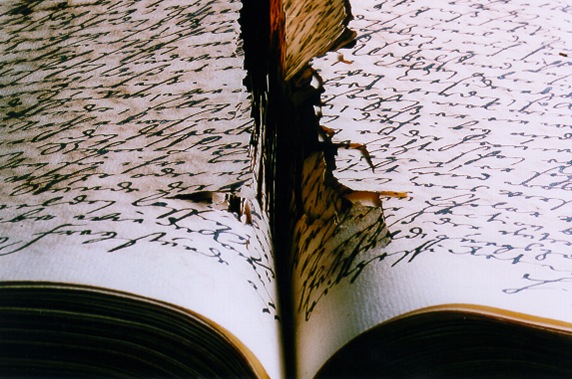
Wine, it turns out, was a key ingredient in many recipes for iron gall ink — for all you non-ink nerds, that was the writing ink used by most of the Western world from the Middle Ages all the way up to the 19th century. “Anyone anywhere near famous will have something in iron gall ink,” says , head of the conservation division at the Library of Congress.

A 1297 copy of history’s great political document the Magna Carta was penned in the stuff. Van Gogh drew with it, Da Vinci jotted notes with it, and Bach composed with it. “The practice of adding wine into historic inks was quite widespread,” says chemist , a senior lecturer at University College London who has worked with historic parchments and inks. The chemistry involved can get pretty wonky, but basically, the wine was believed to make the coloring agents in ink more stable. Wine was also considered a purer solvent than water. And iron gall inks were prized because they were so indelible.

(Image by Dr. Manfred Anders, from Wikimedia)

Face Of The Day

Details on an upcoming show at New York’s Bryce Wolkowitz Gallery:

Street artists JR and José Parlá recently teamed up to create enormous and yet very intimate portraits of senior citizens who survived the Cuban Revolution (1953-1959). It’s a continuation of a series called The Wrinkles of the City that JR started in Cartegena, Spain and that was recreated in Shanghai and Los Angeles. This new iteration, based in Havana, Cuba, involved Parlá, who is of Cuban descent. French artist JR created the large portraits while Parlá added depth and beauty using calligraphic writings and color.

Filling The Treasury Vaults With Opium

Sometimes war calls for drastic measures – like hoarding narcotics:

As the U.S. government contemplated entering World War II, it seemed to face a dilemma. How could they acquire and store opium in mass quantities, a raw material that was both subject to international regulations and publicly deemed illicit (thanks to the activities of the [Federal Bureau of Narcotics])? In fact, it turned out to be easy: the FBN simply waived enforcement of the laws private industry had drafted to protect its business interests, and the pharmaceutical companies drew on the traffickers’ networks to provide opium for the government. … The FBN managed to stockpile roughly three years worth of opium by 1941. And as the gold vaults in the Treasury Department were empty at that time, the government decided to use them for storing [3,000,000 pounds of] the illegal narcotic.

It paved the way for the pharmaceutical industry’s stance on illegal drugs today:

The most enduring legacy of opium stockpiling was not the actual material assembled, but a powerful new affiliation between the federal government, specifically the drug enforcement arm, and private pharmaceutical manufacturers like Merck, a company that is still doing a lively business. These bonds would carry over into a postwar world where the line between public and private was (and is) increasingly, lucratively, blurred.

Previous Dish on drug prohibition and Big Pharma here.

Writing Like We Speak

John McWhorter analyzes the linguistics of texting:

Elsewhere, he summarizes key parts of his speech:

Texting is developing its own kind of grammar. Take LOL. It doesn’t actually mean “laughing out loud” in a literal sense anymore. LOL has evolved into something much subtler and sophisticated and is used even when nothing is remotely amusing. Jocelyn texts “where have you been?” and Annabelle texts back “lol at the library studying for two hours.” LOL signals basic empathy between texters, easing tension and creating a sense of equality. Instead of having a literal meaning, it does something – conveying an attitude – just like the –ed ending conveys past tense rather than “meaning” anything. LOL, of all things, is grammar.

Of course no one thinks about that consciously. But then most of communication operates below the radar. Over time, the meaning of a word or an expression drifts – meat used to mean any kind of food, silly used to mean, believe it or not, blessed.

The Sexy Frequency

We may find voices attractive for what they indicate about the rest of the speaker’s body:

Researchers from University College London found that, at least among a sample of 32 participants, high-pitched female voices females were found to be attractive because they indicated the speaker had a small body. Deep male voices, on the other hand, were judged as more attractive because they conveyed that the speaker had a large frame—but were found to be most attractive when tempered by a touch of “breathiness,” suggesting the speaker had a low level of aggression despite his large size. …

Beyond explaining the popularity of Barry White, the researchers say these findings correspond to much of what we know about voice preferences in the rest of the animal kingdom. Birds and other mammals, it turns out, have long been known to advertise their physical characteristics via the sound qualities in their mating calls.

A Chilly Reception

In an interview from 1960, Robert Frost told the Paris Review about his trip to England in 1912:

INTERVIEWER
What were the circumstances of your meeting [Ezra] Pound when you were in England?

FROST
That was through Frank Flint. The early Imagist and translator. He was a friend of Pound and belonged in that little group there. He met me in a bookstore, said, “American?” And I said, “Yes. How’d you know?” He said, “Shoes.” It was the Poetry Bookshop, Harold Monro’s, just being organized. He said, “Poetry?” And I said, “I accept the omen.” Then he said, “You should know your fellow countryman, Ezra Pound.” And I said, “I’ve never heard of him.” And I hadn’t. I’d been skipping literary magazines—I don’t ever read them very much—and the gossip, you know, I never paid much attention to. So Ezra Pound friend Frank Flint] said, “I’m going to tell him you’re here.” And I had a card from Pound afterwards. I didn’t use it for two or three months after that. …I didn’t like the card very well.

INTERVIEWER
What did he say on it?

FROST
Just said, “At home, sometimes.” Just like Pound. So I didn’t feel that that was a very warm invitation.

Previous Dish on Frost here and here.