Kerry, Keystone, And The Climate

Ben Geman reports on John Kerry’s reluctance to get involved in the battle over the Keystone XL pipeline:

“I am staying as far away from that as I can now so that when the appropriate time comes to me, I am not getting information from any place I shouldn’t be, and I am not getting engaged in the debate at a time that I shouldn’t be,” Kerry told the House Foreign Affairs Committee … Kerry noted the decision would ultimately come to him, but that until then the various steps of the review process aren’t complete. “It is not ripe,” he said. Kerry spoke in response to a question from Rep. Matt Salmon (R-Ariz.) about State’s years-long review of the Keystone project, which would bring oil from Alberta’s oil sands over the border and down to Gulf Coast refineries. …

Salmon and other advocates of the project were buoyed by the draft State Department review, which found that approving it would not have much effect on the rate of expansion of oil sands development, dealing a blow to critics.

Joe Romm worries about the State Department report’s blind spots:

Right now, Kerry has the State Department’s Draft Supplemental Environmental Impact Statement, but if that is all he information he relies on, he won’t get the full picture. While he will see that the project will only bring 35 permanent jobs, which is true, he would also see almost no discussion of the pipeline’s impact on the climate. (Oddly, he will be able to read an extended discussion of climate change’s projected impacts on the construction and maintenance of the proposed pipeline.)

Romm says Kerry should read the new report out from Oil Change International, which argues that the idea the the tar sands will be developed without Keystone is “simply incorrect”:

The Keystone XL tar sands pipeline is a project that will carry and emit at least 181 million metric tons of carbon dioxide equivalent (CO2e) each year. This is a conservative figure, based on industry analysis of the carbon emissions associated with current tar sands production. … [This] is equivalent to the tailpipe emissions from more than 37.7 million cars. This is more cars than are currently registered on the entire West Coast (California, Washington, and Oregon), plus Florida, Michigan, and New York – combined.

Between 2015 and 2050, the pipeline alone would result in emissions of 6.34 billion metric tons of CO2e. This is greater than the 2011 total annual carbon dioxide emissions of the United States.

David Biello summarizes the EPA’s comments [pdf] on the study:

[State Department A]nalysts assumed the tar sands oil would find a way out with or without the new pipeline. The U.S. Environmental Protection Agency does not agree. Keystone XL’s ability to carry an additional 830,000 barrels of tar sands oil per day is vital to expanded production of the tarry crude in Alberta. The EPA contends that the analysis by State got the economics all wrong. In particular the consultants were too optimistic about the ease with which the oil could be moved by railroad—an alternative already in use. But such tar sands oil transportation alternatives can more than triple the cost of moving crude. State’s report also neglected to consider the potential for congestion on the railroads with an uptick in oil transport, EPA contends. Of course, from a greenhouse gas perspective, transport by pipeline results in fewer emissions than transport by rail, truck or barge.

Could The FBI Have Prevented The Marathon Bombing? Ctd

Watch List Diagram

Philip Bump explains the significance of the reports that the government had Tamerlan on its terrorist watch-list:

The terror watch list, as it’s known, isn’t really a watch list. For one thing, it isn’t regularly watched. For another, it’s not one list. It’s more of a set of hierarchical, integrated databases which are checked under various circumstances, most notably when individuals want to travel. According to Reuters, after he was interviewed by the FBI in 2011, Tsarnaev was added to the Terrorist Identities Datamart Environment, or TIDE, which is compiled by the National Counterterrorism Center. It’s a list that comprises over half a million names. “Because of its huge size,” Reuters reports, “U.S. investigators do not routinely monitor everyone registered there, said U.S. officials familiar with the database.”

In other words, there’s a sort of pyramid of terror investigation. At the bottom of the pyramid are hundreds of thousands of people who’ve come to the government’s attention for some reason. As the FBI and other agencies look into behavior and patterns, people can move up the pyramid — fewer people evincing more suspicious behavior — winnowing to a point once held by Osama bin Laden. Or, after a determined time, people can drop out of the pyramid entirely if they don’t behave in a way that raises suspicion. That’s the track Tsarnaev was on.

Previous Dish on the information that the government had on the bombers here.

(Chart from John Hudson)

Chart Of The Day

drug_overdose

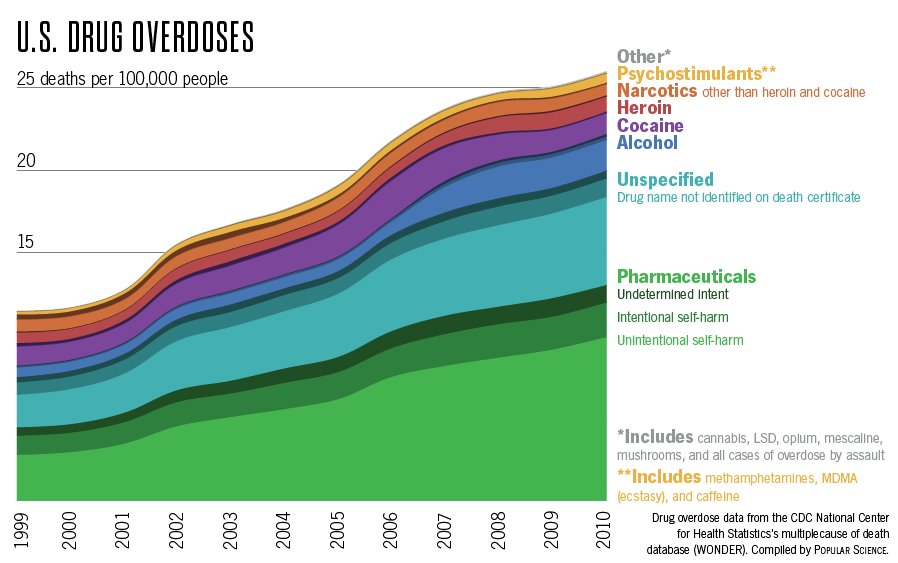
As part of Popular Science’s “Drug Week” coverage, Katie Peek parses the data on drug overdoses, which have more than doubled since 1999:

About half of those additional deaths are in the pharmaceuticals category, which the CDC has written about before. Nearly three-quarters of the pharmaceuticals deaths are opioid analgesics—prescription painkillers like OxyContin and Vicodin. And while cocaine, heroin and alcohol are all responsible for enough deaths to warrant their own stripes on the chart, many popular illegal drugs—including marijuana and LSD—are such a tiny blip as to be invisible.

Boston’s Jihadi Underground

J.M. Berger chronicles the history of CARE International, a Jihadi fundraising and recruiting network that operated in Boston throughout the ’90s (not to be confused with the humanitarian agency also called CARE):

Telling the IRS it was a non-political charity, CARE applied for and received a tax exemption, but its operations continued as before — supporting jihad overseas with money and men. Although it was heavily focused on the ongoing conflicts in Bosnia and Chechnya, its interests reached around the globe to anywhere mujahideen were fighting. As one associate of the group put it in a phone call recorded by the FBI, “As long as there is slaughtering, we’re with them. If there’s no slaughtering, there’s none, that’s it. Buzz off.”

In addition to hosting events at local mosques and universities, the group held fundraising “phonathons” and published a newsletter “stuffed with short, informative news items from various fronts in the global jihad,” mostly Bosnia.  After 9/11 came the crackdown, which led to arrests of many core members on a variety of charges:

Some of the group’s other associates, linked to al Qaeda, were convicted of conspiracy to commit murder overseas. But many involved in CARE’s operations at various levels were never arrested. In some cases, people who were involved in supporting jihadist activity abroad came to realize after 9/11 that their often well-intentioned support had been used to support terrorism against civilians and against the United States, and stopped participating in the scene. Others were simply not implicated adequately to prosecute, although they may have played important roles. Not everyone involved with CARE went to jail, but the organization itself had shut down when the IRS and FBI began investigating it aggressively in 2003, and almost no one involved completely escaped scrutiny.

From West, Texas To Bangladesh

BANGLADESH-BUILDING-DISASTER-TEXTILE

Erik Loomis argues that the reason we don’t see more tragedies like West, Texas is because the US has outsourced industries to places like Bangladesh, where a decrepit, eight-story clothing factory collapsed this week, killing at least 218 people. Loomis wants our labor laws to apply abroad:

In my mind, this is the only way to fight the outsourcing epidemic that provides a cover for irresponsible corporate policies. The injured workers and the families of the dead deserve financial compensation. The American corporations who buy the clothes produced by this factory should be required to pay American rates of workers compensation. Ultimately, we need international standards for factory safety, guaranteed through an international agency that includes vigorous inspections and real financial punishments.

Yglesias pushes back, arguing that “it’s entirely appropriate for Bangladesh to have different—and, indeed, lower—workplace safety standards than the United States”:

Bangladesh is a lot poorer than the United States, and there are very good reasons for Bangladeshi people to make different choices in this regard than Americans. That’s true whether you’re talking about an individual calculus or a collective calculus. Safety rules that are appropriate for the United States would be unnecessarily immiserating in much poorer Bangladesh. Rules that are appropriate in Bangladesh would be far too flimsy for the richer and more risk-averse United States. Split the difference and you’ll get rules that are appropriate for nobody. The current system of letting different countries have different rules is working fine. American jobs have gotten much safer over the past 20 years, and Bangladesh has gotten a lot richer.

Kimberly Ann Elliott sees the situation differently:

[C]ore standards like freedom of association, nondiscrimination, child labor, or forced labor are both fundamental rights, and they’re also framework rights in terms of having a well-functioning rule of law system in place for your economy. Those rights they can vary in the details but, and this is what the 1998 ILO declaration said, all countries, regardless of level of development, should respect these core rights.

Then you have all these other standards like health and safety, like wages, that will necessarily differ by a country’s level of development and, as Matt Yglesias says, by their choices. I wouldn’t go so far as Yglesias to say that therefore it’s only up to them. In a lot of these cases the workers aren’t making a fully informed choice to take these risks. They don’t know the chemicals are toxic. They don’t know that the building’s unsafe.

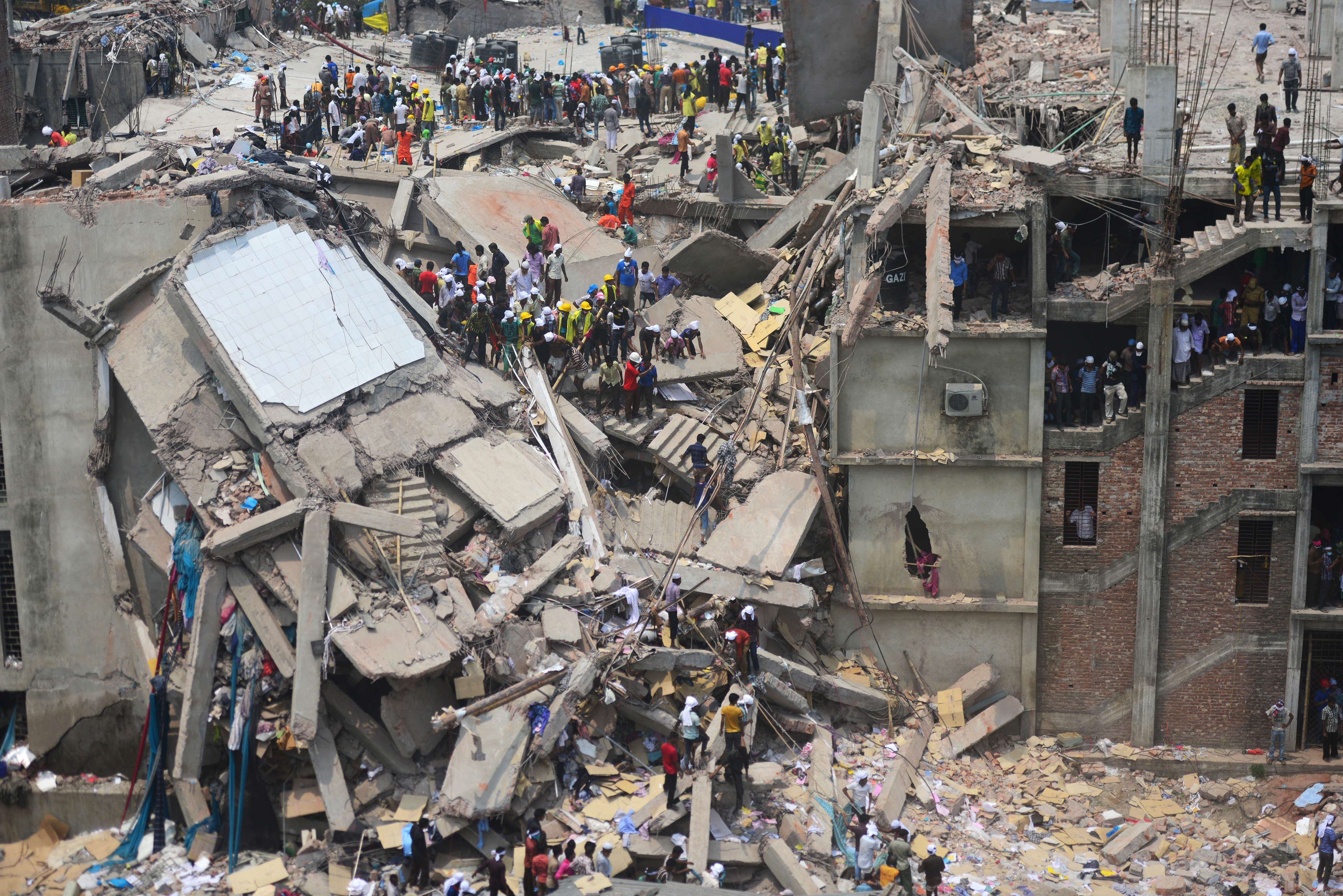
(Photo: Bangladeshi volunteers and rescue workers assist in rescue operations after an eight-storey building collapsed in Savar, on the outskirts of Dhaka, on April 25, 2013. Survivors cried out to rescuers April 25 from the rubble of a block of garment factories in Bangladesh that collapsed killing 175 people, sparking criticism of their Western clients. By Munir uz Zaman/AFP/Getty Images)

The Smoke Starts To Clear In Boston

Adam Clark Estes tries to separate fact from fiction in the media’s coverage of last Friday’s manhunt:

Among other revelations, police are now saying that they don’t believe Dzhokhar Tsarnaev, the younger of the two brothers suspected of carrying out the attack, was armed when they opened fire on him Friday evening. In fact, authorities admit that the two brothers didn’t quite have the small arsenal of weapons they thought they did — just one gun, a gun that wasn’t anywhere near Dzhokhar when he was found in the boat after a shootout. …

[I]t was also revealed on Wednesday night that the Tsarnaev brothers used a remote control to detonate the bombs on Marathon Monday.  According to Rep. Dutch Ruppersberger, a Maryland Democrat on the House Intelligence Committee, it was the same kind of remote control used for remote control cars. And according to CBS News, it was bought with drug money. We already knew that Dzhokhar was a pothead and potential dealer, but the latest reports suggest that Tamerlan got in on the action, too. This leads to the natural conclusion that the bombing, somehow, was funded by their drug money. But honestly, it’s very tough to tell how they got the money they spent on the bombs.

Can The Kochs Save Conservative Journalism?

With their latest round of newspaper acquisitions, Yglesias thinks it’s possible:

[T]he big problem with right-leaning media in America isn’t that it doesn’t exist. It’s that it’s terrible. There is a large audience out there that’s so frustrated with the vile MSM that it’s happy to lap up cheaply produced content from Rush Limbaugh and Sean Hannity, and you can make lots of money serving that kind of thing up. By contrast, to build a great media company that’s top-to-bottom staffed with conservatives is going to be very expensive.

Expressing skepticism about the possibility of a “pro-business conservative media chain”, Garance Franke-Ruta explains a big reason why newspapers frequently lean liberal:

The main reason is that all major U.S. newspapers are based in cities. Cities in America are in the main run by Democrats, because they are populated, by and large, with Democrats, and very often also surrounded by Democratic suburbs. And because cities are run by Democrats, and populated by not only by Democrats but, very often, by liberal, minority, and immigrant Democrats, they tend to have laws on the books that at least formally signal a desire to serve the interests of these voting groups — their residents, let’s call them. …

American newspapers originated as physical objects designed to be distributed in defined, geographically constrained regions. They originated as urban creations because only in urban areas was there enough commerce, enough politics — enough news — for them to grow, and enough readers to make them strong. There are newspapers based in rural areas, but it is hard for them to grow large, both because of the lack of regional news, and because of the difficulty of getting the physical object of the paper to enough people to scale it.

The Turing Tetris

Computer scientist Thomas Murphy has designed an artificial intelligence, PlayFun, that can figure its way through videogames by relentlessly testing strategies that lead to high scores. Gary Marcus explains further:

The program proceeds by automating trial and error. It records everything in the Nintendo’s memory, and correlates every simulated press of a joystick with particular memory locations in the game that represent a player’s score. Any action that increases the score gets weighted more heavily; actions that decrease the score become less likely. In essence, Murphy aims to overpower the Nintendo through sheer brute force, not by what humans would consider actually playing the game. He writes that the “central idea … is to use (only) the value of memory locations to deduce when the player is ‘winning.’ The things that a human player perceives, like the video screen and sound effects, are completely ignored.”

Reality Check

Enten points out that George W. Bush “is still quite unpopular compared with other former presidents”:

Back in 2010, Gallup asked Americans what their retrospective approval rating was for Presidents John F Kennedy through George W Bush. In every instance except for one, the retrospective approval was higher than the final approval was when they left office. Most Republicans, for instance, love to make fun of Jimmy Carter. Carter was the only president of the 20th century to lose re-election after replacing a president of a different party. He left office with a 34% job approval rating. His retrospective job approval rating in the 2010 Gallup poll jumped by 18pt.

Second, Bush’s retrospective approval is the second worst among presidents in the last 50 years ago. To save you doing the math, Carter’s 52% approval rating is higher than Bush’s 47%. Only the Watergate-tainted Richard Nixon recorded a lower retrospective approval than Bush.