Ask Brill Anything: Overpaying For Worse Care

Steven lets us know how poorly the US healthcare system ranks compared to other developed nations, with a follow-up regarding which free market-based reforms we should pursue to help remedy that:

Brill recently debated this same topic on Fareed Zakaria GPS. Yesterday, Steven explained how hospitals have become so profitable. Before that, he gave us an overview of why US healthcare is so expensive. You can also go herehere and here to read our coverage of his stunningly good Time cover-story, “Bitter Pill: Why Medical Bills Are Killing Us”.  A reader chimes in:

Have been enjoying your Ask Anything videos with Steven Brill so much so that I bought the Time Magazine issue containing his article. This all reminds me of reading T.R. Reid’s, Healing of America a few years ago.  For the book, Reid, a longtime journalist and foreign correspondent for several news organizations, took his bum shoulder for treatment in a multitude of healthcare systems around the world.  He looked at all kinds of health system schemes and lists and compared the kudos and flaws in each.  He also showed the US reader the areas of socialized medicine we have in America that are working well and, in fact, are taken for granted by us as US citizens.  (More praise and a more complete review of Reid’s book here.)

When we met Mr. Reid at a lecture in Portland, OR, in 2007, he noted that the medical system he would personally choose, as a parent, would be the British system where everything is free and an aggressive system for preventative health care is in place to keep the populace in a generally healthy state most of the time.  For myself, after reading his book, I felt envious of the French with their little medical ID card carrying all their medical info wherever they went.  Any doctor a patient consults can have up-to-date personal information without keeping mounds of paperwork in his back room or needing to employ several people to sit for hours a day transcribing medical codes into what an insurance company with or will not pay for.

Ask Anything archive here.

Limbaugh, Levin And The Future Of The GOP

Frank Luntz tried to keep the following statement a secret at a recent University of Pennsylvania talk. But nothing is secret when everyone has a smart phone. Money quote:

“And [Rush Limbaugh and Mark Levin] get great ratings, and they drive the message, and it’s really problematic. And this is not on the Democratic side. It’s only on the Republican side…[inaudible]. [Democrats have] got every other source of news on their side. And so that is a lot of what’s driving it. If you take — Marco Rubio’s getting his ass kicked. Who’s my Rubio fan here? We talked about it. He’s getting destroyed! By Mark Levin, by Rush Limbaugh, and a few others. He’s trying to find a legitimate, long-term effective solution to immigration that isn’t the traditional Republican approach, and talk radio is killing him. That’s what’s causing this thing underneath. And too many politicians in Washington are playing coy.”

Coy? I’d say simply too scared to speak. But Luntz is right. The GOP leadership, if it still exists, needs to disown these two fanatics and haters if it is to stand a chance of becoming more than white, old, male and angry.

How Humane Can Slaughter Get?

Mac McClelland visits “one of the first ranches to … to gain Certified Humane Raised and Handled approval”:

The next cow, the cow I watch die, is quiet. It is black. It comes casually down a walkway. It steps into a squeeze chute, the metal hugging cage that closes in on the cows’ sides to calm them. Scott Towne, the guy in charge of the killing, hits it with a CASH Knocker, a blank shell shooting from a metal apparatus at the end of the long, wooden-handled device and into the front of the head above the eyes, denting the skull but not penetrating its brain, rendering the animal insensible. Instantly the cow’s eyes close. Its neck is lax and its mouth open, easy as a child asleep at the dinner table, or a businessman asleep on a plane.

Stopping at a bar on the way home to bourbon-gargle the lingering deathiness and nausea from the back of my throat, I ponder the cow’s existence. Whether or not farmers should torture animals, or keep them in disgusting and overcrowded and shit-filled conditions, or murder them slowly, are not even questions. Prather’s Northern California grass-munching herd is obviously as well treated as any in natural life, but “good” death is not so easily codified.

“Can you make a slaughterhouse perfect?” Grandin asked in Iowa. “No, nothing in this world that’s a practical thing can be made perfect. That’s just impossible.”

For those who kill animals for a living, making peace with those imperfections is a daily affair.

Prohibition In The Lab

Shaunacy Ferro reveals the dizzying red tape that surrounds scientific research on psychedelics:

Currently, according to the DEA, it takes about 9 months to get FDA and DEA approval for a license to research Schedule I substances, though researchers are a little more skeptical. “The DEA’s not in a hurry to grant these licenses,” according to [David Nichols, one of the founders of the Heffter Research Institute to study psychedelics].

Only 349 scientists have them, and that number is on the downswing: Three years ago, there were 550 licenses in the U.S. Nichols suggests that this could be a result of the DEA cracking down on researchers with extraneous licenses. In the past, Schedule I licenses had been renewed on a yearly basis without much fuss, but in recent years the agency has required Nichols to submit his current protocol and justify why he still needs the license.

The free market hasn’t stepped up because “no pharmaceutical company needs or wants to get involved”:

There’s no money in it for them. Though drugs like LSD and psilocybin are relatively easy to make in the lab, as [ Multidisciplinary Association for Psychedelic Studies] founder Rick Doblin pointed out in a 2012 interview, “psychedelics are off-patent, can’t be monopolized, and compete with other psychiatric medications that people take daily.”

“My colleagues say to me, in these days of nanotechology and targeted therapy, what are you doing?” says Donald Abrams, a professor of medicine at the University of California, San Francisco who has done research on medical marijuana. “We live in the 21st century. Studying plants as medicine is not where most investigators are putting their money.” And without the outside funding to continue researching, a scientist’s career goes nowhere, so even fewer scientists want to get involved.

A Kaleidoscope From Under The Sea

Jakob Schiller highlights nature’s trippier side:

The sting from a Portuguese man-of-war hurts like hell, so most people avoid the jellyfish-like creatures. Not Aaron Ansarov — he and his wife don rubber gloves and collect them when they wash up on the beach near their home in Delray Beach, Florida. They take the creatures back to their house and Ansarov photographs them on a makeshift light table and then mirrors the image in Photoshop. He shot dozens of them this past winter and the result is a unique, psychedelic portfolio.

Check out more of his zooids here.

Crack In The Crack

Dan Nosowitz unpacks the biology of drug mules smuggling large amounts of drugs inside their rectum, a practice known as “booty bumping”:

The problem I kept running into in trying to figure out how much cocaine you could fit in your butthole is that, well, there isn’t really an upper limit. It’s all about conditioning and practice. That said, let’s take that 800 mL as an example upper limit. Given the density of cocaine hydrochloride, that converts to about 0.97 kilograms of cocaine, or very nearly the size of one of those big bricks you see confiscated on the news. And that 800 mL isn’t unheard-of; it’s probably on the low end for someone who performs a lot of rectal stretching activities.

Update from a reader:

Booty bumping is taking drugs via the anus, where they’re easily absorbed. It’s a real problem in the gay community here in San Francisco since lots of drugs are corrosive and can leave wide-open opportunities for infections to take hold, thus increasing the odds of any given STI.

The more you know!

Interweaving Old And New

David Thomas Smith

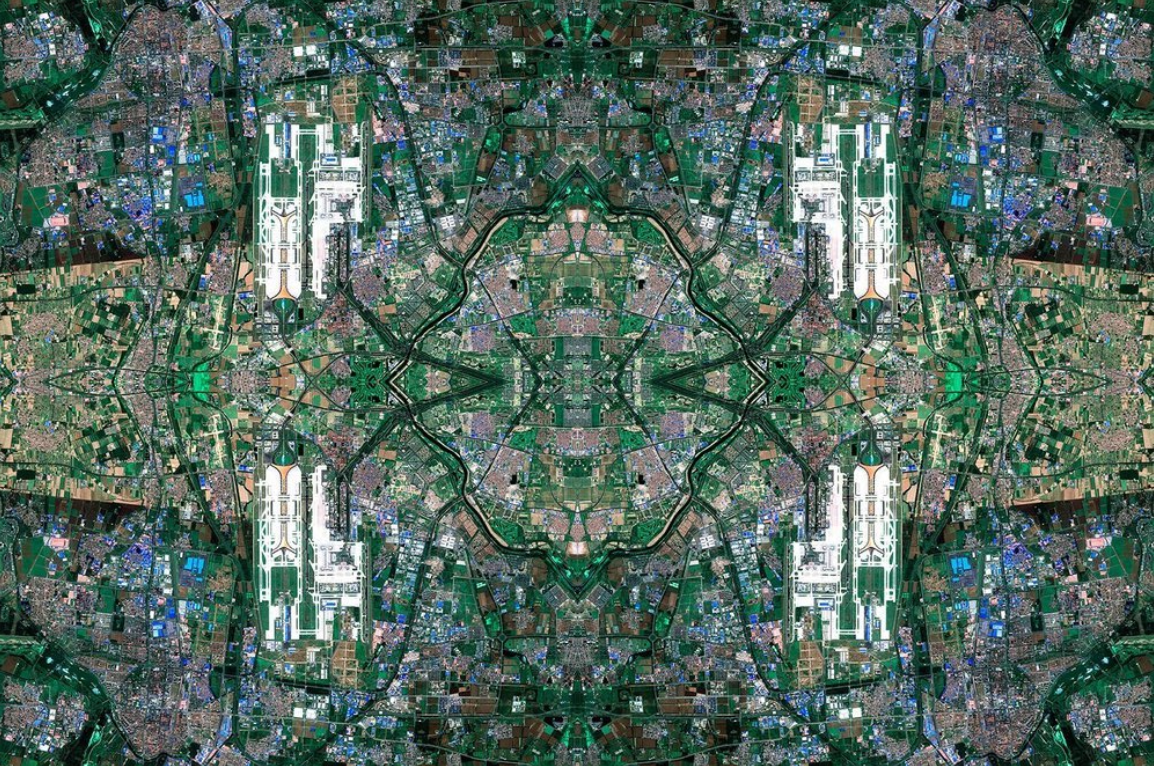
Irish artist David Thomas Smith borrows age-old designs from Persian rugs and repatterns them with screengrabs from Google Maps. From an interview with Smith:

Aesthetically, the initial influence came from Afghan war rugs, I really liked the idea of the rug being used as a document, and this in turn led me to the more decorative Persian motifs as a source of inspiration…. The use of Google Maps (was an obvious candidate, the image quality is by far the best) came about because as [Lev] Manovich said most things are already photographs. For me, a great deal of documentary photography is becoming more and more about the re-contextualization of the image. It’s about taking existing images and giving them new meaning.

(Image: Beijing International Airport, Beijing, People’s Republic of China, 2009-10)

The Invisible Bejeweled Hand

Upscale items and services are generally cheaper in NYC:

In a high-income city like New York, grocery costs are 20 percent lower for high-income people than they are in a low-income city like New Orleans (whereas costs are about 20 percent higher for low-income people in the rich city than the poor city). That’s because there’s a very high concentration of highly skilled people here, so there are a lot of vendors competing for the business of those high-income people, effectively lowering costs and increasing the variety of products that appeal to this consumer group.

Professor Handbury looked specifically at food, but she said that for most things you buy, there are probably positive externalities that come from living around a lot of people who have tastes similar to yours.

Catherine Rampell’s NYT magazine article goes into more detail:

Part of the reason high-income residents get good deals, Handbury explains, results from a particular economic system. Highly educated, high-income New Yorkers are surrounded by equally well-educated and well-paid people with similar tastes. More vendors compete for their business, which effectively lowers prices and provides variety. There’s also a high fixed cost to distributing a niche product to an area; if there’s more demand for that product, then the fixed cost can be spread across more customers, which will justify bringing the product to the market in the first place. That’s why companies go through the expensive hassle of distributing, say, St. Dalfour French fruit spreads in rich cities but not in poor ones and why New York can support institutions like the Metropolitan Opera.

The Daily Wrap

Screen shot 2013-04-22 at 1.47.56 PM

Today on the Dish, Andrew fired back at Greenwald in debating the Boston bombers and jihadism, expounded on his view of Islam and modern terror, agreed with Beinart on the takeaway of the Tsarnaevs’ Caucasian identity and rolled his eyes at ongoing attempts to sidestep the religious explanation. Elsewhere, he unleashed further on Bill Keller’s editorial line on torture, and reflected on the changing significance of the question, “are you gay?” and happily noted that good content means good business.

In political coverage, we dove deep into the politics of immigration reform, revisited the Gulf oil spill and asked whether the FBI dropped the ball in Boston. On the eve of his presidential library opening, we took stock of George Bush’s apparent PR recovery and sensed some love lost between Dubya and his Vice. Barro set the record straight on workplace mortality, readers asked Steve Brill how hospitals turned into profit mills, we debated the politicization of the sequester. Finally, we considered whether citizenship should be up for bidding as Millennials turned out to be a generation in the passenger seat.

In miscellanea, readers responded to the masturbatory debate, we glimpsed a Matrix-esque rehab program, and Dish met Phish. Matt Honan grasped for a solution to misinformation on Twitter, Virginia Heffernan praised the Internet’s new language of looking, and Adam Alter illuminated the clout of color over our minds. Lisa Margonelli proved the eco-friendliness of living mobile as we tasted a stiff glass of enviro-whiskey.

We followed the longstanding blowback of bullying, Amy Benfer took apart love in The Little Prince, and Tom Junod dispensed wise words on how to sustain a marriage. Lastly we welcomed spring back with a beat in the MHB, spent a moment at a Muslim vigil in Boston for the Faces of the Day and peeked out at the Upper West Side in the VFYW.

–B.J.