 Via Wonkette.
Year: 2013
Republicans vs Rubio
The immigration bill and its most prominent Republican supporter are under attack:
Conservative bloggers immediately seized on portions of the bill funding expanded cell phone access along the border as evidence Rubio was supplying free phones to undocumented immigrants. Some commentators connected it to the “Obama phone,” a popular meme on the right last year about a program that provides discounts on phone service to the poor. Despite the moniker, it predated the current administration by decades and rose to prominence last year mostly due to a viral video of a female black Obama supporter talking about the program.
Rubio himself was confronted with the claim on Wednesday in an interview with conservative talk show host Laura Ingraham, who quoted from a blog post that read “Move over Obama phone, this is the amnesty phone.”
In response, Rubio pointed out that the phones are not for illegal immigrants but for US citizens “so they can report illegal crossings because many of them either don’t have phone service or don’t have cell phone service and they have no way of calling.” Waldman bets that the truth won’t matter much:
What folks like Ingraham understand is that when you’re trying to gin up outrage about a big, complex piece of legislation, the way to do it is to find some component of the bill that is weighted with symbolic value and will hit directly on your target audience’s resentments and fears. It doesn’t matter how minor the provision is, or how much you need to distort its actual function and intent. All that matters is that it’ll get people pissed off.
Seth Mandel sees Rubio’s outreach to the talk-radio right as essential:
[E]ven if the bill comes together and passes the Senate, Rubio and the others will have far less influence on what happens to it in the GOP-controlled House. And that is why Rubio is working so hard to dull conservative commentators’ unease with anything that resembles “amnesty” for illegal immigrants. Rubio is scheduled to appear on Rush Limbaugh’s show today, and it will be Rubio’s second interview with Limbaugh since the push for immigration reform picked up steam after the November election.
A Bear Sighting In Brooklyn
A reader spotted one last night:
Andrew, I walked past you walking down 8th Ave in Brooklyn tonight, and didn’t want to bother you, as much as I wanted to say hello. Glad to see you venturing into the outer boroughs! And thanks for a great blog. I have been reading for quite some time and of course, became a member.
(Video: First segment shot in late March, then in early April)
The Disgrace That Is The New York Post
Its coverage this week of the Boston bombings puts it, it seems to me, in the same area as the British Murdoch equivalent, the News of the World. No, they have not committed any legal crimes, or systematically replaced reporting with illegal taping of private phone conversations. But crimes against journalism should also count. They have reported the news of this week with reckless indifference to the truth.
On Monday, they published that twelve people had been killed. That story remained on their website all day, as I kept checking back in amazement. I have yet to see a correction. I searched for one. Do they ever print corrections? But to be wrong on such a critical fact, and to resist withdrawing or apologizing for it, is not journalism. Deadspin – which has higher standards than the New York Post – takes on today’s front-page featuring two guys with backpacks and dark skin:
They are most assuredly innocent.
They carry large bags. They are dark-skinned. This was enough for internet sleuths to peg them as suspicious. (They show up here, in Gawker’s rundown of “suspects” identified by crowdsourcing on Reddit and 4chan.) And that was apparently enough for the Post to run with its front-page story today, claiming investigators are circulating photos of the two. (The photo on the paper’s cover is a cropped and zoomed-in version of the one taken by Ben Levine, which appeared on Deadspin on Tuesday.)
But maybe there was a reason for them to be at the marathon, wearing track jackets and carrying bags: they’re runners. The kid in the blue jacket is a middle-distance runner at Revere High School. Last week he ran the two-mile in 11:20 … Today on CBS This Morning, John Miller specifically said these two are not the suspects the FBI is seeking.
The smearing of private individuals as terrorist murderers with reckless indifference to the truth because they have dark skin is almost a text-book case of libel compounded with racism.
Why Are Bombings So Rare In America? Ctd

Douthat goes through various theories. Among them is the idea that we’ve “just gotten lucky”:
That’s the case Will Saletan made for Slate [Tuesday], after running through the F.B.I.’s list of cases involving explosives going back to the beginning of 2012. He found plenty of intercepted plots against soft targets (malls, synagogues, restaurants, etc.), several cases where only a last-minute break prevented the plot from going forward, and plenty of plotters canny enough to cobble together their devices out of ordinary household materials. ”When you look at the 20 cases,” Saletan writes, “you realize that Boston is just the tip of the iceberg. What’s surprising isn’t that the marathon bombing succeeded, but that so many other plots failed.” And given the combination of an expanded target list and the ongoing innovations of bombmakers, he suggests, we should expect more of them to succeed in the future.
Douthat’s two cents:
Like Saletan I fear that we’ll see more Boston-style atrocities in the near future, but even his examples of failed and foiled plots don’t add up to anything like the kind of sustained campaign that everyone feared we’d face, understandably, after 9/11.
Earlier Dish on the subject here.
(Photo: A running shoe and US flag are part of a memorial on the Boston Marathon route on April 18, 2013 in Boston. By Don Emmer/AFP/Getty Images)
The Firefighters Of West, Texas
MISSING: Sister says this is Morris Bridges, father of 3. His car is still at firehouse – @rayvilleda#WestExplosion twitter.com/RayVilleda/sta…
— NewsBreaker (@NewsBreaker) April 18, 2013
Dreher is watching coverage of the fertilizer plant disaster:
West is a town of 2,500 people, which makes it about the same size as my own town. Here’s an interesting thing: Piers Morgan asked the woman he was interviewing by phone if her husband, Marty, is a professional firefighter. No, she said, he’s a volunteer. Everybody in the West Fire Department is. Marty is an air-conditioning and heating installer. The plant was on fire, and he ran to help put it out. And even though there’s still a great deal of danger there — toxic fumes, chance of second explosion — and his house is destroyed, and some of his friends and colleagues have been killed, Marty still won’t come home. Because he’s needed.
Earlier tweet reax on West here.
Labeling Terror

President Obama announced this week that the FBI is treating the Boston bombing as a case of terrorism, since explosives were used to target civilians. Yesterday, I likewise wrote that “happened in Boston was an act of terror.” Lisa Beyer demurs:
Actually, that’s not right. The U.S. federal code and the Federal Bureau of Investigation both include in their definitions of terrorism an element of political motivation. Having spent nearly a decade based in Israel, I understand the common impulse to fit any grave disturbance into an obvious narrative. While politicians, commentators and bystanders can afford such assumptions, the responsible authorities cannot. I remember a particular car bombing in Israel, which the media, as a matter of course, treated as a terrorist act. Evidence later emerged proving the bombing was an internal mob hit.
That’s a helpful perspective. My own definition was based on a simple idea: violence designed to terrorize a broader community – violence random and dangerous enough to affect far more people than those directly hurt. There’s no question that many Bostonians were terrorized by the bombings. But that definition would definitely fit Newtown as well – arguably more broadly. Maybe I was painting with too broad a brush. It’s also true that unintentional violence can terrorize. I cannot imagine how the citizens of West, Texas, feel this morning. They just witnessed an explosion far larger than Oklahoma City. (Despite the location near Waco and the mid-April date, I am assuming no one was behind the explosion.) Ackerman agrees with Beyer:
For some, “terrorism” will equate to an act committed by Muslims, no matter how many pre- and post-9/11 acts of terrorism were committed by non-Muslims.
It’s not fair. But it is real. That association can have dire consequences for innocent Muslims and non-Muslims, both from ignorant fanatics and from law enforcement. One of the biggest sources of speculation in journalism and on social media concerned a Saudi national questioned in the bombing. Yet Boston police commissioner Ed Davis said flatly [yesterday], “There is no one in custody.” The investigation is just beginning to interview Bostonians.
That’s to be expected: law enforcement has to run down what one investigator called the “voluminous” leads emerging in the hours after the explosions. After reports came through social media about police questioning Arabs who among the thousands running away from the Copley disaster area, people grimly joked that “Running While Arab” is the new “Driving While Black.”
The Saudi national, a student, turned out to be simply a victim himself. Brian Beutler blames Benghazi for the focus on the T-word:
The media was listening for that word yesterday because they identified it as a potential source of a future, contrived political controversy; reporters were acting as opposition researchers for the people they cover, and identified a sin of omission. Like the inverse of when Obama said the private sector was “doing fine” and the press corps zeroed out everything else he said in the same press conference.
Waldman’s contribution to the debate:
Words certainly matter, but the idea that if we use the word “terrorism” to refer to a particular attack then we’re being strong, brave, and resolute, while if we call it, say, an “attack” then we’re being weak and cowardly, is just insane.
Yes, that’s a fetish now common on the let’s-panic right. It’s not about what happens. It’s a form of partisan self-expression. Which may be reason alone to be more circumspect before using it.
(Photo: Shattered glass covers items in the front of a thrift show after the West Fertilizer Company exploded April 18, 2013 in West, Texas. A massive explosion at the fertilizer company injured more than 100 people and left damaged buildings for blocks in every direction. The death toll from the blast, which occured as firefighters were tackling a blaze, is as yet unknown. By Chip Somodevilla/Getty Images.)
Being Master Of Your Own Domain
Quitting masturbation is a trend on Reddit now, in the “NoFap” forum:
The goals for all these men, regardless of their personal lives or relationship statuses, seemed to be similar: to return to a more charged, natural self. It’s a throwback notion—virility as integral to manhood—but many of these anti-masturbators regard it as truth. “I feel like a man again” is a common refrain. One NoFapper referred to his 90 days without masturbation as “a passage into manhood.” They see masturbation as a failure of masculinity—not because it’s shameful or forever associated with adolescence, but because, on a fundamental, even chemical level, it’s draining their true potential.
The medical profession isn’t convinced. Every doctor and psychologist I spoke with informed me that “there’s no evidence” to link masturbation to sexual performance, and that it’s an oversimplification to think that frequent masturbation is the cause of delayed ejaculation.
Adam Weinstein isn’t on board:
The thing about jacking off is, it’s so personal it’s mystical: There is only you, and the feeling that arises in you. No one can judge that relationship better than you—as opposed to abstainers, who like ardent ex-smokers can judge and browbeat you, Mr. (or Ms.) Self-Abuser, as only the zealous convert can. For my part, jerking it makes me a calmer, happier, more compassionate person. I am confident in my body. I am exultant in sex and sensitive to anyone I’m lucky enough to share my sex with. And in compartmentalizing masturbation as separate from the finer pursuits of life, I feel more mindful of my surroundings, not less.
It’s worth recalling that the formal, theological case against masturbation is identical to that against contraception and gay marriage. It is sodomy, as defined in the early modern period, i.e. ejaculation outside the vagina of a married female. So, as I argued at length a decade ago, we are all sodomites now. Men, anyway. Has any priest now living not masturbated?
For the record, I could never grasp why this was so wrong. My instinctual reaction to my first teenage orgasm was total wonderment. Of course, I had been taught nothing about this strange liquid coming out of my dick. It happened while I was reading – of all things – one of the Don Camillo short stories by Giovannino Guareschi. Not the most predictable erotic trigger – but when you’re fourteen, it could be the ceiling and you’d hit yourself in the eye if you weren’t careful.
To me, having this amazing thing suddenly come alive in my body was so obviously marvelous, so instantly ecstatic, it never occurred to me that God forbade me to forsake it. Why give me this 24-hour, unlosable instrument of blind, transcendent pleasure – and then bid me not to touch it? I had never experienced anything so simply pleasurable in my whole life until then. If we’re talking natural law, all I can say is that masturbation was the single most natural thing I had ever done at the moment in my life. More natural than watching television or riding a bus. If I felt guilt, it required some excruciating effort – until I realized that the most effective thing to trigger the constantly loaded rifle was thinking of another man. Usually naked. I had no porn or access to it. So I drew the men I wanted (and they all looked scarily like my husband). It was only then that the culture began to bear down on my nature.
But as I’ve grown older, and mercifully less driven by my dick, I can see the point of self-denial. In your teens, you have a constant unstoppable production of more sperm than could ever merely reproduce (another natural refutation of natural law). By your forties (unless I’ve just had my testosterone shot), not so much. So a little self-restraint definitely increases the pleasure and intensity of the orgasm you eventually get. And no, I feel no guilt about it whatever. It’s so psychically natural, so obviously intuitive, it was the first step for me toward dismantling the strange doctrines of natural law on human sexuality, devised in the early middle ages by men who knew a lot at the time – but tiny shards of truth compared to what we know now.
Wank on, my brothers and sisters. Wank on.
Ask Dreher Anything: “A Club Of Epistemic Closure”
Rod explains why he is not a Republican:
Rod recently discussed his political evolution and the current state of conservatism:
When I was in college, and first became a conservative, it was the liberals who had a reputation as rigid, doctrinaire, snide, and off-putting. I’m generalizing, but in those days, liberals were the ones who were far more likely to be brittle, who weren’t willing to look around and adjust their prescriptions to changing circumstances, who seemed disconnected from the world as it was. It seemed to me that liberals had emotional and ideological touchstones in a bygone political and cultural era, and they dealt with changing times by insisting on greater ideological purity in the ranks. Whatever else 1980s liberalism wasn’t, it wasn’t attractive. It seemed outdated and exhausted, both in terms of substantive policies and in terms of the way it presented itself to the public.
I began my college career as a liberal, and it slowly began to dawn on me that I didn’t really believe in liberalism so much as I couldn’t stand Reagan and the people who loved him. I spent my freshman year fuming over the fact that my dad and all his friends were Reagan Democrats living in false consciousness; it never once occurred to me to wonder why it was working-class men had ceased to identify with the Democratic Party, and whether or not liberalism had anything wrong with it. My side was losing, but we found it easier to blame the fools who voted for Reagan, or to blame Reagan for being such an accomplished liar, than to examine ourselves and our own beliefs. (When I did begin to do that, my liberalism, which was primarily attitudinal, faded away.)
This is pretty much the case with conservatism today, I’m afraid. We could argue, and should argue, over what the policies of conservative government should be today; that’s not my point in this blog entry. My point here is that there is no creative ferment on the Right, no breathing space, few places where new ideas can emerge. All the energy on the Right seems aimed at hunting down the heretics within. That, and making life as hard as possible for the opposition, not because they have something better in mind, but as an end in itself.
His previous Ask Anything videos are here, here, here and here. Be sure to check out his new book, The Little Way of Ruthie Leming: A Southern Girl, a Small Town, and the Secret of a Good Life. Ask Anything archive here.
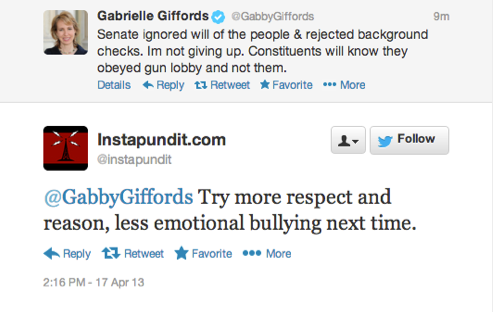
The Failure Of Gun Control: Reax
Tomasky praises the president’s remarks (above) after the Senate’s gun-control bill failed:
Obama’s words were the most powerful he’s delivered in years. Call it failed if you want, but this was leadership: knowing that he was probably going to lose on the Hill, but putting everything he had into the fight anyway. He took on not only the NRA and its whores in Congress, he took on the blasé complacency of a pundit class that said repeatedly: he’ll never win, so why do this; he should have struck while the iron was hot; he should have talked to Republicans more. Yes, it was clear that a challenge to the NRA was likely to lose, but that isn’t what always should dictate a politician’s actions. He behaved out of conviction. This is rare enough among politicians that Obama certainly should not be nitpicked for this or that little thing he did or didn’t do.
Jacob Sullum differs:
Obama does a fine job of empathizing with the parents of Adam Lanza’s victims. But that is something any decent human being should be able to manage. Where he has trouble, despite his lip service to the idea of putting himself in the other guy’s shoes, is in empathizing with his opponents. He not only says they are wrong, which is to be expected. He refuses to concede that people who disagree with him about gun control are acting in good faith, based on what they believe to be sound reasons—that they, like him, are doing what they think is right. His self-righteous solipsism is striking even for a politician.
But the way in which the NRA re-framed the debate dishonestly was “bad faith.” And after Heller, and more than a decade of looser gun restrictions, what more do Second Amendment enthusiasts want? When you look at the balance of things – and I’m not a big enthusiast for more gun control, but see the obvious sanity of universal background checks – the NRA has taken its own achievements as the middle ground and keeps moving ever further right. They remind me of AIPAC – and they distort public policy just as toxically. Drum looks ahead:
President Obama was right to call this “round one.” This kind of thing is a long-term fight for public opinion, and only after you get the public firmly on your side do you have any real chance of passing serious legislation. So the question today for liberals is simple: Is this issue important enough to keep banging away on it for years on end, the way the NRA does? If not, nothing will ever happen.
In an earlier post, Drum examines public opinion on gun control:
Gun control proposals poll decently all the time. But the plain truth is that there are only a small number of people who feel really strongly about it, and they mostly live in urban blue districts already. Outside of that, pro-gun control opinion is about an inch deep. This is a classic case where poll literalism leads you completely astray. Without measuring intensity of feeling, that 90 percent number is meaningless.
Chait adds:
Almost everybody may support background checks, but not every American knows the actual content of every bill that gets a vote. Look at health-care reform. Americans overwhelmingly favor nearly every provision of Obamacare, but oppose the law because they had a general sense of not liking it. Likewise, opponents have turned the debate into a general discussion of “gun control,” which is way less popular than a specific law about background checks. Lisa Murkowski explains her No vote thusly: “In Alaska you’re pretty much pro-gun. That about sums it up.”
Adam Winkler wonders if proposing an assault weapons ban was a mistake:
If President Obama had pushed for a law only requiring universal background checks—maybe coupled with the NRA’s proposal for more funding for school security—he might have been able to persuade Congress to consider his proposals in February, when Newtown was fresher in our collective memory. The four-month delay enabled the NRA to rally its troops—and, more importantly, its allies in Congress.
Weigel’s perspective:
Manchin-Toomey was “branded” about as well as any gun bill can be, endorsed by a man whose state handed Barack Obama a defeat in every county and a man who spent most of his life in politics trying to primary Republicans. The watered-down bill was only as watery as a background checks bill that narrowly failed in 1999, with more Republicans supporting it. Democrats had come to view the NRA as unsavory liars who had to be beaten on something legislatively, just as they were beaten at the polls in 2016, to shift back the center of debate. They failed.

