Always Tell Kids The Truth?

The above video shows children reacting to the “news” that their parents ate all their Halloween candy – a prank. Sam Harris takes offense, insisting that “anyone who takes pleasure in all this exploited cuteness is morally confused”:

My daughter is nearly five, and I can recall lying to her only once. We were looking for nursery rhymes on the Internet and landed on a page that showed a 16th-century woodcut of a person being decapitated. As I was hurriedly scrolling elsewhere, she demanded to know what we had just seen. I said something silly like “That was an old and very impractical form of surgery.” This left her suitably perplexed, and she remains unaware of man’s inhumanity to man to this day. However, I doubt that even this lie was necessary. I just wasn’t thinking very fast on my feet.

As parents, we must maintain our children’s trust—and the easiest way to lose it is by lying to them. Of course, we should communicate the truth in ways they can handle—and this often demands that we suppress details that would be confusing or needlessly disturbing. An important difference between children and (normal) adults is that children are not fully capable of conceiving of (much less looking out for) their real interests. Consequently, it might be necessary in some situations to pacify or motivate them with a lie. In my experience, however, such circumstances almost never arise.

Face Of The Day

dish_1stselfiefotd

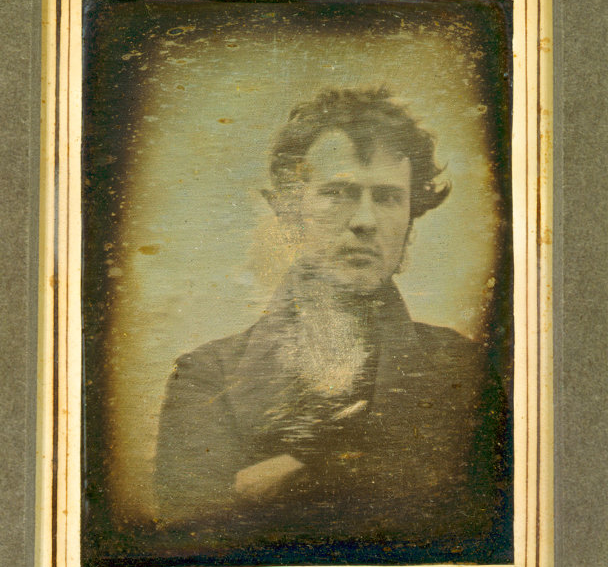
Joe Berkowitz captions the earliest known selfie:

According to the Library of Congress, chemist and metallurgist Robert Cornelius is believed to be the first person to ever stare into the unblinking iris of a machine, beseeching it to capture his ephemeral essence forever. His self-shot daguerreotype from 1839 is the earliest known American portrait photo. It was taken in the yard of his family’s lighting store, back when long exposure times rendered the idea of photographing people just a wonderful dream. We’ve already seen what some historical photos might look like as selfies, but now we have the real deal to measure against.

When Thinking Trips You Up

A new study from sports psychologist James Bell suggests that neurotic people are more likely to make more accurate judgments the faster they respond:

One hundred and ninety-six teenage male cricketers, all members of regional academies, took part in the study. They watched six clips of footage recorded from behind bowlers during the Twenty20 World Cup in England in 2009. Just as the bowler released the ball, each clip was frozen and remained visible for half a second – the approximate amount of time that a batsman has to decide how to react to a delivery. After the freeze-frame disappeared, the participants pressed one of two keyboard keys as fast as possible to indicate whether they judged it was better to attempt to hit a single run, or to go for a “six” (a boundary shot similar to a home run in baseball). Four qualified cricket coaches agreed on the optimum response for each clip. The participants also completed a neuroticism scale, measured by their agreement with statements like “I worry about things” and “I get stressed out easily.”

The key finding is that for low scorers on neuroticism, the more quickly they responded on average, the poorer their judgments tended to be, yet for high scorers on neuroticism the opposite was true. “The most parsimonious explanation,” the researchers said, “… is that individuals with high levels of neuroticism tend to have a stimulus-driven attentional orientation, which means they are likely to react automatically to environmental stimuli (particularly if it is threat related) resulting in faster and more accurate responses in the context of the current task.”

The World’s First Trillionaire

Elliot Hannon wonders who it will be:

The two industries are best positioned to take a billionaire to the next level are technology and retail, for the same reason: Both use a global labor pool to make affordable products, inexpensive enough that workers can soon become the consumers of the products they are making. Of course, the tech industry is building on Internet infrastructure to create billionaires faster than ever. In October 2010, photo-sharing social network Instagram came into being; less than two years and a mere 13 employees later, Facebook snapped up the company for a cool billion.

A look at the Forbes list of the world’s wealthiest shows that the rise of technology and telecommunications has made a big impact:

Mexico’s Carlos Slim, who vies with Gates for the top spot on global-richest lists, made the bulk of his fortune in telecom. Lurking just below these technology magnates are Amancio Ortega, the founder of Zara; the Walton family and their ubiquitous Walmart chain; the Mars family of candy fame; Stefan Persson, chairman of H&M; and Jeff Bezos of Amazon. The rise of these individuals and families is perhaps more surprising than that of Gates, Slim, and their peers—and may be revealing about the clearest sustainable path to 10 figures. These magnates are best positioned, in different ways, to find and use available labor no matter where it is. That will help them sell their products at prices that a wealthier world will be able to afford most quickly. For that to happen, they’ll need emerging markets to continue emerging, creating not only employees but customers, too. If that happens, in two generations – about 60 years – Credit Suisse predicts there could be as many as 11 trillionaires walking among us.

Of course, forecasts can be way off; in 1999, Wired predicted that Bill Gates would reach the trillion-dollar mark by August 2015. He’s currently about $928 billion short.

The Consciousness Of A Cockroach?

Responding to the experiments of cockroach-controlling neurologists Backyard Brains – featured previously on the Dish – Brandom Keim looks at the evidence for insect sentience:

Before dismissing bug consciousness out of hand — their brains are so tiny! And, they’re bugs! — it’s worth recalling that one of the first scientists to seriously consider the notion was Charles Darwin, who spent most of his adult life, even as he completed The Descent of Man (1871) and On the Origin of Species (1859), thinking about earthworms. … Among the surprising — to me, anyway — facts detailed by [ethologist Mathieu] Lihoreau, [and researchers James] Costa and [Colette] Rivault about Blattella germanica (the German, or small cockroach) and Periplaneta Americana (the American, or large cockroach), found in kitchens and sewers worldwide, is their rich social lives:

one can think of them as living in herds. Groups decide collectively on where to feed and shelter, and there’s evidence of sophisticated communication, via chemical signals rather than dances. When kept in isolation, individual roaches develop behavioural disorders; they possess rich spatial memories, which they use to navigate; and they might even recognise group members on an individual basis. Few researchers have studied their cognition, says Lihoreau, but cockroaches likely possess ‘comparable faculties of associative learning, memory and communication’ to honeybees.

As to whether cockroaches possess a self, in the pages of Cockroaches: Ecology, Behavior, and Natural History (2007), co-written by William J Bell, Louis M Roth and Christine A Nalepa, I happened upon a reference to Archy, a popular early-20th-century cartoon cockroach who said: ‘Expression is the need of my soul.’ Archy’s inclusion was intended in fun, but there was a grain of truth. Cockroaches could very well possess a sense of self, and one that’s perhaps not entirely alien to our own.

Painting America’s Imaginary Past

James Parker reviews Deborah Solomon’s American Mirror: The Life and Art of Norman Rockwell, which tells the story of how “this rather strange, marginal-feeling man contrived to represent the inner life of a mass audience” – a less straightforward portrayal of “simpler times” than you might surmise:

The secret, clearly, is that Rockwell’s productions, his tableaux of American innocence, are notNorman_Rockwell-_Scout_at_Ships_Wheel simple at all. If they were, we would have forgotten them by now. Instead they are loaded with unconscious energy, with nervous hum and erogenous gleam. The grotesque, like some goblin field of gravity, seems to bend and warp even his most conventional subjects. Shiny noses, stringy throats, eyes too avid or too dull; a freakish quiddity in his rendering of shoes, elbows, baskets, bricks. Which to us, post-Freudians that we all inevitably are, can mean only one thing: repression! Rockwell’s preference for the company of boy models and rugged apprentices over that of, say, women is a recurring note in Solomon’s book. (“Draws Boys Not Girls” was the headline of a 1923 Boston Globe article.) He married unhappily, twice, and more happily a third time. And although his demons were not very sulphurous, not very rock-and-roll, they were demons nonetheless: shame, awkwardness, a cyclical sense of his own artistic insufficiency, and an enormous, hellacious self-imposed pressure to get everything right.

And about that repression:

If he was gay, he was never—on the evidence currently available—actively so. Solomon’s point is more that he wasn’t gay, he wasn’t anything. He hovered fraughtly, jamming his canvases with inference. Of his habit of placing a dog, person, hatbox, or similar item in the foreground of his paintings, between the viewer and the action, she writes: “It is one of the tensions in Rockwell’s art. He paints objects with the kind of fastidious realism intended to bring you closer to the touchable, handleable world. But then he paints a barricade in the foreground to keep you from touching. He cannot allow himself to touch what he wants.”

Ben Davis emphasizes the way the new biography shows the paradoxical relationship of the artist’s life to his work:

What drama there is comes not from the incidents of Rockwell’s life but from how, in Solomon’s telling, everything in his art actually represents its opposite. Rockwell created the imagery of the Boy Scouts—his most lucrative and long-lasting gig was for the annual Boy Scout calendar—but he was himself not particularly outdoorsy, a neat freak who couldn’t bear to get dirty. He created memorable images of piety (Saying Grace, 1951), but his clan was uninterested in religion; captured scenes of scampy rebellion (The Shiner, 1954) but was rule-bound and order-obsessed; and, most damningly, painted odes to family togetherness (The Homecoming, 1948) but was so affectionless that his own family despaired of ever knowing him. His first bride, Irene O’Connor, divorced him in 1930 on grounds of “mental cruelty;” his second wife, Mary Barstow, was driven to alcoholism and finally the mental hospital by his remove. Only his third wife, Molly Punderson, whom he met when he was 65 and she 64, seems to have been a fit, and they slept in separate beds. “At last he had found his feminine ideal,” Solomon writes: “an elderly schoolteacher who was unlikely to make sexual demands on him.”

Recent Dish on Rockwell here and here.

(Image of Scout at Ship’s Wheel, Rockwell’s first published magazine cover illustration, from the September 1913 cover of Boys’ Life, via Wikimedia Commons)
The Good Old Days Of Hideous Webpages

Screen Shot 2013-11-25 at 1.41.17 PM

Amid the sleek uniformity of Twitter and Facebook, Joe Kloc longs for the Geocities era:

Geocities began in 1994, advertising an enticing 15 megabytes of free space to any homesteader looking to make their place on the Web. The World Wide Web was only a few years old when this digital Northwest Ordinance was issued, and so its users, often referred to as netizens, were necessarily having their first interactions with the Internet, learning to make a place for themselves in the newly discovered online world. Millions of netizens with little to no experience or understanding of how a webpage “should” look utilized the site’s built-in development tools to create clapboard homes spattered with stray GIFs, looping MIDI files, and busy backgrounds. It was the Internet’s Wild West.

It is easy to dismiss these pages as a sort of outsider art. But outside of what? There was no such thing as a personal page before Geocities. And, in almost every meaningful sense of that word, there is no equivalent today.

Consider a page from [Geocities’] Heartland neighborhood, where one resident wrote, “Hi! My name is Sherry, my husband is Richard. We have three children, Colleen, Alicia, and James and we are out here in the desert of southern California.” Further down on the page is a link to “Richard’s Original Bedtime Stories.” … Where today do families publish their homemade bedtime stories about giant pickles? Sites like these have simply disappeared.

Geocities was bought by Yahoo in 1999, during the height of its popularity. Then along came Myspace in 2003, Facebook in 2004, and Twitter in 2006. And by 2009, Petsburg, Heartland, and the rest of Geocities had been shuttered. The world had chosen the pre-fab aesthetics of social networks over the 15-megabyte tracts of open land offered by Geocities. Jacques Mattheij, the founder of the Geocities archive site Reocities, explained this choice to me: “The Geocities environment offered more freedom for expression. Don’t like blue? Then Facebook probably isn’t for you.”

You’ll certainly find less comic sans. Update from a reader:

Know about Neocities? Started by a bitcoin “cyberpunk” dude named Kyle in Portland, Oregon.

From the About page:

(Screenshot via Reocities)

Sharing In The Pain

Jamil Zaki looks to a classic psychological experiment about the desire for company:

One of my all-time favorite studies, conducted by Stanley Schachter in the late 1950s, examined whether fear might bring people together.  Schachter convinced college-aged women that they would receive a series of electric shocks about 15 minutes later.  Some were told that these shocks would barely tickle, and others were told they would be very painful.  Participants were then asked whether they wanted to wait for their shocks in a room alone, or with other people.  People who believed that shocks would be painful strongly preferred being near others, whereas those who believed the shocks would be mild generally did not care whether or not they had neighbors in their waiting room.  On Schachter’s logic, this exposed a powerful rule about social behavior: in times of anxiety, people seek each other out.  Like penguins in February, we tend to face adversity by huddling up.

Schachter refined this rule through a follow-up study.  Some participants were given the option to be alone or with others who would also be shocked; others could wait alone or with people who would receive no shocks.  When individuals could no longer wait with fellow shock-fearers, their preferences for company disappeared.  This suggests that the benefit of crowds depends on our belief that others share our experiences.  Schachter put this more poetically, claiming that his finding “removes one shred of ambiguity from the old saw ‘Misery loves company.’  Misery doesn’t love just any kind of company, it loves only miserable company.”