Saint Paul, Minnesota, 8 am
Saint Paul, Minnesota, 8 am
Jeff Sharlet considers that claim in David Sedaris’ blurb for Katherine Boo’s Behind the Beautiful Forevers, a portrait of the slums of Mumbai:
“It might surprise you how completely enjoyable this book is, as rich and beautifully written as a novel.” Emphasis mine. Cliché Sedaris’s. Should we blame him? He liked the book. He wanted people to read it. And David Sedaris is nothing if not a savvy salesman. He must’ve understood that the promise of “enjoyment,” married to all that is implied, in the context of a book blurb, by “a novel”—characters, plot, resolution, a seamless world—beneath a best-selling writer’s “brand,” would give Behind the Beautiful Forevers a readership far beyond the market share for true tales of relentless filth and poverty. “Reads like a novel”—that’s the elevator pitch. That’s how you sell suffering for $27. …
My own work has on occasion been compared to a novel, and whenever it was, I was delighted. I knew that for a book to be “like a novel” meant that it was safe for mass consumption. It knew that to be “like a novel” meant sales, even though nonfiction outsells fiction. But facts like that are beside the point. For David Sedaris to say that Behind the Beautiful Forevers is like a novel is to reassure the reader that the suffering documented on every page isn’t what matters. It’s the experience. The reader’s, that is. This book will make you feel close to that suffering, but not too close.
For a novel take on boys and their toys, watch the trailer for Fast & Furious 6, where all cars are replaced with miniature RC versions:
(Hat tip: Devour)
Ian Crouch wonders:
Critical opinion is not a statistics-based endeavor, and so we don’t have a graphical curve that tells us when a writer is likely to produce his or her best work. Some writers never match their first novels (Ralph Ellison, Joseph Heller). Others reach their peaks in some middle-career moment, when they have fully developed voices and still retain vigor and health and time to put toward the task. (Roth seems to fit this category, although favorites might be found at the beginning and the end).
Yet there are examples of great writers writing splendidly right until the finish—and even the diminished output of older writers is valuable, if only because it matters how great writers absorb and accept and reject the pains and insights of age. Roth has mentioned that he didn’t want to add mediocre books to the world’s library—and there are many, many examples of great writers perpetrating all kinds of lesser crimes in their advanced age. It seems likely that a novel by, say, Hemingway at seventy would have been among his worst, charting the decline of his output. But who wouldn’t want to read what worlds Hemingway might have made out of being seventy? A quote attributed to him goes like this: “Retirement is the ugliest word in the language.” It seems safe to say that dying is uglier.
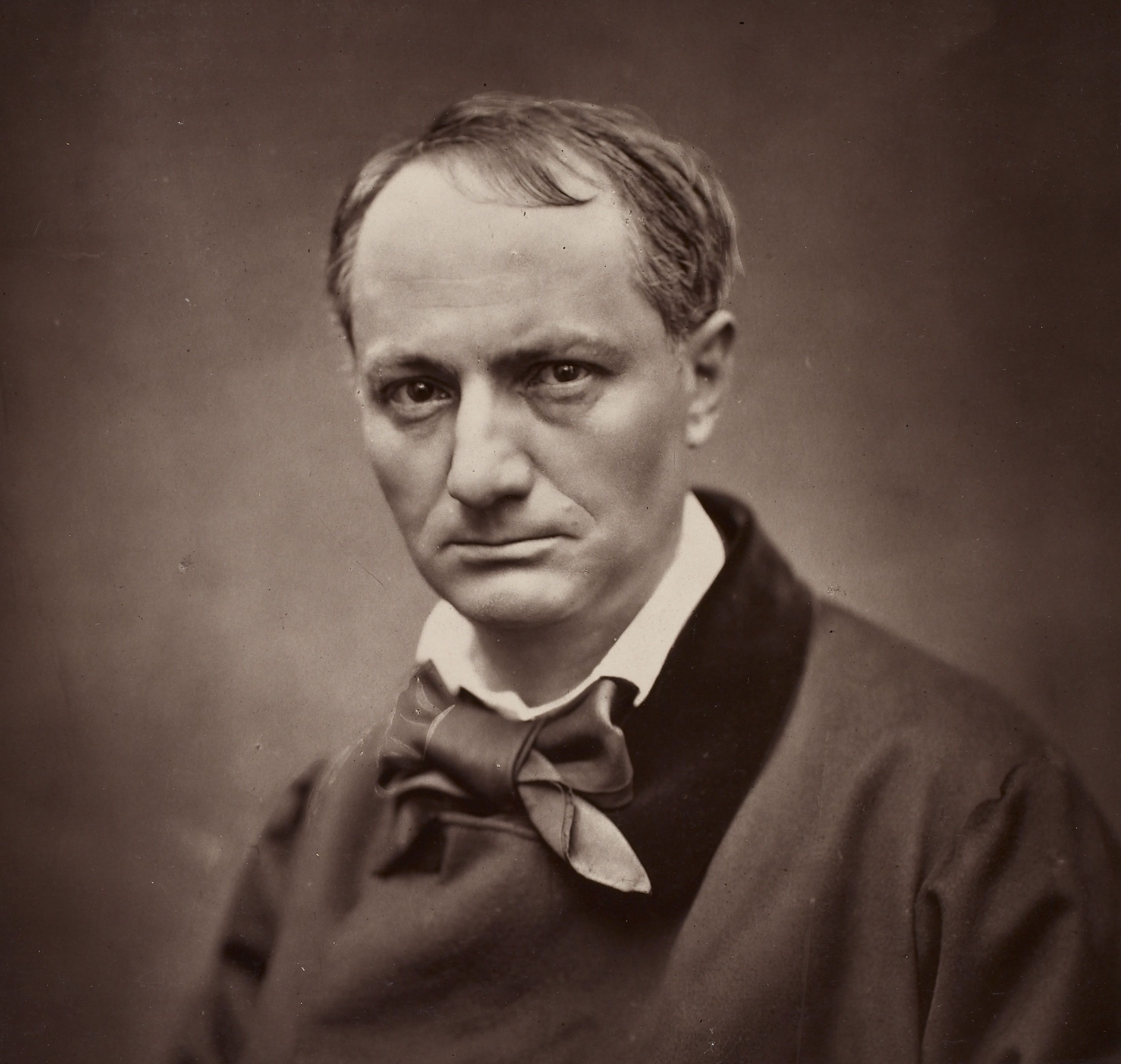
Stephen Akey praises the French poet Baudelaire for confronting our failures:
Like a blasphemous Jesus, he took on our worst sins — pride, sloth, envy, lechery — and turned them into art. T.S. Eliot and others have found in him a profound religious yearning beneath the
blasphemy. I, on the contrary, find blasphemy beneath the blasphemy. Baudelaire’s “business” was not, pace Eliot, to “assert the necessity” of Christianity. He asserted, if anything, the necessity of belief in a self that, threatened from forces within and without, might remain whole and integral, if only through the consciousness of its own suffering. Even so, it’s impossible not to be moved by Eliot’s essay on the poet, which concludes not with the expected apportions of praise and censure but, astonishingly, with this prayer: “Baudelaire was man enough for damnation: whether he is damned is, of course, another question, and we are not prevented from praying for his repose.”
Extraordinary as Eliot’s benediction is, Baudelaire didn’t hold out for prayer. He had work to do. Tormented, slothful, and sickly, he managed to produce masterpieces in every genre to which he turned his hand: metrical verse, prose poetry (which he more or less invented), translation, and art criticism. I think of Baudelaire at work much as he depicted his loved and hated city in the last stanza of his magnificent aubade “Twilight: Daybreak” (“Le Crepuscule du Matin”). It’s a Baudelairian dawn. Whores, beggars, the debauched and the dying fitfully awaken to a cold and damp morning — not a promising start to the day. And yet this city will clothe itself in beauty and get to work:
Shivering dawn, in a wisp of pink and green,
Totters slowly across the empty Seine,
and dingy Paris – old drudge rubbing its eyes –
picks up its tools to begin another day.
(Photo of Baudelaire by Étienne Carjat via Wikimedia)
Lydia Kiesling goes searching for it in San Francisco:
Let no woman say that Tech People — and here I mean the real architects of technological progress–can’t express themselves. Reading Larissa MacFarquhar’s epistolary article about Aaron Swartz in The New Yorker, I was struck, and moved, by how open Swartz and his friends were in their public and private writing. Swartz wrote raw, intensely personal things on his blog; Reddit is full of people expressing themselves in ways that are often shocking. But a novel requires something a little different.
It is my understanding that most writers feel some sense of being outside of things looking in. A good social novel requires a particular balance of alienation and access to be successful. (Tom Wolfe had to get invited to all those dinner parties; the tech novelist has to get invited to the Teach-Up.) Tech, the way it happens in San Francisco at least, seems to present some real deterrents to the access part of the equation. Tech companies, even when they are in the city proper, seem like compounds evoking non-disclosure agreements and badges and loyalty. The buses that ferry the workers from their San Francisco neighborhoods to their Peninsula offices are unmarked. I think these are insular, fortified environments in which it would be hard to achieve the balance of outside and inside status. And when you work twelve hours a day, how would you find the time?
The documentary Room 237 outlines various interpretations of The Shining – that the film is about the slaughter of Native Americans, the Holocaust, or is Kubrick’s apology for faking the footage of the Apollo 11 moon landing:
Kubrick’s longtime assistant and collaborator Leon Vitali (who played Lord Bullingdon in “Barry Lyndon”) recently said that “Room 237” had him “falling about laughing most of the time” because he knows these ideas are “absolute balderdash.”
Billy Wyman enjoyed the film nonetheless:
What “The Shining” is really about will remain opaque. Beyond child abuse, writer’s block, and insanity is the history of the hotel, which seems to weigh Nicholson down more than anything. One commenter in “Room 237” makes this point: “This is a movie about the past. Not just our past, but ‘pastness’.” This, interestingly, parallels something Pauline Kael wrote in The New Yorker in her original, appreciative but skeptical review: “I hate to say it, but I think the central character of this movie is time itself, or, rather, timelessness.”
Noah Millman points to more underlying themes:
The resort to esoteric, secret meanings behind reality is a psychological comfort when the capriciousness of that reality is too threatening. When we badly need reality to make sense – to be sending us a message – secret codes and vast conspiracy theories provide that sense. So in a way, the existence of “Room 237″ is a testament to the success of “The Shining” in capturing the unassimilable horror of reality. If it weren’t so terrifying, nobody would see the need to tame it by explaining what it’s really about.
Ann Napolitano toured Flannery O’Connor’s childhood home in Savannah. The tour guide emphasized a photo of the author at age three:
“A little after this point,” he said, “something happened to change this little girl into the Flannery we recognize. Between the ages of four and six, she started to call her parents Edward and Regina. She began to speak to everyone as if she were an adult. She called her teachers by their first names, and that got her into some trouble at school. Her parents allowed it, though. They were ever after Edward and Regina to her.”
I love this anecdote, because the obvious assumption would be that something sinister had happened to Flannery during that period to alter her, or force her to grow up too quickly. But, as the tour guide assured me, and as I’d learned from my own research, that simply wasn’t the case. Flannery had, on the whole, a happy childhood. She simply did away with the trappings of childhood as soon as possible. She became herself earlier than most of us do. The vision of a fierce five-year Flannery pleases me, but it also rings true. The true Flannery could never be denied, not even by childish impulses.

You have until noon on Tuesday to guess it. City and/or state first, then country. Please put the location in the subject heading, along with any description within the email. If no one guesses the exact location, proximity counts. Be sure to email entries to contest@andrewsullivan.com. Winner gets a free The View From Your Window book. Have at it.
Incredible new tech:
Aman Russom, senior lecturer at the School of Biotechnology at KTH Royal Institute of Technology in Stockholm, says that his research team converted a commercial DVD drive into a laser scanning microscope that can analyse blood and perform cellular imaging with one-micrometre resolution. The breakthrough creates the possibility of an inexpensive and simple-to-use tool that could have far-reaching benefits in health care in the developing world.
Ashley Feinberg applauds:
Standard HIV testing already uses a laser-based method called flow cytometry to count the CD4 cells (a low count of which would be an indicator of the disease). But access to these kinds of tests—with machines costing upwards of $30,000—has been highly limited in the developing countries that need it most. By contrast, the Lab-on-DVD units, could be mass-produced and sold for less than $200. Plus, these relics of media yesteryear are far more portable.
Equally amazing is the sheer realization that technology has advanced to the point where, even when on the verge of being outdated in one field, just a few tweaks can redirect it towards an incredible, innovative, and medically astounding task in another.