What is it about lists that we find so irresistible? As far as I can tell, no one has tried to figure it out (though it’s possible there are psychologists who have solved the mystery, and I just haven’t seen their work). Maybe it has to do with the promise of something both finite and complete, distilling the world down to something you can manage and then be done with. The world is full of photos of cute corgis, but these 37 are the cutest, and once you’ve seen them not only will your day be a little sweeter but you need search no more for cute corgi photos. It could also be the attraction of something easy to read—because it’s broken into small pieces, you know it won’t require too much work to read, you’ll be able to skim it easily, and if you want to read part of it and then stop, you’ll be able to.
Lawrence Rifkin questions whether “making babies is the meaning of life”:
Do we laud the parents of extremely large Mormon, Hasid, Catholic, and Muslim families as public exemplars of a meaningful life? Do we honor the most popular sperm donor as humankind’s greatest philanthropist? Even if our genes get perpetuated, our genes are not us. After a few generations of genetic mixing and shuffling, there’s unlikely to be anything unique or identifying about us in our offspring. If your great-great-grandchild has your brown eyes and your blood type, but no other personality or physical traits uniquely identifiable to you, how much of “you” has really lived on? Further, if the idea is to perpetuate our genetic lineage, what if we have children, but no grandchildren?
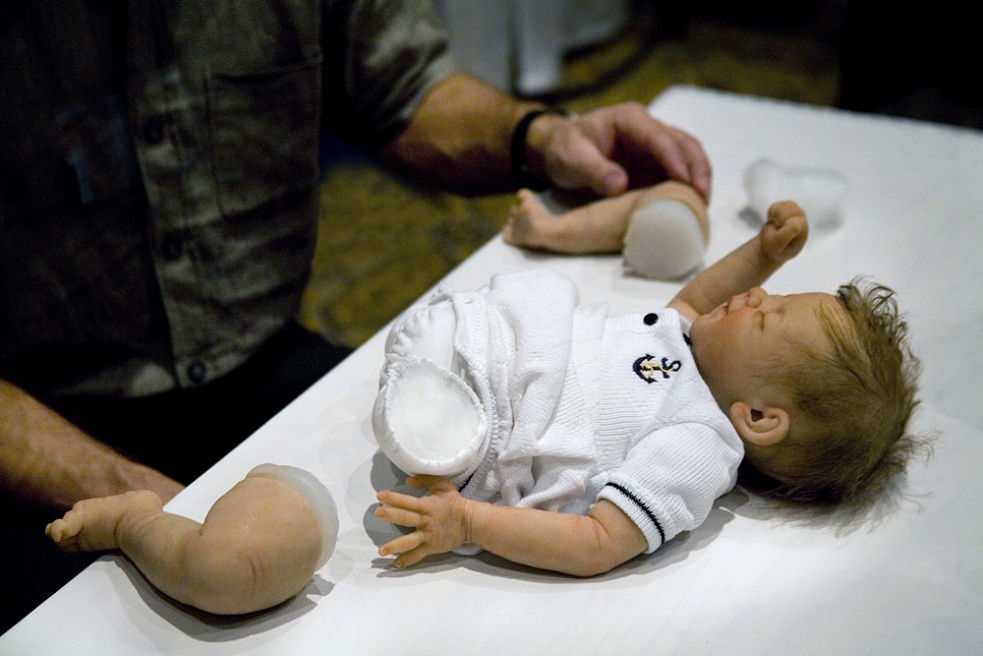
The above photo comes from photographer Rebecca Martinez. A few months ago, James Estrin interviewed Martinez about her submersion into the Reborn subculture, “a growing group, almost exclusively women, who collect shockingly lifelike handmade dolls of newborn babies.”
News Corp COO Chase Carey has threatened to convert Fox to a cable-only channel if they lose their case against online streaming service Aereo, which allows users to stream antenna TV for $8 a month. Rebecca Greenfield analyzes the situation:
While News Corp.’s threat to stop broadcasting is more likely big talk than an actual game plan, Wall Street likes that idea. News Corp.’s announcement sent its stock soaring, even though it would have to wait until after its current NFL deals, which run for another seven years, expire.
But look around and content owners have already started pulling their best, most valuable stuff from the public waves. Sports, for example, have started moving to pay TV. Most regular season baseball, basketball, and hockey games now run on regional sports cable stations. While the really big sport events are still broadcast, that’s showing signs of slipping, too. Starting in 2014 the Final Four of the NCAA Tournament will be on TBS. That would follow Monday Night Football, the staple of ABC for decades, that moved to ESPN, and even the Olympics, which, aside from the primetime packages, was shown live (whether on cable stations or streamed online) only to people who pay for their TV.
Last week we ran an Urtak poll of Dish readers regarding the thread and the questions it raises. Below are the results from the roughly 1,000 readers who responded (blue means yes, orange means no):
But that support dropped a little when it came to graphic images of kids:
And although readers overwhelmingly support the idea of posting graphic images, they seemed to be sensitive to the impact those images have on the small minority of readers who oppose it:
Understandably the aversion to seeing graphic images of kids was higher among readers who have children (22% aversion) compared to those who do not (14% aversion). Review all of the poll results here. Another reader continues the thread:
I am a little surprised that most of your readers either object or insist on war photography by listing similar reasons – confronting the reality of a war that we take part in but don’t generally have to look at. It’s surprising to me that no one is really questioning the idea that the photography is in some way allowing us to access this reality. It’s not. It’s a picture. One of the common complaints in theories about photography is that looking at these images actually desensitize the viewer by making them complicit with the act of photography, which is by its nature an act of non-intervention.
It makes the documenting of the event seem to be more important in some contexts than the event itself. Think of photographs of starving children, where the photographer presumably could feed the child but takes a picture instead, arguing that if the world sees the starving child that more children could be saved than the one day of extra life this photographer could provide by feeding. But it also turns the act of witnessing the photography into a feeling that you have done something important by confronting something horrible – when in fact the viewer hasn’t done anything at all, hasn’t even confronted something horrible, has just looked at a picture.
And then there is the argument that says basically the shock of seeing carnage like this wears off, and any sadness or horror the viewer feels on being confronted with the image takes the place of any action or more critical thought that might be engendered by another way of presenting the facts of war. I can’t for the life of me remember where I read it, but I think it’s true that the magazines that first published starving children photos in the ’80s sparked a lot of donations – but not really many after that. The photograph insists on the grinding reality of what it portrays, which suggests that these horrors always exist in the world with or without our participation while also only asking of its viewers that they look at them. All you have to do is view them and you have done your part about recognizing the horrors of war. Now, pat yourself on the back and be sure you look at tomorrow’s pictures from some other bloody conflict.
I don’t really have an opinion about whether or not you post pictures. They make me sad but they don’t give me nightmares. And reading about the conflicts also make me sad. But this isn’t a simple question of whether or not your readers have a moral obligation to see this stuff. It’s a lot more complicated than that, and being aware of those complications can help your viewers steer clear of those traps.
Kanan Makiya claims that the Iraq War sparked the Arab Spring. Peter Maass counters:
Where’s the proof? The best Makiya can do is note that a number of years after the invasion, uprisings occurred elsewhere. The logical imperfection is audacious. He does not quote any leader of those uprisings as making a connection with Iraq—perhaps because they don’t. Wael Ghonim, one of the online leaders of the Egyptian uprising, has noted, “The war in Iraq killed so many innocent people, and it’s not something that any civilized nation should be proud of.” Makiya cannot drum up support from even Fouad Ajami, another backer of the invasion. “Having supported the Iraq war, I would love to make this connection,” he wrote last year. “But Iraq, contrary to the hopes and assertions of conservative proponents of the war, is not relevant to the Arab Spring.”
Responding to Melissa Harris-Perry’s TV spot for MSNBC (seen above), Friedersdorf pushes back against the idea of collective or communal responsibility for children:
Parents raising their own children as they see fit can disagree vehemently, even on deeply held values, and coexist with nothing more dramatic than incredulous bitching to their spouses about other nearby parents. Conceive of the community as ultimately responsible for raising kids and see how suddenly, intractably contentious and upsetting a formerly thriving place becomes. A secular progressive parent put in a small town of devout Mormons would be the first to tell you that he gets to decide how to raise his kids, not the community. He would be exactly right. Parents get to decide how to raise their kids. Their neighbors ought to help them succeed, but have no claim to the kids.
Harris-Perry responds to critics here. Update from a reader:
I saw the criticisms of this video making the rounds on my conservative in-laws’ facebook pages, and their angry rants about how no else can make decisions about their children, a more vitriolic version of Friedersdorf’s comments. Their interpretation of Harris-Perry’s video is entirely misguided. She is not saying that anyone has a LEGAL interest in your kids.
Look, none of us want your kids, okay? None of us want to take them away from you, or force you to make certain decisions. She is saying that we all need to think of children as a collective asset of our society. I don’t want your kids, but I do want your kids to grow up educated, productive, and thoughtful members of society. That’s good for me, for my kids, and everyone else. That’s why we need to vote to fund schools, to keep funding for school lunches and other programs that benefit less well-off kids, not mention public preschools and all-day kindergartens, programs that are proven effective.
My in-laws would probably vote to cut funding for public education because their kids don’t go to public schools, and anyway they think the curriculum is extremely suspect because it doesn’t involve enough Christian(ist!) values. They think that raising their kids is a private endeavor, and increasingly try to do it away from society. This intensely private mindset is what Harris-Perry is railing against. Society has an interest in the welfare of our kids, and we should continue to try to support them as best we can. It’s called a civilization. Everybody should try it.
Another:
Conor thinks communal parenting is a nonstarter. I believe this is because he has not raised kids yet. We were fortunate to move to a great neighborhood when our kids were young and we are still there. All of our kids are grown and we are so glad we had all the help we did raising them. Our educational, career and religious backgrounds were all over the place. We were Catholic, Jewish, black, Hispanic, blue and white collar. We helped raise each other’s kids in the sense that we made the neighborhood safe, we participated in Scouts, baseball and the PTA. When we saw our kids out in public acting like fools we admonished them and then called their parents. We put them in our cars with wet swim suits and bloody noses. They slept on our floors and cried on our shoulders.
We didn’t interfere with the parenting of other houses nor them ours. The values each parent imparted were theirs alone. No one criticized or belittled anyone. That is your prerogative as a parent and we were not intent on sabotaging that.
As a result our kids are all grown. When they came home from college or the Army they reveled in being in the neighborhood where everyone knew and loved them. When a set of parents died we unofficially adopted the three kids (all in their 20s) so they would have Christmas, birthdays etc. Last weekend we went to a wedding of one of the neighborhood kids. It was a lot of fun as we don’t see each other as often. What touched me the most was all of our kids said to us and each other that they hope when they get married and have kids they will end up in a neighborhood like ours. They want help raising their kids just like we had.
Another:
Don’t feed the trolls. Friedersdorf is placing himself as one among many of the continually offended wing-nuts. This is just a retread of the “you didn’t build that” bullshit taken completely out of context and spun to put the perpetually panicked pundits into overdrive. “OUTRAGE!™”
The reader you quote is 100% correct in their assessment. Even when I was in my early 30s and wasn’t sure if I’d marry much less ever have kids, I recognized the importance of a well-funded school system even while many around me had determined that since they had no kids (or they had already completed their public education), they shouldn’t have to pay taxes for schools. I recognized how a knowledgable, educated, well-rounded citizenry benefits everyone in the society. Lacking any real semblance of empathy or even the ability to see beyond their noses is the hallmark of today’s Republicans and libertarians. Their childish and simplistic policy proposals stem from their childish and simplistic views of life.
Jay-Z and Beyoncé’s recent trip to Cuba has put Florida Republicans in a tizzy. But the US Treasury has confirmed that the couple had the appropriate educational travel license for the trip. France François questions why the nonsensical tourism ban is still in place:
[A]fter spending the appropriate amount of time admiring Beyoncé’s outfit and Jay-Z’s ability to look cooly detached as he undoubtedly crafts a witty punchline in his head about private flights, Brooklyn mornings and Havana nights, all I wondered was why I too couldn’t stroll the streets of Havana as effortlessly as they are. Rather, why is the United States holding on to the embargo against Cuba, a policy that Secretary of State John Kerry said “has manifestly failed” for more than half a century? …
[T]he lessons we’ve learned about conflict resolution between the end of the Cold War and North Korea posturing about nuclear war with Rick Ross-like conviction have yet to be applied to Cuba. These lessons are that: 1. Democracy cannot be imposed from the outside. By its very nature, democracy has to be a grassroots movement; and 2. Isolating a country from the rest of the world–even when you abhor its policies–won’t necessarily force it to change.
(Photo: American singer Beyonce is seen in a balcony of the Saratoga Hotel in Havana next to her husband Jay Z, on April 5, 2013. By STR/AFP/Getty Images)
Bobby Jindal’s home-state popularity has plummeted and his tax reform plan is dead. Barro’s postmortem:
Advocating the replacement of state income taxes with sales taxes remains a cottage industry for conservative think tanks around the country. They have had a partial success this year in Kansas, where the legislature paid for a modest reduction in the state income tax by making a “temporary” sales tax increase permanent. But conservatives have had less success than they expect with this agenda because they haven’t admitted to themselves the tradeoff it involves. Sales taxes do indeed appear to be better for the economy than income taxes. But they are also much more regressive, so a shift toward sales tax buys economic growth at the expense of greater inequality. This fact, which Jindal was not prepared to rebut, was a key reason his plan died.
Jindal was attempting to enact a state-level version of the Ryan approach, but in a context that left him unable to use the Ryan-style obfuscations that are necessary to hide the fact that it’s a gigantic exercise in upward redistribution of wealth.
Silver sees Jindal’s troubles as a reminder that “it can be difficult for a candidate to serve in an executive role and to position himself for national office at the same time”:
There was a series of active governors nominated by the parties between 1988 and 2000 (Michael S. Dukakis, Bill Clinton and George W. Bush). But there have been none since. Mr. Romney was a former governor but was almost six years removed from office at the time of his nomination and talked little about his executive record in either the primaries or the general election.
As the parties have become more nationalized, demanding greater ideological fealty from their candidates, sitting governors may face an unpleasant choice between working to preserve their standing among their constituents while alienating national party leaders – or pursuing a national agenda at the price of their home-state popularity.
After Obama’s widely-debatedcomment about California AG Kamala Harris’ attractiveness last week, Kevin Drum reveals why comments like this matter:
[T]he Name It, Change It campaign released a survey conducted earlier this year on exactly this subject. In the survey, Jane Smith and Dan Jones are pitted against each other in a race for Congress. Both have similar backgrounds, and after reading their bios the survey respondents prefer Jane slightly, 49-48.
Then they read a second story. In one version of the story, there’s no physical description of either candidate, and Jane’s lead stays pretty much the same. In a second version, there’s a neutral description of Jane’s appearance. Suddenly she’s 5 points behind Dan. In a third version, there’s a positive description of her appearance. Now she’s 13 points behind Dan. A fourth version that contains a negative description has about the same effect.
In other words, any description hurts Jane. And any non-neutral description, even a positive one, just kills her.
[T]he real point of the survey — and the most salient fact that came from it — is that pushing back on the commodification of a female candidate’s beauty can be just as impactful as the criticism itself. Some respondents heard a defense from Jane Smith, saying, “My appearance is not news and does not deserve to be covered. Rarely do they cover men in this fashion and by doing so they depict women as less serious and having less to offer voters.” Others heard a similar defense from Name It, Change It. In both cases, when they heard that, their votes flipped back.