Quote For The Day I

Supreme Court Hears Arguments On California's Prop 8 And Defense Of Marriage Act

“Defeatism is more often than not a psychological instrument designed to relieve one of the responsibility to act (if change is impossible, then I have no reason and no obligation to work or take risks for it). That is bolstered by the effort of all ruling interests to instill a sense of powerlessness and hopelessness in those they suppress; systemic power abuses are, above all else, designed to persuade people of the futility of opposition, to adopt a defeatist mindset. But it is a mindset that finds little to no support in political history. The rapid and relentless dismantling of the anti-gay legal and societal framework in the US is yet more proof for that proposition,” – Glenn Greenwald.

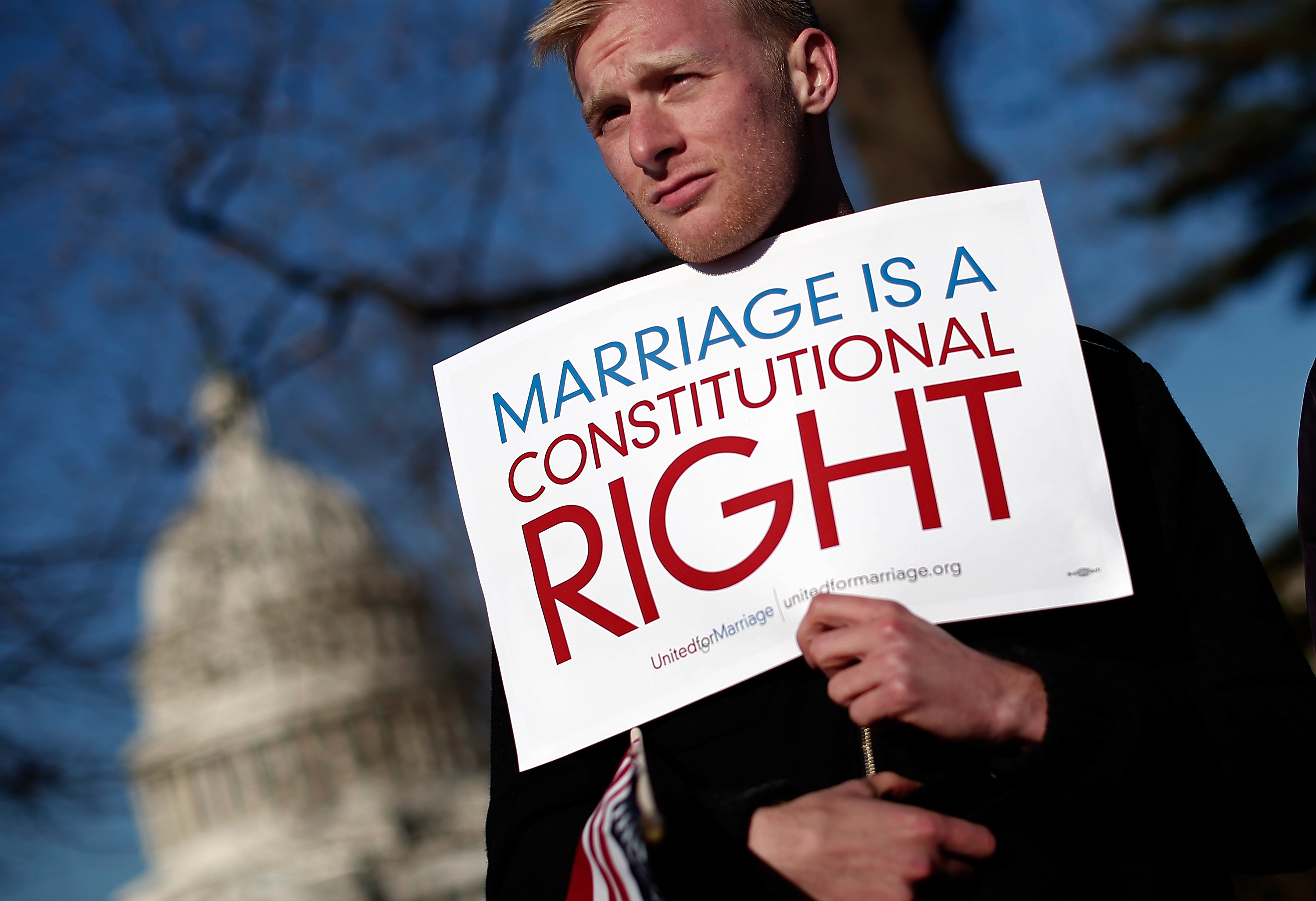
(Photo: Alex Wilson, of Los Angeles, California, watches a rally from across the street in front of the U.S. Supreme Court on March 26, 2013 in Washington, DC. The Supreme Court is hearing arguments March 26, in California’s proposition 8, the controversial ballot initiative that defines marriage only between a man and a woman. By Win McNamee/Getty Images.)
Are Prenups Pernicious?

W. Bradford Wilcox is against prenuptial agreements:

My research suggests that couples who embrace a generous orientation toward their marriage, as well as those who take a dim view of divorce, are significantly more likely to be happy in their marriages. A National Center for Family and Marriage Research study finds that couples who share joint bank accounts are less likely to get divorced. In fact, married couples who do not pool their income are 145 percent more likely to end up in divorce court, compared to couples who share a bank account.

So, the kind of partners who wish to hold something back from their spouse in a marriage — emotionally, practically and financially — and to look out for No. 1 instead are more likely to end up unhappy and divorced. If that is your aim in marrying, go ahead and get a prenup.

Erik W. Newton, on the other hand, argues that every “married couple has a prenup, whether they want one or not” because the “laws covering marriage and divorce in every state are nothing more and nothing less than premarital agreements”:

For the majority of couples, a state’s default prenup is perfectly sufficient. It has been crafted over hundreds of years both through common law and common sense. That said, a couple can’t know if it works for them unless they take the time to explore the law. We enter into a nuptial contract when we say “I do” but not very many of us know the exact terms of it.

A couple should use the existence of a “state prenup” to discuss finances before getting married. Challenging topics will inevitably arise during a marriage. Many of these topics are addressed in the law, but some might be more delicately handled with a customized prenup.

Poll Of The Day

Californians now overwhelmingly support marriage equality:

As the Supreme Court hears oral arguments today on California’s Proposition 8 banning same-sex marriage, a new SurveyUSA poll shows that 67 percent of Californians believe same-sex couples deserve the legal benefits of marriage. Only 30 percent believe those benefits should be limited to “a man and a woman.”

Will Perry Be Another Roe?

Stephen Presser claims that, if “the Supreme Court rules that the federal Constitution requires gay marriage, the political uproar that will ensue may well make the reaction to the court’s Roe v. Wade decision look tame.” David Fontana disagrees:

We know that a Court decision about an issue intensifies opinions about that issue; there is evidence that state court gay marriage decisions have done exactly this. But there is reason to think that the reaction of an intense minority might not be quite so significant. One reason: Just as there has been a shift in preferences about gay marriage over the past two decades, there has also been the shift in the intensity of these preferences. It used to be the case that opponents felt much more strongly than supporters. It was easy to organize state ballot initiatives banning gay marriage because so many opponents of marriage equality were motivated to go door-to-door, solicit signatures, and organize rallies. These days, supporters of gay marriage care more deeply than foes, with one poll indicating that only about one-third of Americans are strongly opposed to gay marriage. There might not be enough strong opponents enough to create the political or social momentum to do something about an unfavorable Court ruling, even in a small number of states.

The Cure For Earworms

Science is here to help:

We humans — cognitively, at least — like to finish what we’ve started. So even when our conscious minds move on to a new thing, our unconscious minds can still be preoccupied with our unfinished business, leading to dissonance. … To defeat an earworm, [researchers at Western Washington University] suggest, you just have to fool your brain into solving another puzzle — a non-musical puzzle. The best way to do that? Give it actual puzzles to concentrate on. Do a quick crossword. Tackle an anagram. Spend a few minutes, even, reading a novel. Replace the earworm with another worm, tricking your mind out of its need to finish what it started by giving it something else — something simple, but not too simple — to focus on.

Taped-Delayed SCOTUS Live-Blogging

SCOTUS will release the audio from the Prop 8 oral arguments no later than 1 pm today. As soon as the audio is released, I’m gonna live-blog my thoughts as I listen. I’ll do the same thing on Wednesday with the DOMA oral arguments audio, which SCOTUS has promised to release by 2 pm tomorrow. After mulling over the real options, that seemed like the best compromise.

I had a chance to be there, if only huddled in a corridor, unable to see the Justices, and like other reporters, barred from using my laptop to live-blog. So I figured I’d listen to the arguments in delayed real time and give my impressions. At this point, while I would have loved just to be there for the day, I have a job to do.

The Smartphone Theft Epidemic

Some startling statistics:

Cell phone theft in major cities has become a national criminal epidemic, like the car stereo crime wave of the 1990s. In San Francisco, about half of all robberies now involve mobile phones, and in New York there was a 40% increase in mobile thefts in 2012. One recent Harris poll of phone owners found that nearly 10% of cellular users said their phone had been stolen at one point.

The reason is simple: The black market resale value of the devices, like car radios two decades ago, is high. “Your mobile phone is probably the most expensive thing you carry around with you,” says Kevin Maheffey, co-founder of Lookout, a mobile security company. “It’s like holding $400 up to your head.”

Chart Of The Day

Popularity And SCOTUS

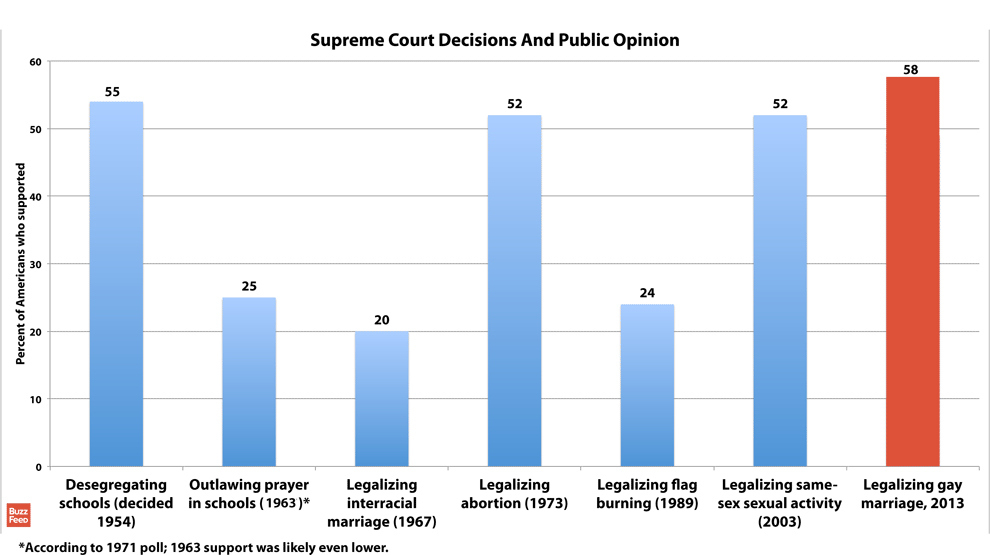
SCOTUS often doesn’t do what’s popular:

In the cases of Loving v. Virginia, which struck down state laws banning interracial marriage; Abington School District v. Schempp, which declared Bible reading in public schools unconstitutional; and Texas v. Johnson, which found flag-burning to be constitutionally protected, large majorities of Americans at the time disagreed with the Supreme Court’s decision. On interracial marriage, public opinion is now aligned with the Court’s decision — on flag-burning and prayer in schools it’s not, though it may be moving in that direction.

The Smart Watch Cometh, Ctd

Freddie dismisses the hype:

[W]ith tech in particular, I merely continue to observe constantly repeated human nature: many of us become convinced, over and over again, that there is one missing element of our lives, and often it’s a better phone or a new computer or our first tablet. We salivate over it, we wait for it, and it arrives, and for maybe a couple days we get the expected rush of endorphins as we play with it. And then, somehow, our lives are still just our lives– hectic, harried, incomplete, vaguely dissatisfying. Then we decide we need a new product, or a new service (once I use Evernote I will be unstoppable!), and the cycle continues. And we never, ever learn. It just seems that the tech heads are the most likely to engage in unlikely flights of fancy about how cool their lives are going to be, and the most susceptible for falling for their own hype. Brian Ries’s revolutionary, life-changing Pebble watch is a couple of months from being the slow pain in the ass that he feels obligated to wear and is tired of talking about.