Making Art Museums Less Boring

dish_bellini

In his new book, Art as Therapy, reviewed by Joshua Rothman, Alain de Botton argues that museums “have embraced as their guiding paradigm the discipline of art history,” focusing on arranging pieces by period or artist, rather than emphasizing “what actually makes art interesting”:

Most people, [de Botton] thinks, care only a little about who commissioned what. When a visit to a museum succeeds, it usually isn’t because the visitor has learned facts about art but because she’s found one or two works that resonate in a private way. And, yet, museums do very little to foster these kinds of personal connections; if anything, they suggest that our approach to art should be impersonal and academic. “The claims I’m making for art,” de Botton said, “are simply the claims that we naturally make around music or around poetry. We’re much more relaxed around those art forms. We’re willing to ask, ‘How could this find a place in my heart?’”

On a stroll with Rothman through the Frick, de Botton offered practical examples of what he means:

Museums, de Botton believes, would be more energetic, unpredictable, and useful places if curators thought less like professors and more like therapists.

Instead of being organized by period—“British eighteenth-century painting,” say—galleries could be organized around human-scale themes, like marriage, aging, and work. Rather than providing art-historical trivia, wall text might address personal questions: How do I stop envying my friends? How can I be more patient? Where can I find more beauty in my life? …

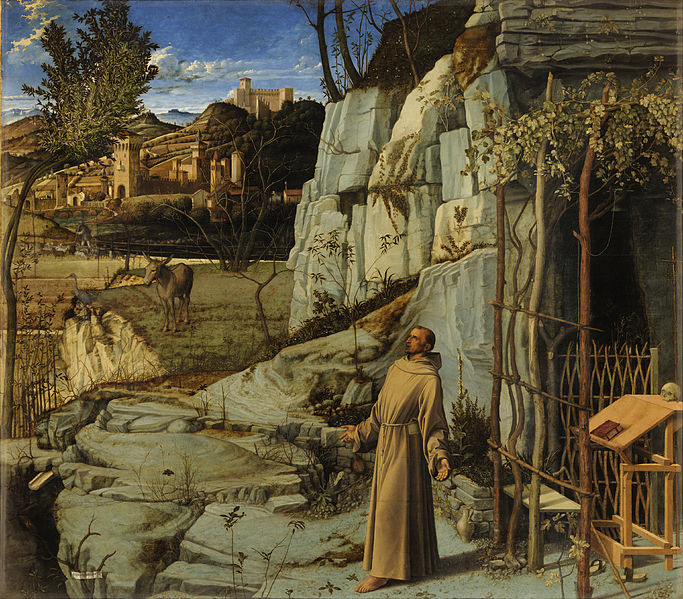
The word “therapy”—a “big, simple, vulgar word”—is meant, de Botton said, to be taken broadly. It can be therapeutic to acknowledge “the ugly, the complicated,” or to be reminded of one’s neglected, inner possibilities. Contemplating Bellini’s “St. Francis in the Desert,” what struck de Botton wasn’t Francis’s story, per se, but Bellini’s attention to detail—a dirty hare amongst the rocks, a perfect little town in the distance, the Saint’s toes. “This picture can make us feel guilty, and a bit sad, about how we’ve neglected close observation,” he said. “We rush through experience. We’re on our phones. But that’s also why it’s moving. My theory is that many of the things that move us are things we long for but find hard to do.” (In a video from 2010, the Frick’s former curator, Colin Bailey, offered an alternate, but still de Bottonian, reaction: “The picture gives us comfort because it seems so restful, so joyous, so joyful.”)

(Image of Saint Francis in the Desert by Giovanni Bellinni, 1480, via Wikimedia Commons)
A Think Tank With An Agenda

Julia Ioffe highlights the growing extremism of the Heritage Foundation:

DeMint was known nationally as a warrior for purity, spending more of his time seeking out like-minded candidates for the U.S. Senate rather than passing legislation. But, at Heritage, DeMint found kindred spirits in [Chairman of the Board Thomas] Saunders and [Heritage Action CEO Michael] Needham, who created a Heritage Action scorecard to grade Republican members of Congress on their ideological mettle. (The standard is so high that, at this writing, the House Republican caucus gets a paltry 66 percent rating.)

Among the consequences of Heritage’s transformation:

With DeMint’s arrival, Heritage’s government relations team, which once boasted the ability to meet with 250 GOP and as many as 40 Democratic congressmen on any given day, disappeared. “The people at government affairs would go down to the Hill, and they had Hill folks saying, ‘Listen, we don’t want to meet with you because of what the folks at Heritage Action did yesterday,’” says the former Heritage staffer. Heritage analysts now have a hard time getting meetings on the Hill, even with Republicans. The congressional staffer told me that, for many Republican members of the House, “their research staff is probably not dealing much with Heritage anymore. They’re systematically going elsewhere for their information.”

Pareene chimes in:

Truth be told, Heritage was always mostly political hacks, they just used to be effective political hacks with a realistic agenda. What was different now was the cheerful absense of any coherent and/or achievable goal — beyond fundraising and image-boosting for Heritage Action itself.

Animals May Have Been Harmed In The Making Of This Film After All

How the American Humane Association – which confers the “No Animals Were Harmed” label on movies – sells itself:

The organization is now under fire:

A Husky dog was punched repeatedly in its diaphragm on Disney’s 2006 Antarctic sledding movie Eight Below, starring Paul Walker, and a chipmunk was fatally squashed in Paramount’s 2006 Matthew McConaughey–Sarah Jessica Parker romantic comedy Failure to Launch. In 2003, the American Humane Association chose not to publicly speak of the dozens of dead fish and squid that washed up on shore over four days during the filming of Disney’s Pirates of the Caribbean: The Curse of the Black Pearl. Crew members had taken no precautions to protect marine life when they set off special-effects explosions in the ocean, according to the AHA rep on set. And the list goes on … All of these productions had AHA monitors on set.

An AHA employee describes as the organization’s 99.98 percent safety rating record as “a total B.S. number made up for PR purposes.” Nora Caplan-Bricker parses the expose:

[The Hollywood Reporter] lays [the] filmmaking fatalities at the feet of the American Humane Association, the non-profit that hands out the “No Animals Were Harmed” designation that is such a staple of TV and movie credits, building a portrait of an organization that is far too cozy with Hollywood to effectively police it. The regulator is actually on the movie industry’s payroll: AHA’s Film & TV Unit subsists largely on a multi-million dollar grant from the SAG-AFTRA actors’ union and the Alliance of Motion Picture and Television Producers, and it’s currently working on a “fee-for-service” plan, under which producers will pay AHA to monitor sets starting as early as January. In other words, this litany of Hollywood’s furry casualties is a familiar parable of what happens when a powerful entity regulates itself.

The Timeline On A Final Iran Deal

It’s more relaxed than the press reports would have you believe:

Most news stories cite Obama and Kerry as saying Geneva is a six-month arrangement. However, the text of the agreement notes that the deal is “renewable by mutual consent.” And lest that line is viewed as a throwaway to placate Tehran, the text specifically notes that the parties “aim to conclude negotiating and commence implementing” the final agreement “no more than one year after the adoption of this document.”

In other words, negotiators did not agree on a hard deadline to reaching agreement on the final deal, approving just an aspirational goal that it will be achieved a year from now. The administration probably welcomed this additional wiggle room to avoid a situation in which negotiations are deadlocked and it is cornered into admitting that the diplomacy had failed, forced the White House to consider unattrative alternatives.

On the surface, it stands to reason that Iran has an interest in getting a final deal as quickly as possible. After all, the most punishing economic sanctions remain in place under the “first step” deal and Obama promised renewed vigilance in sanctions enforcement when he announced the Geneva accord. But with the signing of this deal, the perception of leverage will begin to tilt away from Washington and toward Iran, which may want to see how this deal improves its regional standing before it heads into talks for a final agreement.

Meanwhile, Fisher analyzes a new Khamenei letter:

What makes this letter significant is not just that Khamenei is blessing the deal, but that he’s giving Rouhani some political cover in Tehran. This suggests, and is surely meant to broadcast as much, that Khamenei not only supports the deal so far but that he supports it sufficiently that he’s willing to publicly pressure Iranian hard-liners to get behind it.

It can be easy for Americans to forget that Iranian politics are complicated and noisy. Khamenei is the ultimate authority but only when he’s willing to use that power, which is only true sometimes.

Healthcare.gov Is On The Mend

Ezra checks in on the administration’s progress:

The worry, at this point, is that the site is working in ways that are visible but broken in ways that are harder to see. The Obama administration won’t answer direct questions on the percentage of “834s” — the forms insurers need to sign people up for the correct policies at the correct prices — that are coming through with errors. Robert Laszewski, a health-industry consultant with deep contacts among the insurers, told the National Journal the problem is getting better, but that his clients are still seeing a five percent error rate. That’s still too high.

The systems that determine whether applicants are eligible for insurance are also improving. But inside the administration there’s a recognition that it was error-ridden in the first six weeks of Obamacare — and so the question is how to handle the many people who unknowingly received an eligibility determination that can’t be trusted.

Still, it’s clear that HealthCare.Gov is improving — and, at this point, it’s improving reasonably quickly. It won’t work perfectly by the end of November but it might well work tolerably early in December. A political system that’s become overwhelmingly oriented towards pessimism on Obamacare will have to adjust as the system’s technological infrastructure improves.

Garance rattles off some of Healthcare.gov’s remaining problems:

• Ongoing site outages. The site had outages both this week and last week. It turns out that fixing one part of the site can crash other parts of it, and CMS says it expects intermittent site outages to continue in the weeks ahead.

• Capacity issues. At the height of interest in Healthcare.gov, as many as 250,000 people were on the site at once—five times more than the site is expected to be able to manage on November 30 under the best-case scenario.

• The return of the dreaded waiting room. “There will be times that volume on HealthCare.gov will exceed … demand, and we are preparing for that,” Bataille said. “If we experience extraordinary demand, consumers may not be immediately able to complete the application. They will be queued, in order to ensure a smoother process, and will experience some wait time.” The new online version of “your call will be answered in X minutes” is being touted as better than the last version, an “online waiting room” in which people had no idea how long they’d need to wait.

• Novel glitches. New bugs will continue to be discovered and need fixing, especially since every new fix risks causing trouble downstream.

Drum prematurely declares victory:

Republicans have run out of time, and they know it. Their fixation on Obamacare already looks sort of balmy—this weekend’s deal with Iran was designed to draw attention away from Obamacare? Seriously?—and it’s only going to look loopier as time goes by. Getting Obamacare to the end zone wasn’t easy, and Obama almost fumbled the ball at the one-yard line, but he’s finally won. There’s nothing left for conservatives to do. Love it or hate it, Obamacare is here to stay.

The Banality Of Gaming

Liel Leibovitz explores the Orwellian effect of Papers, Please, a simple online game that establishes the player as “a bureaucrat at a border-crossing in a fictional totalitarian state”:

The metal gate goes up. Your station is open for business. People come streaming in. The rules, communicated by the government in the beginning of each level, are simple, telling you just who is to be let in and under what circumstances. The reality of your job, however, is infinitely more complex: What, for example, would you do with the mother whose papers are not in order but who begs you to let her in so that she could reunite with her long-lost son? Or the woman who begs for sanctuary from persecution in a neighboring state? The married couple, he with his papers in order and she without?

The questions aren’t just theoretical.

Each transgression from protocol will cost you dearly: With every act of kindness comes a steep fine, which means that heating bills go unpaid and medicine for loved ones unobtained. Each level ends with a short statement of your personal finances and their consequences. Without heat and medicine and food, children and spouses and parents get sick and die.

But for many, I suspect, such deprivations will never come to pass. The most terrifying thing about Papers, Please is the temptation to excel in it, to be the best border guard possible, the most well-oiled cog in the machine. This, after all, is a game, and like most games it invites its players to gradually hone their skills. By the time you get very good at examining passports for forgeries, work permits become mandatory as well. You learn to read different kinds of documents. An elaborate handbook is on hand to offer guidance. Mastering the technicalities is a tedious and time-consuming affair, but its rewards are immense—in the game, as in life, control brings with it a sense of order and peace.

Previous Dish on morality-based gaming here.

Might Israel Act Alone?

Micah Zenko takes their threats at face value:

The recognition of Israel’s nuclear capabilities will continue to matter over the next six months because, if we are to take Tel Aviv seriously, Israel could undertake a unilateral military attack against Iran’s known nuclear facilities. Should the IAEA’s outstanding questions about the possible military dimensions of Iran’s nuclear program go unaddressed, or access to sensitive sites remain restricted, there are intentionally ambiguous undefined conditions under which Israel might attack Iran, with or without the United States.

Steinglass warns Israel against such actions:

American Jews are largely liberal, and largely support Barack Obama; Mr Netanyahu’s relentless baiting of Mr Obama over the past five years has already tested their willingness to take Israel’s side. Now, Mr Netanyahu’s threat to stage a unilateral attack on Iran risks creating an unprecedented schism.

In every previous conflict between Israel and its regional enemies, even when Israel initiated the military action (as in the 1956 and 1967 wars, and to some extent the invasions of Lebanon and Gaza), American Jews have accepted Israeli assessments of the threat. This time, many of them won’t. An Israeli attack on Iran that resulted in Iranian and regional Shiite attacks on American targets and interests, against the wishes and best judgment of most Americans and many American Jews, could lead to an irreversible break. The fact is that Mr Netanyahu is wrong about the deal signed on Sunday: it reduces, rather than increases, the risk of an Iranian nuclear bomb. But even if Mr Netanyahu were right, an increase in the risk of an Iranian nuclear bomb poses nowhere near as great a threat to Israel’s security as losing the solidarity of American Jews.

Waldo’s Whereabouts

Waldo Trick

Ben Blatt dishes on how best to find the striped loiterer:

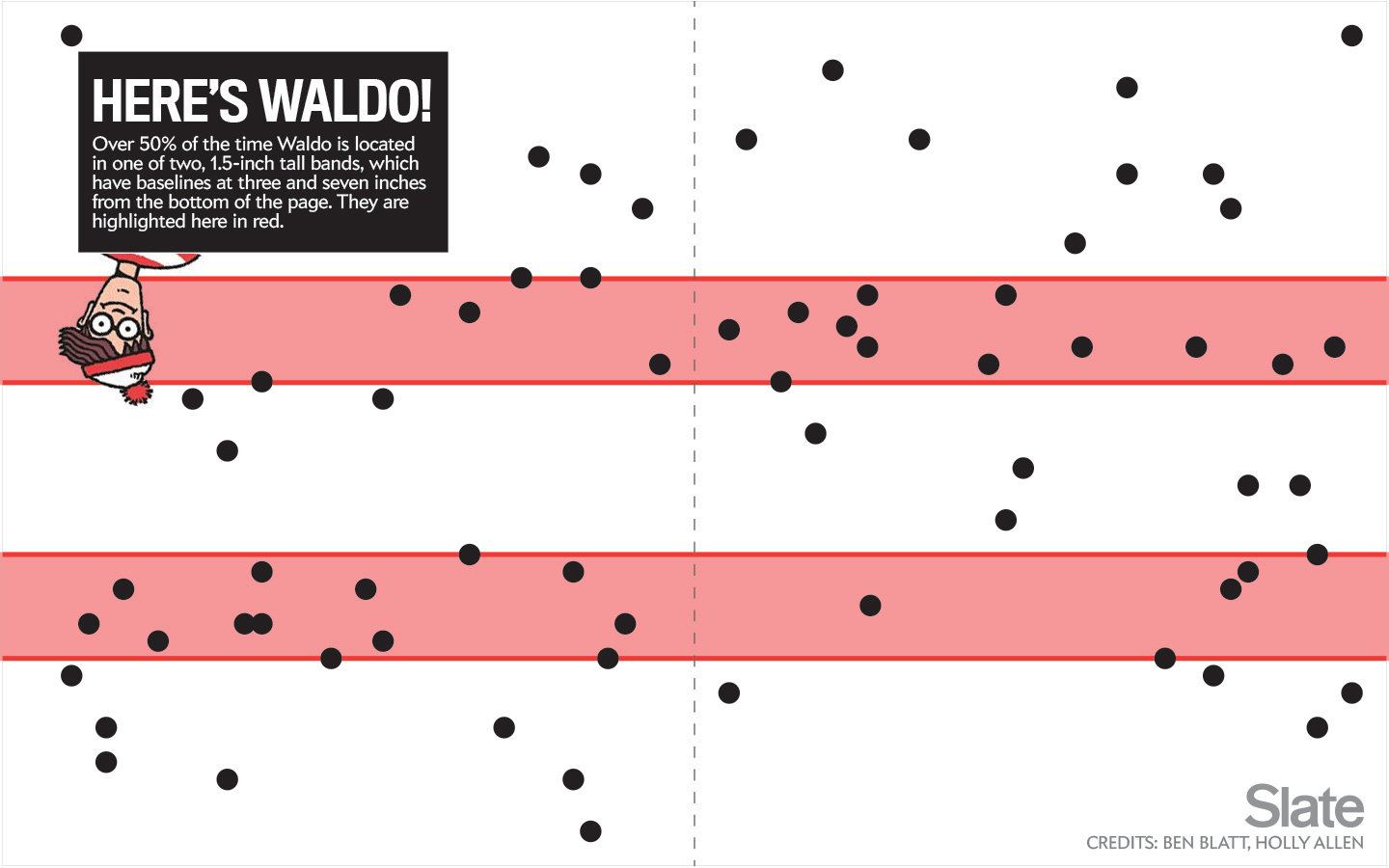
[Creator Martin] Handford generally shies away from putting Waldo near the bottom or top of a page, which leads me to theorize that Waldo placement is largely a function of two factors: aversion from extremes and aversion from the middle. While we would expect Waldo to be hidden within an inch-and-a-half of the spread’s top or bottom borders almost 25 percent of the time if Handford were placing him randomly, in practice he is there only in 12 percent of all pages. More surprising is the fact that Waldo is also unlikely to be in the middle of the page. … It’s possible that Handford avoided the edges and centers of the pages out of concern that they may not print clearly. However, Waldo is placed in these locations occasionally, which weakens this hypothesis. I think it’s more likely that Handford was trying to avoid locations that might be construed as too obvious—i.e. the centers or the corners, where children and adults alike might begin their search. But while this might make Waldo harder to find for the reader whose eyes immediately dart to the center or edge of the page, once you know your quarry is unlikely to be in those places, it actually makes him much easier to find.

Obama’s Keep Your Doctor Promise

Alex Altman expects it to come back to bite the president:

“No matter how we reform health care,” Obama said in 2009, “we will keep this promise: if you like your doctor, you will be able to keep your doctor. Period.” It’s not that simple. In order to participate in health-insurance exchanges, insurers needed to find a way to tamp down the high costs of premiums. As a result, many will narrow their networks, shrinking the range of doctors that are available to patients under their plan, experts say.

Chait counters:

The main difference between Keep Your Plan and Keep Your Doctor is that Obamacare’s disruption of the individual insurance market was a conscious policy choice. Obamacare creates regulations that, by design, phase out health-care plans that are based on skimming healthy people off the insurance pool. It does not create regulations designed to force people out of existing doctor-patient relationships. Keep Your Plan has been a political disaster for Obama because it was a broken promise. Keep Your Doctor is not even close to a clear-cut broken promise.

Cohn argues that Obamacare isn’t to blame for limited network plans:

[A]ccording to nearly every source inside and outside the industry I’ve consulted, the primary reason carriers are offering so many small-network plans in the exchanges is that they believe consumers want them. Their marketing research suggests that, when forced to choose between paying higher premiums for wider networks or lower premiums for narrower networks, the majority of people will go for the cheaper insurance. The one survey I’ve seen on this question, by Morning Consult, suggests the carriers may be right: In that survey, nearly 60 percent of respondents said they’d opt for plans with fewer provider choices if meant saving on premiums.