A Poem For Saturday

daisy

“Shudder of a Daisy” by Gennady Aygi (1934-2006):

little cloud! –

would once the moment
(invisibility-visibility)
of my death thus be shaken –

(what then
shall I choose
more dear):

wind – jewel-like – fleeting! –

as in flight
awakened in me – first of all:

freshness! –

of absence of memory

(Translated, from the Russian, by Peter France. Reprinted from Field-Russia: Poems by Gennady Aygi © 2001 by Gennady Aygi. Translation © 2007 by Peter France. Reprinted with permission of New Directions Publishing Corporation. Photo by Flickr user peter pearson)

Love And Hate In The Age Of Smartphones

Like most millennials who don’t actually use their phone for phone calls, Eric Jett missed the “golden age of the booty call”:

“What are you up to?” read many a late-night text message during my years at Oberlin College. The text was a feeler, a thin, transparent antenna, projecting out into the night. While during the day, such an innocuous message could be followed up by any number of requests or offers, at two o’clock in the morning, it could mean only one thing. But unlike the analogue booty call of yore, which required at least a semblance of tact and care — “How have you been?” — the booty text is a Boolean expression, a true or false question, a gambit to be either declined or accepted. It is the ring — in that awkward moment between the caller ID and SMS — not the call.

Another casualty of smartphones? The ability to slam a receiver:

Hanging up on someone is a physical act, a violent one even, one that produces its own pleasure by discharging acrimony. Like the model 500, the flip-phone supports hang ups because its form is capable of resisting them; because it can survive the force a hangup delivers. Just try to hang up your iPhone or your Samsung Galaxy. I don’t mean just ending a call, but hanging up for real, as if you meant it. For a moment you might consider throwing the handset against a wall before remembering that you shelled out three, four, five hundred dollars or more for the device, a thing you cradle in a cozy as if it were a kitten or a newborn. Everyone is a milquetoast when a smartphone is in their hand.

Hopheads

Exhibit A:

Martha Harbison wonders if some beer drinkers could be addicted to hops:

Modern-day hopheads–the beer drinkers who gleefully, obsessively seek out hoppier and hoppier brews–don’t usually start out that way. Most people have a natural aversion to bitter compounds–useful for avoiding eating lethal doses of poisons in the wild. No, one must work one’s way up to hops: Start off drinking beers with lower IBUs (International Bitterness Units, one measure of how bitter a beer is), be them ambers, lagers, brown ales, or stouts. Next, try a pale ale. Then try many pale ales. Then discover the IPA — and with it, become obsessed with hop varietals such as Simcoe (piney aroma) and Amarillo (fruity aroma). Be happy with that for a while. Maybe try a double IPA (twice the malt, twice the hops as a regular IPA), which may or may not be successful, depending on whose you drink. Begin to love being punched in the face with a fist of hops. Become obsessed with IBU ratings. Buy the hoppiest beers one can find, even if they don’t actually taste all that good. Despair.

But it’s not actually addictive:

You can cut hops out of your diet with no adverse physical reactions just like you can do the same for curry or bacon cheeseburgers or any number of other food items for which one occasionally develops cravings. Gustatory cravings are not the same as caffeine jags, nic fits or heroin jones.

So how does one account for the obsessiveness? Zak Stone theorizes “it’s the association of hoppiness with stronger alcohol content in beers that drives the sense of addiction”:

Beer lovers not only get used to drinking more bitter beers, they often get used to drinking ones with higher alcohol content. The hops are the bell that make Pavlov’s dogs water at the mouth: only this time it’s for booze.

Pink Bubbly

Rose_champagne

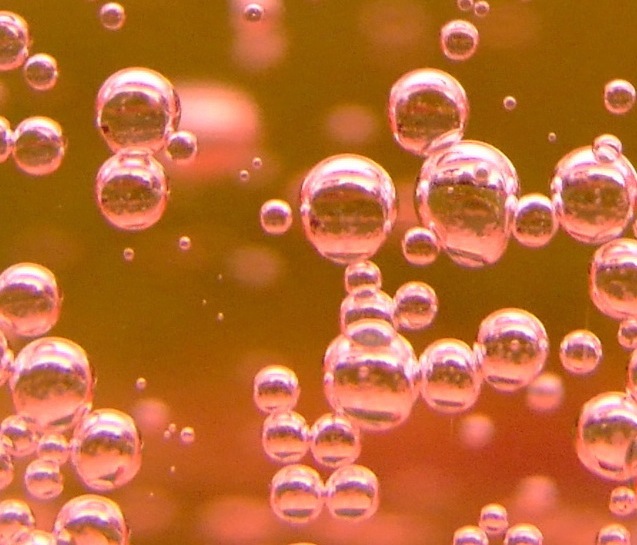
Peter Foges tells us all about rose champagne:

One legend has it that this ineffable nectar was first created for a queen to match her bridesmaids’ dresses. But it wasn’t until well into the twentieth century that rose champagne went democratic and entered the public domain. In Depression-era New York it passed in the more upscale speakeasies for cherry soda. But it reached an apogee of applause when it turned up in the movies, most memorably in 1959 in An Affair to Remember, when Cary Grant drinks it with Deborah Kerr as they first meet aboard an ocean liner. They proceed to drink nothing but the stuff as their love affair unfolds. Sales in the U.S. ballooned that year. President Reagan was particularly fond of it—and famously used to pair a bottle or two of Louis Roederer Crystal Brut Rose 1974 with a bowl of jelly beans. …

Rose champagne is rare. Only three percent of the 350 million bottles produced annually in the Champagne region of France are pink, perhaps because giving it its tint while maintaining its quality is hard. It’s basically a matter of either adding still red Pinot Noir just before the second fermentation, or leaving the red Pinot grape skins in contact with the wine for a while—both of which are risky and complex. A small mistake can turn the champagne into an unwanted, unsalable red, blue or brown.

(Photo by Gaetan Lee via Wikimedia Commons)

A Contemporary In Cold Blood

In American Honor Killings: Desire and Rage Among Men, David McConnell chronicles six notorious killings committed by straight men against gays. In an interview with Patrick Ryan, McConnell rejects the term “gay panic” as a motive for the murders:

It’s a term that solves the singular mystery of any killing – motive – before you even have a chance to think about it. No wonder defense lawyers love it. But if you’re at all interested in what really goes on in the world, that kind of categorization just isn’t enough. Besides, as I keep insisting, gay panic often isn’t accurate. Of the six cases I write about in detail, several days or more passed between the ‘provocation’ – if there even was a unique precipitating event – and the murder. Can you panic for days or weeks? To me it seems obvious something else is going on. I think the violence exists in the hearts of these men long before the victim comes along.

Ryan tells McConnell, a novelist, that “your recreation of the events in each murder has the same kind of narrative pull as Capote’s book.” McConnell talks about his foray into nonfiction:

In the Oklahoma City case, I was especially fixated on how [Darrell] Madden and his accomplice had hijacked their victim, Steve Domer. A normal newspaper account might have left it at ‘the two lured the older man with the promise of sex for pay.’ But I wanted to know how it happened instant by instant. Because I was having trouble getting clear answers from Madden, I just wrote up the scene as I would in a novel, complete with dialogue. Then I sent him the pages, and he sent them back to me covered with annotations. It was by far the most perverse ‘editorial’ experience I’ve ever had, but it was a great way to get information.

On a related note, Ben Yagoda tracked down the New Yorker‘s fact-checking records for Capote’s In Cold Blood.

A Biography Of Unrequited Love

Is a certain amount of infatuation necessary for a good biography?

Leon Edel, who wrote five volumes on the life of Henry James, said that writing biography was a little like falling in love. “Of course,” he added, “it’s a one-sided love affair since the love object is dead or, if alive, relatively unwooable.” In other words, a proper biography is an exercise in safe stalking: no one gets hurt, and the subject is too busy or dead to care. Without the passion it’s a chronicle of schooldays and grocery lists and letters to insurance adjusters. But if we end up learning as much about the author (and his obsession) as we do about the subject, the story can come alive. The best biographers end up as stealth characters in their own books: they fall in love, they follow the trail, they fall out of love, they lose their way, they find their way, and the subject is revealed almost by accident. The story is the search, not the discovery. And if the searcher is motivated by love—even a weird, obsessive, cockeyed, never-to-be-resolved love—even better.

A Kid’s Guide To Serious Cinema

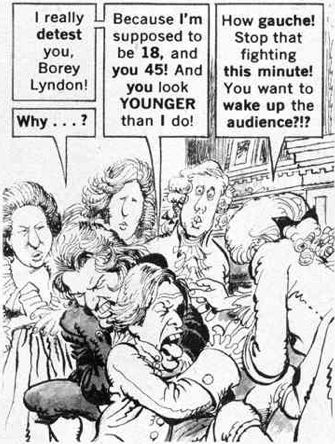
Grady Hendrix fondly recalls MAD magazine’s film satires:

Borey Lyndon - 02 stepson age Always happy to aim over the heads of its target audience of teenaged boys (issue 28 featured a guide to IRS form 1040), MAD was parodying movies like Barry Lyndon (Borey Lyndon) and Blow-Up (Throw Up) to a readership with little awareness of these movies beyond their newspaper ads. Long before most kids were old enough to see R- and X-rated movies like Dressed to KillAltered States, and Midnight Cowboy, they were familiar with Undressed to Kill, Assaulted State, and Midnight Wowboy. While film studies majors gasp over the deconstruction of genre in the works of David Lynch and the meta-movies of Charlie Kaufman, “the usual gang of idiots” over at MAD have been deconstructing, meta-narrativing, and postmodernizing motion pictures since the very first movie parody (Hah! Noon!) appeared in 1954.

(Cartoon from Borey Lydon)

Saved By Puppy Pics

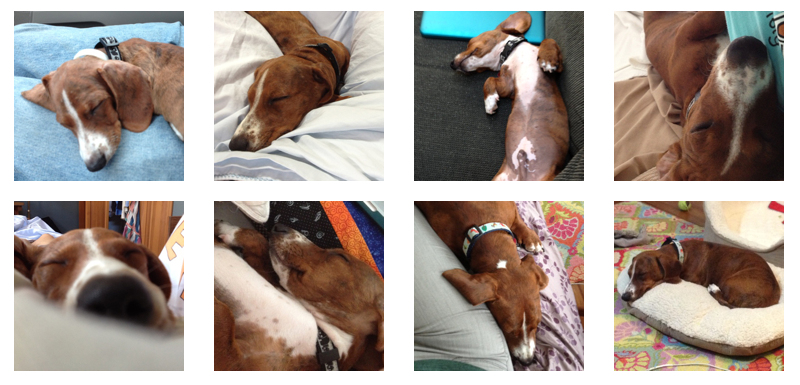
Matt Flag and his girlfriend were able to endure long-distance dating with the help of technology and the photogenic dog they share:

I’m not suggesting that pictures can make a relationship work. And I’m not exactly sure why dog pictures are more effective for me than Skype or the telephone or texts. Suffice it to say that, with or without any kind of modern technology, living with half the continental U.S. between you and your significant other is difficult and, bottom line, an entirely mediated relationship is sub-ideal: the things around you will always be more immediate and grass is quantifiably greener when it isn’t piped through the internet before it appears on a screen. …

At the same time, though, this dog — something very much a product of our ability to raise it but at the same time independent, separate, us mediated into dog-life — has made a huge difference. And somehow, the camera, a known liar, manages to capture his personality, and once a day I laugh at him and, more abstractly, see some kind of diffracted reflection of how good my girlfriend and I are together. Somehow, through all the wires, the pictures are genuine and uplifting. That, to me, is the magic of creativity, technology done right: just when you think it can’t help but lie, obfuscate, confuse, it seems to reach out and give you something real.