Cutting Through The Saudi Spin

SAUDI-IRAN-NUCLEAR-MEDIA

Simon Henderson assesses Saudi Arabia’s public and private reactions to the deal with Iran:

Saudi princes and officials often cast Israel as the villain of the Middle East, implying and often saying outright that if it were not for the Israeli-Palestinian dispute, everything in the region would be fine. Prince Alwaleed skipped this line of argument completely, instead saying, “For the first time, Saudi Arabian interests and Israel are almost parallel. It’s incredible.”

Incredulity is also a good word to sum up the feelings at a roundtable in Washington D.C. that I attended a few days earlier, when U.S. officials, military officers, and think tankers questioned another prominent Saudi personality. Asked what the kingdom would do if Israeli aircraft flew over Saudi Arabia on their way to bomb Iranian nuclear facilities, the Saudi, whose remarks were off the record, replied: “Nothing. Why would we do anything? They would be doing what we want to happen.” Of course, after a pause, he added, “But we would issue a strong public note of condemnation for the intrusion into air space when it was all over.”

Despite the rhetoric coming from Riyadh, Keating is skeptical that the Saudis will express their displeasure by obtaining a nuke:

First, as Steve Cook wrote last year, Saudi Arabia “has no nuclear facilities and no scientific infrastructure to support them,” so building a bomb from scratch could be a long and daunting process.

But what if Saudi Arabia simply bought itself a nuke? A BBC Newsnight report earlier this month suggested that “nuclear weapons made in Pakistan on behalf of Saudi Arabia are now sitting ready for delivery” should the Saudis decide they want them.

In the midst of negotiations, the report seemed awfully conveniently timed to provide ammunition to the deal’s critics. Moreover, as Zachary Keck pointed out in the National InterestSaudi interests aside, it’s not really clear what Pakistan would get out of this other than enraging its major source of military aid—the United States—as well as what it hopes will be a major energy supplier—Iran.

Walt’s read on the Saudi and Israeli freak-outs:

[T]he real issue isn’t whether Iran gets close to a bomb; the real issue is the long-term balance of power in the Persian Gulf and Middle East. Iran has far more power potential than any of the other states in the region: a larger population, a fairly sophisticated and well-educated middle class, some good universities, and abundant oil and gas to boost economic growth (if used wisely). If Iran ever escapes the shackles of international sanctions and puts some competent people in charge of its economy, it’s going to loom much larger in regional affairs over time. That prospect is what really lies behind the Israeli and Saudi concerns about the nuclear deal. Israel and Saudi Arabia don’t think Iran is going to get up one day and start lobbing warheads at its neighbors, and they probably don’t even believe that Iran would ever try the pointless act of nuclear blackmail. No, they’re just worried that a powerful Iran would over time exert greater influence in the region, in all the ways that major powers do. From the perspective of Tel Aviv and Riyadh, the goal is to try to keep Iran in a box for as long as possible — isolated, friendless, and artificially weakened.

Photo: Saudi newspapers headlining the deal made with major powers over Iran’s nuclear program are seen on November 25, 2013 in the capital Riyadh. By Fayez Nureldine/AFP/Getty Images)

The End Of DIY DNA Testing?

The FDA is going after DNA testing company 23andMe. The FDA’s reasoning:

The FDA says it is concerned that consumers would misunderstand genetic marker information and self treat. For example, the agency cites the company for testing for versions of the BRCA gene that confers higher risk of breast cancer worrying that women might get a false positive test leading “a patient to undergo prophylactic surgery, chemoprevention, intensive screening, or other morbidity-inducing actions….”

Ronald Bailey rejects that logic:

What the test results would actually lead patients to do is to get another test and to talk with their physicians. The FDA also cites the genotype results that indicate the sensitivity of patients to the blood-thinning medication warfarin. Again, such results would be used by patients to talk with their doctors about their treatment regimens should the time come that they need to take the drug. In fact, in 2010 the FDA actually updated its rules to recommend genetic testing to set the proper warfarin dosages for patients.

Razib Khan’s take:

23andMe has been moving aggressively to emphasize its medical, as opposed to genealogical, services over the past year. But this isn’t the story of one firm. This is the story of government response to very important structural shifts occurring in the medical delivery system of the United States. The government could potentially bankrupt 23andMe, but taking a step back that would still be like the RIAA managing to take down Napster. The information is coming, and if there’s one thing that can overpower state planning it is consumer demand. Unless the US government wants to ban their citizens from receiving their own genetic data they’re just putting off the inevitable outsourcing of various interpretation services. Engagement would probably be the better long term bet, but I don’t see that happening.

Alex Tabarrok weighs in:

The FDA wants to regulate genetic tests as a high-risk medical device that cannot be sold until and unless the FDA permits it be sold.

Moreover, the FDA wants to judge not the analytic validity of the tests, whether the tests accurately read the genetic code as the firms promise (already regulated under the [Clinical Laboratory Improvement Amendments (CLIA)]) but the clinical validity, whether particular identified alleles are causal for conditions or disease. The latter requirement is the death-knell for the products because of the expense and time it takes to prove specific genes are causal for diseases. Moreover, it means that firms like 23andMe will not be able to tell consumers about their own DNA but instead will only be allowed to offer a peek at the sections of code that the FDA has deemed it ok for consumers to see.

Alternatively, firms may be allowed to sequence a consumer’s genetic code and even report it to them but they will not be allowed to tell consumers what the letters mean. Here is why I think the FDA’s actions are unconstitutional. Reading an individual’s code is safe and effective. Interpreting the code and communicating opinions about it may or may not be safe–just like all communication–but it falls squarely under the First Amendment.

The View From Your Window Contest: Winner #181

vfyw_11-23

A reader writes:

My first thought was the Caribbean, so I searched for soil types, mountain profiles, street signs, checking who drives on right/left. My first choice was Cuba, and the mountains were similar, but not quite the right profile from the Vinales valley.  I checked other red soil countries around the Caribbean, near mountains, tiny bit of Mexico, Guatemala, Honduras, right-hand-drive Caribbean islands.  No joy.  Dominican Republic is a possibility, but again, not the right config of mountains. Not even the little blue sign at the far right was a help. Africa? Seems too lush. Indonesia? Not lush enough. So I finally went back to my original guess: Vinales, Cuba.

Another:

I can’t spare the time this weekend to give this contest its due, but the view reminds me of certain coffee-growing locales, so I’ll take a wild swing and say this is in Haiti. I’m probably wrong. It’s probably Sumatra or something.

Another:

Now that’s a challenging VFYW!  I’ll be gobsmacked if anyone nails the precise location.  Aside from it being tropical, I haven’t much else to guide me, so given it’s prominence in the news lately, I’ll go with somewhere in the Philippines, someplace that was spared the recent wrath of a typhoon.

Another:

This reminds me of the view from the outskirts of La Paz.  I found myself there in November 2009, while going to see Cholita wrestling.  The evening culminated in me getting knocked out of my chair when one of the lucha libre fighters threw another into the crowd. Photographic evidence attached:
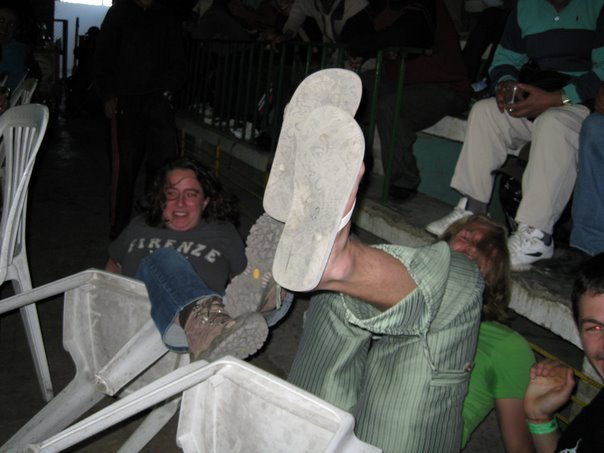
Cholitas

Another:

I think this is in Darjeeling, India. I’ve never been there, but at first glance, the pic reminded me of India. My mom, who is Indian, is always telling me about hill stations, so I googled a few. Am I close?

Not very. Another gets on the right continent:

Definitely Africa. Looks very much like an area of northeast Tanzania I visited a number of years ago called the Usambara Mountains. So I’d guess it’s somewhere in the main city of that area, Lushoto.

Another:

This looks like a scene from Mbarara, Uganda.  I could be wrong, but I’m in Mbarara now and it looks like the view from my window!

Another:

Baffling.

I believe that the mountain in the right background is Table Mountain which overlooks Cape Town, South Africa. This photo is obviously at elevation, but I can’t put together the distance and population on Google Earth. At first, I thought it was north of Cape Town, but I’m now convinced it is actually southeast. My best guess is in the foothills above Somerset West.

Another:

Can’t be South Africa, because it was South Africa last week. Nevertheless, I see a Toyota Yaris, which is common in South Africa. The Yaris appears (hard to say) like it may be right-hand drive, as I can’t make out a steering wheel on the left side. South Africa maybe. The multi-colored paving slabs in the parking lot below us are also typical of South Africa. I even found a company that makes them in Cape Town. The chairs too! They appear to be of a kind made by ISA Group in South Africa – from their web site, I’d say these chairs are “The Snapper” model. Regardless of last week, I’ve got to go with South Africa again. But where in South Africa?

Well, then you’ve got the two dirtbags, er, I mean, backpackers outside the cafe below, the one with the chairs. These two have a decidedly “Motorcycle Diaries” look about them. And if I know my comrades, they would desperately love to see Kruger National Park, but wouldn’t be caught dead in the company of fellow tourists (travelers, I mean, these guys are clearly travelers). So my guess is that the travelers are NEAR South Africa’s prime tourist target – Kruger – but spending as much time as possible in a shanty town so as to maintain their cred. Which leads me to: Kanyamazane, a township near Nelspruit. Can’t find any landmarks to confirm, but it’s a plausible theory. Final answer.

Another:

I can’t tell you the exact place, but this feels very much like some of the places I have seen up along the lower boundaries of the Aberdares range or Mount Kenya, although really it could be anywhere in tropical African highlands.  I will take a guess and say it’s Chuka on the eastern side of Mount Kenya.

Another:

I saw this photo and it brought me back to the three years I spent living in Guinea in West Africa.  But after looking at the photo a little longer, I don’t think it is Guinea. It’s too small to be a capital city, so must be some upcountry town, but there’s a lake in the distance and possibly a volcano – not things Guinea has. So I’m thinking it might be looking at the lakes in central Africa. I’m going with Bunia, DRC, which seems to be just far enough way from a lake and the mountains on its shore. It looks like it’s taken from a small guesthouse. You can tell by the clean courtyard and the well cared for bushes.  But I don’t know which one.

Another:

I give up. There’s pretty much nothing I can identify to indicate a precise city. I’m resigned to this week’s prize going to a flagstone-colourist or garden furniture distributor, or someone doing a doctorate in global windshield sticker formations. My first instinctive thought was Caracas, but the single-story shanty towns aren’t built up enough for the Latin American conurbations. Looks from the fencing like it could be East Africa, but given Uganda, Kenya and Tanzania all drive on the left, I’m inclined to say Rwanda, “the land of 1000 hills”. Given that the hills are all I have to go on, and I can’t see the shape for the clouds, I’m going to punt at Kigali, but am resigned to knowing I can’t find the actual window this week.

Another gets the right country:

This has got to be Addis Ababa, Ethiopia.  Eucalyptus trees, tin-roofed huts, the standard school structure on the hill to the left.  The thing that gives me some pause are the motorcycles in the parking lot; there just aren’t as many scooters or cycles as I’ve seen in other developing countries, but there are some.  As for specific location, I’ll go with Mount Entoto, looking south. I submitted a VFYW photo from Addis a few months ago, but I’ve since left, so this brought back some fond memories.

Another:

It looks like Addis to me; I was there for a week three years ago when we were adopting two children.  Of course, that’s the only African city I’ve ever been to, and since this looks like Africa, I’m shooting in a dark a bit.

Another:

Looks like Addis Ababa to me, more specifically a view from somewhere north of the city, Entoto or Gulele.

Another:

Addis? I’m always way wrong.

No one got the right city in Ethiopia. Details from the submitter:

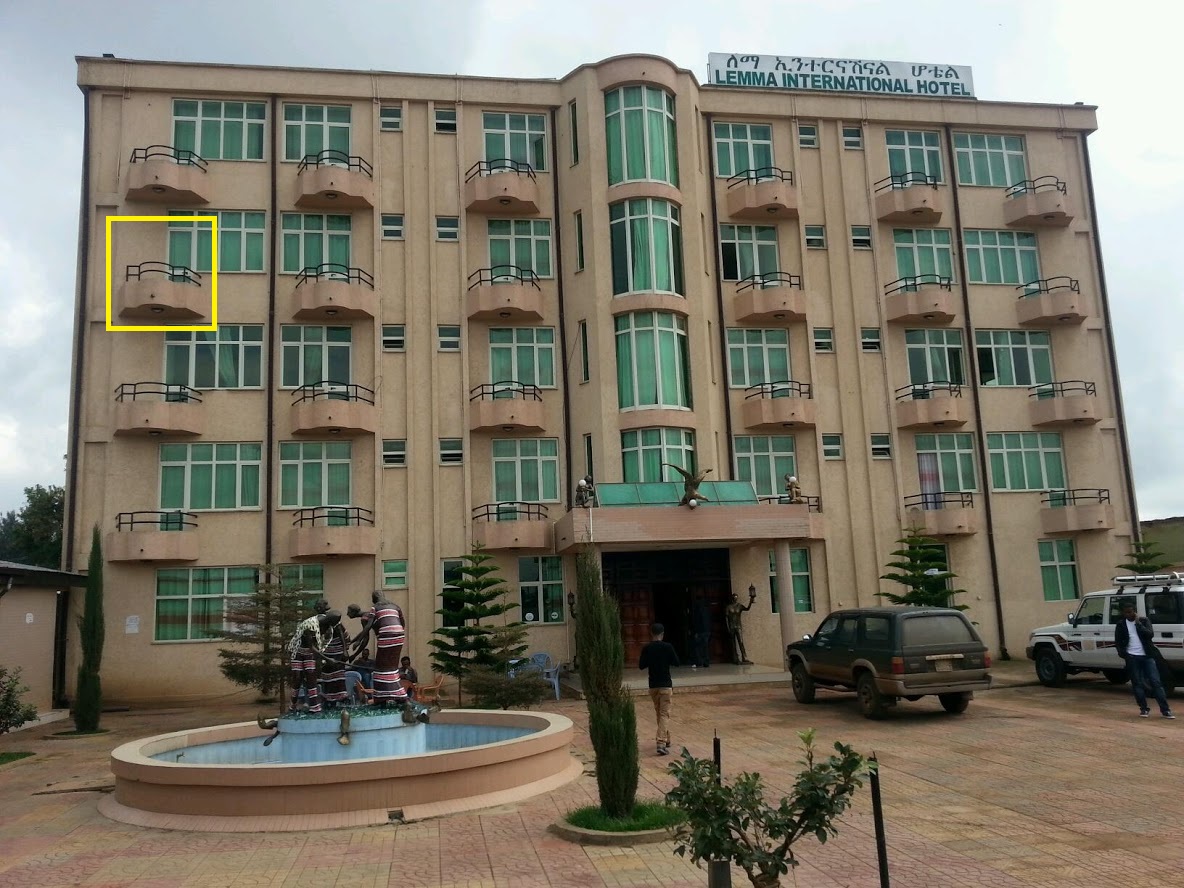
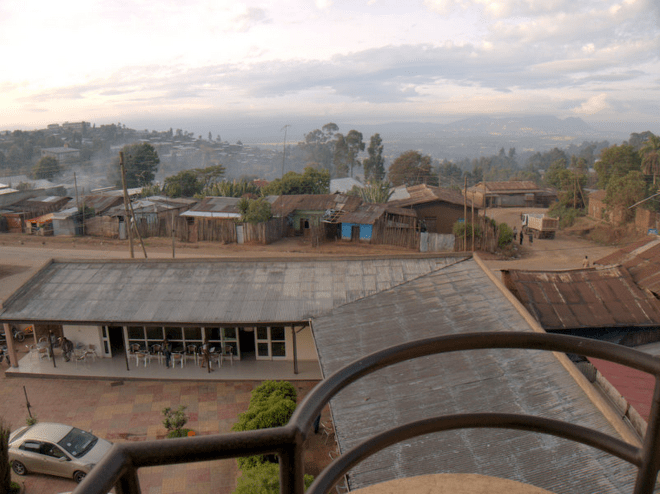
Lemma Hotel, Room 301, Hossanna, Ethiopia, taken 11/15/13

Of the four readers who guessed Addis Ababa, none of them are correct guessers of previous contests. The first two Addis entries posted above are from first-time guessers, while the second two are both from second-time guessers, making a tie-breaker very difficult. But since the second-to-last entry guessed “somewhere north of the city, Entoto or Gulele”, and Hossanna is actually south of Addis, the winner this week goes to the last entry, from the reader who is no longer “always way wrong.”

Update: A last-minute entry from our grand champion, prior to the deadline:
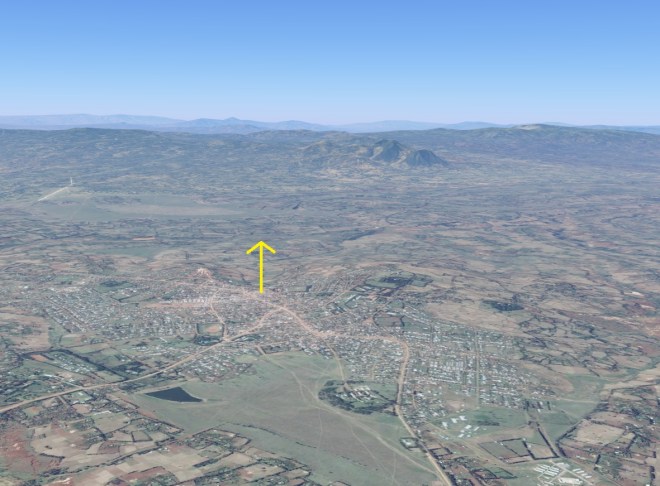
VFYW Hosaena Bird's Eye Marked - Copy

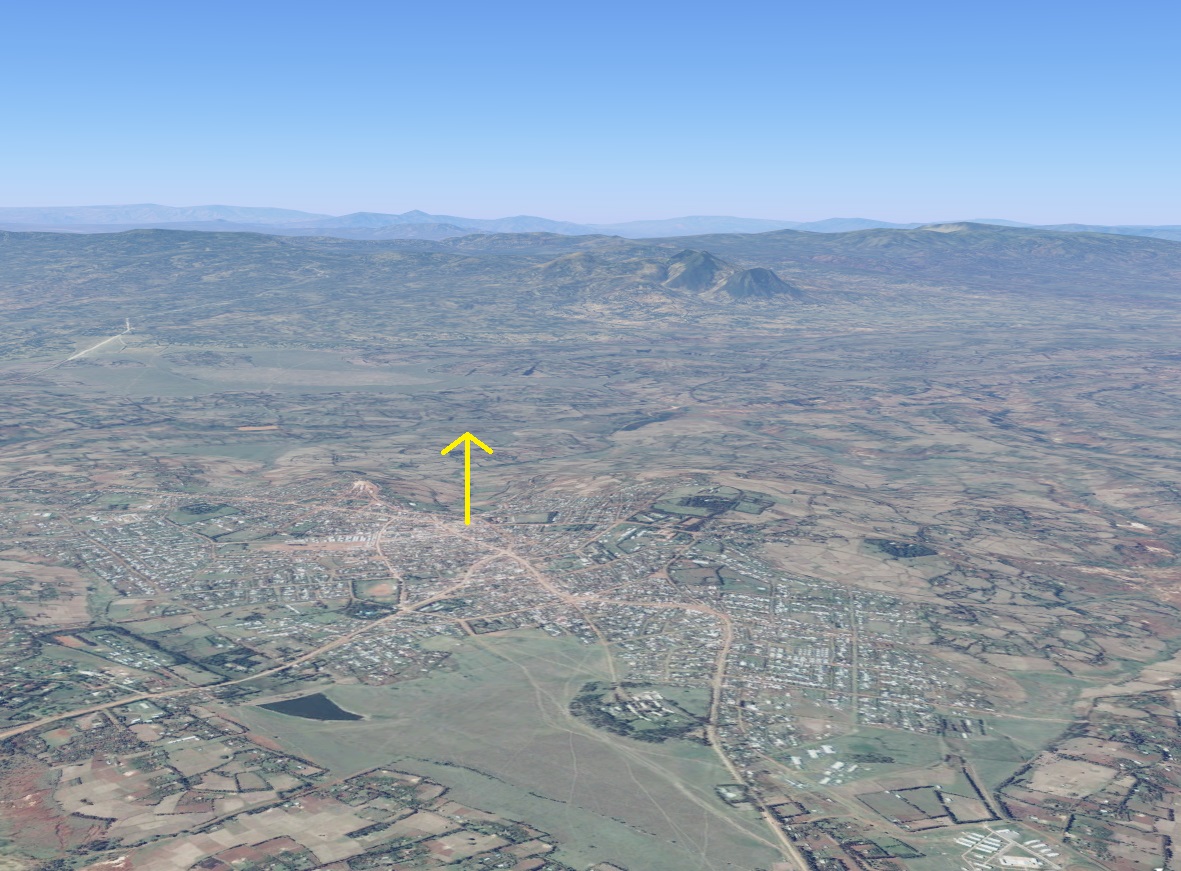
A few months ago a Dish reader mocked your choice of Addis Ababa for VFYW #161 because they thought it was too hard.  I can only imagine how they’re gonna feel about this week’s location. One thing’s for sure though; views are much harder to find when the satellite imagery shows an empty lot instead of the hotel the picture was taken from.

This week’s view comes from Hosaeana, Ethiopia, a small city located approximately 120 miles from Addis Ababa. The view looks south by southwest from the Lemma International Hotel along a heading of 208.42 degrees towards the hills just above Jajura. The exact coordinates are  7°32’40.76″N 37°51’3.00″E, and the picture was likely snapped on the fourth story (third numbered floor) of the hotel:
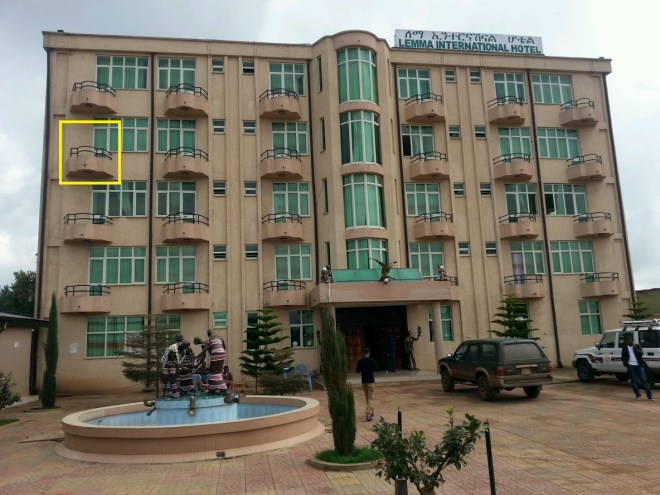
VFYW Hosaena Balcony Marked - Copy

Incredible.

(Archive)

Quote For The Day

francisshadow

“I prefer a Church which is bruised, hurting and dirty because it has been out on the streets, rather than a Church which is unhealthy from being confined and from clinging to its own security. I do not want a Church concerned with being at the center and then ends by being caught up in a web of obsessions and procedures … In her ongoing discernment, the Church can also come to see that certain customs not directly connected to the heart of the Gospel, even some which have deep historical roots, are no longer properly understood and appreciated. Some of these customs may be beautiful, but they no longer serve as means of communicating the Gospel. We should not be afraid to re-examine them. At the same time, the Church has rules or precepts which may have been quite effective in their time, but no longer have the same usefulness for directing and shaping people’s lives,” – Pope Francis, whose radical call to renewal and reform seems to be deepening still further.

It’s worth noting that the Pope has reaffirmed the church’s teaching on abortion, but left other “rules and precepts” in more ambiguous territory.

Know hope.

The Party Of No, No, No, No And Never

Dana Milbank destroys Ari Fleischer this morning – and deservedly so. Fleischer’s instant reaction to even the news of an agreement – without any knowledge of its details – was to denounce it. Dana calls the faster-than-a-jerking-knee response “mindless.” And how could one argue against that? To denounce something before you even know what it is … well, what else do you call it?

It is indeed mindless to denounce a temporary agreement for a six month negotiation to end the possibility of Iranian nuclear bombs without offering any feasible alternative. The one proffered – to actually tighten the sanctions that have already brought the Iranian regime to its knees – cannot work to achieve the desired result. Such sanctions would destroy Rouhani’s standing and credibility, split apart the global coalition on sanctions, help cement in Khamenei’s mind that no deal is possible with the West without national humiliation and regime change, and do nothing to, actually, you know, stop Iran’s nuclear program. It is a de facto argument for war as the only acceptable policy toward Iran.

So their policy is effectively another pre-emptive Middle East war on a country with no nuclear weapons with unknowable consequences and without any allies that would only delay, at best, an Iranian nuclear program. Does any of that sound familiar to you? Such a war would, moreover, strengthen the regime, dis-empower the opposition and all but guarantee that any Iranian regime would try even harder to get a nuclear deterrent.  You will find nothing, nothing in the GOP analysis that even begins to absorb the fact that the Iranian opposition also supports a civilian nuclear program. So they are also intent on picking the one fight with Iran that would unite the regime and the people.

Yes, Dana is right. The word for this is mindless. It is an attitude – a nasty, belligerent, impulsive attitude, the kind of attitude that gave us the Iraq war and Abu Ghraib, and made the world less, rather than more safe. Or consider Syria. The GOP was determined to stop a military strike and also denounced the UN-Russian deal to secure and destroy Syria’s WMDs! So that’s a no and a no. And the last no was to a policy that has been remarkably successful in ending a major source of WMD worry in the region. They opposed a policy that made Israel more secure.

As for healthcare, words fail.

They are running for Congress next year entirely on a platform of repeal and sabotage. They have offered nothing faintly serious to grapple with the dysfunctional socialized system America now labors under – no program to end the free rider problem or the pre-existing conditions problem or the uninsured problem or the costs problem. None, none, none and none. One reason I’ve been grateful for Ramesh Ponnuru and Yuval Levin’s proposals is that at least they exist, have some real merits and might be an alternative. But what’s staggering is how lonely their position is within the actual GOP.

This total nihilism on policy and nullification strategy toward the president, whatever he does, is also mindless for another reason. It is not good for the GOP. At some point, they will not get back the White House without an alternative, and the prospect of ending the insurance the ACA would provide without any alternative is a fool’s errand. It will backfire in the end, even though it may feel very good at the beginning. They are setting themselves up once again to appear as callous, intemperate and denialist. In the end, the American people will pick the party and the president with the constructive ideas rather than the destructive attitude. In this, the Republicans have entrenched Obama’s legacy and done nothing to shape it to more conservative ends. Again: mindless.

I care about this not just because I care about the country, but because I also deeply believe in a strong conservative force in politics. We don’t have that right now, whatever they say. We have a nihilist force. And it is cloaking itself in a political tradition they have long ago left in the dust.

An Ad Critic At Buzzfeed Doesn’t Work

Copyranter claims that one of the reasons he was fired from Buzzfeed was blowback from advertisers:

Because BuzzFeed had grown so big so fast, they didn’t want some loose cannon highlighting the shitty ads of potential or current big name advertisers. Yeah, that’s a pretty good reason to fire enhanced-buzz-11511-1378148297-13 (1)me. Being a visionary, I brought this point up in my initial interview with Ben Smith. He said, more or less, “You don’t worry about that, that’s my problem.” Boy oh boy did it become his problem. Ben Smith made me delete a post I did on Axe Body Spray’s ads, titled, “The Objectification Of Women By Axe Continues Unabated in 2013” (it was initially called something to the effect of “Axe Body Spray Continues its Contribution to Rape Culture,” but I quickly softened it). Get this: he made me delete it one month after it was posted, due to apparent pressure from Axe’s owner Unilever. How that’s for editorial integrity? Ben Smith also questioned other posts I did knocking major advertisers’ ads (he kept repeating the phrase “punching down”), including the pathetically pandering, irresponsible Nike “Fat Boy” commercial.

Ben responds:

We parted ways with Mark in because his tone and vision are really different from ours. In particular, it’s important to him to make charges — and in one case, imagine dialogue — without the reporting to support them. That’s something he is perhaps doing with me here. Our editorial team operates independently of advertisers, and I’ve never based a decision about reporting on an advertiser’s needs. In fact, if you glance at his page, you’ll see any number of unflattering posts about businesses, some advertisers and some not (and I’m not always in the loop on which is which); in both cases, I took the angry calls and emails and usually didn’t tell him about them, which is what I think an editor is supposed to do.

You can keep up with Copyranter at his new perch at Vice and his own blog.

What’s So Wrong With “Sucks”? Ctd

Many readers pounce on this post:

If your reader concerned about the use of “sucks” worries that he sounds like a queer studies major, then his worries are founded. By his logic, we should think about ceasing to use “jerk” (from the fuller “don’t be such a jerk-off!”). The British “tosser” has to go too. So does “ass-kisser”, which seems a perfect description of someone who sucks up to the boss – but ‘”suck up” probably has to go too, as well as “brown-noser” obviously. More generally, we should probably consider dropping “fuck” and its infinite permutations (certainly “this fucking sucks”), for we don’t want to suggest that there is anything wrong with fucking. Or are we allowed to keep “motherfucker” because we still disapprove of incest? What about “asshole” – isn’t that just a body part like all the others? Does the use of “asshole” as an insult display a certain puritanical revulsion at the body? I could go on indefinitely …

Another:

I’ve never considered “sucks” – as in “this broccoli sucks” – to be referring to a sex act. To me, it means the thing in question sucks the joy out of the situation. “This broccoli sucks the joy out of eating.”  Nothing derogatory about it.  Maybe it’s a guy thing to automatically jump to the sexual?

Another:

“Sucks” can actually be traced back to a phrase common among farmers during the Great Depression, who would remark that something “sucks hind tit.” This is because pigs, dogs, etc feed from their mothers, and from the perspective of the farmers the rear one was the least desirable (I’m not sure if there’s a reason for that, or just the general proximity to the rear end of the animal).  From there, the phrase was shortened and has certainly be considered low and offensive for a long time.  But that might speak more to the dirty minds of the censors than those who actually came up with the term.

Several more:

A quick Google search reveals that there is an ongoing debate as to the origin of the word.

According to the Urban Dictionary, it comes from jazz musicians.  A great musician on the horn could really “blow.”  Someone who was horrible sounded like they were “sucking” on the horn.  A recent defense of the word on Slate offered other sources, like farmers using the phrase “sucks hind teat” or British schoolchildren using “sucks to you” with no sexual connotation. And even if it does have a sexual origin, who cares at this point?  Your reader should just suck it up and let it be.

Another:

Back when I was a kid, I was able to convince my very skeptical father that I should be allowed to wear a “Boston Sucks” T-shirt (I’ve been a lifelong Yankees fan) because it was plausibly “Boston Sucks Eggs” rather than “Boston Sucks Shit”, which was how he interpreted it.  I seem to remember “Go suck eggs” was a relatively common insult (the functional if less inflammatory equivalent of “Eat shit and die”), even showing up in cartoons. I’m pretty convinced that that’s the etymological line that leads to everything sucking these days.

Another:

In 1986 or ’87, when I was a naive 6th-grader (maybe 7th), on the first day of class my science teacher laid down the rules.  She was a tough, progressive, feminist, four-Swatch-on-one-wrist-wearing bitch. Not butch, but maybe a lesbian – I don’t know.  I liked her right away.  In addition to saying things like, “This classroom is not a democracy, it is a monarchy, and I am the monarch,” she also said:

I will not tolerate the phrase “you suck.”  Do you know where that term comes from?  It comes from the root word “cocksucker” meaning one who sucks cocks, and in no instance is it appropriate in my classroom.  It is derogatory and offensive and will not be tolerated.

Holy Handjobbers!  I’d never heard such a thing, but boy did it stick with me.

Another:

So we have a word that may or may not have originally referred to a homosexual act and that is usually not used to refer to a homosexual act. I fail to see the problem. Etymology is not destiny. Just because the origin of the term is fellatio does not mean that’s what it means now.  Lots of words are secretly vulgar. “Pencil” shares a root with “penis”. “Avocado” is an Aztec word meaning “testicle”. “Scumbag” means condom. I will give you the pleasure of looking up the etymology of “pumpernickel” on your own. Words change. Usage matters more than history.

(I can’t believe I just spent half an hour researching “suck”. This is why I read your blog.)

Tweeting For Tradition

The Herdy Shepherd isn’t your typical social media star: 

Our shepherding work in the English Lake District is all about continuity and being part of a living cultural tradition that stretches back into the depths of time. Our work is often little changed from the way things were done when the Vikings first settled these valleys. Even our dialect is peppered with Norse words. I like old things, old ways of doing things, old stories, old places, and old people. I’m deeply conservative with a small ‘c’. Ask any half decent economist and they’ll tell you that most new ideas are a waste of time, most new ideas fail. Our way of life results in fairly conservative people suspicious of pointless chatter and new technologies for the sake of newness. I am, in short, about as unlikely to get excited by something like Twitter as anyone alive.

And yet, when he “reluctantly” accepted a cell-phone upgrade, he found that he “could now defend the old in my own quirky and probably misguided way”:

Tweeting is kind of an act of resistance and defiance, a way of shouting to the sometimes disinterested world that you’re stubborn, proud, and not giving in as everywhere else is turned into a clone of everywhere else.

I’m not alone, there are some amazing people tweeting about their lives on Twitter. They are fascinating unique lives that were often invisible before the ability to self-publish on social media. I’d like to think that Twitter has given people that had disappeared from view – obscured and crowded out by the loud noise of modernity – the chance to raise their voice, tell their stories, share their lives, and to say “Hey, we didn’t go away, we are still here, and you might just be interested because what we do is important to everyone.”

Being able to share your life enables other people to see you for the first time, to see past clichés and stereotypes. And since the 1960s farming has had a rather poisonous image for some people. Now, for the first time, lots of folk following us on Twitter actually know a farmer. They know what we do each day and that we are essentially decent people doing our best sometimes against the economic and natural odds. They see that we have a love of what we do, and a deep respect for the landscape and wildlife around us. … Most new ideas may fail, and most new ideas might be rubbish – but sometimes a new idea, a new technology, empowers you to defend the old against the new, and some old things are worth defending.

Will Marriage Equality Come To Israel?

Despite Israel’s progressive policy when it comes to gays, Liam Hoare doubts it will join the growing list of countries with marriage equality:

Marriage is an exclusively religious institution in Israel, with separate religious authorities for Jews and Muslims, Christians and Druze. For Israeli Jews, marriage policy is dictated by the Chief Rabbinate, which is under the exclusive control of the Orthodox—and firmly opposed to gay marriage. Since the country has no civil marriage, gay couples seeking to marry within the borders of Israel are out of luck (as are any Jewish Israelis seeking a non-Orthodox marriage ceremony).

This arrangement—whereby marriage is in the control of the Orthodox rabbinate—is part of what Israelis call the status quo: an understanding between secular and religious Jews regarding the balance between religion and state. The status quo affects not only marriage, but also the education system, family law, supervision of kosher restaurants, and the opening of shops and public transportation on shabbat.

Altering the status quo, particularly concerning something as delicate as marriage, is the third rail of Israeli politics. This is not only because of the power and importance of ultra-Orthodox parties in the Israeli political system, but also due to a fear that changing the status quo would lead to the encroachment of secular values upon the religious—and vice-versa. Among Israel’s many political parties, only Meretz—a left-wing, social democratic faction—proposes to upend the status quo entirely by separating religion from state and legalising civil marriage.

A Sinking State

10706932715_9075899f74_c

Goldberg reports from the South Pacific island nation of Kiribati, a “flyspeck of a United Nations member state” where locals are nervously eyeing the rising waters:

If scientists are correct, the ocean will swallow most of Kiribati before the end of the century, and perhaps much sooner than that. … Before the rising Pacific drowns these atolls, though, it will infiltrate, and irreversibly poison, their already inadequate supply of fresh water. The apocalypse could come even sooner for Kiribati if violent storms, of the sort that recently destroyed parts of the Philippines, strike its islands. For all of these reasons, the 103,000 citizens of Kiribati may soon become refugees, perhaps the first mass movement of people fleeing the consequences of global warming rather than war or famine.

This is why [Kiribati’s president Anote] Tong visits Fiji so frequently. He is searching for a place to move his people. The government of Kiribati recently bought 6,000 acres of land in Fiji for a reported $9.6 million, to the apparent consternation of Fiji’s military rulers. Fiji has expressed no interest in absorbing the I-Kiribati, as the country’s people are known. A former president of Zambia, in south-central Africa, once offered Kiribati’s people land in his country, but then he died. No one else so far has volunteered to organize a rescue.

More bad news for the I-Kiribati: New Zealand recently denied a Kiribati citizen’s high-profile bid f0r refugee status.

(Photo: A scene in South Tarawa, the capital of Kiribati. By Australian Aid)