“Splash” is something I made to learn the basics of fluid sims in RealFlow. Feels like I haven’t even scratched the surface yet, but for now I can hardly wait to get back to Mograph, Xpresso and the rest of it.
Beinart thinks Obama’s speech today was “a great, even profound, speech”:
It was a great speech because Obama rejected the Jewish right’s endless rhetoric about Israel having “no partner.” He defended Mahmoud Abbas and Salam Fayyad, and told Israelis what their own security officials know: that Palestinian leaders in the West Bank, at political risk to themselves, have in recent years helped save countless Israeli lives. It was a great speech because Obama asked Israelis to “look at the world” through the eyes of a Palestinian child who sees her parents controlled and humiliated by a foreign army. Contrast that to Benjamin Netanyahu, who when referring to the Palestinians’ “plight” and how much “they have suffered,” in his 2000 book, A Durable Peace, put those phrases in quotation marks, as if to suggest that real Palestinian suffering does not exist.
Yossi Klein Halevi calls it perhaps ” the most passionate Zionist speech ever given by an American president”:
Of course, his embrace had an explicit message for Israelis: Don’t give up on the dream of peace and don’t forget that the Palestinians deserve a state just as you do. But as the repeated ovations from the politically and culturally diverse audience revealed, these are messages that Israelis can hear when couched in affection and solidarity. After four years of missed signals, Obama finally realized that Israelis respond far more to love than to pressure.
Elliott Abrams remains convinced that Israel has no partner for peace:
Obama was most persuasive when discussing American-Israeli bonds, and least persuasive in his descriptions of the Arab Middle East. In his remarks today he pictured an Arab world, and a Palestinian political system, yearning for peace with Israel through negotiated compromises. This ignores the vast ocean of anti-Semitism in the Arab world, and the inculcation of hatred of Jews and Israel in generation after generation of Arabs—including Palestinians. And it ignores the rising tide of Islamism in the region, which threatens to engulf all those political figures who would really like a compromise peace. The Arab world Obama described is a place far more desirous of, and far closer to, peace with Israel than the one Israelis actually see around them.
I spoke to several members of the audience, who confirmed my impression that Israelis just wanted to know that he liked them. It’s hard to understand this from the U.S., but the idea really did take hold here that Obama genuinely hated Israel. So this whole trip is a bit of a revelation for ordinary Israelis. On the other hand, I’ve run into people who were surprised President Obama took it too strong to Bibi (one conservative-leaning Israeli I just ran into suggested that Obama was interfering in Israeli politics as payback for Netanyahu’s alleged meddling in the American election).
Here is the progression of his speech. Having demonstrated empathy for Israel, Obama then asked Israelis to feel empathy for Palestinians. Of course there is only so much Obama can do. He can’t make Netanyahu negotiate peace, nor can he make Palestinians accept one. But as much as he could do with a speech, Obama did today. He probably wishes he gave it a long time ago.
Alyssa studies how the entertainment industry processed the Iraq War, noting that most films and TV shows focused on soldiers’ experience rather than addresing the larger political backdrop:
[I]t’s hard to think of a single movie about the war in Iraq that actually addresses why soldiers were sent there in the first place, even the ones with serious ambitions. Armando Iannucci’s biting satire In the Loop examines how misstatements and diplomatic gaffes can be manipulated to whip up public opinion, but doesn’t quite get to the dark and murky depths of the misinformation that contributed to our going to war in Iraq. And of the few movies that address policy or bureaucracy that govern who serves, for how long, how they’re treated when they’re in Iraq, and what resources are available to them when they come back, most can tackle only one issue at a time, rather than recognizing the matrix of cultural and organizational factors that shape the veteran experience.
iFixit’s Kyle Wiens makes the case that being locked out of our technology is an issue that goes beyond smartphones:
Who owns our stuff? The answer used to be obvious. Now, with electronics integrated into just about everything we buy, the answer has changed. We live in a digital age, and even the physical goods we buy are complex. Copyright is impacting more people than ever before because the line between hardware and software, physical and digital has blurred. The issue goes beyond cellphone unlocking, because once we buy an object — any object — we should own it. We should be able to lift the hood, unlock it, modify it, repair it … without asking for permission from the manufacturer. …
This isn’t an issue that only affects the digerati; farmers are bearing the brunt as well. Kerry Adams, a family farmer in Santa Maria, California, recently bought two transplanter machines for north of $100,000 apiece. They broke down soon afterward, and he had to fly a factory technician out to fix them. Because manufacturers have copyrighted the service manuals, local mechanics can’t fix modern equipment. And today’s equipment — packed with sensors and electronics — is too complex to repair without them. That’s a problem for farmers, who can’t afford to pay the dealer’s high maintenance fees for fickle equipment. Adams gave up on getting his transplanters fixed; it was just too expensive to keep flying technicians out to his farm. Now, the two transplanters sit idle, and he can’t use them to support his farm and his family.
A video segment from Democracy Now shows deeply disturbing images of Iraqi newborns with extreme birth defects reportedly traced to the use of depleted uranium in weaponry deployed by the US military. According to investigative journalist Dahr Jamail:
Dr. Samira Alani actually visited with doctors in Japan, comparing statistics, and found that the amount of congenital malformations in Fallujah is 14 times greater than the same rate measured in the cities of Hiroshima and Nagasaki in Japan in the aftermath of the nuclear bombings. These types of birth defects, she said—there are types of congenital malformations that she said they don’t even have medical terms for, that some of the things they’re seeing, they’ve never seen before. They’re not in any of the books or any of the scientific literature that they have access to. She said it’s common now in Fallujah for newborns to come out with massive multiple systemic defects, immune problems, massive central nervous system problems, massive heart problems, skeletal disorders, baby’s being born with two heads, babies being born with half of their internal organs outside of their bodies, cyclops babies literally with one eye—really, really, really horrific nightmarish types of birth defects. And it is ongoing.
I do not understand the outrage at CNN’s reporting. Can we not discuss how this will impact the guilty? Can we not have any compassion for the guilty? Full disclosure: I served 4 1/2 years in prison for a violent felony when I was 19 years old. Fast-forward 19 years and I am in a Master’s Marriage and Family Therapy program specifically to help people like those two teenagers. Believe it or not, they are people and they will be entering society in one or two years and it’s in society’s interest to rehabilitate them. I believe the first step is having compassion for people who commit crimes. This does not mean we cannot abhor the crime. We must. But we must also get them to take responsibility and understand the impact of their crime. That powerful video showed me that at least Ma’Lik Richmond seemed to understand the severity of his actions. And to everyone who detests these guilty teenagers, never fear; they will be dealing with the repercussions for the rest of their lives, for there is no label worse than “rapist”.
Another writes:
Honestly, I don’t see how this story is the least bit sympathetic to the rapists. If I were one of those boys, the best thing, the most sympathetic thing CNN could have done would be never to have turned this local crime into a national story in the first place. Now, not only does everyone in their hometown know about it, but millions of people across the country.
Another:
Isn’t the young men’s narrative a useful one alongside the victim’s? I mean, wouldn’t young men who think they have a bright future or want to create one, take the crushed dreams of the guilty young men as a cautionary tale? The victim’s story alone might not be enough of a compelling story to keep young men out of trouble.
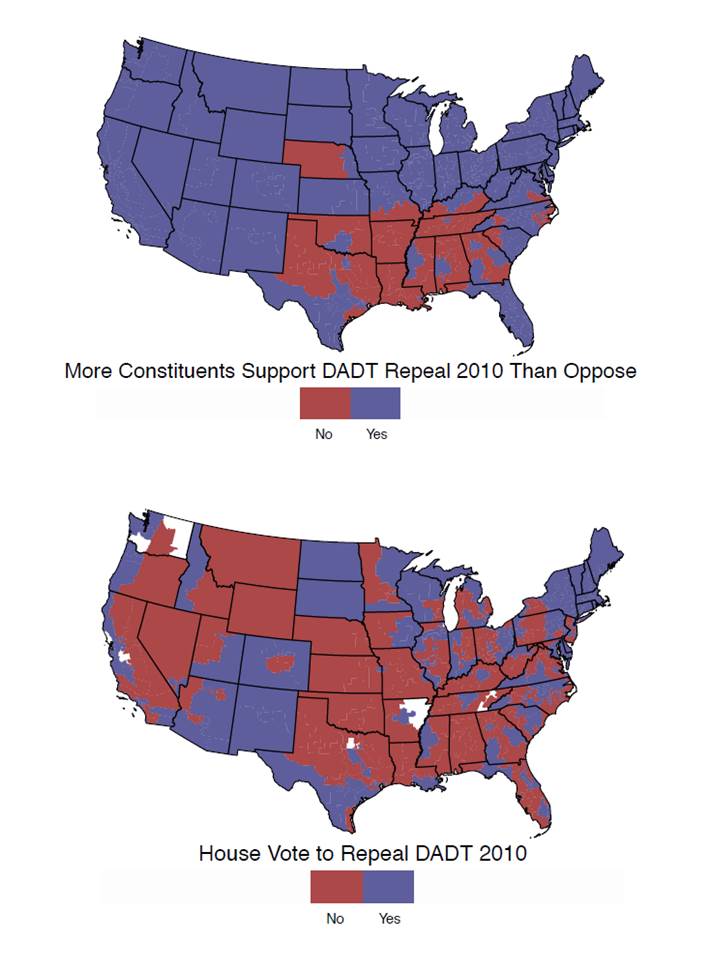
Erik Voeten flags a paper (pdf) on the conservative bias of Congress. One finding:
[O]n average public support in a district for a liberal policy towards gays needs to be well over 50% for a Congressman to vote in favor of that policy. Moreover, when opinion in a District changes, Democrats are much more likely to change their votes than Republican Congressmen. The figure [above] illustrates their findings for the Don’t Ask Don’t Tell issue. There were only small pockets in the country where majorities opposed changing the policy. Votes against it in Congress were much more numerous than we would expect from public opinion.
Now that’s some writing I can relate to. It’s Charles Pierce’s high-spirited rant against Ezra Klein’s hymn to Kenneth Pollack. Money quote:
Let Pollack go to Walter Reed and avoid those pesky moralistic arguments.
“‘We’ll never know,’ Pollack replied. ‘History doesn’t reveal its alternatives. But I think the evidence out there is that we could have handled this much better than we did, and that it didn’t have to be this bad. The best evidence for that is the surge. In 18 months, we shut down the civil war and reversed the direction of Iraqi politics.'”
In brief, fuck you. History “revealed its alternatives” at the time. You did your damndest to make a buck while shutting them down, and 65 people died in car bombings this week as a demonstration of how the surge reversed the direction of Iraqi politics. As for Ezra, well, he should go and sin no more. It is encouraging that he no longer believes in fairy tales.

 The Dish