Dreznerhas some fun translating the HBO series into a parable of international politics:
Ray is a coffee-shop manager, the oldest member of the group, and far and away the most cynical and angry character on the show. He scorns just about everything that every other character says or does, but seems unable to make much of himself. Ray is Russia personified.
In contrast, Adam — Hannah’s former beau — is China. He’s a force to be reckoned with, but it’s not entirely clear whether he’s socialized into how the rest of Brooklyn society behaves.
One could posit that Hannah’s relationship with Adam represents the promise and peril of the “responsible stakeholder” concept. On the one hand, Hannah seems to use her “soft power” to entice Adam into liking her a lot more than he originally thought — in other words, getting him to want what she wants. He begins to socialize with Hannah’s circle of friends. At the same time, Hannah is unsure just how much she wants to engage Adam, reflecting America’s ambivalence in its relationship with China. At the end of the first season, she is quite uneasy about moving in together. The result is an Adam that, much like China, is angry and frustrated at his treatment by others — which in turn leads to bellicose behavior, which in turn leads Hannah to call the cops and try to contain his behavior. The breakdown in the relationship between Hannah and Adam is yet another example of the security dilemma destroying lives.
Recent research has determined that DNA molecules decay too quickly to make it a reality:
“We believe this is the last nail in the coffin,” of claims that scientists can get DNA from million-year-old fossils, says Morten Allentoft, a scientist from Copenhagen’s Natural History Museum who worked on the project. Even in ideal preservation conditions, the scientists calculated that every single DNA bond would be broken at 6.8 million years: The youngest dino fossils are 65 million years old. And because scientists need long stretches of DNA to replicate it, they estimate that the oldest usable DNA will actually be one to two million years old. The record holder right now is DNA found in ice cores, at 500,000 years old.
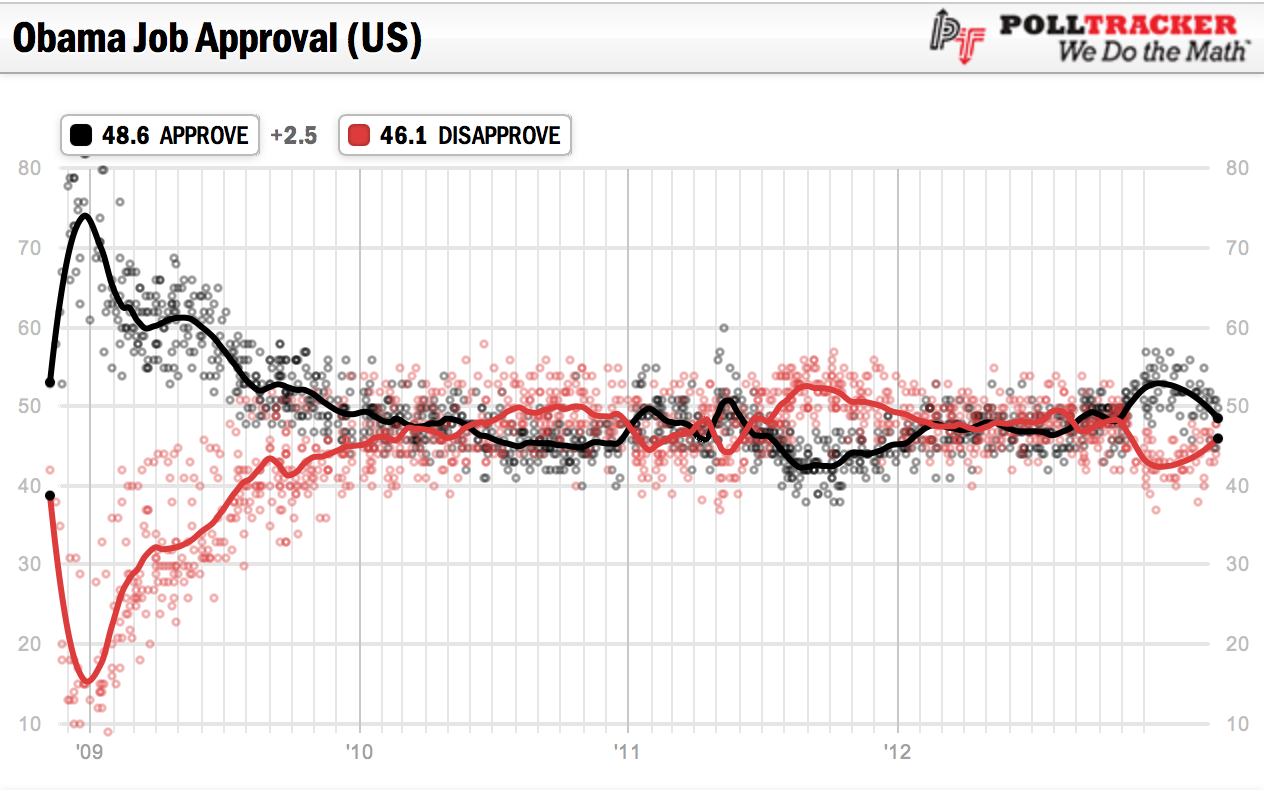
Nate Cohn is unfazed by Obama’s approval ratings slide:
The ratings’ steady decline isn’t surprising. So long as Republicans remain uniformly dissatisfied with the president, Democrats need to be all but entirely unified for Obama’s approval ratings to eclipse 50 percent. Even support from 85 percent of Democrats, still an impressive show of party unity, wouldn’t be enough to keep the rating above 50. (YouGov/Economist and Washington Post polls both show Obama down to 87 percent approval among Democrats, while McClatchy/Marist showed Obama at 82 percent.) With tepid economic growth and a never-ending stream of manufactured crises to diminish the public’s faith in Washington, Obama wasn’t likely to maintain that kind of party unity. Even without those problems, it was only a matter of time before Obama’s ratings returned to the upper forties, which is more or less where he’s been for the last three years, with only the debt ceiling crisis causing his numbers to dip further. So it’s safe to assume that what we’re witnessing is merely a modest correction rather than the beginning of a severe drop in support.
Kilgore wonders whether Portman’s flip on marriage will have a ripple effect:
Portman’s move could trigger a wave of conversions in the Republican ranks, and that in turn could break down legal resistance to same-sex marriage. Already we’ve seen most conservatives abandon the “traditional marriage” cause as a backlash generator and vote mobilizer. Now we’ll see if votes change in state legislatures, and the walls come tumbling down.
I’ll point out the way that Marco Rubio addressed the question at CPAC:
Just because I believe that states should have the right to define marriage in a traditional way does not make me a bigot.
Indeed. But that’s a defense of federalism, not an attack on marriage equality per se. I know I’m splitting hairs here – but my main worry is that over-reach by SCOTUS this June might hand the advantage on this issue back to the right, just after it appears to being settled in the court of public opinion in the states. I’m also struck by Jennifer Rubin’s account of a marriage equality event at CPAC last night:
The event featured, among others, GOProud Executive Director Jimmy LaSalvia. Former CEI chairman Fred Smith moderated the panel, which included Jonah Goldberg, GOProud and Freedom To Marry adviser Liz Mair, GOProud board member and author Margaret Hoover, and me. To his credit, NRA president and CPAC board member David Keene attended…
LaSalvia made the conservative case for gay marriage (“We should want everyone to settle down, be monogamous, get married and be happy – even gay people”) and for the GOP to shed the image of intolerance toward gays, which “contributes more to conservatives’ image problem than any other, because it’s an issue that cuts across all demographic groups.” And he spoke more generally about the need “to seriously examine and recalibrate our movement to build a new coalition that can win,” one built around a common understanding of the centrality of liberty but one that allows for differences …
LaSalvia received a boisterous ovation. There were polite differences among the panelists, with Goldberg encouraging federalism and Hoover making the case that marriage is a “fundamental right” recognized in a host of Supreme Court decisions. But there was widespread agreement that support for gay marriage is consistent with modern conservatism and that opposition to it is a barrier to political success for the GOP.
That’s a huge shift – in line with the British Tories. One small hat tip: Liz Mair has done amazing work on this for years, and I personally want to thank her. Nonetheless, Jonathan Bernstein bets that the 2016 GOP nomination won’t feature a serious debate over marriage:
I’m still guessing that Portman will remain the exception, and that opponents of marriage will still maintain a solid veto over the presidential nomination in the 2016 cycle. To some extent, that’s because public opinion within the GOP, and presumably especially among the presidential primary electorate, still runs overwhelmingly against marriage equality. It’s possible that could change, especially if GOP elite opinion continues to change, but right now it’s hard to see a same-sex marriage supporter benefiting even in a large field in which staking out a minority position could have some advantages.
We’ll see, won’t we? But this change is accelerating, not losing steam.
Bhaskar Sunkara, in a leftist reading of the hit series, derides its lack of ideological kick:
After Obama’s election, liberals tried to make over Washington in The West Wing’s image—post-political, free of legislative rancor, fixed to the will of a single charismatic president. But they’ve run into a roadblock, an obstructionist Congress unbound by Sorkin–style civility. No wonder so many liberals eat up the seediness in House of Cards. Underwood is a leading member of the House of Representatives, an institution beset for decades by low approval ratings and lurid scandals. It’s not just legislative policy that is called into question by House of Cards, but the motivations of those doing the legislating. …
But easy cynicism shouldn’t be mistaken for considered political critique. House of Cards’ message is simple: Bad men and women inhabit Capitol Hill. It’s superficially progressive. Like the series’ creators, liberals have a tendency to see the structures of American political life—our Constitution, for example—as being inherently sound instruments of the popular will, rather than systems meant to protect against mob rule.
I have two episodes to go. I don’t look at this inspired miniseries as ideological. It has some clumsy compressions, some melodrama, and a main character so close to Shakespeare’s Richard III I wonder whether Kevin Spacey’s breaking the fourth wall isn’t some sly reference to Richard’s chillingly fun soliloquies to the audience. Robin Wright is like adding Lady MacBeth to Richard III.
But in general, it captures the Washington I know better than almost any movie I have seen. From the power struggle between old and new media to the wonderful humanity of Peter Russo and the subtle but pervasive influence of lobbyists and whom they represent, it takes its time to re-create reality.
My one criticism is that it is too cynical.
Washington is full of the characters you see in the series, but it is also full of people trying to make the world a little better, trying to maneuver their way through the avenues of power without accumulating too many scalps, believers and dreamers and genuinely hard-working folk doing their best. They’re a minority, of course. This is politics. But they are there – and not only among the ranks of the non-profit martyr of Claire’s charity. And there are bloggers more ethical than Zoe Barnes. But her ambition is of an Ezra Klein magnitude.
I like the fact that Underwood is a Southern Democrat. The show’s head writer explains his reasoning behind the choice:
The broader point of “House of Cards” is that anyone is fair game, no matter what side of the aisle they are on. You could easily write this story about a Republican congressman as well, but we wanted to dramatize the fact that these sort of creatures live on either side of the aisle. The things people will find objectionable about Underwood will be about deeper ethical belief systems that transcend political affiliation. If you look at Underwood and what he’s actually doing, he is not someone who binds himself to any particular ideology. His ideology is quicksand, and he would say that the only way to truly survive in Washington and to be effective is to be adaptable.
And he would be right. Which is why the GOP, if it does not mellow its ideological rigidity, is in trouble.
Manjoo wonders which money-losing product the company will kill next:
[H]ow about Google Scholar, the academic papers search engine? Sure, this extremely useful service is in keeping with Google’s larger mission to make the world’s knowledge universally accessible. But Google does not display any ads in Scholar, and I can’t think of any other way it’s padding Google’s bottom line. So might it, too, disappear some day?
If Google killed off Scholar next year, there would be no easy substitute. Discovery of academic research would fall back into the hands of major publishers. I remember that regime and, put simply, it was costly and often not worthwhile to search. Scholar changed all of that.
Allahpundit ponders Portman’s reversal on marriage equality:
I’m loath to scold the guy for his reasoning given that I agree with him and that he’s taking on a bit of political risk in doing this, but why did he need his son to come out to get him to look at this issue from the perspective of someone who’s gay? He’s been a professional legislator for years; he’s supposed to consider all sides of an issue when deciding which policy to support. That’s a surprisingly parochial approach to a national debate that’s been rolling around for a solid decade now. Makes me wonder if his feelings on the subject really did change recently or if he’s always quietly been open to gay marriage but only felt politically safe to announce it once he discovered his son’s orientation. Conservative primary voters may be less likely to hold it against him if they think it’s a decision driven by fatherly love for his son.
Portman ought to be able to recognize that, even if he changed his mind on gay marriage owing to personal experience, the logic stands irrespective of it: Support for gay marriage would be right even if he didn’t have a gay son. There’s little sign that any such reasoning has crossed his mind.
I do wish conservatives could demonstrate a little empathy even for people and causes that don’t directly affect their own lives, but it’s not as if this is an exclusively conservative thing. It’s a human thing. Personal experience always touches us more deeply than facts and figures, and in the case of gay marriage we all knew this was how progress would be made. People would see gay characters on TV and shed a little bit of their discomfort. They’d learn that old friends are gay and decide they wanted to stay friends anyway. They’d learn their children are gay, and decide that they still wanted the best for them, even if that means supporting same-sex marriage.
And Yglesias asks, “if Portman can turn around on one issue once he realizes how it touches his family personally, shouldn’t he take some time to think about he might feel about other issues that don’t happen to touch him personally?”:
Senators basically never have poor kids. That’s something members of congress should think about. Especially members of congress who know personally well that realizing an issue affects their own children changes their thinking.
Micah Cohen puts Hillary’s 2016 early-polling lead in historical context:
Her lead in the polls we have so far exceeds that of any other candidate — of either party — in any election cycle in our sample. Many observers have pointed out that Mrs. Clinton also had a large lead in early polls of 2008 and yet lost that race. But her 2016 lead over Mr. Biden (33 percentage points) exceeds even her 2008 lead over Mr. Obama (22 percentage points). And she may benefit from the sense of being “the next in line,” having been the runner-up in her party’s last open contest — a dynamic seen in several recent Republican primaries.
RSS has been dying for years — that’s why Google killed Reader. It was a lovely open format; it has sadly been replaced with proprietary feeds like the ones we get from Twitter and Facebook. That’s not an improvement, but it is reality. Google, with Reader, was really providing the life-support mechanism for RSS. Once Reader is gone, I fear that RSS won’t last much longer.
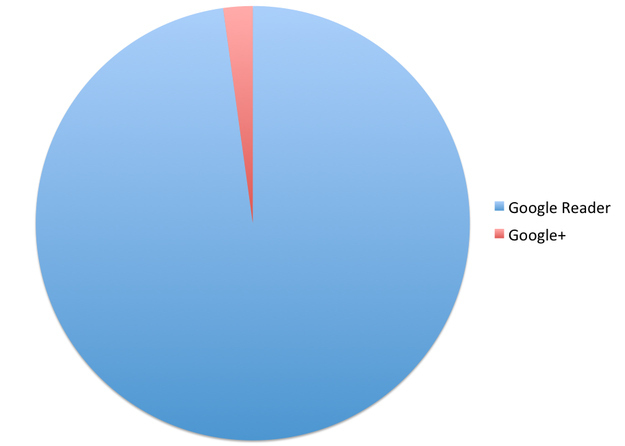
That would be a sad coda to the death of Aaron Swartz, who at the age of 14 was part of the team that invented RSS. The end of Google Reader, and RSS more generally, could also hurt blog traffic. Buzzfeed provides the above chart:
According to data from the BuzzFeed Network, a set of tracked partner sites that collectively have over 300 million users, Google Reader is still a significant source of traffic for news — and a much larger one than Google+. The above chart, created by BuzzFeed’s data team, represents data collected from August 2012 to [yesterday].
Josh Green unpacks the politics of the sequester’s defense cuts:
Anti-tax activists steamrolled the defense crowd. Why? The answer probably lies in the composition of the Republican caucus, especially in the House: Nearly half its members—48 percent—were elected in 2010 or after. These Republicans are genetically different from those who held power in the 1980s and ’90s.
They came of age during a period of two failed wars in the Middle East and exploding budget deficits. “This is a group that got elected to rein in spending, not to protect Cold War-era defense,” says David Wasserman, House editor for the nonpartisan Cook Political Report.
But individual Republicans are starting to complain about sequester cuts that impact their districts.