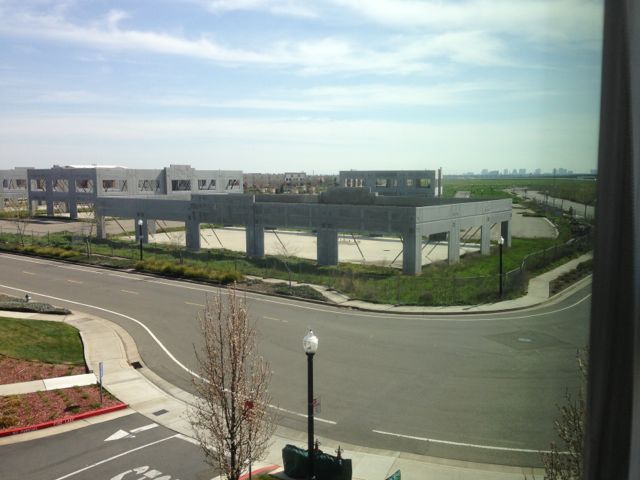
The View From Your Window Contest: Winner #144

Screen Shot 2013-03-08 at 8.13.47 PM

A reader writes:

I see we’re going back to harder contests after the hundreds of winners in the previous weeks. The street light, no standing sign, and fire lane tell me that this view is definitely somewhere in the US. The haze in the distance kind of reminds me of the exurban areas of Los Angeles. So I’ll guess Riverside, California, and leave it at that. I don’t think 10 hours of internet searching would get me any closer. Perhaps this is one of those construction projects that stopped mid-recession and never got started again?

Another:

Has to be Las Vegas! All the tells are there: the American “no parking” sign and lamppost; flat barren landscape, the big city buildings in the distance.  This must be some of the construction that surrounds Las Vegas, started in the boom times and stopped suddenly when everything crashed.  As you fly into Las Vegas you can see how the outskirts of the city were once being developed, housing subdivisions that have streets and sidewalks, but no houses (or even worse, one or two houses in an otherwise empty development).  I’d give 10:1 odds that I’m correct!

Another:

Tough one. I was going to guess Fargo, North Dakota, because the land is dead-flat and there’s so much new construction going on there, but there’s no snow. That skyline in the background looks a little like Tulsa, and that’s what I’m going with.

Another:

Just a wild guess mostly, but it is obviously a picture next to a decent, but not overly large, city.  The skyscrapers are tall enough to give a good view from ~5-10 miles away.  The signs are English, and the climate seems to be similar to that of Texas, warm and relatively dry.  Since it doesn’t seem the downtown is either dense, or large, enough for Houston or Dallas that leaves San Antonio.  Now to see the e-mail from someone who picks the exact window.

Another:

SXSW started this week, and as I have no clue where in the world this is, why not guess Austin, Texas?

Another:

This picture feels like the Meadowlands area.  The long expanse of undeveloped. swampy-looking land leading up to a series of nondescript urban buildings.  A Google image search suggested this hunch might be correct (e.g. see attached – source here).  Other clues: the “fire lane” marking puts us in an English-speaking country, and that no parking sign looks like the ones in the NYT metro area.  the town that the Meadowlands are in is called East Rutherford, and a Google Maps search of it shows certain sections that appear isolated and with long windy roads.

Another:

I would rate this one as nearly impossible. A flat area in the US.  It’s a new office park, or something similar, so perhaps a growing area. A few medium sized buildings in the background. I’ll take a wild stab and guess Lincoln, Nebraska, somewhere near I-80 and Hwy 77.

A reader nails the right city:

I immediately thought “Sacramento, CA” when I saw this photo. Unlike most of America at this time of year, California’s Central Valley is green. My wife and I lived in Sacramento for two years, and we would visit Davis, CA as often as we could (they have a great Farmer’s Market). From the east side of Davis, you can often see Sacramento in the distance; so I’m going with Davis, CA, near El Macero Estates.

Another:

For the first time ever, I think I recognize the location. It looks like it was taken in Elk Grove, California, a suburb south of Sacramento. That looks remarkably like the half-finished, abandoned mall at the south end of the city limits. But I don’t recall there being any buildings near that lovely wasteland that are actually occupied as residences or businesses. Still, it does look like Sacramento’s petite skyline in the background. Unfortunately, there are probably several places around here that would allow a view such as this, and around the country as well. At least I finally have a guess based on more than intuition.

Another:

Around Sacramento stalled developments were a common site. Though many of the housing projects have started up again, check out this similar pre-ruin south east of Natomas in Elk Grove:

Screen shot 2013-03-09 at 10.18.24 AM

Neither project has moved an inch since the financial crisis.

Another gets the right part of Sacramento:

This area is called Natomas and the hotels serve the Sacramento International airport near by. Two doors down is a hot dog place with late night drive through. For years these building skeletons have waited for real estate to turn around. The blocks are sketched out and the cement sides raised but there hasn’t been the money to finish them. I’ve stopped there at dusk before to look at them. To the north are the rice fields of the Sacramento valley. Natomas grew from the fields in a few decades and the effect, along with the half constructed buildings has always brought Caffa to mind- the outpost remade by Venice and then the first to collapse under the plague.

Another adds, “The empty development is locally known as “Stonehenge,” or sometimes, “Natomas Stonehenge.” Another:

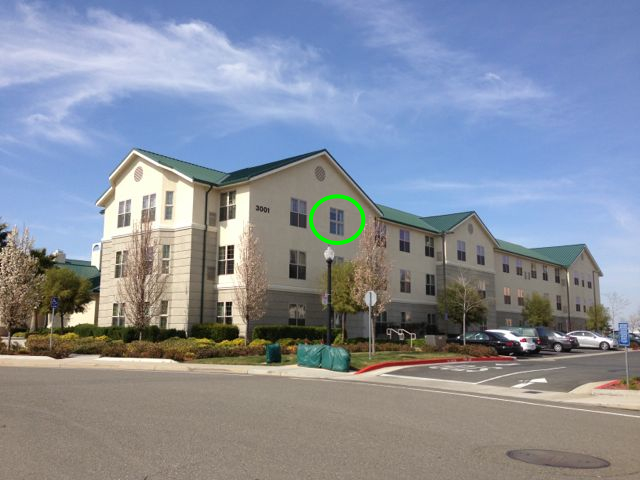
First-time participant here, I never thought I would be able to correctly guess a VFYW contest. The picture was taken at the Homewood Suites in Sacramento, CA. I will try to be as specific as possible since I am sure anybody who stayed there might remember the location: the second floor, on the southeast side of the hotel indicated by the arrow in the attached picture:

SMF

I stayed there a couple of years ago on a business trip and I remember jogging around the area.

So very close – it’s actually the third floor. About a half-dozen readers correctly guessed that floor, but none of them have guessed a difficult window view in the past (“difficult” defined by only ten or less correct answers), so breaking the tie is tough again this week. But the following entry was the most detailed and proactive of all:

Since I live in an eastern suburb of Sacramento, my first reaction was, “Wow, there are dozens of these abandoned developments all over the Sac region; there’s even an entire mall.” Then I noticed that the city skyline looked familiar, the tree was budding, grass/weeds growing; plus the No Parking sign eliminated a large chunk of the world. So Sacramento in early March seemed like a possibility.

A quick scan of Google Earth and a comparison to various skyline images confirmed that the image must have been shot from the north toward downtown (sunset shadows and open space were clues). After a few more minutes map-scanning, I was confident I had it thanks to the sidewalk design, driveway arrows and landscaping. So it’s Homewood Suites (a hotel) at 3001 Advantage Way in Sacramento, CA. And my hunch was that it was taken from a window on the 3rd floor:

VtoYW Sacramento

You might find it interesting that the commercial structures mask a view of one of our many housing failures in the region. An entire neighborhood of streets, utilities, house foundations overgrown by weeds, and most striking – a small community center and swimming pool that’s abandoned and deteriorating. Looks like the developer sold five townhomes before shutting down; they appear occupied, so I hope the owners aren’t paying HOA fees for that pool.

By the way, my 3- and 6-year-old daughters and I (ok, mostly me) decided to make an adventure of it and attempt to see “The View TO Your Window.” We didn’t expect to replicate the view FROM, but fortunately, this is a window in an open-space hallway on the 3rd floor, just outside of room 301 (and the hotel staff were very friendly):

VFYW Sacramento recreated

My 6 year old, comparing the original image on my phone to the actual view, thought it was amazing that “we found the match.” Then she immediately asked, “What will we do if the next picture is in China? Will we go there?”

Thanks for spawning a fun excursion for the three of us. (Mom thought we were crazy.)
Congrats, we’ll get a book prize to you soon. One of the contest’s most consistent winners adds:

The site is probably familiar to local basketball fans, as Arco Arena, home court of the Sacramento Kings, is visible rising behind the unfinished buildings on the left. Because the Kings will likely be sold this year, the city is actively working on development plans for the surrounding area. As for the unfinished buildings, they were originally supposed to house a TGI Friday’s, a Sonic Drive In and healthcare buildings, but the recession drove the developer into bankruptcy.

VFYW Sacramento Recession Marked - Copy(1)

Could there be a better monument to the last decade than the half completed shells of suburban chain restaurants and medical offices? The street in front of your viewer’s hotel is named Advantage Way, but it’s really the high-water mark of an entire era.
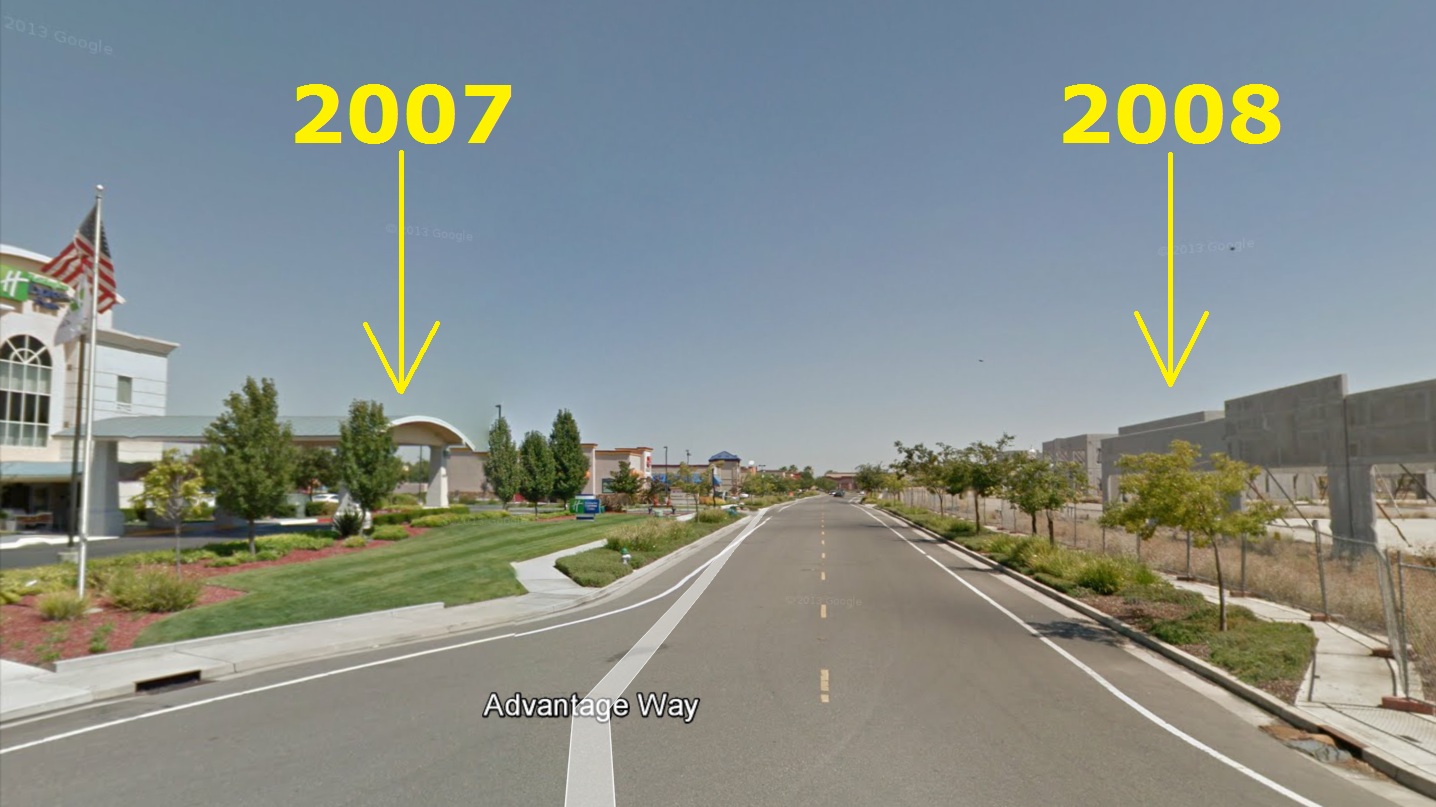
The photo submitter’s entry, for the record:

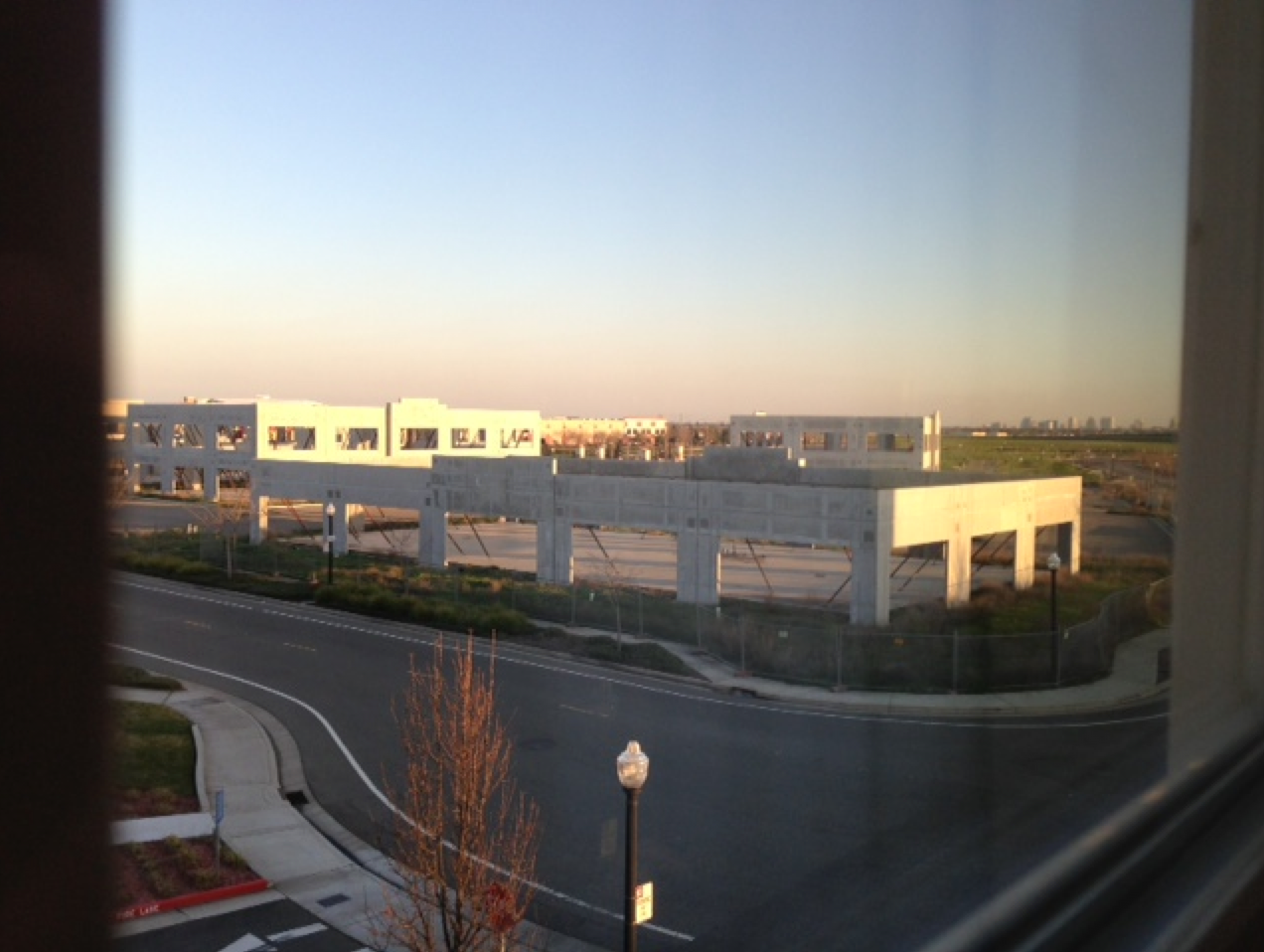
Sacramento, California, 5pm on 2/13. Looking from 3rd floor of the Homewood Suites in Natomas. Someone had great plans for a development in this area – foundations are laid, streets have names, but it apparently came to a crashing halt. I’ve been coming here on business for 7 months and it’s been like this since then. You can see the slightest sliver of the (hilariously named) Sleep Train Arena, home of the threatening-to-move-to-Seattle Sacramento Kings.

Update from the submitter:

The guy who won was exactly on target: I took that photo from the hallway window near room 301 of the Homewood Suites. I’m delighted to hear that he went there with his daughters. I’ll be back in that hotel on Monday and will let the staff (who know me by now) know how this all came about. Extra fun – thanks!

(Archive)
How Racism Was Made, Ctd

Slave-ship

Jamelle Bouie parries my argument:

Sullivan is right to throw water on the idea that the law can “create racism any more than it can create lust or greed or envy or hatred.” But Coates is making a more precise claim: That there’s nothing natural about the black/white divide that has defined American history. White Europeans had contact with black Africans well before the trans-Atlantic slave trade without the emergence of an anti-black racism. It took particular choices made by particular people—in this case, plantation owners in colonial Virginia—to make black skin a stigma, to make the “one drop rule” a defining feature of American life for more than a hundred years. By enslaving African indentured servants and allowing their white counterparts a chance for upward mobility, colonial landowners began the process that would make white supremacy the ideology of America. The position of slavery generated a stigma that then justified continued enslavement—blacks are lowly, therefore we must keep them as slaves.

I don’t dispute this, but equally, the slave trade itself, along with colonialism everywhere, presumed a racial inferiority before the Southern states codified it so precisely along Nuremberg lines. And it endures in the human soul as long as sin does.

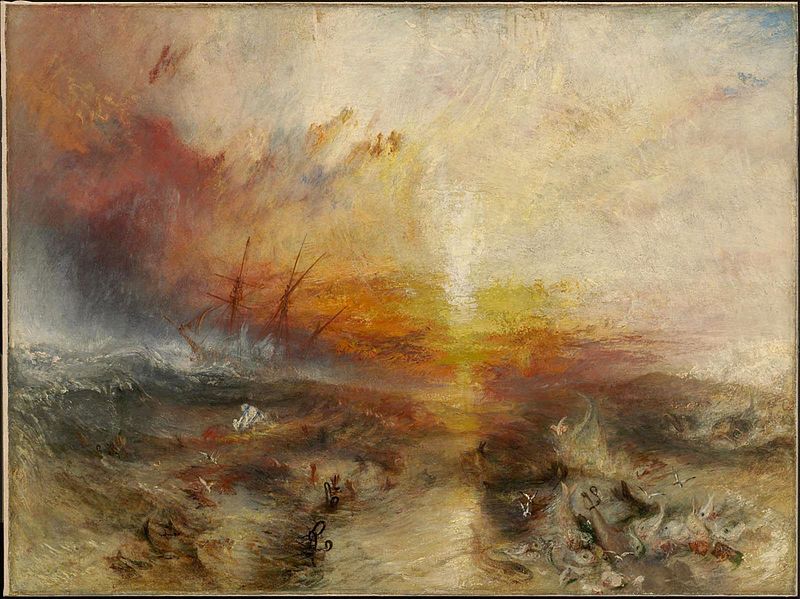
(Painting: Slavers throwing overboard the Dead and Dying — Typhoon coming on “The Slave Ship” by JMW Turner, 1840. )

About That Washington Clubbiness

I know I’m late on this but I was reading the latest issues of TNR and even read a dispassionate if not terribly ground-breaking cover-story on the Israel-Palestine question. That in itself is a huge change. From Leon Wieseltier’s rancid bile toward any critic of Israel to a serious piece that holds all sides accountable and says what must be said – that a democratic Israel is no longer viable – is a big improvement. Then there’s a profile of Ezra Klein. This made me throw up a little in my mouth:

Klein now says that he will not write a negative book review. “Because if you’ve gone through the trouble to write a book? And I just don’t think it’s that good?” Klein told me, breaking into his occasional habit of lilting at the end of each clause. “I’m not going to shit on your work. I just won’t review it. This is a rule James Fallows has that I’ve adopted. Whom I really respect, by the way.”

The Vatican’s Very Convenient Gay Bathhouse

I kid you not. Recall that they covered up the rape of children because of fear of “scandal”. But right in the same building as the Congregation for the Evangelisation of Peoples is the Europa Multiclub – not just any bathhouse, but the alleged Number One in Italy! The Beeb has some fun with a future event:

Also on offer are “bear parties”, which are advertised on its website with a video of a man stripping down before donning clerical attire. Bruno, “a hairy, overweight pastor of souls, is free to the music of his clergyman, remaining in a thong, because he wants to expose body and soul”, the website says.

But they seem a rather responsible joint from this page. And the club’s statement helps unpack why the Vatican would not be that uncomfortable sharing a building (which the Vatican bought for $26 million):

Behind this door an exciting, funny and comfortable world is waiting for you… A place created by males and for males only.

Let the Conclave begin! And after that, we can all go and “evangelize some peoples”.

The Literary Humblebrag

Noreen Malone rolls her eyes at the lengthy and self-aggrandizing “Acknowledgements” page of Sheryl Sandberg’s new book and complains about what the practice has become:

While Sandberg is the latest egregious example, she’s in good company. E.J. Dionne, a master of the form, tends to include just about every famous person he has ever met in his end pages. “[I]f these acknowledgments are a bit long, I hope the reader will forgive me. It’s because I have a lot of debts to pay,” he writes at the close of Why Americans Hate Politics. (The list is actually very useful in that it offers a much more concise evocation of why Americans hate politics than the book itself: Look no farther than his lengthy list to be reminded of Washington’s much-maligned clubbiness.)

Chelsea Clinton was recently thanked in the acknowledgments of Andrew Solomon’s Far From the Tree, and also scattered faux-carelessly amidst the long list of Brooklyn writer types who’d read drafts of Gideon Lewis-Kraus’s A Sense of Direction, suggesting either that Ms. Clinton has a particular interest in highbrow modes of self-discovery, or that those interested in highbrow modes of self-discovery have a particular interest in her.

David Haglund counters:

“Perhaps readers already know that book publishing is an insular, back-scratching industry,” [Sam] Sacks says, “but does it have to be revealed quite so openly?” Why wouldn’t we want it to be? The real inspiration for a work of literary art may be mysterious, but the process by which that work reaches us should not be. Transparency is good. And so is gratitude.

But there’s gratitude and then there’s the literary equivalent of fellating every conceivable human being who had anything even faintly to do with the project. It’s a bit unfair to pick on EJ – revealing my own Washington clubbiness – because I bet he’s just a Catholic making sure he is not being ungracious. But he’s the exception to the rule.

There is, of course, the hathetic response: a gleeful examination of the author’s network of influential friends and literary connections. They tell you something about an author.

The Next Pope Will Probably Be Dreadful

Ron Fournier zeroes in on how the press covers transitions of power, from the papacy to business to politics:

I read this sentence in The New York Timess outstanding analysis of papal politics:

“The next pontiff must unite an increasingly globalized church paralyzed by scandal and mismanagement under the spotlight in a fast-moving media age.”

Let’s play Mad Libs with that sentence: For “church,” substitute the name of almost any U.S. institution and for “pontiff” substitute practically any institutional leader. For example:

“The next governor must unite an increasingly globalized state paralyzed by scandal and mismanagement under the spotlight in a fast-moving media age.” …

As a practicing Catholic, I want the next pope to use this inflection point to eliminate corruption (particularly the unforgivable protection of sexual predators) and to breathe transparency into Vatican banking and governing practices. But there is nothing in the Church’s past to suggest a better future. It is the same in politics and business and charity and sports and virtually all walks of life. We are promised, and promise ourselves, that the next leader will change things and make things work.

I had a day-dream that one day the last Pope would resign – as a sign of the entire church’s renunciation of its recent corruption and long existence as a global conspiracy to rape and abuse minors and teens. Then we’d have the mass resignation of the Curia after the election of a new Pope with a new humility and a new outreach to the world. Ha!

But I’m not as gloomy as Fournier. Because this is the Church. Without hope, it cannot exist. And the thing with Popes is the same thing as with Supreme Court Justices. You never know. No one predicted Vatican II. For my part, I’ve long since decoupled my faith life from the papacy or the hierarchy. I focus on prayer, the sacraments, Mass and the Gospels. The church does not draw its ultimate strength from the powerful; it draws its real strength from the weak.

Establishing Rand’s Bona Fides, Ctd

Senators Gather To Caucus Over Hagel Nomination

In what might – or might not  – be a real shift among Republicans about the disastrous consequences – fiscally and strategically – of neoconservatism, Limbaugh backs Paul. Conor – ever alert to twitches in right-wing posturing – notices a fascinating if rather endless monologue when Limbaugh treats Paul as a serious contender, unlike his dad, Ron. Limbaugh thinks inside the heads of the GOPers dining with the president as Rand filibusters the Senate:

He’s a freshman.

And he’s a wacko!

“Ron Paul’s his dad. He’s an absolute nutcase Libertarian, and he’s talking about drones? Nobody wants to drop a drone on the American people. What the hell is this?” But he has the nation captivated. It’s caused a real reversal. Not a reversal, but the whole structure of things has now been upset, and it’s got a lot of people concerned, and it has legs. It does have legs. So I think it’s fascinating to behold, and once again it illustrates that these guys going to dinner with Obama, they were not challenging him.

They were not. People think this country is falling apart. People think that this country’s on its last legs as they know it, as it was founded. People in this country are really scared. There is a despondency among the population, a majority of the population. This isn’t just politics-as-usual. As far as the population the country’s concerned, the opposition party still doesn’t get it to the point that they’re not even the opposition party! Well, Rand Paul appeared to be the opposition, and he had the guts and the courage to stand up and demand that they explain something to him. And not only is he alive to tell about it, he’s not being called names.

He’s a hero to people.

I will leave alone the fact that the claims of the Bush administration for untrammeled executive power to kill, seize and torture anyone in the world at will, including US citizens, were dismissed out of hand by the Limbaugh right. Some of us on the right objected strenuously. We were cut off, called wackos, anti-Semites and the usual Trotskyite crap from an originally Trotskyite movement. Partisanship seems to be doing the trick.

Which is both encouraging but also deeply depressing at the same time.

(Photo: U.S. Senator Rand Paul leaves after a caucus meeting at the Capitol February 14, 2013 on Capitol Hill in Washington, DC.By Alex Wong/Getty Images)

Paused Paternalism

Less than 24 hours before it was scheduled to go into effect, a judge struck down Bloomberg’s ban on large sodas as “arbitrary and capricious.” The mayor’s response:

Rick Hills, observing that the ban was struck down for being too narrow rather than too broad, is uneasy with the judge’s ruling:

How can it make sense to force the Health Department into such a judicially tailored straitjacket, requiring bureaucrats to pursue an all-or-nothing policy whenever they implement a law? Is Justice Tingling really demanding that agencies jettison consideration of cost, administrative feasibility, personal privacy, or financial feasibility when they pursue their primary mandate? Such reasoning is not unprecedented: Recall FDA v. Brown & Williamson‘s argument that the FDA would have to ban cigarettes entirely if they were an unsafe “medical device” and not merely regulate cigarettes’ advertisements.

Frum considers the broader implications:

The serving ban obviously had problems. It represented an experiment that might or might not have achieved results. But if incremental – sorry, “arbitrary and capricious” – steps are not permissible, what is? Or is the plan that government can do nothing about the obesity problem except continue to defray through Medicare and Medicaid the large and rising costs of the super-sizing of the American population?

And Alex Koppelman wonders whether Bloomberg’s successor will support the ban:

Tingling’s ruling could well be overturned at the appellate level—the ban was widely expected to survive legal challenges without too much trouble—but that can only happen if the case gets that far. Bloomberg’s administration will go to a higher court, of course, but he’ll be out of office next year, and not everyone who’s vying to replace him supports the ban. The issue was bound to surface during the upcoming election; now it’s all but certain to, and the key question to the candidates will be whether they’ll continue the court fight if they’re elected, or if they’ll simply let it drop.

Negotiating With NIMBY

Bruce Barcott argues that America needs a safe place to store its nuclear waste. Some tips on getting a community to support the construction of a nuclear waste site:

“With an issue like this, explicit cash payments make people very uncomfortable,” says Michael O’Hare [a professor of public policy at the University of California at Berkeley who has studied Not In My BackYard problems for more than thirty years]. “They feel that this is not the kind of thing that ought to be traded in money.” When people consider a NIMBY project, whether it’s an airport, a prison, or a nuclear waste site, they impute a moral content to their behavior. Compensation sullies their motivation. “Crudely caricatured,” he wrote in a recent report, “a compensation offer can appear to ask, ‘How much do we have to pay you to give your children cancer?’”

Towns that entertain the thought of a nearby nuclear waste dump often have an economic rationale for doing so, but they’re also wary of being bought off. The key, O’Hare said, is to find indirect ways of compensating the local community that builds on a sense of pride in the facility.

White Smoke And Mirrors

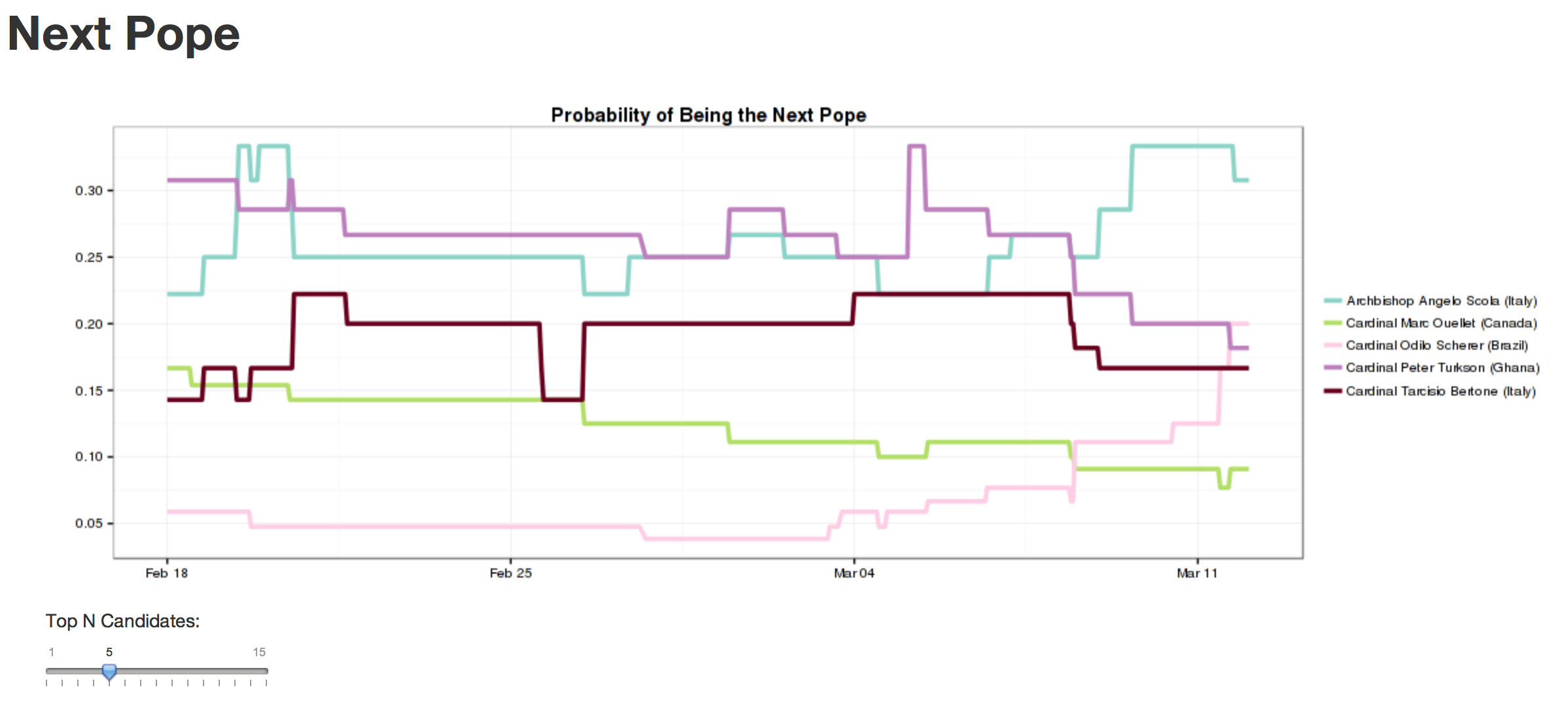
The latest from the Papal betting markets:

Pope Odds

Andrea Tornielli previews Conclave, which begins today:

[W]hen the 115 voters will shut themselves in the Sistine Chapel for the election, a fair number of votes (some mentioned 35, others 40) should go to the Archbishop of Milan, Angelo Scola, who has the support of various European cardinals and a few Americans. If he is elected, the papacy will become Italian again, thirty-five years after the election of John Paul I. Another candidate who should gather a fair amount of consensus is the Archbishop of São Paulo, Odilo Pedro Scherer, a Brazilian with a long experience in the Curia.

Unconfirmed reports on the eve of the Conclave – which of course need to be taken with a pinch of salt – suggest the Brazilian could get 25 votes. A third candidate who might stand out from the beginning is the Canadian Marc Ouellet, Prefect of the Congregation for Bishops who is believed to be able to draw to himself twelve votes from South America and the United States.

Rocco Palmo dismisses the horserace mentality:

The road to a Conclave never begins with a slate of “contenders,” but the discernment of issues and exchange of ideas – in this instance, 115 slates of experiences, philosophies, priorities and concerns on what’s needed most at this moment in history, all weighing a mix of skill-set, background, personal qualities and, yes, image, plus the sliding scale of sending a message to the wider world while, internally, providing the optimal substance of leadership.

In short, the path begins with a question in each elector’s mind: “What is the situation of the church?”  It ends with which melding of those answers in human form can make it to 77.