“I think serious poems should make something happen that’s not correct or entertaining or clever. I want something that matters to my heart, and I don’t mean ‘Linda left me.’ I don’t want that. I’ll write that poem, but that’s not what I’m talking about. I’m talking about being in danger—as we all are—of dying. How can you spend your life on games or intricately accomplished things? And politics? Politics is fine. There’s a place to care for the injustice of the world, but that’s not what the poem is about. The poem is about the heart. Not the heart as in ‘I’m in love’ or ‘my girl cheated on me’—I mean the conscious heart, the fact that we are the only things in the entire universe that know true consciousness. We’re the only things—leaving religion out of it—we’re the only things in the world that know spring is coming,” – Jack Gilbert.
Year: 2013
A Deal Israel Didn’t Agree To
Netanyahu is furious about the US-Iran deal:
Sheera Frenkel reports on Bibi’s bluster:
“There is no doubt that Netanyahu is a big loser in the Iran deal,” said Gil Hoffman, political editor at the Jerusalem Post. “His whole political career is built on two things: number one is that he persuaded Israelis that only he could protect them from Iran, and number two is his image as someone who could speak to the world in his perfect English in a persuasive way better than any other Israelis. And here he failed.”
What Karl Vick is hearing:
[I]n political circles, the primary reaction to the pact in Israel was alarm, both for the technical realities of the pact, and the political realities that Israel – which did so much to make the Iranian nuclear program a matter of global concern – no longer feels it is driving. “I’m worried twice over,” said Finance Minister Yair Lapid, whose Yesh Atid party emerged as a centrist power in the January elections. “Once from the agreement and its implications and I am also worried because we’ve lost the world’s ear. We have six months, at the end of which we need to be in a situation in which the Americans listen to us the way they used to listen to us in the past.”
John Bolton urges Israel to strike Iran unilaterally:
Undoubtedly, an Israeli strike during the interim deal would be greeted with outrage from all the expected circles. But that same outrage, or more, would also come further down the road. In short, measured against the expected reaction even in friendly capitals, there is never a “good” time for an Israeli strike, only bad and worse times. Accordingly, the Geneva deal does not change Israel’s strategic calculus even slightly, unless the Netanyahu government itself falls prey to the psychological warfare successfully waged so far by the ayatollahs. That we will know only as the days unfold.
Bob Dreyfuss doubts an Israeli strike is in the cards:
Israel’s reaction is, predictably, apoplectic. Naftali Bennett, Israel’s economic minister, said, “If five years from now a nuclear suitcase explodes in New York or Madrid, it will be because of the deal that was signed this morning.” But Prime Minister Benjamin Netanyahu will have trouble playing that card for long, since Israel is drastically isolated from the rest of the world and risks an open break with Washington. Already, some Israel leaders, such as President Shimon Peres and the newly installed leader of the Israeli Labor Party, have issued mild to moderate statement that undermine Netanyahu’s bluster. And, ironically, though, the harsh reaction from Israel will help Rouhani and Zarif sell the deal in Iran, since they can point to Israel’s criticism of the deal as a sign that it was, indeed, a victory for Iran’s “nuclear rights.”
Kerry defends the deal against Israel’s objections:
“I believe that from this day, for the next six months, Israel is in fact safer than it was yesterday because we now have a mechanism by which we are going to expand the amount of time in which they [Tehran] can break out [toward making a nuclear bomb]. We are going to have insights to their programme that we did not have before,” he added.
Paul Woodward argues that Israel would have objected to any deal:
At a time when the diplomatic momentum was clearly not moving in Netanyahu’s favor, one might ask: why did he not back down from his maximalist demand on zero enrichment and find a way of offering qualified support for this emerging nuclear accord? Why hold on to a set of conditions that Iran would find impossible to accept?
The reason is that Netanyahu’s goal has never been for the nuclear issue to be resolved. It’s political value resides wholly in this remaining an unresolved issue and in Israel’s ability to cast Iran as a perpetual threat. For Netanyahu, any deal is a bad deal because absent an Iranian threat, Israel will find itself under increasing pressure to address the Palestinian issue.
A Natural Virgin Birth
A couple of things stand in the way:
First, a mammal’s egg cell usually won’t divide until it receives a signal from the sperm.
Second, most mammalian eggs have only half the number of chromosomes necessary for development. If there isn’t any sperm, the embryo will end up with only half the DNA it needs to survive. Both of those barriers could potentially be overcome in the lab or through random mutation, but there is a third obstacle that probably can’t be. Under normal conditions, the DNA in both egg and sperm cells is altered such that some genes will be more active while others are suppressed. When the egg and sperm join to form an embryo, these imprints work in tandem, ensuring that all the necessary proteins are produced in the right amounts. If an egg cell starts reproducing on its own, without the sperm-cell imprint, the offspring won’t survive for very long.
Scientists estimate that imprinting affects about 200 different genes. For parthenogenesis to occur, many of these changes would have to occur through random mutation. “I just think it’s too complex and you’d need too many things to happen accidentally,” says Marisa Bartolomei, a molecular geneticist at the University of Pennsylvania. While highly unlikely, it’s still theoretically possible that scientists could one day induce the necessary changes in the lab. “Is there a mutation that could eliminate all imprinting, so we would see that we didn’t need Dad or Mom in order to have normal development?” Bartolomei asks. “This is a question that people have asked a lot, and we don’t know the answer.”
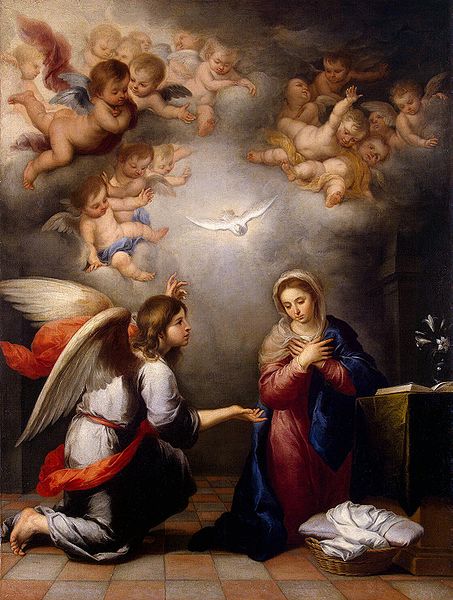
(Image of The Annunciation by Bartolomé Esteban Murillo, 1655-1660, via Wikimedia Commons)
A Deal With Iran: Blog Reax
Obama’s remarks last night:
Fred Kaplan approves of the agreement:
The Iranian nuclear deal struck Saturday night is a triumph. It contains nothing that any American, Israeli, or Arab skeptic could reasonably protest. Had George W. Bush negotiated this deal, Republicans would be hailing his diplomatic prowess, and rightly so.
Juan Cole weighs in:
The only question here is whether the agreement is in American interests. It is. Ever more severe sanctions increasingly risked war with a country three times as big geographically and 2.5 times as populous as Iraq (the American occupation of which did not go well). That danger is now receding, which can only be a good thing. And if negotiations and UN inspections can indeed succeed in allowing Iran a civilian enrichment program while forestalling a weapons program, it is a breakthrough for the whole world and an important chapter in the ongoing attempts to limit proliferation.
Jonathan Tobin, predictably, is against the deal:
It must be conceded that the chances that this agreement will make it less likely that Iran will eventually reach its nuclear goal are not zero. It may be that Iran has truly abandoned its goal of a weapon, that it will negotiate in good faith and won’t cheat, and that there are no secret nuclear facilities in the country even though just about everyone in the intelligence world assumes there are. If so the world is safer, and many years from now, the president will go down in history as a great peacemaker worthy of a Nobel Prize. But since that scenario rests on a series of assumptions that range from highly unlikely to completely far-fetched, the only possible reaction to the deal from sober observers must be dismay. In exchange for measures that only slightly delay Iran’s nuclear progress that don’t come even close to putting them into compliance with United Nations resolutions on the nuclear question, the administration has begun the process of lifting sanctions on Iran. Even more seriously, it has, in effect, normalized a rogue regime that is still sponsoring international terrorism, waging war in Syria, and spewing international sanctions, while effectively taking any threat of the use force against Tehran off the table.
Jennifer Rubin, no surprise, also opposes the deal:
The loopholes and fallacies are huge and obvious. Iran must only dismantle connections to enrich over 5 percent (“dismantle the technical connections required to enrich above 5%.”), allowing these to be plugged right back in after six months. Arak was not set to go online until next year anyway so promises not to move it online are meaningless. And most of all, the time and effort it takes to enrich from 5 to 20 percent is slight compared to enrichment up to 5 percent which is unabated.
That the deal could have been worse is of little consolation. What matters is what it fails to do and that it points the way toward consent to Iran’s nuclear enrichment program.
Mitchell Plitnick pushes back on these sort of complaints:
There is only one reason to oppose this deal and that is that, whether with weapons of war or sanctions that will lead to a full-blown humanitarian catastrophe in Iran, an all-out attack on Iran with the hope of regime change is what this is really about. The conclusion is inescapable—if you oppose this deal, you are looking for a lot more than the neutralization of Iran’s ability to construct a nuclear weapon.
Christopher Dickey’s take:
There may yet be a war intended to bomb Iran back to the pre-nuclear age, and maybe even to try to change the regime. But it’s ever less likely that the United States will fight it. As the polls show, Americans don’t see why they should, and if this negotiating process moves forward, there’s no reason they ought to.
Uri Friedman looks beyond the immediate agreement:
[W]hat’s arguably a bigger deal, and what’s been overshadowed in all the coverage of the haggling over this interim pact, is just how momentous these last several months have been for U.S.-Iranian relations. Since Iranian President Hassan Rouhani took office this summer, the two countries have engaged in the highest-level talks since the 1979 Iranian Revolution, first through a meeting between Zarif and Secretary of State John Kerry, and then through a phone call between Rouhani and President Obama (the two had previously exchanged letters). Zarif has also pioneered a new approach to speaking directly to the American people, turning to social-media outlets like Twitter and YouTube to defend, in English, Iran’s positions at the Geneva negotiations.
The way the news cycle works these days, we take it for granted that Kerry is now in Geneva celebrating a diplomatic breakthrough with Zarif. But the frenzied diplomacy this fall has truly been exceptional.
Michael Crowley considers the possible longterm consequences:
It’s worth thinking about the long path Obama has trod to get here. When he ran for president in 2008, Obama’s rivals warned he couldn’t be trusted to deal with a nuclearizing Iran. Hillary Clinton would brand him “irresponsible and naïve” for saying he’d meet with Iran’s leader. John McCain later called that a sign of his “inexperience and reckless judgment.”
Six years later, Obama’s Iran policy has the potential to reshape the Middle East and define his legacy. If it proves a success, historians might compare it to Richard Nixon’s breakthrough with China.
Martin Longman adds:
Those who preferred Obama to Clinton because of the distinction in their positions on the authorization to use military force in Iraq now have something concrete to point to, to argue that electing Obama would lead to a more peaceful world than would electing Clinton.
Ben Smith and Miriam Elder’s bottom line:
Now [Obama has] earned the foreign policy legacy he campaigned on. And now perhaps the Norwegians can feel a bit more confident about their hasty reward.
“The Human Propensity To Fuck Things Up”
Or HPtFTU, for short. That’s what Francis Spufford renames the Christian doctrine of original sin in his recent book, Unapologetic. Pascal-Emmanuel Gobry praises the rhetorical move, writing that it presents “an old, and much-maligned, idea in a fresh new light”:
Casting original sin as HPtFTU shows how all our sins are somehow connected.
It allows, as Spufford masterfully writes, to realize how, on some level, my selfishly, dumbly cutting remark to my wife is, in its fundamental meanness and selfishness, the same thing as beating up a homeless vagrant, is the same thing as defrauding your employer, etc. It forbids us from casting the evils of others as “other” and therefore beneath us, and it reveals the important truth that all of the infinite panoply of human evil, despite the great diversity of its commission, ultimately has the same source.
Casting original sin as HPtFTU shows how original sin makes us all equal before the eyes of God, and shows that our HPtFTU means that none of us can ever think that we are better than any other, because all of us are fundamentally broken and equal in our brokenness. Therefore, casting original sin as HPtFTU shows that, contrary to the legend of sin as an instrument for enforcing guilt-ridden terror, the recognition of original sin is the first step on a path of love, because once I see in you the same brokenness that is in me, I am moved to love you. Casting original sin as HPtFTU, therefore, lets us enter into the properly Christian dynamic of, recognizing ourselves as broken, moving both towards God—since only He, and nothing of this world, can heal the HPtFTU—and towards our fellow man—equally fallen and, therefore, equally crying out for love.
The View From Your Window
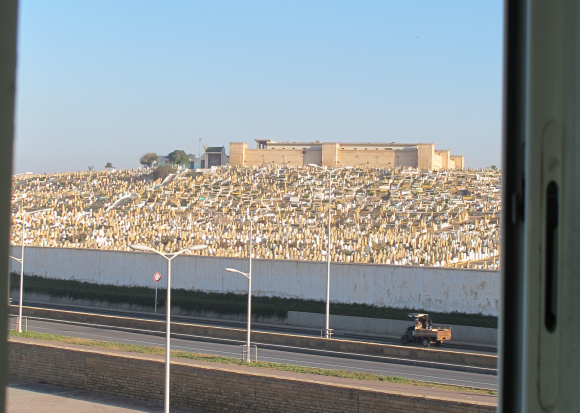
Rabat, Morocco, 4.15 pm
Faith’s Signposts
Still in the midst of grappling with Dante’s Divine Comedy, Dreher ponders a lesson from the poet’s relationship to Beatrice – that she was part of Dante’s own unique, faltering path to God:
Reflecting on this, I thought about the ways God has used to draw me away from my own follies, and back towards Him. As a matter of fact, over the past few months, He has used Dante. Many years ago, He used the beauty of a Gothic cathedral. I can think of times in my life in which the sorts of things that would have struck many others as indicative of God’s presence meant nothing to me. Yet things that others couldn’t care for, or couldn’t see, proved to be icons of God, and doorways to the Way, for those with the eyes to see and the will to step through them. Or to be more precise, doorways for me, if I dared to go through them.
As I’ve gotten older, I’ve become much less willing to judge people’s paths to unity with God, only because I know how peculiar my own has been, and how God pursued me in my particularity. This is not to say that I’m a universalist, but it is to say that I’m far less inclined to say, “No, God does not work like that.” After all, what a scandal it is that the Most High condescended to become one of us, and not just one of us, but an itinerant preacher and healer in the far reaches of the Roman Empire. You never know. There are false goods, and false gods; not everyone who thinks he is pursuing God, or has found God, really has done so. This requires discernment. Still, reflecting on my own long and winding road, filled with false starts and detours and oddities, I can detect the signs directing me to Himself that God placed on the path, signs that others could not have read, or would have denied, but through which He revealed Himself to me, myself, and I.
Kennedy’s Catholicism
George Weigel attempts to capture its essence and effect:
[T]here is the mythology surrounding Kennedy’s 1960 speech on church-and-state, delivered to the Greater Houston Ministerial Association. No one should doubt that hoary Protestant bigotry was an obstacle the Kennedy campaign had to overcome in 1960. Still, a close reading of the Houston speech suggests that Kennedy neutralized that bigotry, not only by deft rhetorical moves that put bigots on the defensive, but by dramatically privatizing religious conviction and marginalizing its role in orienting a public official’s moral compass. Thus Kennedy became, in effect, a precursor of what Richard John Neuhaus later called the “naked public square”: an American public space in which not merely clerical authoritarianism, but religiously-informed moral conviction, is deemed out-of-bounds.
Finally, there is the phenomenon that might be called the Kennedy Catholic: a public official who wears his or her Catholicism as a kind of ethnic marker, an inherited trait, but whose thinking about public policy is rarely if ever shaped by Catholic social doctrine or settled Catholic moral conviction. The many Kennedy Catholics in our public life are one of the last expressions of urban (or suburban), ethnic, Counter-Reformation Catholicism in America; and as such, they evoke a certain nostalgia. Unfortunately, the shallowness of their Catholic formation and the invisibility of Catholic moral understandings in a lot of their judgments make Kennedy Catholics de facto opponents of the Church’s mission in the postmodern world, not protagonists of the culture-reforming Catholicism of the New Evangelization.
“A Child Of The Light But Still A Child”
Thinking through what it means to believe in a God beyond his sight, Matthew Becklo finds wisdom – and the possibility of common ground between the religious and atheists – in this passage from Michael Novak’s No One Sees God: The Dark Night of Atheists and Believers:
Both the atheist and the believer stand in similar darkness. The atheist does not see God – but neither does the believer … we all stand in darkness concerning our deepest questionings … withal, a certain modesty should descend upon us. Believers in God well know, in the night, that what the atheist holds may be true. At least some atheists seem willing to concede that those who believe in God might be correct. Sheer modesty compels us to listen carefully, in the hopes that we might learn.
Becklo comments:
This is an especially good caveat for the faithful. Pope Francis wrote in his first encyclical Lumen Fidei (or “The Light of Faith”): “One who believes may not be presumptuous; on the contrary, truth leads to humility, since believers know that, rather than ourselves possessing truth, it is truth which embraces and possesses us. Far from making us inflexible, the security of faith sets us on a journey…”
In other words, faith does not mean knowing God through and through and tapping a stockpile of straightforward answers.Instead, it’s an ontological light burning in the same existential darkness that scandalizes the atheist. “Faith is not a light which scatters all our darkness,” Francis reminds us, “but a lamp which guides our steps in the night and suffices for the journey.”
(Hat tip: Matthew Cantirino)
A Deal With Iran: Tweet Reax
We have reached an agreement.
— Javad Zarif (@JZarif) November 24, 2013
Picture of Iran FM Zarif embracing France's FM Fabius after Geneva deal: pic.twitter.com/ANrXwMNsbU via @TorabiAli @rezahakbari
— Saeed Kamali Dehghan (@SaeedKD) November 24, 2013
#BREAKING Iran enrichment is recognized. Iran oil sanctions will be stopped. Iran can sell oil at the same level. Oil revenues released
— Abas Aslani (@abasinfo) November 24, 2013
WH puts total effect of sanctions easing at $6.1 billion for Iran.
— Zeke Miller (@ZekeJMiller) November 24, 2013
Iran and P5 finessed it by focusing on recognition and acceptance of iran IMPLEMENTING enrichment. Clever. #IranTalks #iranelection
— Trita Parsi (@tparsi) November 24, 2013
NYT: All of #Iran’s stockpile of uranium that has been enriched to 20 percent would be diluted or converted into oxide. #IranTalks
— Fahimn (@fahimn) November 24, 2013
President on conference call w/U.S. negotiating team in Geneva (White House Photo/Pete Souza) pic.twitter.com/05UkMq31DA
— West Wing Reports (@WestWingReport) November 24, 2013
Full White House fact sheet on Iran deal: http://t.co/hYEms4aI13
— Zeke Miller (@ZekeJMiller) November 24, 2013
So, we have the biggest nuclear breakthrough in a decade (since the October 2003 EU3-Iran agreement), and this time with the US signing on.
— Shashank Joshi (@shashj) November 24, 2013
Iran deal: A victory for sanity with potential to usher a great civilization back into community of nations. Hawks will holler. Let them.
— Roger Cohen (@NYTimesCohen) November 24, 2013
Unless the agreement requires dismantling of the Iranian centrifuges, we really haven’t gained anything. #IranNukes
— Lindsey Graham (@GrahamBlog) November 24, 2013
NYT: No new centrifuges allowed, ones not yet working cannot be started http://t.co/XB6gg00azQ
— Evan Hill (@evanchill) November 24, 2013
.@JohnCornyn No, invading Grenada, as Reagan did, was changing the subject. This is called diplomacy and leadership, Senator.
— Joe Adalian (@TVMoJoe) November 24, 2013
Let’s be straight & call it a peace deal. Peace is not something which only comes after war. Some can make it even before wars. #IranDeal
— Hadi Nili (@HadiNili) November 24, 2013
Iranians are so happy it almost feels like when the football team made it to the World Cup. Social Media full of happy comments. #IranTalks
— Negar Mortazavi (@NegarMortazavi) November 24, 2013
Woman in Tehran tells me she’s crying from joy over nuclear deal. #Iran #Irantalks
— Golnaz Esfandiari (@GEsfandiari) November 24, 2013
Elections, in #Iran, has consequences. #GenevaTalks
— Bahman Kalbasi (@BahmanKalbasi) November 24, 2013
For the first time in a decade, Iran’s opposition and pro-regime supporters are largely united and rejoicing over Geneva deal
— Saeed Kamali Dehghan (@SaeedKD) November 24, 2013
Zarif and Kerry shake hands – Pic by @AlJazeera ht @SharghDaily #Iran #IranTalks #GenevaTalks pic.twitter.com/dwjYmoBPOP
— Reza H. Akbari (@rezahakbari) November 24, 2013
Technically speaking, this appears to be a very a minor deal that easily could be reverted by both sides.
— Arash Karami (@thekarami) November 24, 2013
Deal is as much about freezing Israel for six months as it is freezing the Iranian nuclear program.
— David Rothkopf (@djrothkopf) November 24, 2013
Zarif: War is unnecessary, impractical and illegal. We have prevented this. People should stop threatening to use force. #Iran
— Reza Marashi (@rezamarashi) November 24, 2013
Obama has achieved one of his main goals, preventing an Israeli strike on Iran's nuclear facilities.
— Jeffrey Goldberg (@JeffreyGoldberg) November 24, 2013
This is, if nothing else, an interim victory for tough sanctions.
— Jeffrey Goldberg (@JeffreyGoldberg) November 24, 2013
Iranian people’s vote for #moderation & constructive engagement + tireless efforts by negotiating teams are to open new horizons. #IranTalks
— Hassan Rouhani (@HassanRouhani) November 24, 2013
Will Mousavi & Karroubi be released? RT @eslahchi: This deal should be followed by domestic political opening in #Iran #IranTalks #Geneva
— Saeed Kamali Dehghan (@SaeedKD) November 24, 2013
 The Dish
