Should Trans Surgery Be Covered? Ctd

A reader writes:

A big thank you for posting about the issue of trans surgery insurance coverage and the medical need for it. My younger sister is trans (MTF), and like a lot of trans folk of her generation, was able to come out (relatively) young – 21 – and what a difference that makes! Several of the transgender people in my church waited until retirement, or late middle age, and they would be the first to say how hard it is to accommodate oneself to living in a different body, both physical and hormonal, after years of passing as the gender that one really isn’t. My sister has been lucky in her insurance coverage through her job as a first responder. She gets great coverage for the hormones she must take for the rest of her life. However, her surgery (facial surgery and breast augmentation) were not covered; she paid for them out of savings and from a small inheritance. Using her savings for this definitely set her back for a time – she otherwise might have extended her education, or bought a home, as I did with my inheritance. Still, it was the best thing she ever did. She is so easy in her body, so softly feminine, just lovely. She’s also engaged to be married now – if only we can get Prop 8 overturned here in California and DOMA on the federal level, so they can be legally married. (Ironically, they probably could be married legally in Texas, which doesn’t recognize her gender change.)

Another notes that all uninsured transgender residents of San Francisco get coverage. Another asks, “So a new vagina is covered, but Lasik isn’t?”
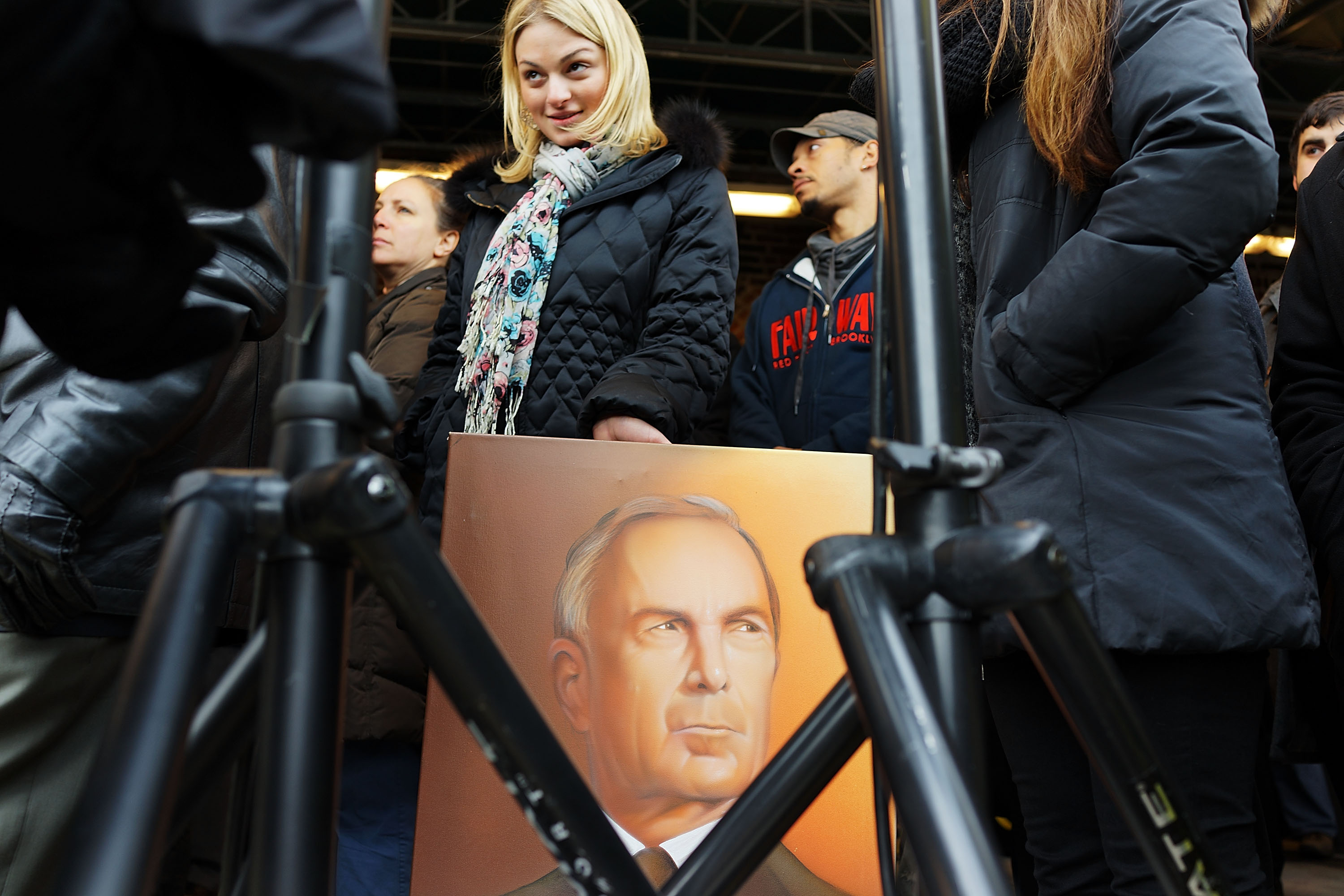
Faces Of The Day

Grocery Store Flooded And Damaged By Superstorm Sandy Reopens 4 Months Later

An aide holds a portrait of New York City Mayor Michael Bloomberg that was given to him as a gift during ceremonies at the newly re-opened Fairway Market on the waterfront in Brooklyn’s Red Hook neighborhood on March 1, 2013. Fairway, which quickly became a popular shopping destination and an anchor in the struggling community of Red Hook, was closed following severe flooding during Hurricane Sandy on October 29, 2012. Like the rest of Red Hook, Fairway has struggled to quickly re-open in a neighborhood that lost dozens of businesses during the storm. The re-opening, which included a ceremony and ribbon cutting featuring Bloomberg and Miss America, is being viewed as Red Hook’s official comeback. By Spencer Platt/Getty Images.

Giving Up Gluten, Ctd

A reader writes:

Thanks for shedding light on the complexities of gluten today. As a restaurant owner, I have found this fad to be problematic in an unexpected way. I have seen requests for gluten-free items go through the roof in the last few years. When these items are ordered, often there is gluten in items that we know about but that the guest may not, so waitstaff returns to the table to alert the guest. Nine out of ten times, the reply is that “A little bit of gluten is ok.”  When this happens often enough, it reduces the importance of gluten-specific requests to your kitchen staff. The next order that comes along, they might not take the care that they should. A little bit of gluten was ok for the last 10 orders with this request, so why not this one? This puts people who have Celiac’s in great danger, even when they make the gluten-free request. People with Celiac’s typically know exactly what ingredients they cannot have and where these ingredients hide. That’s really the best way to operate, as it will make you far less likely to get something you’re not supposed to.

A reader with Celiac’s writes:

I lived with real and severe “fibromyalgia” symptoms for years while rheumatologists, allergists, internists, osteopaths, and orthopods tried to resolve my pain.

My joints hurt, I had generalized pain, depression, fog, fatigue.  Each specialist did their battery of tests and declared that whatever my problem was, it wasn’t in their purview.  All agreed it was “something auto-immune”.  One quickly prescribed an anti-depressant marketed by Eli Lilly to basically stop me from feeling the pain.  Others told me take vitamins to make up for shockingly low levels of some nutrients.  I tried yoga, exercise, tai chi, weight training …

Finally my internist – on information Darshak Sanghavi would certainly reject – said I should try eliminating wheat.  I thought I’d try it for three weeks, then go back to eating wheat to prove the theory.  But then every single symptom went away completely.  Someday, I’ll try eating a pizza, but only when I have time to lie in bed the next day.  It hasn’t happened yet, and it doesn’t even look good any more.

The same here. I was covered in hives and rashes and constantly itching and nothing worked and a few weeks later, it was all gone. I’m one of those guilty ones asking about flour, because it’s not as if I’ll suddenly have a seizure. I’ll be clearer in future. I have lost about 15 pounds, by the way – but that might have also been launching the new blog.

“Sponsored Content” Now Infiltrating Fark

Jeff Bercovici has the goods. Bottom-line: Buzzfeed is using “featured partner links” on Fark to direct traffic to its “sponsored content.” I love this quote from Buzzfeed’s spokesperson:

We’re working with a number of sites, including Fark, to extend our content-driven social advertising to third party sites.

So now it’s “content-driven social advertising”. The damage these people do to the English language is as great as their undermining of ethical distinctions between advertising and writing. Unless you look very closely at the small print, you’ll soon be getting links and posts you may think are journalism – with the Atlantic and Buzzfeed and others branding the page. But all you’re reading is corporate propaganda. Just keep your eyes open.

Replacing Medicaid With Obamacare, Ctd

In Arkansas, Democratic Governor Mike Beebe has negotiated a new breed of Medicaid expansion with HHS under which the Medicaid-eligible population will get federal money to buy private insurance in the Obamacare marketplaces. David Ramsey explains the reason for the creative arrangement:

“My main objective is to make this legislature as comfortable as I can make them,” [Beebe] said. “With a three fourths vote requirement in both houses, that’s a steep, steep burden….If the majority would prefer to go this way to get this done, I’m happy with that. If they want to go the other way, I live with that as well. The cost to the taxpayer for the first three years in the state of Arkansas is going to be the same.”

Beebe said that for some legislators, subsidizing folks to buy private insurance was preferable to directly covering people through a government program for “philosophical” reasons.

Sarah Kliff looks ahead:

The benefit of this approach seems pretty clear: The Arkansas legislature can say they’re moving Medicaid recipients into private coverage, rather than expanding a cash-strapped entitlement program. But will it sway other states on the fence? There is one possible downside they might want to consider, that this approach will likely be more expensive over time. That’s due to the fact that a private insurance plan tends to be more expensive than Medicaid. The Congressional Budget Office estimates the difference between the two, for an individual, is $3,000.

Kevin Drum thinks it might address an issue with the standard Medicaid expansion:

If you’re at 130 percent of the poverty level this year, you qualify for Medicaid. If you get a raise and go up to 140 percent next year, you no longer qualify and instead have to navigate the exchanges. If your hours are cut back and you fall to 130 percent again the year after that, it’s back to Medicaid.

How big a deal is this? That’s hard to say. But it’s not a made-up issue, and it’s possible that the Arkansas approach could legitimately be better. What’s more, I’m OK with allowing states to experiment within limits. It’s the only way to find out whether or not the exchanges really are more expensive, and whether or not the Medicaid ping-pong really is a serious problem.

Previous Dish on the Medicaid expansion here and here.

Escalating The War On Whistleblowers

Supporters Of Army Pfc Bradley Manning Rally At State Department

Yochai Benkler fears the possible long-term consequences of the Bradley Manning case:

Secrecy is necessary and justified in many cases. But as hard-earned experience has shown us time and again, it can be—and often is—used to cover up failure, avarice, or actions that simply will not survive that best of disinfectants, sunlight.

That’s where whistleblowers come in. They offer a pressure valve, constrained by the personal risk whistleblowers take, and fueled by whatever moral courage they can muster. Manning’s statement in court yesterday showed that, at least in his motives, he was part of that long-respected tradition.  But that’s also where the Manning prosecution comes in, too. The prosecution case seems designed, quite simply, to terrorize future national security whistleblowers. The charges against Manning are different from those that have been brought against other whistleblowers. “Aiding the enemy” is punishable by death. And although the prosecutors in this case are not seeking the death penalty against Manning, the precedent they are seeking to establish does not depend on the penalty. It establishes the act as a capital offense, regardless of whether prosecutors in their discretion decide to seek the death penalty in any particular case.

(Photo: Code Pink for Peace demonstrator Tighe Barry chants in front of the U.S. State Department to protest the resignation of State Department spokesman P.J. Crowley and the detention of U.S. Army Private Bradley Manning March 14, 2011 in Washington, DC. Two days after saying the treatment of the accused WikiLeaker was ‘ridiculous and counterproductive and stupid,’ Crowley resigned. The demonstrators stripped their clothing off to protest against the treatment of Manning, who has been allegedly held naked in a Marine Corps base in Virginia. By Chip Somodevilla/Getty Images)

The Number One App

Megan Garber praises the potential of uChek, a new app that helps you conduct self-urinalysis:

And, no, the app does not require you to pee on your smartphone. It does, however, require you to pee into a cup with a chemical strip attached to it. The app, Wired explains, then analyzes those strips “by first taking photos with your phone at predetermined times and comparing the results that appear on the pee-soaked strip to a color-coded map.” The app then offers a breakdown of the elements present in the user’s urine, comparing levels of things like glucose, ketones, leukocytes, nitrites, and proteins — much like a urine test conducted at a medical lab would do, only without the trip to the lab. The app then presents the results to the user, offering visual breakdowns that indicate normal versus abnormal levels of each compound.

From the Wired piece:

[uChek creator Myshkin] Ingawale’s own father-in-law, who is diabetic, has been an early tester of the Uchek app and system. “My wife is the one who wants the information,” Ingawale says. “She wants to make sure he’s taking care of himself. He just takes the test and e-mails her the results.” … [T]here is a pattern to what Ingawale is creating and bringing to market through his startup Biosense Technologies. “The medical device industry operates on proprietary, closed hardware and a recurring revenue business model,” Ingawale says. “I am trying to democratize healthcare.”

The Sanitation Worker Closet

This embed is invalid


Tim Heffernan sits down with Robin Nagle, whose book Picking Up describes her time in the NYC department of sanitation:

Central among Nagle’s themes is the paradox—she would call it the injustice—of sanitation work. It is absolutely vital to any modern society. It is also largely invisible. …

Nagle discovered the job’s invisibility during a parade, as she warned sandal-clad spectators to move out of the way of her broom’s coarse bristles. Nobody heard her. “It’s not that they were ignoring me,” she writes. “I was never part of their awareness.” That attitude goes along with the perception that the work is demeaning. Even san men themselves aren’t immune to the idea. Nagle recalls trying to convince a coworker that his work was important: “‘Aw, bullshit,’ he’d say, dismissing me with a wave of his hand. Even after decades on the job, he still hasn’t told the neighbors what he does for a living. His wife is happier that way.”

(Above scene from “The Mighty Boosh“)