Obama’s Israel Trip

Beinart suspects that it has little to do with the peace process:

[W]hy is Obama going at all? The likeliest explanation is that he wants to delay Israeli military action, and thus buy himself some time for a diplomatic push with Iran, he wants to enlist Israel’s help in a push to end the Syrian civil war, and he wants to end Republican snickering that he hasn’t visited the Jewish state. Kerry’s current trip suggests as much. After initially announcing that he was visiting Israel in advance of Obama, Kerry abruptly canceled on the grounds that he doesn’t want to interfere in coalition negotiations. Instead, he’s embarked on a trip that, according to The Washington Post, “is expected to be dominated by discussion of the situation in Syria.” In addition to trying to meet members of the Syrian opposition, Kerry is visiting Turkey, Saudi Arabia, the United Arab Emirates, and Qatar—four countries that are crucial not only for any American push on Syria but for an Iran initiative as well.

Sequestration Day Arrives

Gleckman sees “the impending government shutdown scheduled for just a month from now” as much more important than the sequester:

If Congress can’t agree on a spending bill by the end of March, nearly all agencies will be shut down and all their employees laid off on April 1, making the sequester’s relatively modest furloughs irrelevant. On the other hand, if Congress and the president do agree on a budget for the rest of fiscal 2013, as they ultimately must, they are likely to make major changes to the sequester—adding money for some agencies, cutting for others, and very likely reducing the overall spending cuts entirely.  Thus, many of those furloughs will never take place.

Stan Collendar expects that “members of Congress that today are saying they are absolutely adamant about letting the sequester stay in place will start to waiver as their constituents become increasingly unhappy about the impact of the spending cuts on their lives.” But he’s not sure we’ll see a repeat of 1995 and 1996:

There are three big difference from the two federal shutdowns that could affect this: (1) the number of safe congressional districts, (2) the tea party, and (3) John Boehner (R-OH) being a much weaker speaker than Newt Gingrich (R-GA). These changes mean both that House members may not care as much about overall approval ratings as they do about the approval of their base voters in their individual districts, and that their leadership may not be able to sell them on any deal even if it wants to make one. If that’s the case, the sequester could stay in place much longer than either of the two shutdowns did individually or cumulatively.

Ezra explains why no deal could be struck to avoid the sequester:

Republicans basically support the sequester because it’s all spending cuts, but they want the cuts allocated more intelligently. The White House opposes the sequester because it hits the economy too hard in 2013 and because it doesn’t include tax increases, and so they want it replaced with a compromise proposal. And so Republicans want to make the sequester a bit better and a lot more permanent while the White House opposes efforts to make the sequester better precisely because it would make it more permanent.

War Isn’t A Winning Issue

Larison forces Syria hawks to face a stubborn fact – that there is little public support for another war. Massie is on the same page:

You may say that Obama has learned the lessons of the last decade too well but, if so, then you need to criticise the American people too. Even if Obama were to favour heavier intervention than that already announced, the administration’s ability to lead public opinion has been diminished by the experience of past interventions. The decreased salience of the Responsibility to Protect doctrine may reasonably be blamed on George W Bush. Whining that it shouldn’t be this way is all very well and good but scarcely changes the fact – uncomfortable perhaps – that it is this way.

Can The South Be Trusted On Voting Rights Yet?

US-VOTE-RIGHTS-JUSTICE

As the Supreme Court this week heard arguments over the Voting Rights Act in Shelby County v Holder, Adam Serwer sets the scene:

Under Section 5 [of the Act], parts of the country with histories of discriminatory election practices have to ask for permission—or “preclearance,” in legal terms—from the Justice Department before making any changes to their voting rules. But [according to Bert Rein, the attorney leading the challenge to the Act,] the South, where most of the covered jurisdictions are, has changed, [and] the law, although once justified, is now unfair and unconstitutional. The five conservative justices on the Supreme Court seemed to agree. “The Marshall Plan was very good too,” argued Justice Anthony Kennedy, “but times change.” … Scalia called Section 5 the “perpetuation of a racial entitlement” that legislators would never have the courage to overturn. “In the House there are practically black districts by law now,” Scalia complained.

Scalia is an asshole, but what Kennedy is saying is not outrageous.

I have to say I am not one of those who thinks that this kind of federal oversight, essential once, must necessarily be essential for ever. And I cannot quite grasp the logic of liberals’ insistence that the bigotry of 1964 is no less a danger today. It’s obviously a much less bigoted society with respect to race than then – in part because of the very Act that liberals are rightly proud of (and that more Republicans as a proportion of their numbers voted for than Democrats). I do think there’s a day in which such supervision may not be necessary as a matter of principle and disagree with Rachel Maddow’s views expressed on last night’s Daily Show that oppression is for ever and that government control of oppression must also be for ever. Societies change. It’s crazy to take no notice of this, and wherever possible the government, in my view, should be race neutral.

But when that change has occurred seems to me to be best left to the legislature – and I thought that was the core conservative position. When last revisited, the Voting Rights Act was passed overwhelmingly. Since when were conservatives the ones asking the courts to strike down laws almost unanimously supported by the representatives of the people?

Serwer argues that SCOTUS shouldn’t even be hearing the case, because jurisdictions can in fact bail out of Section 5 provided they maintain a long-standing record of not having proposed discriminatory voting changes – something Shelby County, Alabama has not done. Jamelle Bouie’s jaw drops at the implication from Scalia and others that racism is a thing of the past. Below he responds to Roberts having asked if it was “the government’s submission that the citizens in the South are more racist than the citizens in the North?”

The answer is a qualified yes. Here is the conclusion of a 2005 study from political scientists Nicholas A. Valentino and David O. Sears:

General Social Survey and National Election Studies data from the 1970s to the present indicate that whites residing in the old Confederacy continue to display more racial antagonism and ideological conservatism than non-Southern whites. Racial conservatism has become linked more closely to presidential voting and party identification over time in the white South, while its impact has remained constant elsewhere.

But Abigail Thernstrom outlines arguments and evidence showing that black voting is vibrant in the Southern state in question:

In Alabama, the number of blacks in the state legislature is proportionate to the black population, Rein replied.  There is also very high black registration and turn-out. The point could have been put more strongly. For many years, those political participation rates have not been especially low in the Deep South. The disparity between black and white registration rates, the Chief Justice pointed out, is greatest in Massachusetts, with Mississippi, where (remarkably) the black registration rate is higher than that for whites, having the third-best rate in the country.

In addition, blacks in the covered jurisdictions have had greater success in winning public office than outside the Deep South “But think about this State that you’re representing, it’s about a quarter black, but Alabama has no black statewide elected officials,” Justice Elena Kagan argued. In reply, Rein might have pointed a finger at the Voting Rights Act.

The insistence on race-conscious districting to maximize the number of safe black legislative seats — built into the enforcement of the Voting Rights Act — is a brake on minority political aspirations.  In majority-black districts, minority candidates tend to consolidate the black vote by making the sort of overt racial appeals that are the staple of invidious identity politics. Very few have any experience building biracial coalitions; they do not acquire the skills to venture into the world of competitive politics in statewide majority-white settings. As a result, max-black districts (the ACLU’s term) seem to have worked to keep most black legislators clustered together and on the sidelines of American political life – precisely the opposite of what the statute intended.

(Photo: Activists hold a pro-voting rights placards outside of the US Supreme Court on February 27, 2013 in Washington, DC as the Court prepares to hear Shelby County vs Holder. The case centers around a key section of the 1965 Voting Rights Act which mandates federal approval for any proposed voting changes in nine states. By Mandel Ngan/AFP/Getty Images)

A Rare Bipartisan Moment

Yesterday, the House finally passed the Violence Against Women Act, which had expired in early 2012. Reauthorization of the law was delayed by the inclusion of measures related to the protection of Native American and LGBT women. Steve Benen points to the significance of the bill’s passing without support from the majority of House Republicans:

[U]nder modern Republican norms, the Speaker only considers legislation that enjoys “majority of the majority” support — if most GOP House members oppose a measure, it won’t even be considered, whether it can pass the chamber or not. The non-binding rule is great for party discipline, but lousy for democracy and governing. For Boehner’s part, the Speaker had long believed in enforcing the “Hastert Rule,” but he’s finding far more flexibility on the issue than we’re accustomed to seeing. When it was time to approve the “fiscal cliff” deal, Boehner ignored the rule to pass a bipartisan Senate plan. When he needed to pass relief aid to Hurricane Sandy victims, he bypassed the rule again. At the time, the Speaker said these were isolated incidents that wouldn’t be repeated, but here we are again — most of Boehner’s caucus opposed the Violence Against Women Act, but he brought it to the floor and passed it anyway.

To reiterate a point from several weeks ago, this may seem like inside baseball, but it’s extremely important. If Boehner, in the name of getting stuff done, is open to bringing important bills to the floor, and passing them with mostly-Democratic support, there’s an opportunity for real governing in the near future.

Amanda Marcotte puts Republicans who voted against the bill in the hot seat:

[A]ll the Republicans who voted against VAWA in the Senate were men—all the female Republican senators voted for it. Then you have the nine Republican congressmen who declared that there was no version of VAWA they would support. Rep. Tom McClintock of California justified his resistance in 2012 by calling VAWA “a feel-good measure” and objecting to how the bill supposedly hamstrings “judges who are attempting to resolve and reconcile highly volatile relationships.” It is true, as I reported at the American Prospect, that VAWA puts an emphasis on separating victims from their abusers instead of trying to patch things up, but that’s because the evidence overwhelmingly suggests that this strategy works better at keeping victims safe. Which is the point.

Alexis Levinson thinks that those who opposed the bill will probably pay a price:

Democrats have gone after Republicans in the past for not supporting the reauthorization of the bill. North Dakota Republican Rep. Rick Berg got an earful last cycle, for example, after he declined to take a position on the bill. His opponent, now-Sen. Heidi Heitkamp, held a number of campaign events on the importance of reauthorizing the bill. Berg ultimately lost [to] Heitkamp, in a state that was expected to lean Republican. Should the House Republicans who opposed the VAWA reauthorization run for Senate, they will likely face withering criticism for being part of what Democrats in 2012 repeatedly called the “war on women.”

The Long Nag, Ctd

An updated chart of readers hitting various levels of readons:

Screen Shot 2013-03-01 at 12.27.33 PM

A reader quotes me:

“…around 5,000 subscribers have yet to log in. (What’s stopping them? We don’t know…)”  I am one of those subscribers. The reason for me is that I have four different devices to read the Dish on: PC at work, PC at home, phone, and a tablet. While I click “read on” fairly frequently, no single device has reached its limit. So I don’t need to sign in. I will keep funding the Dish, as it’s ethical and I want you to succeed. But that’s the only reason I haven’t logged in.

Subscribers can bypass the meter process altogether by clicking the red button in the top-right corner of the Dish. Another subscriber:

I would submit that the cause for some fraction of that 5k is Tinypass’ desire to use a cookie, which means that browsers see a 3rd party site wanting to play with my cookies, and Safari on the iPhone has only all/none/no-3rd-party settings, and I’m not accepting all cookies – eff that. This means that I can’t click your Login button and have it do anything. So what I do is go to dashboard.tinypass.com and login there, then click the “Dish” link in Purchases and that launches me a subscribed-and-logged-in Dish window, allowing me to close the tinypass bootstrap window. Tinypass has helpful paste-in lines for whitelisting them as a valid 3rd party cookie site, but I don’t know how to convince my iPhone of that without opening the cookie floodgates.  So my workaround suffices.

The most common response from readers:

I read your blog through RSS, specifically Google Reader. I rarely if ever visit your site, and have done so recently only to check out the new design (nice work, appreciate the minimalist approach!). I’m guessing that many of the other non-login subscribers come from this group, but perhaps your site analytics could shed light on this.

My feeling is that content consumption strictly through websites will die off as people move to simpler, more customizable mechanisms such as RSS feeds and mobile devices. One of my pet peeves with website feeds is truncated posts that force you to click to a website to read the full post/story. The primary reason I’ve created the feed is to minimize website visits, and the second I’m forced to do so the less likely I will continue to consume your content at all. Serve an ad in my reader, I don’t care, as long as it doesn’t bog down the limited time I have to read the posts I want to read. That is one of the reasons I subscribed to the Dish (besides the great quality of your blog) – as long as you continue to offer full posts in your feed, I will continue to subscribe.

One other note: your “nags” are beginning to feel more like NPR pledge drives – only a nickel a day for honest independent journalism! Not that it’s a bad thing; NPR is great and we all should contribute to the financial stability of the independent media we consume if we can afford it. And hey, I can’t wait for next year’s subscription to come with a free emergency radio or brain power CD.

Obama’s Exquisite Balance On Marriage, Ctd

[youtube http://youtu.be/apQt4xGzvKw ]

The president says rather more dispassionately what I believe. I believe the right to marry is vested in the very Declaration of Independence, and that gay people have as deep a right to it as straights as it is currently composed. But I don’t want that view to be forced, rushed or coerced into action by the Supreme Court, especially when America, and so many states are moving so fast toward equality anyway. Why not keep the judicial decisions limited so as to make the political victories more profound? If there was no way a tiny minority could win th democratic argument, it would be one thing. But in a matter of a decade or so, we have persuaded over half the country and a huge majority of the next generation. Why would I want to give the religious right the satisfaction of saying it was forced on people by unelected judges? Why not get the results of a Roe v Wade without a Roe vs Wade?

Marty Lederman outlines five ways SCOTUS could rule on Prop 8. Part of his analysis focuses on the “eight-state solution,” supported by the Obama DOJ, “which would directly affect only those states (California, Delaware, Hawaii, Illinois, Nevada, New Jersey, Oregon, and Rhode Island) that already treat same-sex couples the same as opposite-sex couples in virtually all ways” but refuse to call their unions “marriage”:

As I noted yesterday, in a rather remarkable development, four of the eight states that provide same-sex couples with virtually all incidents of marriage–Delaware, Illinois and Oregon, in addition to California itself–have filed amicus briefs urging the Court to affirm the judgment of the court of appeals declaring that Proposition 8 is invalid, and making an argument that would, if accepted, appear to seal the fate of their own laws, as well.

The eight-state holding would permit the Court to avoid for now any decision on whether some other states might have a sufficient justification for denying same-sex couples substantial benefits and privileges that they offer to opposite-sex couples.  As Lyle notes, such a holding would of course make it much more difficult for the remaining 33 states to sustain their marriage laws against constitutional challenge.  But the ultimate fate of such statutes would depend on future litigation and/or on political developments.  That is to say, the Court would cast a shadow over the laws of the other thirty-three states, without resolving just yet whether they are constitutional.

Ari Ezra Waldman thinks “there is reason to believe that [the eight state solution] makes strategic sense”:

First, the President knows that Justice Kennedy is the likely swing vote in this case and Justice Kennedy is a cautious, conservative jurist. He has a history of respecting states’ rights above all else and often rejects sweeping policies that reek of overreach. Incremental change, if any change at all, seems to be his mantra, as Professor Kenji Yoshino has argued many times before. The compromise position may be aimed at Justice Kennedy’s cautious nature, giving him room to support gay rights without undermining the driving force of his judicial career.

Second, step-by-step progress may aggravate those of us who want to marry, but can’t, but slow progress denies our opponents fodder to foment backlash.

Mark Tushnet ponders the consequences of such a ruling on future state legislation:

[T]he eight-state solution would force legislators in other states to an all-or-nothing choice. Is that a perverse incentive, or more like holding legislators’ feet to the fire? The eight-state solution tells legislators that, despite what they might prefer, they can’t avoid confronting the issue of marriage equality by adopting something just a bit short of that. (Presumably, even were the eight-state solution to become the law of the land, legislators could avoid enacting full marriage equality by going less far than California and Illinois did in equalizing the rights available to straight and gay/lesbian couples.)

Guess Which Buzzfeed Piece Is An Ad, Ctd

This embed is invalid

A bunch of readers are still sounding off:

Thought I’d bring this to your attention, vis-a-vis your back-and-forth with Buzzfeed: the Native Advertising Summit, “The first conference dedicated to defining and discussing the future of native advertising.” Unfortunately, the summit is mostly over, but I’m hoping there’s a stream of it. I know a lot of these people. They mean well, but try as one might, they have trouble understanding what the problem is with Native Advertising, starting with that atrocious name.

Another points to a troubling detail:

One big difference with Buzzfeed’s sponsored articles is that they appear in searches and are, still, undifferentiated from “real” articles. What other sites show the ads along with the editorial content? Up until now ads were ephemeral. They appeared on a site and were clearly ads. When the site is archived the ads were not (though the archives may also display ads). This extends the confusion far down the road. With sponsored content that is archived the ad, and any bias, extends well into the future. I am not sure what the consequences are but I doubt they are good.

Another reader isn’t too concerned:

Buzzfeed’s convolution of content and advertising seems like a pretty minor sin in the grand scheme of our modern media. Our media has been replete with sponsored content for decades in the form of DC elites leaking information and using journalist mouth pieces to win political arguments. The articles that Judith Miller wrote in the run up to the Iraq war are sponsored content, just not in the way we typically think about it. That kind of sponsorship is far more insidious than an advertisement made to look like content.

Another goes in depth with a helpful and revealing screenshot below:

Nobody expects BuzzFeed to be the standard bearer of modern journalism. But I think most people would want them to be honest brokers of their product.

If their product is cool stuff they found on the internet, then that should be presented as such. And unlike The Atlantic, almost nothing on BuzzFeed is original content – and that’s okay (kind of) because they almost always point that out and provide a link to the original source. Think of BuzzFeed as the Huffington Post of cat videos (it’s no coincidence that they both have the same founder – Jonah Peretti). But the problem is that BuzzFeed is scraping content from other sites and then using it to promote their sponsor’s products and they are doing so without sharing revenue with the actual creator of the content. Perhaps the content creator may get a ‘bump’ in internet traffic, but that’s all they’re ever going to get.

To illustrate the point (problem?) I took a screenshot of BuzzFeed today (February 22, 2013). In those spaces you can explicitly see the words “partner” or “featured partner” and brands that you recognize like Honda, Fuze, IFC and The Daily Beast. These are obviously ads. Maybe the content looks just like all the other stuff, but they aren’t fooling anyone.

But that is not all of the sponsored content on your screen. Not even a little bit. Most of the sponsored content is BF_022213_SC_ADS_Yellowhidden. Look at the posts I’ve highlighted in orange. The ‘Hot on the Web’ section is simply a collection of links to partner sites like The Onion, People Magazine and The Atlantic. The story about cyberbullying is an excerpt from a book by Emily Bazelon and sponsored by Random House – but you don’t find out about that until after you’ve read the whole article. That picture of Bert down at the bottom is an ad for Halls lozenges and the article about some guy selling his socks on ebay is just some guy pushing his own webpage. The music section is brought to you by streaming music company radio and the FTW badge is brought to you by Fuze – a registered trademark of Coca-Cola.  But I think the greatest offender is the headline story about Best Picture nominees which is brought to you by (Dunh! Dunh! Dunh!) The Academy Awards.
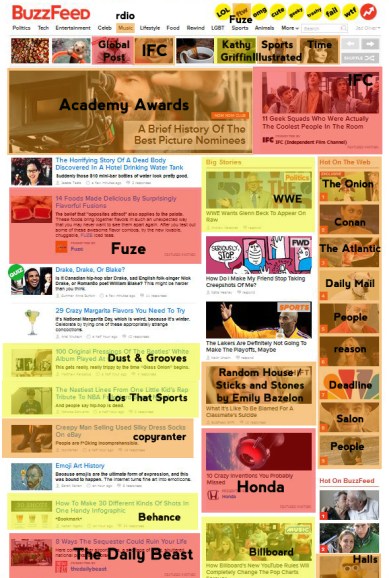
But on top of the ads marked as ads and the ads masquerading as content there are some gray areas where scraped content and advertising cross paths again, but the content isn’t necessarily sponsored by anyone. In these situations I’ve marked the content yellow.  In this grey area (yellow area?) we have Andrew Kacynski “writing” what is simply a repurposed press release from the WWE, another repurposed press release from Billboard magazine and another glorified press release about an innovative use of the White Album from website Dust and Grooves. There’s a suspiciously in depth description of an incident on the Kathy Griffin show, as well as posts which are lifted almost verbatim from their sources – a liquor infographic taken in its whole from an artist on the Behance network and a video of some kid dissing the NBA that’s been lifted from Los That Sports.

BuzzFeed’s problem isn’t that there’s an unmarked article here or there that’s just a glorified advertorial, like The Atlantic. BuzzFeed’s problem is that it’s all glorified advertorials, with the occasional piece of ‘original’ content (and by ‘original’ content, I mean something they scrape from somewhere else and only casually make reference to the actual original, if they make mention at all).

Update from a reader who objects to the problematic previous entry:

The reader may take offense with the re-appropriation of content on BuzzFeed found on other websites, but the posts marked in orange and yellow are not sponsored stories. That is to say, BuzzFeed received no compensation from any of the so-called “sponsors” of any of those stories. Every piece marked in orange or yellow was either written independently by editorial staff at BuzzFeed or, in the case of the stories from other publishers in the “Big Stories” column or the row of thumbnails on top, link directly to those publisher’s websites.

Suggesting that these are “ads” or toeing the line into advertising is a fairly ridiculous standard – the cover story that is supposedly “sponsored by the Academy Awards” is a timeline of each Best Picture nominee’s path from conception to actually being made, written by Richard Rushfield, a veteran entertainment reporter formerly of the LA Times. “Copyranter” is a paid blogger at BuzzFeed (his writing is no more sponsored than your “Cool Ad Watch”), and since when is publishing book excerpts or covering press releases considered advertising? Held to this standard, much of the entire blogosphere would be considered advertising, including the Dish.

I work in the business department at BuzzFeed and spent most of the day following your talk defending the valid points I thought you made. But do please try to avoid publishing unfounded accusations (like the suggestion that the writer of the Sony ad wrote its subsequent product review on the site). It hurts your credibility and takes attention away from the much more pertinent, and important, criticisms you have to make.

Another reader:

Longtime reader, new subscriber to the Dish. Like you, I am also suspicious of the sponsored posts on Buzzfeed, but I’m not sure it’s unprecedented. My mother spent many years working at Newsweek in charge of producing the magazine’s special sections.  These sections were written in a different font than the magazine, but were in center of the book and were essentially advertorials.  Special sections were on subjects as varied as heart health, fall fashion, the national parks, etc.  My mother got writers who were experts on these subjects to write articles, and the sections drew in advertisers who wouldn’t normally buy ads in a general interest publication.

The articles in these special sections was not written by the advertisers per se, but they definitely were not written by Newsweek’s journalists.  The purpose of the special sections was too draw ad dollars, so they usually weren’t hard hitting,  And there’s no question that they emerged from the business side of the magazine. It’s not an exact analogue to what Buzzfeed is doing, but it isn’t that much of a departure either.

Another:

This blurred line isn’t new; it’s just new to the Internet. Radio announcers have been doing it for nearly a century. You listen to local DJs with a wide audience, and in between jokes and gags they launch into a 3-minute soliloquy about the newest Italian joint in town, live on air as part of the “show”. At no point do they reference that it’s sponsored content or an advertisement. But regular fans of the show catch on mostly due to repetition and the fact that the content slides into an “uncanny valley” of entertainment. Buzzfeed readers will figure out the cues too. I’ve already begun to.

Update from a reader, who counters the previous one:

This may have been true a century ago, but for decades it has been illegal.  Fine-and-imprisonment illegal.  A sponsored mention must be identified as such, as part of the mention itself.  Radio staff must not only sign affidavits saying they understand this policy, they also must annually view presentations about the policy and pass an exam about it.  That’s how illegal it is.

Are there still blurred lines?  Yes; you’ll still hear a DJ thank Taco Bell for dropping off samples of that new item on their menu, it tasted great.  But that will last 15 seconds or less, it will be recorded and logged.  3-minute soliloquies about ANYTHING on a music radio station are the kiss of death anyway.

Another on radio ads:

I had an interesting realization this morning on the way to work: I listen to moderately disguised sponsored content on the radio all the time. I love Philly Sports radio and tune in any time I’m in a car. Their ad model includes their popular personalities endorsing products in their own voice without a clear delineation between content and ads. The ads are unmistakeably about products, but sometimes are so woven into the discussion at hand and so tonally similar that it’s hard to tell.

The interesting realization, given my general agreement with you on the issue, is that in that context I honestly don’t mind at all and – egad! – I’ve actually purchased some products that were advertised. I can’t recall ever buying anything because of a web ad, but our mortgage, wedding rings, and some home electronics are all from “sponsored content” I heard. Sure, radio is a totally different medium, but I now find myself much less offended by sponsored ads in general. My only remaining caveat (and The Atlantic’s giant screw up) is that the editors need to have no problem associating their good name with the product at hand.

One more:

As a paid up Dish-head, I wanted to email in about my total boredom with your series on Buzzfeed. Every time I read one of your pieces, I want to scream the same thing over and over again: If anyone is unhappy with what Buzzfeed (and the like) is doing, don’t bloody read it! No one is holding a gun to your head.

Like many Internet users, I occasionally visit Buzzfeed. There’s the decent item here and there, they do a mean gif round-up and their reactions to big events always give me a minute or two of amusement. As a user of a free site, obviously you expect ads, and if they happen to be a bit more clever than the usual dirge offering pills, penis enhancements and amazing ways to make money, in the grand scheme of things, who gives a damn? No one who visits Buzzfeed is going there for thought-provoking, independent journalism – they do some decent political titbits, but titbits are all they are.

Why the hell are you taking it so seriously? The market will soon sort them out if their advertising strategy turns out to be be a sea of deep, insidious evil. Please drop this silly subject – there’s far more important things going on that we want your insight and input on.

The Anti-Ideologue

Reviewing Oakeshott on Rome and America by Gene Callahan, Kenneth B. McIntyre describes what keeps Oakeshott from accompanying fellow British philosophers into America’s intellectual canon:

oakeshottcaius[His] lack of influence among the movers and shakers of American political life should not be surprising,given Oakeshott’s insistence on the irrelevance of political philosophy to practical politics. As he once wrote, “reputable political behavior is not dependent upon sound or even coherent philosophy.” Such behavior is instead related to the concrete practical knowledge of an actual political tradition and what such a tradition intimates.

Oakeshott was skeptical of philosophers who meddled in practical affairs, insisting that he was not concerned with establishing “a seminary for training political hedge-preachers in some dim orthodoxy.”

No, that was Leo Strauss’s metier. Bill Kristol and Paul Wolfowitz are where you end up (or just read Ravelstein). Oakeshott – for fear of being dragged into partisan politics – even refused a knighthood engineered by Margaret Thatcher, who wanted to elevate him as a “movement intellectual”, as if such a thing weren’t an oxymoron. One other thing that distinguishes him from the neoconservative advocates or permanent warfare, as explained on his Wiki page:

Although his 1939 essay ‘The Claim of Politics’ defended the right of individuals not to become directly involved, in 1941, Oakeshott joined the British Army in its fight against Nazi Germany. He was on active service in Europe with the intelligence unit Phantom, which had SAS connections, but he was never in the front line.

He served his country for the rest of the war against the Nazism he despised.

Scouting For Straights

This embed is invalid

Visit NBCNews.com for breaking news, world news, and news about the economy

A reader writes:

You’re usually the last person I’d send a Sports Illustrated article, but this one’s too important to pass up. I don’t know if you’ve been following the story about Nick Kasa, but essentially, this is a college kid, ready for the NFL, and he got caught telling the truth about the interview process teams do before the NFL Draft. Namely, teams are asking potential players, both directly and indirectly, if they’re gay.

So Ed Schultz, of whom I must admit to being no big fan, interviewed one of my favorite players, Brendon Ayanbadejo, a recent Super Bowl champion who used to play for my hometown Chicago Bears. Ayanbadejo, as you know, has been an outspoken advocate of LGBT rights, one of the few NFL players to do so. But he went on Schultz’s show and encouraged rookies, for the sake of their own personal careers, to, if they are gay, lie about their sexuality, since it could be the difference between getting picked higher and getting picked lower, along with the obvious salary differences.

While I find it refreshing to hear someone tell the truth for a change – that players interested in their own careers need to do what’s best for them – this just makes me more and more frustrated with my favorite sport.

I can deal with the homophobes in the locker room; I’ve met enough of them in the real world to know that they’re usually all talk and often are converted to being lesser douchebags as they have their worlds opened up to new ideas. But that NFL scouts and executives, the most powerful people in their leagues, would be asking these kinds of questions … that’s what I find truly depressing. Most of these aren’t people with deep-seated religious or ethical beliefs; they’re just worried about having the next PR story be about “their gay.” How thoroughly disgusting that they’d pick THIS to focus on.

The best player to ever play for my Bears is named Brian Urlacher. He was dumb enough to impregnate a woman who had already been convicted stalking Michael Flatley – yes, the Lord of the Dance himself – much to the consternation of Urlacher’s wife. How is that somehow more moral, more Christian, or less of a PR crisis than simply being attracted to other dudes?

Ugh. Sorry for the vent. This shit just drives me bonkers.

By the way, Ayanbadejo, along with fellow NFL player Chris Kluwe, just filed a joint Supreme Court brief in support of overturning Prop 8.