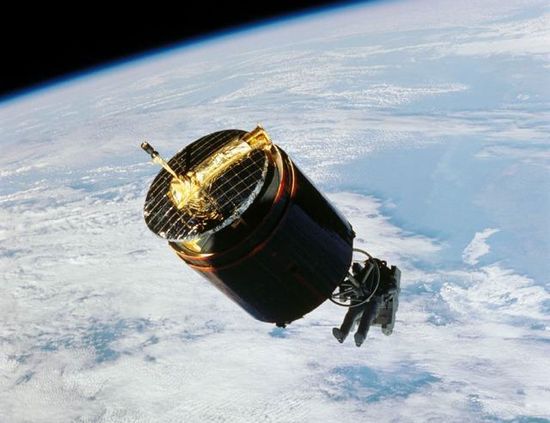
Jesse McDougall explains the science of time and space:
There are a few dozen GPS satellites floating high above the Earth. Each satellite carries an atomic clock that, when on Earth, is perfectly precise and in sync with Earth time. However, when lifted to the less dense gravity of the upper atmosphere, the satellites’ atomic clocks speed up. Were an observer to fly up to one of these satellites and watch the on-board atomic clock, he would see no difference in the length of a second. It would still be that familiar tick, tick, tick of Earth seconds. At that level of gravity, he, too, would be moving faster through time and would therefore see one second to be one plain old second. But, from here on the Earth’s surface and from within our denser gravitational field, we can see that the seconds pass a little more quickly on the satellites.
Time is slowed by heavy gravity. Just as it's easier to swim through outer space, than it is through the atmosphere, than it is through water, than it is through rock, time moves more quickly through less dense gravity. Time passes more slowly on Jupiter than it does here on Earth. And, as the impatient clocks on the Mars rover prove, time passes more quickly on Mars due to its lighter gravitational pull.
(Above from NASA's APOD: "In 1984, high above the Earth's surface, an astronaut captured a satellite … Communications satellite Westar 6 had suffered a rocket malfunction that left it unable to reach its intended high geosynchronous orbit.")
 The Dish