More and more, the second term is coming into focus. The nominations of Kerry, Hagel and Brennan in the national security tent confirms that Obama intends to make his mark more emphatically in his second term than his first (which primarily meant cleaning up the mess from Bush-Cheney). All three are skeptical of resorting to military force; Kerry is a veteran diplomat and decorated veteran; Hagel has two Purple Hearts and is ideally positioned to defend cuts in Pentagon spending. Brennan has the confidence of the CIA, even as he appears to be intent on bringing its often unaccountable actions more firmly into the nexus of law, and checks and balances. Of course, they should all be grilled by the Senate – on Iran, Greater Israel, torture, secrecy and Asia. But they seem like sterling and solid picks to me.
But it's Hagel's potential for cutting the Pentagon – and the credibility he has a Nebraska Republican vet – that really hits home. When you look at the slo-mo fiscal pile-up, you can see Obama's logic. He has essentially dispensed with Item Number One: raising taxes on the very rich. Next up comes the fight to cut spending or increase revenues by roughly the sequester amount. On the table for cuts, we have Medicare, Medicaid, Social Security, and the Pentagon, now spending almost twice what it did ten years ago. I defer to David's core judgment:
As the federal government becomes a health care state, there will have to be a generation of defense cuts that overwhelm anything in recent history. Keep in mind how brutal the budget pressure is going to be. According to the Government Accountability Office, if we act on entitlements today, we will still have to cut federal spending by 32 percent and raise taxes by 46 percent over the next 75 years to meet current obligations. If we postpone action for another decade, then we have to cut all non-interest federal spending by 37 percent and raise all taxes by 54 percent. As this sort of crunch gradually tightens, Medicare will be the last to go.
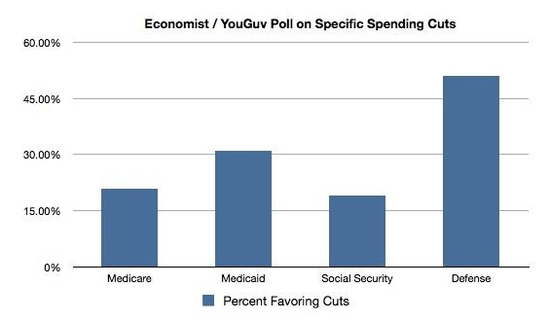
The polls agree (see above). If the cuts are not so much to the troops but to the massive defense contracting industry, then we could be in a whole new world. My sense is that Americans will want tax loopholes cut as a first resort (though nowhere near as much as would represent real tax reform), defense cut as a second resort and Medicare dead-last. (This isn't my preference. I'd rather see more serious cuts in Medicare, along with Simpson-Bowles radical tax reform and a radically reduced global footprint. But I'm just a blogger.)
Now that Obama has taken the tax rate issue off the table, all we know about US public opinion and the popularity of entitlements suggests that Obama has strategized to make the US government structurally more progressive, with defense being cut hard. Yglesias, who produced the above graph, notes:
I recently read David Karol's Party Position Change in American Politics which reveals that the politics of the defense budget is one of the most frequently flip-flopped non-procedural issues in modern politics. It's one where party leaders seem relatively unconstrained by constituency group commitments or ideology, and fairly free to engage in freelance gambits of various kinds. So given the gap between current polling and current elite positioning, it's a place where we might expect to see some surprisingly rapid changes.
How about back to the levels of Reagan in 1984 at the height of the Cold War, for example?
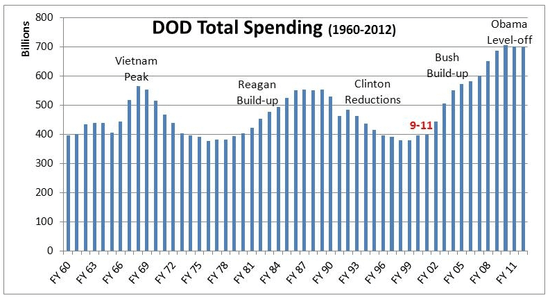
That would require a cut from around $700 billion to around $500 billion. Could we do that in four years? It seems to me that if we could almost double "defense" spending in the last decade, we should be able to cut it around 30 percent in four years. Leaving not a soldier behind in Afghanistan by 2014 would help.
(Graphs from Yglesias and simple serf)
 The Dish