David Frum tackles Mark Kleiman's 13 theses on marijuana and my approach to cannabis. The heart of Frum's argument (with my responses):
First, as Kleiman notes, it's an illusion to imagine that marijuana and alcohol users form two separate and distinct camps. It's already true that many of those who drink too much also smoke marijuana, and ditto for many heavy marijuana users. I'll defer to Kleiman's warning about avoiding under-researched overstatements about these interactions, but they exist and could well become much more severe in a legalized world.
This has to be the weakest point I've yet heard. Why should we not on these grounds ban many prescription drugs – whose interaction with alcohol is profoundly more dangerous than pot. 20,000 Americans died last year by abusing prescription drugs. No one died of smoking marijuana. It's a physical impossibility. As Sanjay Gupta notes, "Distribution of morphine, the main ingredient in popular painkillers, increased 600% from 1997-2007, according to the U.S. Drug Enforcement Administration." And yet David focuses on pot as the truly deadly mixture that must be curtailed. It's the one pain-killer that will never kill you. Bizarre.
Second, as former Obama drug-control official Kevin Sabet pointed out in his bravura appearance on MSNBC's "Up with Chris," it's not as if alcohol law enforcement does not exist. In fact, as he notes, some 2 million arrests occurred last year for alcohol offenses (e.g. public drunkenness, drunk driving, and violation of liquor laws) – not counting actual crimes, such as assault, committed under the influence of alcohol.
And your point is … what exactly? Those against Prohibition favor laws to punish driving while stoned. And I'm happy to lay a bet with David right now that in those states with legal pot, drunk driving arrests will far outpace stoned-driving arrests. But that is the right balance: it's if your use of an intoxicant presents a threat to others. Right now, alcohol is exponentially more dangerous than pot in this respect.
Third, as with guns and cars, the trend lines on marijuana and alcohol are sloping in different directions. Alcohol abuse is becoming less of a problem for American society in the 2010s, marijuana use, by contrast, is increasing – and increasing particularly among the very youngest users, who should not be using it at all because of the harms to brain development.
Again: what's the point here? The argument for legalization begins with it being a better way to protect kids from easy pot use. David doesn't address this crucial issue. It's Prohibition that drives up teen pot-smoking. And yet David wants more of it. He continues:
Fourth, as with guns, so with marijuana, proponents misstate what critics think public policy should look like. The goal is neither gun elimination nor the arrest of every marijuana user. Guns are constitutionally protected, subject to reasonable restrictions. Occasional in-home marijuana use by adults is not something that any police department in America will bother with.
Fifth, in both cases, proponents and critics agree on a strategy of risk reduction. What proponents refuse to acknowledge, however, is that a legal regulatory regime is essential to risk reduction. It's because police could arrest a young man smoking marijuana in a park that they can effectively divert him to treatment instead – as more and more police departments do. Everybody understands that neither guns nor cars, neither alcohol nor marijuana, will vanish from our society. The key thing is not to make existing problems even worse.
Does David really think we cannot have a reduction in pot use under a rational legalization scheme? Didn't he just note that alcohol use – far more dangerous to society and the individual body – has declined thanks to social pressure and government information programs? As have drunk driving incidents? Did we have to make alcohol illegal to achieve these gains? Of course not. Kleiman responds:
If legalizing cannabis (under some specified set of taxes and regulations, including, for example, a ban on lacing beer with cannabinoids) turned out to decrease heavy drinking by 10%, then any "public health case against cannabis legalization" would vanish in – pardon me – a puff of smoke.
Since the benefit-cost analysis of cannabis legalization turns crucially on its effect on heavy drinking, and since that effect is unknown, dogmatic assertions about whether legalization would, on balance, be beneficial or harmful are not justified by the current state of knowledge. (Principled support for legalization on libertarian grounds, or principled opposition to it on cultural-conservative grounds, remain logical possibilities.)
I think David is really opposed on cultural-conservative grounds. But he gins up all these non-arguments to avoid sounding like a Puritan. But he is one on this subject. Which is unlike him.
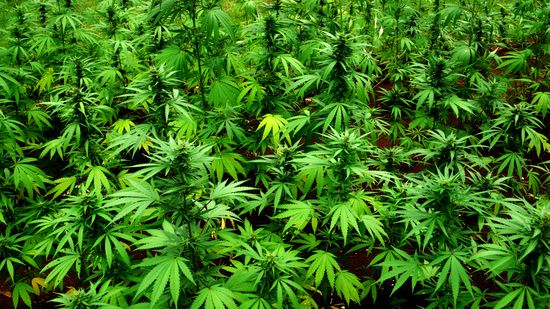
(Photo: Marijuana plants at the mausoleum for reggae musician Peter Tosh (1944 – 1987) in the grounds of his former house in Belmont, Jamaica, 3rd June 2011. By Kevin Cummins/Getty Images.)
 The Dish