James Temple lays out the debate surrounding "cloud brightening," a geoengineering strategy that may help combat rising global temperatures:
It's clear that cloud brightening is possible. Satellites have observed "ship tracks," or whitened lines in marine clouds that large vessels have formed inadvertently by pumping out particles in their exhaust. Unknown is whether humans can do it purposely, on a large enough scale to matter, and without severely altering weather patterns elsewhere.
The World Economic Forum is pessimistic and included "rogue deployment of geoengineering" as an "emerging game changer" in its Global Risks 2013 report (pdf):
The problem is that incoming solar radiation drives the entire climate system, so reducing sunlight would fundamentally alter the way energy and water moves around the planet. Almost any change in weather and climate patterns is likely to create winners and losers, but determining causation and quantifying impacts on any given region or country would be a massive challenge.
They go on:
[T]his has led some geoengineering analysts to begin thinking about a corollary scenario, in which a country or small group of countries precipitates an international crisis by moving ahead with deployment or large-scale research independent of the global community. The global climate could, in effect, be hijacked by a rogue country or even a wealthy individual, with unpredictable costs to agriculture, infrastructure and global stability.
Previous Dish on geoengineering here, here, here and here.
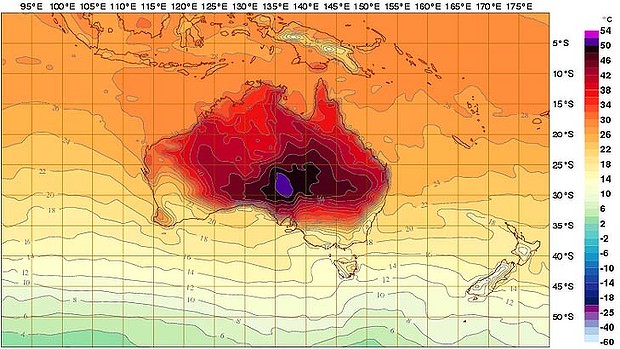
(Image: The Australian Bureau of Meteorology recently added new colors to its weather forecasting chart to extend the range above 50 °C [122 °F]. Credit: Bureau of Meteorology via Sydney Morning Herald)
 The Dish