A reader writes:
As far as I can tell, there’s no evidence for the story that the piggy bank is named after a kind of clay called “pygg.” I’ve checked various dictionaries (including asking Merriam-Webster’s etymology editor) and looked into the origin of the “pygg” story, and as far as I can tell, the whole “pygg” thing is folklore (although extremely widely believed). Here’s a detailed writeup of my research so far.
Another writes:
I researched this subject recently for a post on my History Blog, and Megan Cohen’s summary of the origins of the piggy bank leaves out a key piece of the story. In so doing she inaccurately implies that the concept of a pig-shaped container for household moneys was a coincidence of English nomenclature that traveled across the world to 15th century Indonesia.
The “natural evolution of the English language” that transformed the pygg jar to the piggy bank was the Great Vowel Shift.
Between the 15th and 18th centuries, English long vowels gradually began to be formed higher in the mouth, changing the sound markedly. (This website has a nifty Java applet that allows you to hear the shift.) In 1400, “pygg” would have sounded like “pug.” It wasn’t until the Great Vowel Shift did its magic that it changed to “pig” and thus became a homonym of the animal. By 1700, then, even though pygg clay was no longer in widespread use, the term “pygg” had stuck and since it now sounded like “pig,” it gave craftsmen the undeniably adorable idea of turning out coin banks shaped like the animal.
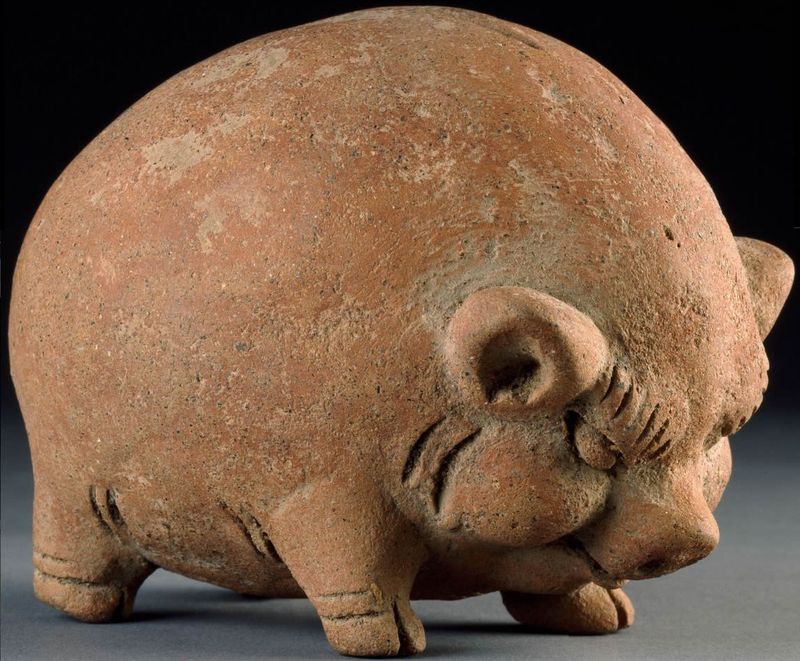
The piggy banks produced in the Majapahit Empire of Java obviously had nothing to do with the Great Vowel Shift of the English language. Majapahit piggy banks began to be made in the 14th century, when pygg jars in England were still pronounced “pug jars” and were just generic cheap vessels for home use with zero connection to the porcine world. Under the Majapahit Empire, increasingly widespread wealth and a massive importation of bronze coins from China led to a new money economy in which even the common people had cash on hand. Cash necessitates a place to put it, which gave rise to artisans creating closed terracotta containers with slots into which coins could be dropped. The celeng, a wild boar native to Java, was the favored shape because their endless appetites, rotund bellies and love of mud made them a symbol of good luck and prosperity connected to the spirits of the earth. How apposite to shape clay into a creature which wallows in mud and then to fill its well-fed round tummy with literal prosperity.
The concept of a pig-shaped home savings bank didn’t “[go] global early,” as Cohen put it. The Javanese got the idea from their own cultural imagery, and then centuries later the English got the idea from a fluke of their language. Even more centuries later, the Ashmolean bought the cutest Majapahit piggy bank ever.
Seen above.
 The Dish