Kayla Williams, who served in the 101st Airborne Division, had doubts about the idea of women serving in combat roles – until she found herself in Baghdad:
Suddenly, my skills as an Arabic linguist were more important than my gender: On combat foot patrols with infantry troops, my ability to help successfully accomplish the mission was the only thing that mattered. During major combat operations, the fact that I was a woman was only meaningful if my presence made it easier for the guys to interact with local women. Some Iraqi women were prevented by custom or religion from talking to men; others were simply terrified of huge soldiers strapped in military gear suddenly appearing at their door. The presence of another woman sometimes calmed them and give them the comfort level to tell us about threats in their neighborhood. …
Those who served in Iraq and Afghanistan came to understand that in complex counterinsurgency operations, especially in Muslim nations, the presence of women troops is a vital way to interact with the civilian population—so important, in fact, that military leaders have long been skirting the old regulations by placing women in combat units.
Previous Dish on the Lioness Program – which allowed female Marines to serve in combat units to interact with Muslim women – compiled here. Will Saletan draws a larger lesson from the Pentagon’s decision this week:
This is what happens to warnings about social experiments. Officially or not, the experiments take place. Sometimes, as in the case of single parenthood, they fail. Sometimes, as is in the case of gay marriage, they succeed. When they succeed, we lose our fear. And when they involve bravery, service, and sacrifice, we’re moved. We aren’t talking about experimentation anymore. We’re talking about experience.
A reader broadens the scope to black soldiers and gay soldiers:
What many folks don’t understand or appreciate when they try to justify the lack of roles available to women in combat is that military service has always been a dominant avenue of advancement in America. Not just military service – combat service. The history of black advancement is as much driven by war and military service as churches and social protest. Perhaps more. Black advancement in the military was always towards combat. “Let us fight.” Combat is the crucible that proves military – and, often, social – status. Without the 54th Massachusetts, without the 369th New York, without the Tuskegee Airmen, we would not have had the landmark desegregation of the US military for God knows how long.
For women to be denied combat roles is holding a capable group back and doing so for structural reasons, not merit. For LGBTQ service members, it is the same issue.
To read all our coverage of the end of the combat ban, go here. For more Dish posts and reader feedback on this issue, go here.
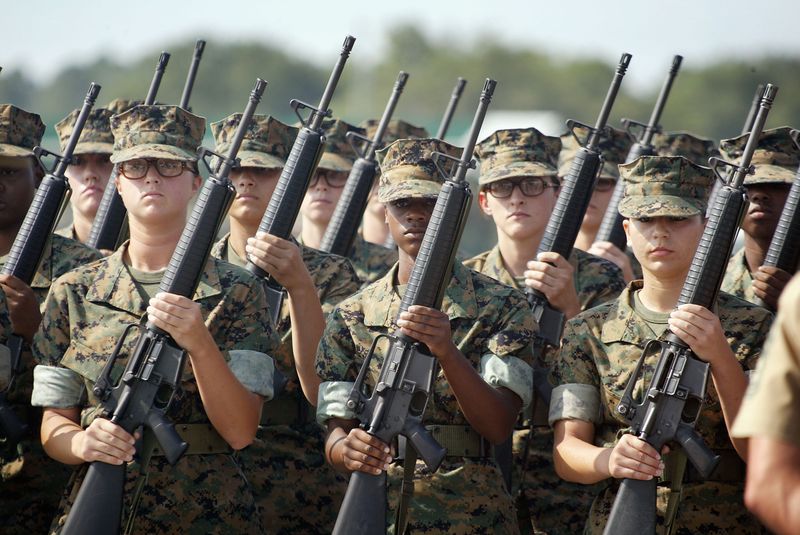
(Photo: Female Marine Corps recruits pratice drill at the United States Marine Corps recruit depot June 22, 2004 in Parris Island, South Carolina. By Scott Olson/Getty Images.)
 The Dish