Freezing As The Planet Overheats, Ctd

Just as you’re getting all bundled up:

The wild roller coaster ride of January 2013 weather continues this week, as Winter Storm Luna spreads snow, sleet and freezing rain across much of the Midwest and Northeast today, to be replaced by a spring-like surge of warm air nearly unprecedented in warmth and moisture for January. Temperatures in Oklahoma City have only reached 80° three times during January since 1890, but threaten to do so again today, and record-breaking high temperatures in the 70s are expected over much of Kansas and Missouri. Accompanying the exceptional January warmth will be near-record January moisture, as a flow of unusually moist air rides northwards from the Gulf of Mexico, where water temperatures are about 0.3°F above average.

The GOP Calculus On Immigration Reform

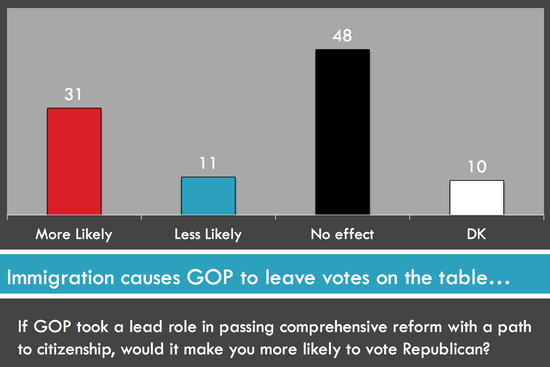
Numbers from Latino Decisions (pdf) suggest that Republicans could gain Latino votes by moderating on immigration:

6a00d83451c45669e2017d40895ff9970c-550wi

Ezra explains the GOP’s thinking:

Two numbers explain why a rational Republican Party needs to do something dramatic on immigration: 27 percent and 2 percent. Twenty-seven percent is the percentage of the Latino vote Mitt Romney received in 2012, according to the exit polls. Two percent is the projected increase in the non-white electorate come 2016.

Chait summarizes the GOP plan as “go left on immigration, right on everything else”:

The key figures leading the way are Paul Ryan, the Republicans’ de facto leader, and Marco Rubio, perhaps its leading presidential candidate. The two have moved generally in tandem, with Rubio leading the way on immigration, but the whole party apparatus has jolted into action. Within days of the election, partisan barometers like Krauthammer and Sean Hannity had announced they had suddenly changed their mind and now favored comprehensive reform. Freed up to cut a deal, Rubio has thrown himself behind a reform plan liberals can happily accept, while he has steadily neutralized every source of conservative discontent. (Hardly a day goes by without some new Republican praising Rubio’s plan.) Crucially, Ryan himself has signaled support for Rubio. The party’s rapid embrace of immigration reform has been a sight to behold, a ruthlessly efficient exercise in partisan calculation.

Frum is skeptical that immigration reform will pay dividends:

The same senior Republican leaders who believed that Mitt Romney was winning the 2012 election now insist that immigration reform will deliver Hispanic votes. They’re just wrong about that.

Republicans face increasing difficulty with the Hispanic vote for pocketbook reasons. As the Hispanic electorate becomes less Cuban, more Mexican and Central American, it becomes less susceptible to GOP cultural themes. The claim that Hispanic voters are “natural Republicans” is based on nothing but wishful thinking, fortified by ignorance.

Bouie’s analysis is more nuanced:

The GOP’s best hope comes from assimilation. If Latinos follow the path blazed by Irish and Italians — and ethnic identity becomes less salient to political affiliation — then Republicans stand a chance at winning a sizable share of their votes. Already, you can see hints of this in Latino public opinion: First generation Hispanics are the most supportive of “big government” (81 percent to 12 percent), but third generation are the least supportive (58 percent to 36 percent). But even then, you have a situation where the bulk of younger Latinos are broadly supportive of government. In other words, no matter how you slice it, Latinos will remain a Democratic constituency. Republican outreach might work on the margins, but there’s no reason to expect anything more than that.
Blanco, Whitman And Orwell, Ctd

Sean Hughes asks if it’s even possible to have an outstanding contemporary poem mark a president’s inauguration – and finds that current tastes in verse are a major obstacle:

6a00d83451c45669e2017c36596ac1970b-320wi[T]he audience for occasional poems — those composed for particular occasion — has collapsed. People have relatively set expectations about poetry, even if they don’t read it: I’ve met very few people who still think that poetry must rhyme, but most people expect poetry to have an aura of exceptionality, one way or another. If you’ve ever combed through submissions to a lit mag, or looked at what gets in, you’ll see that occasional poems are rare. People are generally inclined to think that a poem should be its own occasion and express whatever caused its composition.

This is a relatively recent consensus. Occasional poetry was standard for much of history, and it was common for newspapers to publish occasional poems into the early twentieth century. At the outset of World War One, for example, there were thousands of poems printed, and people must have known that few of these poems would be read in the future. There’s still topical poetry, but there isn’t really a general audience for versifying on current events.

Perhaps not to-order, but poems are often uniquely appropriate comments on events long after they have been written. Meanwhile, David Biespiel takes issue with my juxtaposition of Whitman and Blanco:

In Blanco’s passage, his focus is on the hands that belong to individuals, hands that glean and dig and are worn. The hands are symbols for the Americans who go about their daily jobs. These depictions are isolated, individual dramas, such as the one Blanco mythologizes about his father’s hands and how his fathered wonderfully cared for his children. This is a singular, private, standard sort of contemporary American poetry of the self.

In the Whitman passage, everyone is singing individual songs. But, here’s the important fact, they are singing them together. That’s what Whitman hears when hears “America singing.” I mean, he doesn’t hear “Americans singing.” It’s e pluribus unum. That’s the essential difference Sullivan misses.

Achievement Anxiety

Heather Horn ponders the sentiment among millennials who see Lena Dunham achieving the kind of early fame her Girls character can only dream about:

The feeling of having hoped you’d be further along by age x is pretty common, whether the yardstick is in financial success or artistic achievement and critical acclaim (and often young writers aren’t sure which they value more). … The writer goes through all the standard justifications, including looking for great late-blooming poets to use as benchmarks. But—oh, damn: Do you want to be one of those late bloomers? No, you want to know that you’re going to be a great poet now! No one wants those years wondering if you’ll forever be trapped in your own mediocrity.

It’s not unique to the millennials, however, as Horn illustrates by turning to an anonymous Atlantic column from the early 20th century:

[T]wenty-one threatened me to the very teeth. Drake’s Culprit Fay mocked me; Holmes’s Old Ironsides roared at me; Campbell’s Pleasures of Hope enticed me; Milton’s Nativity ode submerged and cowed me. ‘No, no,’ I cried, as I read again these resonant strophes, ‘I will be a minor poet and never strive with Milton.’ Later, by strange reversal, I consoled myself with proofs that the great poet must come slowly to his height, and I lived for cheerful months on the surpassing badness of Shelley’s work before Alastor, fruit of twenty-three.

Anti-Drone Apparel

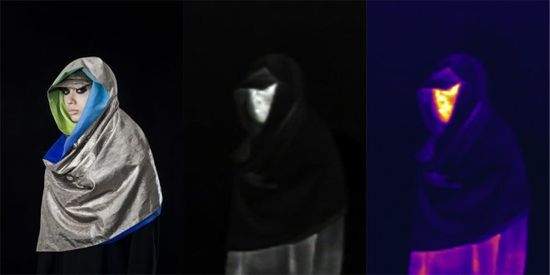
6a00d83451c45669e2017ee7946d7a970d-550wi

Artist Adam Harvey has spent the last four years designing counter-surveillance fashion. Tim Maly reviews his work:

His latest addition is a collection of clothes and accessories called Stealth Wear. The collection includes an anti-drone hoodie and scarf that are designed to thwart the thermal-imaging technology widely used by UAVs, and the OFF Pocket, a phone accessory that blocks all incoming and outgoing communication from your phone. Harvey’s earlier work includes the CamoFlash, a set of powerful LEDs that trigger when it detects camera flashes, turning the tools of the paparazzi against them, and CV Dazzle, a experiment with makeup and hair styles that will confuse facial-recognition systems.

How Harvey explained the philosophy of the project to Maly:

Conformity is what surveillance wants and fashion is anti-conformist. And I think the decision to conform or not happens on a personal level. The projects I’ve been working on act upon surveillance in a way that exploits a vulnerability and makes this vulnerability accessible through using something ordinary (hair, makeup, or fashion) in a non-conformist and legal way.

More images here.

(Image by Adam Harvey/ahprojects.com)

The Window For Immigration Reform

Drum thinks it’s tiny:

Tougher enforcement—which included building the fence, beefing up border patrols, pushing ahead with E-Verify, and escalating the number of deportations—has worked alongside a weak economy to slow illegal immigration to a crawl over the past four years, and this has steadily whittled away at the appeal of the immigration table pounders. Combine this with a Republican Party that desperately needs to stanch its bleeding among the fastest growing ethnic group in the country, and you finally have, for the first time in decades, a political climate that just might make immigration reform possible. But I doubt that this moment will last very long. This probably needs to happen in the next six months if it’s going to happen at all.

Correction Of The Day

“An earlier version of this column misstated a plot point in “South Park.” While the character Kenny was once killed in every episode, that is no longer the case. The earlier version also misstated the circumstances of his repeated deaths. While he has met his fate in a variety of ways over the years, he was not routinely “ritually sacrificed,”” – David Carr, NYT.

Foreign Fast Food

Jeb Boniakowski dreams of “McWorld,” a place in Times Square that would serve all the world’s variations of the McDonald’s menu:

Everyone talks about how globalization “McDonalds-izes” the world, but the funny thing about a place like New York is that you can get basically every kind of food *except* whatever they serve at the foreign outposts of our proud American chains. I would say I know more people who have had a lamb face salad from the Xi’an Famous Foods in the Golden Mall in Flushing than have had the poutine from the Montreal McDonalds, never mind something you really have to travel for, like a Chicken Maharaja Mac.

Continue reading Foreign Fast Food

Learning By Heart

Brad Leithauser sees value in poetic memorization:

The best argument for verse memorization may be that it provides us with knowledge of a qualitatively and physiologically different variety: you take the poem inside you, into your brain chemistry if not your blood, and you know it at a deeper, bodily level than if you simply read it off a screen. [Catherine] Robson puts the point succinctly: “If we do not learn by heart, the heart does not feel the rhythms of poetry as echoes or variations of its own insistent beat.”