Product Review Of The Day

A reader urges:

Please read the comments section for Veet hair removal. The British have such a way with words.

The top-ranked review:

Being a loose cannon who does not play by the rules the first thing I did was ignore the warning and smear this all over my knob and bollocks. The bollocks I knew and loved are gone now. In their place is a maroon coloured bag of agony which sends stabs of pain up my body every time it grazes against my thigh or an article of clothing. I am suffering so that you don’t have to. Heed my lesson. DO NOT PUT ON KNOB AND BOLLOCKS.

(I am giving this product a 5 because despite the fact that I think my bollocks might fall off, they are now completely hairless.)

I miss Blighty for stuff like that. But any male who forcibly removes any hair from his body is asking for it.

“Bone-Gnawingly Cold”

One reader’s story sparks another:

I couldn’t resist sending a note in response to the reader story you posted last tonight about the ISU Phi Gamma. Seeing that photo was like being transported back in time. I Iowa State Universitywas a 9 year old living on the east side of Des Moines in January 1982 and I was awestruck by the photos in the Des Moines Register showing the aftermath of the fire. It looked like a more refined version of the Wampa’s cave on Hoth and I spent a lot of time imagining how cool it would be to explore it. The memory of that ice encrusted building, simultaneously beautiful and terrible, has lingered with me ever since, as has the memory of that arctic January.

See, back then we didn’t get delays or cancellations for cold weather (insert “these kids today” grumbling here). We got them for blizzards, and that year it seemed like there was one howling in every single week in January. But once the wind had died back and it wasn’t a full on white-out anymore we were expected to be at school at the usual time, no excuses.

Continue reading “Bone-Gnawingly Cold”

From Karl Rove To Karl Marx?

Bhaskar Sunkara sees both challenge and opportunity for the far left in an era of disillusionment with the status quo:

For many in my generation, the ideological underpinnings of capitalism have been undermined. That a higher percentage of Americans between the ages of 18 and 30 marxhave a more favorable opinion of socialism than capitalism at least signals that the cold war era conflation of socialism with Stalinism no longer holds sway.
At an intellectual level, the same is true. Marxists have gained a measure of mainstream exposureForeign Policy turned to Leo Panitch, not Larry Summers, to explain the recent economic crisis; and thinkers like David Harveyhave enjoyed late career renaissances. The wider recognition of thought “left of liberalism” – of which the journal I edit, Jacobin, is a part – isn’t just the result of the loss of faith in mainstream alternatives, but rather, the ability of radicals to ask deeper structural questions and place new developments in historical context.

Now, even celebrated liberal Paul Krugman has been invoking ideas long relegated to the margins of American life. When thinking about automation and the future of labor, he worries that “it has echoes of old-fashioned Marxism – which shouldn’t be a reason to ignore facts, but too often is.” But a resurgent left has more than worries, they have ideas: about the reduction of working time, the decommodification of labor, and the ways in which advances in production can make life better, not more miserable.

I don’t think Sunkara is wrong about this – but mainly by default, because conservatives, instead of trying to rein in a corrupt capitalism, have been defending its excesses as principles, and just ran a Bain executive as its nominee, for Pete’s sake, after an era in which reckless financial oligarchs nearly destroyed the entire global economy. What we have now is not democracy, properly understood, but an oligarchy on the take and a justice system designed to convict rather than try. Conservatism should be on the forefront of reform here – as Disraeli and Bismarck and Lincoln were – because it is our beloved free market economics and representative democracy that are being discredited for at least two generations.

And not because a free market doesn’t work when government regulates it right, when the tax code is simple enough for every citizen to understand, and when government tax-expenditures do not infiltrate every nook and cranny of our economic life. The GOP needs to propose and fight for a return to real capitalism and opportunity, radical tax reform, an end to all deductions, serious long-term cuts in entitlements that Obama won’t touch, prison reform, breaking up the big banks, ending the drug war, and turning the permanent war department back into something recognizable as “defense.” That doesn’t include intervention in fricking Mali, by the way. Or picking yet another military fight in the Middle East with a land invasion and air-campaign. Or thinking that torturing defenseles prisoners is some kind of strength, when it is, in fact, proof of our lost way.

Marxism in its classic sense cannot come back. It was proven wrong. Collectivism, however, always has a future. In my view, it is at worst a necessary evil from time to time (defensive war, a social safety net against the hazards of life), and at best a vital resource for liberal democracy in crisis (see FDR and Obama). But it is much more avoidable if real conservatives do their duty all the time, and attend to corruption in capitalism diligently, regulate lightly but firmly and without favors, fight the military-industrial complex and keep the lid on domestic spending.

But in America, the Republicans haven’t done this for decades. They’ve forgotten entirely what their reformist tradition requires of them. Now.

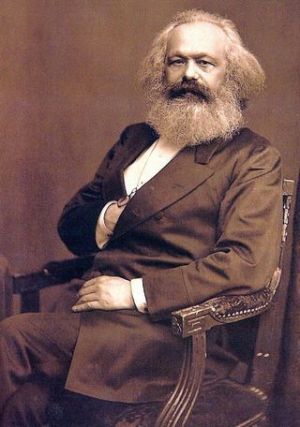
(Photo: dude with major beard who inspired some of the worst mass-murderers in history.)

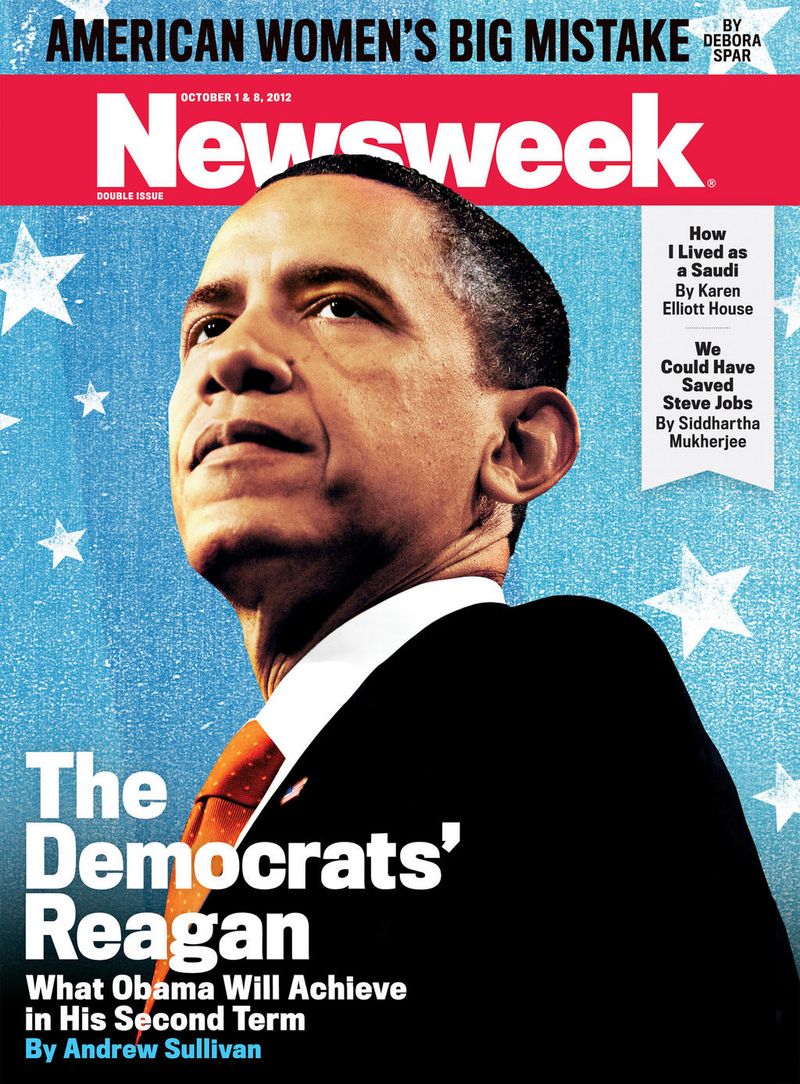
The Democrats’ Reagan, Ctd

democrats_reagan

Douthat concedes that, in a certain respects, “Obama is already more like Reagan than he is like any other recent president of either party.” But much could change:

Reaganism’s ascendance wasn’t sealed by his re-election, let alone his first inaugural: It took 1988 to consolidate the rightward shift and 1994 to really ratify it. For now, Obama still awaits his George H.W. Bush (hey, Biden!) and his Newt Gingrich — and for that matter, he awaits his Clinton, because there’s a sense in which declarations of victory are less telling than statements of surrender. The moment when you knew that the age of Reagan would be remembered as a lasting political epoch didn’t come when Reagan declared that government is the problem in 1980; it came sixteen years later, when a Democratic president felt the need to open his re-election campaign with the Reagan-esque promise that “the era of big government is over.” In the same way, the clearest vindication of Obama’s presidency, if such a vindication comes, will probably take the form of a Republican president who sounds uncannily (if reluctantly) like him.

All those caveats are correct. But culture and timing also matter, in my view.

The first Reagan Inauguration had a real sense of a new cultural and psychological beginning.  The hostages were freed, the “revolution” was begun, taxes were swiftly cut with Democratic support (the Dems were still a diverse party then even if the Republicans are not now). Yes, Reagan then plummeted in the polls in a Fed-induced recession – below Obama’s trough – before using Keynesian reflation as a spur to growth (and the first shoots of what is now our massive debt).

Obama’s first Inauguration was the same cultural-historical breakthrough; two new generations are bonded with him and three against the GOP; universal healthcare is as profound a change as permanently lower tax rates; ending the wars in Iraq and Afghanistan will also allow for a peace dividend if the Pentagon and GOP don’t stand in the way. These years look likely to cement the integration of gay people in America and the beginning of the end of marijuana Prohibition. They also show a shift toward reining in the excesses of conservative hubris – unfunded wars and entitlements, abuse of capitalism, and reckless adventurism abroad. Reagan was also unimaginable without Carter. And I think Bush-Cheney’s legacy will very soon seem far, far worse than Carter’s.

Yes, at some point he has to win over the other side, which takes time. From Thatcher’s first four years to Blair was an eternity; Ditto Reagan to mid-Clinton. But have you noticed the fizzling of the anti-gay rhetoric from the GOP in the campaign? Do we have a potential Republican defense secretary who will treat Israel as a critical ally rather than as a 51st state? Can you imagine Bobby JindalMarco Rubio endorsing women in combat before Obama’s re-election?

Obama has yet to have an Iran-Contra. But he has also yet to have a Reykjavik. No one with any good sense and historical understanding will predict anything with confidence. But I think our first black president, who saved us from the economic fate of Europe and Britain, who legislated healthcare for all, who changed politics and campaigning for good through the web, and who is slowly watching his political foes crumble – from Netanyahu to Cantor … well, he may eclipse Reagan at some point. May. If Iran turns on his watch and democracy stabilizes in Egypt, the game is over. But he has been history from the get-go.

My previous thoughts on the subject here.

Empirical Equality

females-front-3

Kayla Williams, who served in the 101st Airborne Division, had doubts about the idea of women serving in combat roles – until she found herself in Baghdad:

Suddenly, my skills as an Arabic linguist were more important than my gender: On combat foot patrols with infantry troops, my ability to help successfully accomplish the mission was the only thing that mattered. During major combat operations, the fact that I was a woman was only meaningful if my presence made it easier for the guys to interact with local women. Some Iraqi women were prevented by custom or religion from talking to men; others were simply terrified of huge soldiers strapped in military gear suddenly appearing at their door. The presence of another woman sometimes calmed them and give them the comfort level to tell us about threats in their neighborhood. …

Those who served in Iraq and Afghanistan came to understand that in complex counterinsurgency operations, especially in Muslim nations, the presence of women troops is a vital way to interact with the civilian population—so important, in fact, that military leaders have long been skirting the old regulations by placing women in combat units.

Previous Dish on the Lioness Program – which allowed female Marines to serve in combat units to interact with Muslim women – compiled here. Will Saletan draws a larger lesson from the Pentagon’s decision this week:

This is what happens to warnings about social experiments. Officially or not, the experiments take place. Sometimes, as in the case of single parenthood, they fail. Sometimes, as is in the case of gay marriage, they succeed. When they succeed, we lose our fear. And when they involve bravery, service, and sacrifice, we’re moved. We aren’t talking about experimentation anymore. We’re talking about experience.

A reader broadens the scope to black soldiers and gay soldiers:

What many folks don’t understand or appreciate when they try to justify the lack of roles available to women in combat is that military service has always been a dominant avenue of advancement in America.  Not just military service – combat service.  The history of black advancement is as much driven by war and military service as churches and social protest. Perhaps more. Black advancement in the military was always towards combat. “Let us fight.” Combat is the crucible that proves military – and, often, social – status.  Without the 54th Massachusetts, without the 369th New York, without the Tuskegee Airmen, we would not have had the landmark desegregation of the US military for God knows how long.

For women to be denied combat roles is holding a capable group back and doing so for structural reasons, not merit.  For LGBTQ service members, it is the same issue.

To read all our coverage of the end of the combat ban, go here. For more Dish posts and reader feedback on this issue, go here.

(Photo: Female Marine Corps recruits pratice drill at the United States Marine Corps recruit depot June 22, 2004 in Parris Island, South Carolina. By Scott Olson/Getty Images.)

The Alternative To Abortion

Unmarried_Birth_Rate

Naomi Cahn and June Carbone argue that, if “abortion is not an option, then more single-parent births are pretty inevitable”:

The big increase in African-American nonmarital births occurred in the 1960s and 1970s. For whites, the development has been more recent, and it has occurred at the same time as the emergence of anti-abortion sentiment as a key constituent of conservative political identity. Has the hardening of anti-abortion attitudes among white working-class conservatives helped cause the increase in white nonmarital births? Did it contribute to the erosion of the stigma on nonmarital births? As scholars, while we suspect that the answer is yes, we have to admit that we have no definitive data.

Douthat counters:

Yes, in a post-Roe world, social conservatives often find themselves accepting single parenthood as the lesser (by far) of two potential evils. But there’s good reason to think Roe itself was instrumental in creating the kind of sexual culture that makes the Bristol Palin dilemma as commonplace as it’s become. While the frequent use of abortion can limit out-of-wedlock births, that is, the sudden mass availability of abortion almost certainly had the opposite effect — mostly by changing the obligations associated with pregnancy, and by legitimating male irresponsibility where sex and its consequences are concerned.

(Chart: “Number of births, birth rate, and percentage of births to unmarried women: United States, 1940-2007” from (pdf) the CDC.)

“The Innocence Penalty”

Balko defines it:

Innocent people are much more likely to refuse to admit to their crimes–before and after conviction. (Although it still happens.) That “lack of remorse” often moves prosecutors to throw the book at them, judges to give them longer sentences, and paroles boards to keep them behind bars for as long as possible.

Falling For A Fictional Woman

This embed is invalid

The Manti Te’o hoax prompted Gregory Crosby to describe his relationship with a woman who didn’t exist. How he found out:

When two days went by without a call, and I couldn’t reach Myella on her phone, I at last gave in to the suspicions that had grown within me, and called a third party who very reluctantly answered my questions. Yes: Myella, I learned, was the creation of an acquaintance of mine from years ago, a woman I barely knew, who I later discovered had a long history as a pathological liar, three kids, an abusive ex-husband and fantasies of another life, a life that I seemed to represent. It turned out that she had been arrested for unpaid traffic tickets and spent two days in jail without her phone, hence the wholly uncharacteristic silence that led to my call. I should have been devastated, and if I’d found out the truth early on, I would have been… but after a year and a half, mostly what I felt was relief that I’d finally found the strength to tear the veil away, along with a great well of anger and sorrow that only a few months of therapy could dissipate.

(Video: One of the voicemails from Manti Te’o’s “girlfriend” released to Katie Couric. Listen to others here.)

Saving The Sounds Of America, Ctd

For a more literal take on archiving America’s sound, read Peter Andrey Smith’s short profile of Hillel Schwartz, a historian who just published, Making Noise: From Babel to Big Bang and Beyond:

Sound does not persist, neither across space nor across generations, so the tremendous rattle of horse-drawn drays, the clink of cupboards, the sneezes and shuffles of domestic life fall into the vacuous, silent crevices of history. “How did diners respond to the switch from pewter to china?” Schwartz wondered aloud. “How did a midwife register the sound of a new baby coming into the world? How did a person walking out in the woods register the sound of thunder or lighting?”

In the course of nearly two decades of research, he had examined diaries, listened to wax cylinders, poured over digitized copies of the Brooklyn Eagle from 1901, and yet these subtle historical shifts in the soundscape eluded him.