America’s Habit Of Training Its Enemies

Mali_GT

While analyzing the situation in Mali, Steve Coll points out the unpredicable consequences of the US training foreign militaries:

The Pentagon has yet to meet a military in a desperately poor or hopelessly corrupt country that it does not believe it can train and equip to a professional standard. Pentagon training has in fact strengthened and stabilized professional militaries in many developing countries. Yet some of the militaries that the United States has mentored in North and West Africa are best understood as criminal organizations that happen to wear pressed uniforms and epaulets. The better that some of these students learn to shoot while at Fort Benning, and the better the equipment they receive as favored clients, the more effective they become at their enduring vocations—drug smuggling, coup-making, and profitable collusion with pirates and terrorists.

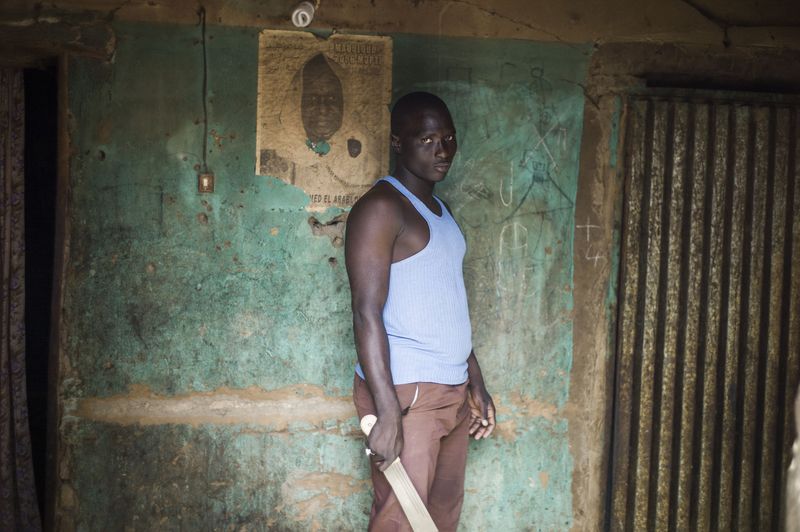
(Photo: A Malian man, Mohamed, poses at his home with a machete to protect himself in case of attacks by Malian Islamist rebel groups, in Mopti, on January 24, 2013. By Fred Dufour/AFP/Getty Images)


Females At The Front, Ctd

A reader highlights another reason why ending the ban is so crucial:

Without the combat designation, women veterans can be denied the benefits they need, particularly medical and psychological, because they were designated non-combat while serving. Receiving many benefits from the VA is dependent on “if the veteran engaged in combat with the enemy.” A critical part of the approval process is what was the veteran’s designated military occupational speciality. If women will have noncombat MOS even if they engaged in combat because they are women then that means the VA might not approve them for combat related requests for benefits.  Women are not being treated equally under the law because of the noncombat designation.

I expect there will be a massive  lawsuit on behalf of all the female veterans of the Iraq and Afghanistan wars to be retroactively reclassified as having served with combat duty in order to get the medical benefits they will need from the VA for the rest of their lives.  Because right now, that shit is being denied and will continue being denied for the entirety of their lives, all because they were designated ‘non-combat’ when they served.

Update from another:

The last reader’s comment regarding women not getting full VA benefits from combat related issues strikes me as utter horseshit. I’m a male serving in a support MOS, along with way more males than females in these non-combat arms MOSs, so wouldn’t I have the same problem (if I had medical issues from combat) regardless of gender but based on MOS? If there is just plain old sexism going on in the VA, then it’s already illegal.

The Combat Action Badge, awarded for directly engaging or being engaged by the enemy, was specifically invented to recognize the combat service of non-infantry MOSs (who are awarded the Combat Infantryman’s Badge and have for a long time). So, if this issue is actually occurring systematically based on “combat designation”, it would be a discrimination based on job description and not actual combat service, and not actually fixed by women in combat arms.

I have (thankfully) had very little to do with the VA health system, but I would guess your previous reader has had even less. From what I understand, if you have documentation that your health issues are combat related the VA will address it. So while it might be a tad harder to justify if you’re not in a combat MOS, it should not be because of gender already.

Map Of The Day

budget_info

The CBPP flags a new report by the International Budget Partnership on global budgetary transparency:

While the current picture is bleak, budget transparency has improved steadily over the four rounds of the Survey since 2006, and such countries as Honduras, Afghanistan, and Mozambique have made major improvements.  These examples show that the commitment of governments — combined with donor interventions, international standards, and civil society pressure — can significantly and rapidly improve budget transparency.

Dylan Matthews adds:

[O]verall, the document is a pretty strong vote of confidence in the [US] federal government’s transparency efforts. While not perfect, our budget offices beat just about every peer country, from Spain to Italy to Germany. We best India and absolutely crush China (Russia, curiously, actually does pretty well in this area). Features like this and the presence of reliable statistical agencies like the Bureau of Labor Statistics are real triumphs of governance, and worth being proud of.

Have No Fear Of Killer Robots, Ctd

A reader writes:

I would take Bruce Sterling’s comments about the Singularity with a grain of salt.  In a recent book called Race Against the Machine, Harvard Professor Eric Brynjolfsson recounts a 2004 book written by an economist from Harvard and one from MIT.  Their book, The New Division of Labor, looked at the comparative capabilities of humans and computers and present a spectrum of information processing tasks.  On the one end of the spectrum are straightforward applications of existing rules, such as math, at which computers are very good, and which can easily be automated.  At the other end they identify pattern recognition tasks where rules cannot easily be inferred.

The authors specifically refer to driving in traffic as a difficult pattern recognition type of problem, and they assert – in 2004 – that it is not automatable.  Fast forward less than 10 years, when Google and others have driverless cars driving automatically over hundreds of thousands of miles. Without one accident.  Oh, and those cars have now been on the road for several years, meaning they were introduced just a couple of years after the 2004 book by Harvard economists said it was basically impossible.

The future is unknowable, but one thing we know is that change sometimes comes fast.  Things that are unimaginable become reality in the space of only a few years.  So, can I comprehend the Singularity?  Not really.  Do I fear it?  Of course.  Do I doubt it ever happens? Absolutely not.

First Tancredo; Why Not Obama?

getty-pot

The far-right former congressman from Colorado will soon publicly and legally smoke a joint in his home state – to make good on a bet he made with a producer of a documentary on the passage of Amendment 64. This is a statement I hope David Frum reads:

I am endorsing Amendment 64 not despite my conservative beliefs, but because of them. Our nation is spending tens of billions of dollars annually in an attempt to prohibit adults from using a substance objectively less harmful than alcohol.

The president, who smoked more pot as a teenager than most people will in a lifetime, has previously laughed off the option of legalizing and taxing cannabis. His DEA, moreover, retains the simply insane notion that pot is in the most dangerous category of drugs, right up there with heroin, with no medical use whatever. This is bonkers. It seems to me that this administration should order a review of that classification as soon as possible; and that the next time our former hardcore stoner president arrives in Colorado, he might visit a legal dispensary and show his appreciation of Coloradan freedom. Or maybe – in my dreams – the next generation of Republicans will seize this issue against racist, wasteful and unnecessary government intrusion into our lives – and help win back a generation for limited government.

The Daily Wrap

Today on the Dish, Andrew took aim at the historical myths concocted by the gay left and religious right, and stared in disbelief at the criminalization of HIV in America. With the Israeli elections over, he studied the country’s deep division in light of the results and put his foot down about US meddling in Syria. Elsewhere, Andrew noticed that the pro-torture right has yet to really brandish Zero Dark Thirty as propaganda, groaned at the infinite lameness of the Democrats and Harry Reid, and spread the gospel of winter beardage.

On the politics beat, we rounded up coverage and commentary on the US military lifting the ban on women in combat, which saw both considered and boorish pushback. A reader tipped us off to the GOP’s quiet but disquieting effort to rig states’ electoral vote count, Neil Irwin assured us that the stock market’s current boom is no bubble, and Mary Elizabeth Williams earned herself a Yglesias Award for her honest remarks on abortion. Meanwhile, we kept an eye on Rhode Island’s push toward marriage equality, charted the cost of American empire since WWII, and examined why investors keep turning to sketchy hedge funds.

In assorted coverage, readers sounded off on yesterday’s anonymous letter in defense of Mel Gibson, while one shared a surreal college story that produced an unforgettable photo. We reaffirmed the truth of the moon landing, rolled out a canine atlas of NYC, and tried to give Internet comments the best of both accountability and pseudonymity.

Cristy Gelling introduced the birds whose brains are both a hazard and an asset, Paul Marks let cyclists know they can strap a GPS around their waist, and Jessica Dorr proved that libraries are as vital as ever. We sampled the morning mist on the Ucayali River, Peru for the VFYW, met the gaze of a particularly colorful Face Of The Day, and enjoyed every frame of today’s MHB.

– B.J.

Females At The Front, Ctd

females-front-ctd

Adrian Bonenberger, a former “executive officer (second in command) of a mixed-gender logistical unit in the 173rd Airborne Brigade for seven months,” says, “watching women do CrossFit at strength levels beyond anything I achieved as a soldier have convinced me that women are capable of meeting the challenge of infantry training and infantry missions as well.” His perspective on lifting the ban on female troops in combat positions:

There are two truths functioning in parallel here. The first is that women are different from men. The second is that in modern warfare, women may in many ways be as good as men at fighting. Some evidence suggests that women may be better suited than men to be pilots, for one thing, and may be as capable as or better than men as snipers and marksmen. Rather than ignoring the differences (the current method) or trying to make women into men, or vice versa (the proposed future method), the military should be looking for ways to maximize the capabilities of both.

Here’s what I’m worried about: that the military will let women fail, that it will change the standards to allow unqualified candidates to succeed, then stand around with crossed arms waiting for a chance to say: “You see? I told you. Women can’t do it.” Instead, it should be taking all measures necessary to ensure that qualified women succeed.

You can read our entire “Females At The Front” thread here.

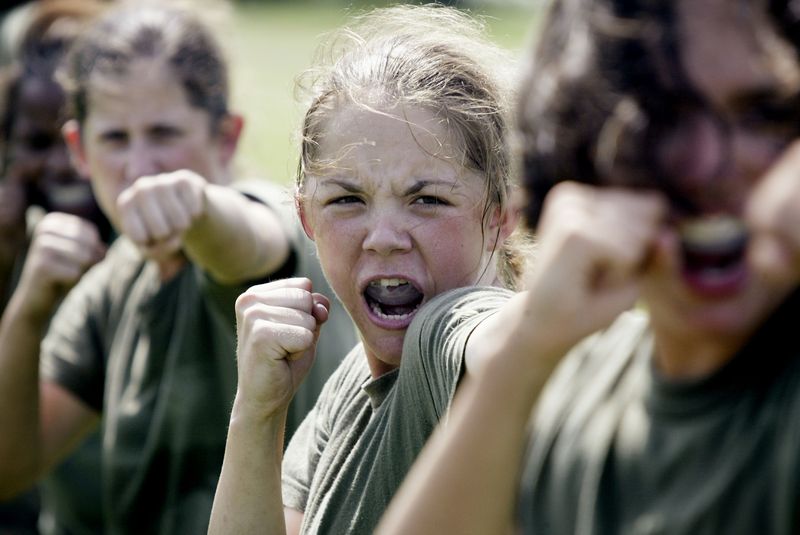
(Photo: Female Marine Corps recruit Megan Shipley, 17, of Kingston, Tennessee, lets out a yell during hand-to-hand combat training at the United States Marine Corps recruit depot June 23, 2004 in Parris Island, South Carolina. Marine Corps boot camp, with its combination of strict discipline and exhaustive physical training, is considered the most rigorous of the armed forces recruit training. By Scott Olson/Getty Images)

Ah, College

Iowa State University

Dish readers have the best stories:

After seeing that photo of the fire in Chicago, I thought you might like this picture of my fraternity, Phi Gamma Delta, at Iowa State University, Ames, IA. We had a fire in the middle of a blizzard on January 16, 1982, my roommate’s birthday. The wind chill factor was near -100F. The ice-free spot by the upper window was where a fire truck snorkel had frozen to the house. They had to bring a crane to lift it off.

We were allowed inside after three days. Water was frozen in ripples to the walls and stairways, like something out of Fantasia.  Half the roof was burned off, including the section where my room was. There was one wisp of smoke left rising, coming from what was left of my room. When I entered, I saw it was my record collection, still smoldering. As I stood in disbelief, a firefighter pushed by me and stomped it out.

This photo hit the wires and we got copies of newspapers with this photo from all around the world. I don’t think I will ever have another experience as thoroughly surreal as those few days.