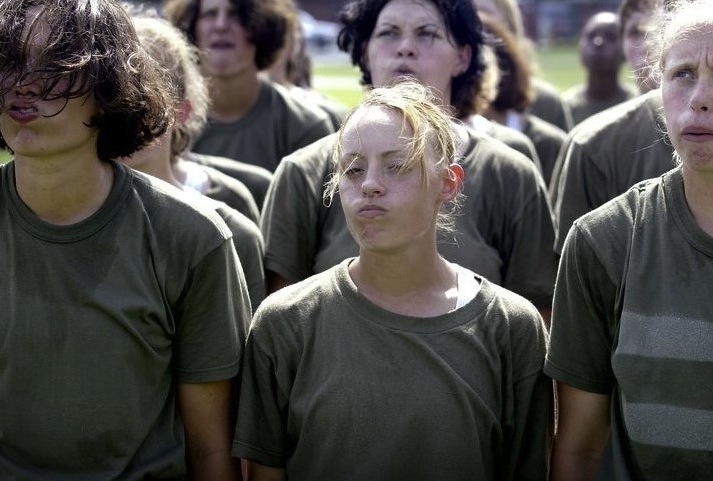
Females At The Front, Ctd

Heather Mac Donald complains about the military ending the ban on women in combat roles:

Any claim that our fighting forces are not reaching their maximum potential because females are not included is absurd. The number of women who are the equal to reasonably well-developed men in upper-body strength and who have the same stamina and endurance is vanishingly small. Because the number of women who will meet the military’s already debased physical-fitness standard will not satisfy the feminists’ demand for representation, the fitness standard will inevitably be lowered across the board or for women alone, as we have seen in civilian uniformed forces.

Ambers rebuts her:

The worry that standards will be relaxed for women is more appropriately expressed as a desire to make sure that the standards for the job are exacting and right; that means that some may be relaxed, and some may be tightened. Equality of condition in the military for men and women is not a goal of this policy. An end to discriminatory policies that have no rational basis while preserving military readiness — a readiness that stilldoes incorporate a recognition of gender differences — is.

A reader sounds off:

One thing that always chafes at me is the way in which the military term “non-combat” is portrayed by the media, almost always in relation to the (correct) inclusion of women in combat roles. I’m a soldier in the Military Police, a branch within the Army that’s often jokingly derided by the Infantry and Armor types as “women’s Infantry” (emphasis on jokingly). My sense is that soldiers in the Maneuver branches (Maneuver is the Army term that replaced ‘CombatArms’ – Infantry, Field Artillery, Air Defense, Armor, and Special Forces) seriously acknowledge that non-Maneuver soldiers, especially MPs and Engineers, provide a combat capability that’s vital to the fight and that they themselves could not provide. The MP branch in particular has been seen as the go-to destination for female officers looking to lead soldiers in combat.

It’s great that those women will now be able to test their mettle in the Maneuver branches of the Army. One key thing that I think is lost on the civilian world though is that there is going to be fierce resistance to women being held to different physical standards in these new roles.

In the military, men and women are scored on different scales for their branch’s particular physical training test, and their scores greatly impact their job evaluation. The tests also serve as a sort of pass/fail barrier to entry to some elite military schools like Ranger School in the Army, seen as the ‘must-do’ for all junior Infantry officers wishing to make it past captain. In the Maneuver world, where leaders are expected to score above the 90th percentile on these physical tests, you’re going to see fierce resistance from male soldiers and Marines who dislike their female competition being graded on a different (easier) scale. I wouldn’t be surprised if they make the women who try to get into these units meet male physical standards.

These courses are incredibly physically demanding, and most men fail. It sounds bad to say it, but it might be a long time before we see a woman graduate wither from Ranger School or the Marine Corps Infantry Officers Course. The women who were handpicked by the Army and Marine Corps over the past few years to test the waters by going through those schools all failed, and failed badly. And they were real-life G.I. Janes. Today’s a victory for women in the service, but the true victory is going to come when we see Ranger-tabbed female Infantry captains.

You can read our entire “Females At The Front” thread here.

The Right Amount Of Anonymity

TechCrunch explains why they are reintroducing some anonymity into their commenting platform:

[W]e eventually discovered that our anti-troll tactic worked too well; The bullies and asshats left our comments sections, but so did everyone else.

Jeff Sonderman points to data from commenting platform Disqus that indicates this might be a wise move:

[Disqus] says those with pseudonyms post the best comments, while anonymous comments are lower quality. One theory: People don’t mind being accountable online, but they don’t want it to blow back on their work or personal lives by using a real identity. A pseudonym protects them while providing a measure of accountability.

Previous Dish on pseudonymity here and here.

Not Another Bubble?

four-bears

Neil Irwin notes that “last time the S&P lodged a four year gain as strong as the current run was from late 1996 to late 2000, which was, with hindsight, a time of an epic bubble.” He thinks the recent gains are different:

The key thing to know is that American businesses have spent the last four years becoming much more profitable. Tabulations by Bloomberg News, based on 11,000 analyst estimates, found that 2013 earnings for the Standard & Poor’s 500 are expected to be about $1 trillion, 31 percent more than the 2007 peak. If you’re an investor buying into the stock market, you are getting much more earnings power out of Corporate America at a lower price.

(Chart: Comparison of four major American bear markets from Doug Short)

The Meaning of Girls, Ctd

A reader tones down the enthusiasm:

Ugh! Why do we have to analyze the “meaning” of Girls?  I’m a 45-year-old married hetero male currently living in the dreaded suburbs and I’m a fan of the show.  I think Lena Dunham has created a terrific but very specific group of women living in a specific place at a specific time.  Somehow, this leaves a number of critics and viewers either dismayed or disproportionately giddy.  On one side, the reaction seems to be, “It’s not accurate, it’s too cynical, and the women don’t seem to respect themselves.”  Or: “It’s brilliant, unapologetic, and these ladies are archetypes for their generation.”  Neither viewpoint says anything that hasn’t been said before about a television show.

Me?  I like Girls for its interesting characters and the way they interact with themselves and the city they live in.  I’m not looking for an anthropological exploration of 20-somethings in Brooklyn, as if it would answer profound questions about the wider world. And, please, Girlsdoes not validate the importance of so-called Millennials.

Every generation gets a label from an earlier generation, usually for self-serving marketing or political campaign purposes.  Then that labeled generation picks the parts they like and reinforces the stereotype through contrived behaviors.  That doesn’t prove anything except that some folks are willing to play along.  Girls may, consciously or unconsciously, play into cliches about 20-somethings, but can’t we recognize the good work of 20-somethings like Lena Dunham without turning it into a thesis on an entire generation?

Libraries Unbound

bexar-library

Despite “nearly two decades as a librarian, library trainer, and part of the Gates Foundation’s team working to support libraries and their role in communities,” Jessica Dorr is surprised by the popularity of public libraries:

Pew found that 91 percent of Americans (16 or older) say that public libraries are important to their communities, and 76 percent say libraries are important to them and their families. I can’t think of another idea, place, or issue that 91 percent of Americans support. I also think this puts to rest once and for all the notion that public libraries are not needed in a world where information is available predominately online and in electronic formats. Americans continue to see the value of libraries and this report shows that Americans now believe the availability of computers and Internet services is as fundamental to libraries as books and reference help.

In fact, books may no longer be “fundamental” to the library experience; Husna Haq envisions BiblioTech in San Antonio as having “scores of computer terminals, laptops, tablets, and e-readers – but not a dog-eared classic or dusty reference book in sight.”

(Image: Conceptual rendering of BiblioTech courtesy of Bexar County Commissioners Court, via ABC)

Curiosity Killed The Bird

kea

Cristy Gelling laments the high levels of lead found in deceased New Zealand kea, “among the most devastatingly intelligent birds on the planet.” They often poison themselves by chewing on “lead-headed nails and lead roof flashing”:

The kea’s unusual culinary experiments are well known to visitors to New Zealand’s Southern Alps, who often find gangs of the parrots “eating” their rental cars. … But these destructive behaviors are crucial to the kea’s ability to find food in their harsh mountain habitats. Many juvenile kea do not survive their first winter, and to avoid starvation they must be willing and able to eat almost anything they find. It is their distinctive curiosity and intelligence that gives them the behavioral flexibility to exploit new sources of food as they become available.

Previous Dish on lead’s effect on humans herehere and here.

(Photo of two kea by Maria Hellstrom)

A Map That Nudges

Paul Marks describes the “vibrobelt”, a new navigation tool for cyclists that “uses vibrating actuators that indicate left, right, backward and forward turn directions”:

Developed in a masters project by Haska Steltenpohl of the Intelligent Systems Lab at the University of Amsterdam, the Netherlands, alongside supervisor Anders Bouwer, the system aims to give cyclists a “heads-up” navigator, allowing them to keep their eyes on the road after they have chosen their destination on a GPS smartphone. They simply set off and get directional nudges from the vibrators just before each turn.

To see if the vibrotactile navigation compared well with using a standard GPS map on a handlebar-mounted smartphone, 20 volunteers tried both methods on a variety of unfamiliar routes. While all the cyclists reached their destinations successfully, the researchers noted an important difference: when questioned about landmarks they had passed, the vibrobelt users proved much more aware of their surroundings en route than those who were constantly glancing at a GPS screen.

Update from a reader:

Cool! That would be very useful for deaf drivers, too. (I am one.) I just got an iPhone, and recently used it to check directions for something. I looked at the route while parked, memorized it, put the phone away, and then set off. I was focusing on the road and not the three girls I was ferrying (who were laughing and carrying on in typical 12-year-old fashion). I did notice as we got closer to home that my daughter, in the front seat, would glare in the direction of my phone at intervals but I didn’t think much of it.

After we dropped off the other girls and pulled into my driveway, I noticed her say “Shut UP, Siri!” It turns out that the iPhone had been telling me what to do the whole way home (who knew). This was obviously useless to me. And I couldn’t keep visually checking the phone while driving. The route was pretty simple and easy to memorize but if it had been more complicated, I can imagine the Vibrobelt being incredibly helpful.

Females At The Front

women-at-the-front

The outgoing defense secretary is lifting the ban on women in combat roles, thus expanding and formalizing the reality that women already fight on the front-lines:

Women currently serve in a number of combat positions, including piloting warplanes or serving on ships in combat areas. Since the start of the wars in Afghanistan and Iraq, 292,000 women have served in those combat zones out of a total of almost 2.5 million, Pentagon records show. In both wars, 152 women have died from combat or noncombat causes, records show, and 958 have been wounded in action.

Milblogger C. Blake Powers applauds Panetta, noting that the “efforts to restrict or remove them when someone suddenly realized that there was no rear area have cost time, money, and sometimes even blood needlessly.” Ackerman connects the big news with the DADT repeal:

Reminiscent of the drawn-out effort to remove the ban on gays and lesbians serving openly, the different military services will have a long time to open their most dangerous tasks to women. Initial plans from the services for implementing the repeal are due on May 15. Reportedly, the services have until January 2016 to seek exemptions for positions they believe should remain closed to women. Still, as CNN notes, eliminating “Don’t Ask, Don’t Tell” might have taken a long time, but when it ultimately ended in mid-2011, it happened all at once, with all military positions open to out gays and lesbians.

The Pentagon official who leaked the news made that connection explicit:

It’s likely to have the same effect as the repeal of Don’t Ask, Don’t Tell, the policy that allowed gays and lesbians to serve but required them to hide their sexuality. “The effect of that?” the official said. “A big zero.”

Previous Dish coverage of women in combat here.

(Photo: Female Marine Corps recruits listen to instruction during hand-to-hand combat training at the United States Marine Corps recruit depot on June 23, 2004 in Parris Island, South Carolina. By Scott Olson/Getty Images)

The Daily Wrap

chicago-ice

Today on the Dish, Andrew reflected on what Bibi Netanyahu’s election victory means for Israel, the Middle East, and America. He questioned Douthat’s expectations for the Republicans to take the lead of their moderate Tory cousins, vouched for Obama’s partisanship in the face of an intransigent GOP and scoffed at Fox News’s comparison of Mali to Iraq. Meanwhile, Andrew answered a livid letter from one of Mel Gibson’s close friends, and on a related note, agreed with Mendelsohn that “gaydar” develops into a sensor for bullshit in general. He gave his take on the appeal of Oxford debates, from experience, and continued to shake his head vigorously at the Manti Te’o media fail.

In political coverage, we prepared for the looming decline of a newly-reelected Bibi Netanyahu and speculated whether there’s a chance left for Middle East peace, as Millman popped the bubble on the hope for Israeli centrist parties. Sam Harris lamented the perverse incentives that guide our society, while readersrebuked our post on the possible blowback of immigration reform and sounded off on Kenny’s valuation of living in the US.

Elsewhere, we revisited the real significance of Roe v Wade just as legal abortion appears to have become a majority view in the country, and Hillary stared down Congress in the Face of the Day. We also spied on the whole country with Brandon Martin Anderson’s census map, Keith Humphrey discovered a lack of class consciousness in American couples, while Canada apparently botched its new currency.

In miscellanea, readers shared their connection to Lena Dunham’s Girls, McArdle looked at Israel as a test-ground for electric cars, and we found an engrossing but depressing story of another predatory clergyman. Readers reassured us that dive bars aren’t extinct yet. Rebecca Jane Stokes chided mealtime Instagram-ers, and an ex-vegan dismissed the effects of an animal-friendly diet.

On the sportsy circuit, we debated the effect of doping on the integrity of the games, and witnessed the modern athlete’s brain on football. Finally, we grouped together a final batch of reader reax to the independent Dish, flicked gloomy songs into major keys for the MHB, and glanced into a backyard in Wimbledon, England for today’s VFYW.

– B.J.

(Photo: Firefighters work to extinguish a massive blaze at a vacant warehouse in Chicago, Illinois on January 23, 2013. More than 200 firefighters battled a five-alarm fire as temperatures were in the single digits. By Scott Olson/Getty Images)