The End Of The Dive Bar? Ctd

A reader writes:

Maybe dive bars are going away in LA and DC, but here in Chicago they are doing just fine. There’s a place near me that has $1 PBR all the time.  I live in an old German neighborhood, which means my closest dive bars actually have pretty good beer and still manage to be affordable. Even in the areas that have been heavily gentrified it seems there’s always a couple dives that manage to stick around. I suspect in the end it’s just a question of economics.  At some point it’s not profitable to run a dive bar, but in Chicago with a lower cost of living than LA or DC, there are plenty of good dive bars.

Another:

I think smoking bans have been the death knell for the venerable “dive bars.” Oh SURE, it’s a healthier environment now … but whoever went to a dark, sleazy dive bar for the sake of HEALTH?

Another points to a great tumblr:

I’ve been contracted to write a massive beer book in a compressed time frame, and to clear my mind, I go for walks around Portland, Oregon. The strange and wonderful architectural oddities that are dive bars mesmerize me.
Vegan Ethics

Former vegan Rhys Southan surmises that vegans have an overly narrow view of the impact that humans have on animals:

Universal veganism wouldn’t stop the road-building, logging, urban and suburban development, pollution, resource consumption, and other forms of land transformation that kills animals by the billions. So what does veganism do exactly? Theoretically, it ends the raising, capture and exploitation of living animals, and it stops a particular kind of killing that many vegans claim is the worst and least excusable: the intentional killing of animals in order to use their bodies as material goods.

Veganism, as a whole, requires us to stop using animals for entertainment, food, pharmaceutical testing, and clothing. If it were to become universal, factory farming and animal testing would end, which would be excellent news for all the animals that we capture or raise for these purposes. But it would accomplish next to nothing for free-roaming wild animals except to stop hunting, which is the least of their problems.

James McWilliams, on the other hand, isn’t bothered by incremental progress:

Ethical veganism is not an all or nothing position. It’s a journey on a long continuum. It’s critical that we never stop articulating the ultimate goal: a world as free of animal exploitation as we can achieve.

No Cameras At The Table

Rebecca Jane Stokes applauds restaurants that ban snapshots of your meal:

I don’t like people taking photographs of their food at restaurants because it takes the food out of its context. Whatever people might say — and I’ve heard it so many times from so many diet proponents — food is inherently social. Do you need to have food around to have a good time with someone? No, of course not. But there is something primal and nourishing in sharing a meal with people you enjoy. Social interaction sustains us, so does ingesting food — and when both are of the highest quality in a place designed with respect for that, taking a quick pic with my iPhone feels like giving the entire event short shrift.

Can The GOP Find Its Way? Ctd

Though acknowledging that Douthat makes a “fair point,” Larison remains unconvinced that the GOP will change anytime soon:

The problem for the GOP, as it is for all defeated, flailing parties, is that its leaders are sometimes oblivious to the party’s most serious weaknesses, or else they mistake those weaknesses for strengths. Hard-line foreign policy is one example of a clear liability for the party that its leaders believe to be one of their great advantages, which is one reason why it never even occurs to them that they are losing current and possible future supporters by hanging on to failed policy ideas. (Another is that they can’t or won’t acknowledge that the policies failed.) Far more politically damaging for Republicans are the national party’s lack of any relevant economic policy agenda and its cynical, selective interest in fiscal responsibility.

Rewarding The Wrong Behavior

Sam Harris worries about perverse incentives:

A prison is perhaps the easiest place to see the power of bad incentives. And yet in many other places in our society, we find otherwise normal men and women caught in the same trap and busily making life for everyone much less good than it could be. Elected officials ignore long-term problems because they must pander to the short-term interests of voters. People working for insurance companies rely on technicalities to deny desperately ill patients the care they need. CEOs and investment bankers run extraordinary risks—both for their businesses and for the economy as a whole—because they reap the rewards of success without suffering the penalties of failure. Lawyers continue to prosecute people they know to be innocent (and defend those they know to be guilty) because their careers depend upon winning cases. Our government fights a war on drugs that creates the very problem of black market profits and violence that it pretends to solve….

We need systems that are wiser than we are. We need institutions and cultural norms that make us better than we tend to be. It seems to me that the greatest challenge we now face is to build them.

Revisiting The Great Migration

TNC reflects on Isabel Wilkerson’s The Warmth Of Other Suns, which is “a narrative history of the Great Migration through the eyes of actual migrants.” Among other take-aways is his conclusion that “America does not really want a black middle class”:

Some of the most bracing portions of Wilkerson’s book involve the vicious attacks on black ambition. When a black family in Chicago saves up enough to move out of the crowded slums into Cicero, the neighborhood riots. The father had saved for years for a piano for his kids. The people of Cicero tossed the piano out the window, looted his home, torched his apartment and then torched his building. In the South, when black people attempted to leave to earn better wages, they were often forcibly detained, and thus kept in slavery as late as the 1950s.

On a policy level, there is a persistent strain wherein efforts to aid The People are engineered in such a way wherein they help black people a lot less. It is utterly painful to read about the New Deal being left in the hands of Southern governments which were hostile to black people, and then to today see a significant chunk of health care, again, left in the hands of Southern governments which are hostile to black people. At this point, such efforts no longer require open bigotry. They are simply built into the system.

Marrying Across Classes

Keith Humphrey, who has worked as a couples counselor, shares stories about American class blindness:

Unhappy American couples impressed me deeply with their ability to talk about how their marital strife emerged from their racial, ethnic and religious differences, as well as differences in personal experiences (e.g., if one went through a bitter divorce and has a hard time trusting since). But it was a rare couple who recognized that social class differences were a force which shaped their relationship.

The “classless” American marriage makes a stark contrast to places like Great Britain, where it is hard to listen to a couple talk about their relationship for even 20 minutes without class coming up as part of how they describe and understand each other. The comparative American class awareness deficit matters because a non-negligible proportion of the strife in some marriages can be traced to social class differences. And such problems are hard to resolve if you can’t see them (or don’t want to).

Face Of The Day

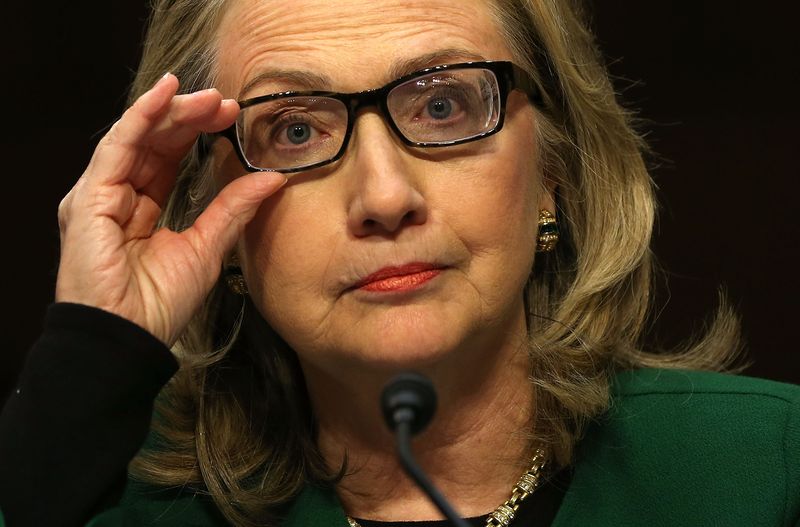
hillary-fotd

U.S. Secretary of State Hillary Clinton testifies before the Senate Foreign Relations Committee on Capitol Hill on January 23, 2013. Lawmakers questioned Clinton about the security failures during the September 11 attacks against the U.S. mission in Benghazi that led to the death of four Americans, including U.S. Ambassador Christopher Stevens. By Alex Wong/Getty Images. Tweet context here.

Does The Electric Car Have A Future?

McArdle is discouraged by an electric car pilot program in Israel:

[W]hen you see [electric cars] failing in Israel, the obstacles look pretty daunting. Israel has some of the highest gas prices in the world–almost $10 a gallon last August–and its compact size makes it easy to cover with battery-swapping and charging stations. The economies of scale would have to be amazing to make this business model work in a bigger country like the US. Even if we somehow developed the political will to impose a $7 gas tax.

Which is perhaps why, so far, our electric car market isn’t looking so bright. We’re a long, long way from Obama’s goal of 1 million electric vehicles on the road by 2015.