How No Sick Days Make Us Sick

Shamus Khan sees America’s lack of paid sick days as a public health threat:

The jobs with the most contact with the public are the least likely to provide sick days, such as the hospitality and food-service industries. For example, when you go to purchase a cup of coffee or eat a restaurant, know that almost all (76%) of the people serving you are likely to show up to work sick, because not doing so means not getting paid and could mean getting fired.

Face Of The Day

FOTD-0122

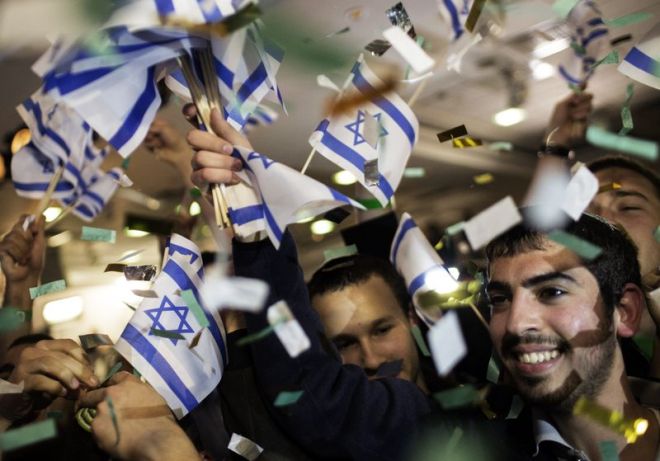
Supporters of Naftali Bennett, head of the Israeli hard-line national religious party, Jewish Home, celebrate after exit polls were announced on January 22, 2013 at the party headquarters in Tel Aviv. Israeli Prime Minister Benjamin Netanyahu’s Likud-Beitenu was the top vote getter in today’s election but the right-wing combination was weakened by a strong showing by the centrist Yesh Atid, according to TV exit polls. By Marco Longari/AFP/Getty Images. Recent Dish on Bennett and his modern theo-fascism here. Update from a reader:

I’ve been out reporting for 19 hours straight, my brain is fried and probably I shouldn’t write, but: for many months you have reported, as per almost every blogger and media outlet, that the radical right had a stranglehold on Israel. One thing proven today is that Israel badly needs a Nate Silver. And that fearful commentators probably should calm down a bit and think. Despite grave problems, Armaggedon is not around every corner.

The main message of today’s election is a wide and deep repudiation of Netanyahu. It’s not the happiness of Bennett supporters. Bennett, actually, also got less than expected. Something else is going on in Israeli politics, which continues to be basically split down the middle, and it is worth analysing. I know as little as anyone about what will happen in the coalitionary horserace, but given the amount of coverage Israel’s axiomatic hard-right turn received I think this is worth pointing out. It’s complicated.

Post-election analysis to come.
Moore Award Nominee

“This guy, this Limbaugh, this is one of the most vile human beings ever to live! If Limbaugh had the power, he would open gas chambers! If Limbaugh had the power, he would line people up against the wall and execute them! If Limbaugh had the power, he would destroy children because he can’t have any! The only thing he sees in children is sex partners! This is a sick, degenerate, evil man!” –Mike Malloy.

Have No Fear Of Killer Robots

Leave it at the cinema:

In Edge‘s doomsday symposium, Bruce Sterling reassures us that runaway artificial intelligence – a “singularity” – is “just not happening”:

All the symptoms are absent. Computer hardware is not accelerating on any exponential runway beyond all hope of control. We’re no closer to “self-aware” machines than we were in the remote 1960s. Modern wireless devices in a modern Cloud are an entirely different cyber-paradigm than imaginary 1990s “minds on nonbiological substrates” that might allegedly have the “computational power of a human brain.” A Singularity has no business model, no major power group in our society is interested in provoking one, nobody who matters sees any reason to create one, there’s no there there.

Walter Russell Mead shifts focus:

There are many other scenarios that would qualify as singularities. Frank Fukuyama has pointed to what you could call a “soft singularity” in which new varieties of psychoactive drugs like Adderall and Prozac increasingly turn consciousness from a given produced by interaction with the outside world into something that we determine for ourselves by varying our drug dosage. Just as Einsteinian physics breaks down inside a black hole, these technological singularities would signal some kind of fundamental breakdown of social order.

Voting Vicariously In Israel

An Israeli woman rides her bicycle past election posters

Mairav Zonszein explains why she gave her vote away to an Arab woman from Ramallah a non-citizen Palestinian from East Jerusalem, “in an act of protest, frustration and guilt”:

A country that prides itself so aggressively on its democracy cannot annex an area and leave its population in the dust and think it can get away with it. And I cannot happily go to the polls and vote for a party – even if there is a party I really do believe in – because it feels like a sham. And I am angry that it feels like a sham. I am angry that I couldn’t feel good about voting today and that I was not capable of feeling empowered by my civil rights.

(Photo: An Israeli woman rides her bicycle past campaign posters for Likud’s Binyamin Netanyahu (left) and Labour’s Shelly Yachimovich (right) in Tel Aviv. By Jack Guez/AFP/Getty Images)

The Awl On The Dish

One of my favorite websites interviewed me about the new Dish when I was still in bed with the flu. Money exchange:

Maria Bustillos: I’ve freaked a few atheists out by telling them: You don’t understand doubt nearly as well as my friends who are believers. Faith is a much harder struggle than just smugly shelving the question of doubt, imagining you “know” something. You don’t understand it.

Andrew Sullivan: Thank you. Thank you, thank you so much for saying that, because the one thing I always argue is that no Christian does not have elements of agnosticism in his or her life, because God is ultimately unknowable; so of course there is a vast amount about God that we cannot begin to understand, and therefore doubt is integral to faith; it’s not some sort of enemy of faith, it’s its wellspring.

“An Unpalatable Truth” Ctd

A reader writes:

The food/eco bloggers I read point to some controversy over this quinoa story. Apparently, it surfaced at end of November, with an NPR story. The counterargument is basically that there is not a quinoa shortage, that farmers have been and continue to grow for themselves.  Some suggest that there is an incentive for some (corn, wheat industry) to push a story that would turn people away from this alternative grain. Here is one of the sources they cite, from filmmakers in Bolivia, who were there at the time of the NPR story. Here‘s another take on it, which makes the point that the popularity of quinoa means that farmers are incentivized to grow it in less successful regions, which has ecological consequences.

Another:

There’s an interesting response to this by Doug Saunders in the Globe & Mail. He compares the case of quinoa today with lobster in Nova Scotia generations ago, arguing that higher prices make farmers’ lives better, not worse.

Another lets loose:

I despised Joanna Blythman’s article about quinoa.  The claim that vegans are somehow responsible for Bolivian farmers going hungry is ignorant and, frankly, insulting.

Continue reading “An Unpalatable Truth” Ctd

Why Athletes Are Unlikely To Follow Armstrong’s Example

After reviewing public opinion polling, Harry Enten concludes that Armstrong’s confession to Oprah did him more harm than good:

Lance’s confession succeeded in alienating everybody. Only 17% in the SurveyUSA survey thought that Lance was being completely honest with Oprah. Those who thought he was a liar beforehand continue to think so now. Those who defended Lance for years, like ESPN’s Rick Reilly, now just feel they were duped. This is the political equivalent of having your own base turn against you.

This series of events matches the research on athletes who admit to steroid use in US sports, which indicates that it’s better just to keep denying …