Finding God Among The Outcasts

Joan Acocella considers the life of St. Francis of Assisi, including accounts of a number of recent books about the man and his ministry. Below is her moving description of his conversion to Christianity:

In a document called his “Testament,” written shortly before he died, Francis said that his conversion was due to his work with lepers, a number of whom lived outside Assisi. He explained, “God allowed me to begin my repentance in this way: when I lived in sin, seeing lepers was a very bitter experience for me. God himself guided me into their midst and among them I performed acts of charity. What appeared bitter to me became sweetness of the soul and body.”

Lepers were horrifying to people at the time, not only because of their unsightly affliction—black boils, truncated limbs—but because the disease was thought to be caused by sin. If a leper wanted to approach a town, he had to do so at night and ring a bell to warn people of his presence. In Roberto Rossellini’s “The Flowers of St. Francis” (1950), the best of the many movies made about the saint, a leper, sounding a bell, goes past the hut where Francis and his fellows are bedded down. Francis rouses himself, catches up with the man, and embraces him. We see the leper only darkly: his blackened skin, its clammy sheen. We see Francis’s face directly, with no tears, just an ardent gaze. This is one of the most appalling and thrilling scenes in Western cinema, and it epitomizes the idea that evidently fired the young Francis. As he saw it now, the more a person was despised, the more he or she resembled Jesus in his last agonies, when he was abandoned by almost all the people he had come to save. To obey Jesus, therefore, you had to join those who were abandoned.

You can read my take on St. Francis here.
The Waiting Is The Hardest Part

Stefany Anne Golberg muses on what Samuel Beckett’s Waiting for Godot taught her about love:

When we say that love is ineffable, as Beckett knew, what we mean is that, when we love, we don’t know what the hell we are doing. We can’t stop talking through it, trying to figure it out. We think we ought to be talking about everything, doing everything, doing anything — breaking into spontaneous rage, talking about suicide, playing games, complaining about our boots — instead of just loving. We wait and wait and wait. Inevitably, boredom creeps in, terror creeps in. When you give yourself completely to another, as Vladimir and Estragon have done with each other, and you say, “Don’t leave me, you’re my only hope,” every day is a little more and a little less frightening, every day is a little more and a little less suicidal, every day is a little more and a little less. You could, like Vladimir or Estragon, easily be talked into hanging yourself from a tree by the only one who could save you from it. We must escape. We cannot. We can’t go on. We do.

Poetry That Preaches To All

Alfred Corn notices the way work of the 17th-century English poet and Anglican priest, George Herbert, resonates with those who aren’t Christians, or have no religious attachment at all. One reason why? Unflinching honesty:

The single-word title doesn’t tell much and therefore acts to draw in its readers, who want to know how the topic will be treated.  Using just one word is rather blunt, and when the title is “Affliction,” the powerful implication of suffering acts like a gavel calling the court to order so that serious business can be conducted.  The suffering dealt with in this poem is multiple, and Herbert the plaintiff brings up sources of his pain one by one, presenting them to a deity inseparable from the qualities of goodness and mercy.  On the face of it, making an inventory of complaints to be presented to God doesn’t strike us as a pious action. No, but it does seem honest, freeing the poem from the charges of hypocrisy and sanctimony that are often leveled at devotional verse.  It isn’t possible to think that Herbert is inventing his discomforts. On one level they make him look self-pitying, lacking in the fortitude expected of an ordained person.  Experience teaches, though, that all people at least inwardly complain, some few of these managing to avoid direct expression of their sufferings. Stoicism is admirable in daily life, but the poet’s job is to show us how feelings, even negative ones, can find expression in words and formal means of expression that are in themselves solacing.

Herbert’s “Affliction I” can be read here. Above is a reading of another Herbert poem, “Love (III).”

Scientology’s Noncelebrities

Mark Oppenheimer regrets that “we just keep reading about Tom Cruise” instead of understanding what it is “like to be embedded in the minority culture of small-town Scientology”:

It would be very hard to write a book about a Scientology community from the inside. No academic is likely to get the story. To get his research proposal past an institutional review board, a social scientist or other scholar would have to promise to identify himself to his subjects, to the Scientologists—who would of course then refuse to cooperate. And many newspapers, like my own, The New York Times, forbid reporters to gather news under false pretenses (restaurant critics are exempt). I would not be allowed to join the Scientology center down the street under the pretense that I was just a curious soul, then write a series of articles about it.

So who could? Perhaps a reporter from a scrappy alt-weekly newspaper, or from a college paper, or from a web ’zine. I hope that someone reads these words and heeds the call. Because until someone does, we are going to get more stories about Scientology in Hollywood and in Florida. And while I love a juicy story about the pope in Rome, I also realize that the church, the real church, is not just there, but everywhere.

Face Of The Day

FOTD_120

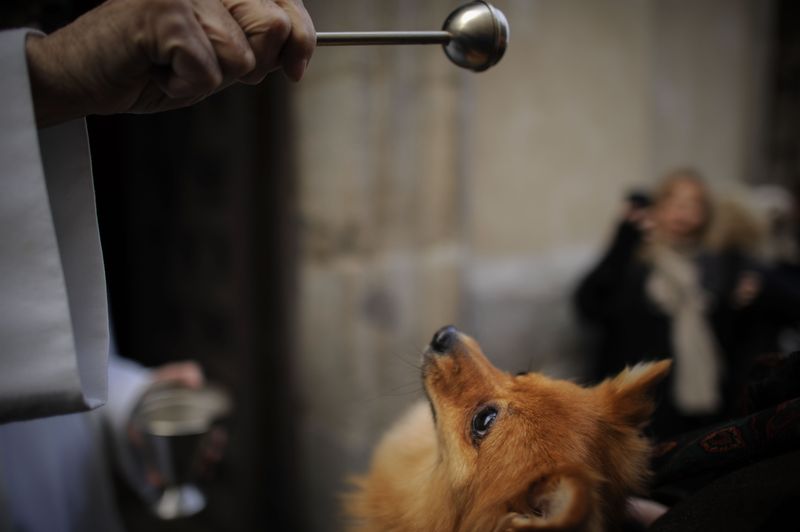
A dog is blessed by a priest at San Anton church in Madrid on Saint Anthony’s Day, on January 17, 2013. Dogs, cats, rabbits and even turtles, many dressed in their finest, trooped into churches across Spain in search of blessing on Saint Anthony’s Day, the patron saint of animals. By Pedro Armestre/AFP/Getty Images.

Which Army Would You Want?

Daniel Dennett poses a hypothetical:

Suppose that we face some horrific, terrible enemy, another Hitler or something really, really bad, and here’s two different armies that we could use to defend ourselves. I’ll call them the Gold Army and the Silver Army; same numbers, same training, same weaponry. They’re all armored and armed as well as we can do. The difference is that the Gold Army has been convinced that God is on their side and this is the cause of righteousness, and it’s as simple as that. The Silver Army is entirely composed of economists. They’re all making side insurance bets and calculating the odds of everything.

Which army do you want on the front lines? It’s very hard to say you want the economists, but think of what that means. What you’re saying is we’ll just have to hoodwink all these young people into some false beliefs for their own protection and for ours. It’s extremely hypocritical.

Alex Tabarrok makes his choice:

It would be astounding if there were never a situation in which a lie was effective in producing a good result, i.e. a noble lie. But is a rule of noble lies effective? In a long sequence of calls to war, how many have been just and wise and how many have been driven by vainglorious leaders and foolish pride–so which army do you want? I prefer the silver.

Embracing The Sleepless Night

embracing

Chloe Aridjis has a conflicted relationship with sleep:

There’s a term in German, Kopfkino, which means the imagination left to run wild, often magnifying the disturbing, unpleasant thoughts best kept at the mind’s edge. The image offered by its literal translation, mental cinema, is what I envision takes place each time I lay my head on the pillow: the projector switches on and the reel starts its endless loops, a whirring machine that comes alive just as I feel ready to shut down.

Faced with the prospects of a cure from a top sleep clinic, Aridjis refused, finding comfort in her condition:

I remember a Hungarian writer friend being astonished when I told him I had never found myself entirely alone in a forest – how could one fully become a writer, or any kind of thinker, without this experience he seemed to suggest, for this represented the ultimate confrontation with the self – and I suppose I feel similarly about insomnia.

The friendship between Goethe and Friedrich apparently suffered when Goethe asked Friedrich whether he would help him in the classification of clouds. Friedrich promptly answered no, explaining that this would signify the death of landscape.

For me, likewise, night would be disenchanted by the scientific explanation of phenomena that may instead be felt as magical, mystical or simply mysterious. And I can’t help thinking, finally, of Kafka’s aphorism, ‘A cage went in search of a bird.’ Free up a space in the mind, and another obsession will come occupy it. We are, to a large extent, our own jail keepers. Our conditions define us, add contours, accents, drama to our lives. And the longer they accompany us, our so-called afflictions, the more years we spend together, the harder it is to part ways.

(“Eagle Nebula” by photographer Bill McDowell, from his series “Ashes in the Night Sky,” made entirely of ashes, via Rosecrans Baldwin)

Heart Strings Attached

heart-string-attached

Claire L Evans considers the social media fallout from ending a relationship, what she terms its “digital shadow”:

In your attempts to clear the debris [after a breakup], you discover that, like an ecosystem, your social network reacts holistically to change. For one, it doesn’t want you to sever ties with anyone: at every turn, it seems to ask you to reconsider. The architecture of the social web, like that of a Las Vegas casino, always leads the user back inside. The engine depends on connections: groups, rather than individuals, are the commodity being sold.

Her advice? Luddite love:

The temptation to tag, cite, post and discover others through their front-facing digital avatars is great, but the rewards of love under the radar are more profound. Love undocumented is love unadvertised and unexploited; it is love that will fade gently, like a photograph, instead of creeping up, algorithmically, like a Google image search result.

(Photo: From the series “Album” by Jon Uriarte)

Dating Isn’t Dying By Text

Jill Filipovic savages a NYT trend piece claiming that “millennials — who are reaching an age where they are starting to think about settling down — are subverting the rules of courtship”:

Newsflash to olds: Yes, dating is different now than it was in your day. It was different in your day than it was in your parents’ day too. That is how things work. Communication is especially different, since now we have cellphones and social media — we do indeed use those things to communicate. And yes, changing gender roles mean that women don’t have to sit around waiting to be asked out, and that we get to pick what we order for ourselves off the menu. Certain aspects of dating are more casual, because people date for many more years before getting hitched. We tend to date many more people. We’re more mobile and often live away from our parents, which means we cultivate local “families” in our social circles. We don’t just want to see how well our partners get along with our biological families; we want to see how well they get along with our friends, and if we share the same values and social preferences.

It’s easy to look at that and conclude that because things are different, they’re worse. But I’m not convinced that’s the case. Are some things surely worse for some people? Definitely. Are other aspects of these changes really overwhelmingly positive? Yes. People who delay marriage until they’re in their 30s or later (and, one assumes, end up dating a wider variety of people) tend to have happier and more stable marriages once they do get married.