“Humanity Connected Is God”

The words of Jim Gilliam, in a spiritual tribute to the Internet that will probably make your eyes mist:

On a similar note, Valarie Tarico suspects that religion’s appeal will diminish in the generations that find interpersonal meaning through the Internet rather than faith communities:

The web showcases the fact that humanity’s bad and good qualities are universal, spread across cultures and regions, across both secular and religious wisdom traditions. It offers reassurance that we won’t lose the moral or spiritual dimension of life if we outgrow religion, while at the same time providing the means to glean what is truly timeless and wise from old traditions. In doing so, it inevitably reveals that the limitations of any single tradition alone.

She argues that the web has also played a huge role in normalizing nonbelievers:

Before the internet existed most people who lost their faith kept their doubts to themselves. There was no way to figure out who else might be thinking forbidden thoughts. In some sects, a doubting member may be shunned, excommunicated, or “disfellowshipped” to ensure that doubts don’t spread. So, doubters used keep silent and then disappear into the surrounding culture. Now they can create websites, and today there are as many communities of former believers as there are kinds of belief. These communities range from therapeutic to political, and they cover the range of sects: Evangelical, Mormon, Jehovah’s Witness, and Muslim. There’s even a web home for recovering clergy.

David Sessions pushes back on the piece:

[O]f course it’s true that the internet has played a role in killing religion in certain people’s lives, or maybe even in the lives of certain (small, fringe) religious communities. It’s made many people more aware of the pluralism of the society they live in, and brought previously far-flung differences close. Those can be powerful things. But it has also provided a means for even the craziest to disseminate their “ideas” and find like-minded followers. Social media allows people to shape their information-world with people and sources who reinforce what they already believe. So is one particular technological revolution “killing” something as huge, and something with such a long history, as “organized religion”? Maybe a little, probably not much.
A La Carte College, Ctd

Ki Mae Heussner checks in on the Minerva Project, which is trying to bring a “Harvard-level education to the Web”:

The company is for-profit but announced a plan to create a non-profit Minerva Institute for Research and Scholarship to create new programs to finance students’ education and recruit top-level teaching talent. Led by former Senator and Governor Bob Kerrey (D-NB), who was also the former president of The New School, the Institute will emphasize Minerva’s commitment to a business model that doesn’t leave college graduates with a crushing debt load and that provides new opportunities for professors in a tough academic job market.

Daniel Luzer, meanwhile, focuses on the University of California’s foray into online education:

The one sucker person who signed up was a high school girl who paid $1,400 for an online precalculus course offered through UC Irvine.

The trouble is that at the same time the UC system created its rent-seeking online program to “knock people’s socks off,” the whole world got all excited about, and signed up for, Massive Open Online Courses, or MOOCs, the college courses Stanford, Michigan, Princeton, Harvard, and the University of Pennsylvania are now offering Americans for free. It’s pretty hard to “market” a $1,400 product when a whole lot of other places seem to be offering a pretty similar product at no cost.

Recent Dish on the rise of MOOCs here.

A Dangerous Bargain

Reflecting on the Aaron Swartz case, Tim Lee argues that plea bargaining is a “corrupt practice”:

If Ortiz thought Swartz only deserved to spend 6 months in jail, why did she charge him with crimes carrying a maximum penalty of 50 years? It’s a common way of gaining leverage during plea bargaining. Had Swartz chosen to plead not guilty, the offer of six months in jail would have evaporated. Upon conviction, prosecutors likely would have sought the maximum penalty available under the law. And while the judge would have been unlikely to sentence him to the full 50 years, it’s not hard to imagine him being sentenced to 10 years.

Orin Kerr gets into the weeds on sentencing:

Why are you hearing that Swartz faced 35 or 50 years if it was not true?

First, government press releases like to trumpet the maximum theoretical numbers. Authors of the press releases will just count up the crimes and the add up the theoretical maximum punishments while largely or completely ignoring the reality of the likely much lower sentence. The practice is generally justified by its possible general deterrent value: perhaps word of the high punishment faced in theory will get to others who might commit the crime and will scare them away. And unfortunately, uninformed reporters who are new to the crime beat sometimes pick up that number and report it as truth. A lot of people repeat it, as they figure it must be right if it was in the news. And some people who know better but want you to have a particular view of the case repeat it, too. But don’t be fooled. Actual sentences are usually way way off of the cumulative maximum punishments.

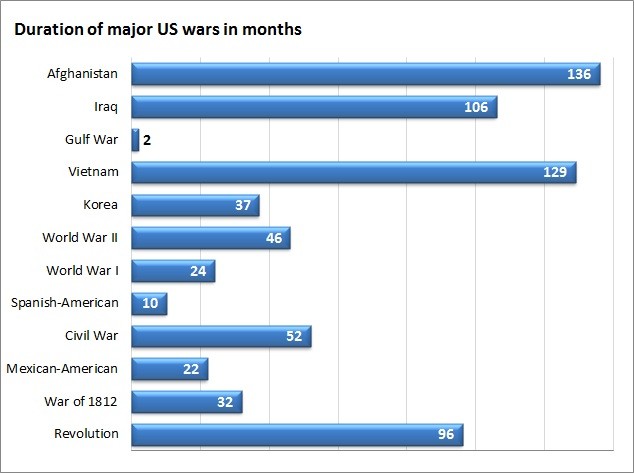
America’s Longest War

War_lengths

Waldman puts the Afghanistan war in perspective with a series of charts. On the cost of the war:

To date, we’ve spent over half a trillion dollars in Afghanistan, a figure that includes only the direct yearly costs for both military expenditures and civilian aid. It doesn’t include the cost of replacing materiel and weapons used in Afghanistan, nor the long-term costs of caring for the thousands of servicemembers who were wounded there. Those factors will add hundreds of billions of dollars to the tally in the years to come. And today, keeping a single servicemember in Afghanistan costs upward of a million dollars per year.

What Should We Worry About?

Edge is holding a forum on the question. John Tooby’s contribution:

The average G-type star shows a variability in energy output of around 4%. Our sun is a typical G-type star, yet its observed variability in our brief historical sample is only 1/40th of this. When or if the Sun returns to more typical variation in energy output, this will dwarf any other climate concerns.

(Hat tip: Arnold Kling)

No, Global Warming Hasn’t Stopped

talking point from denialists is that “there’s been no significant warming trend since the fall of 1996.” Phil Plait rebuts with the above video and explains why these talking points are so troubling:

You can make up any old nonsense and state it in a few seconds, but it takes much longer to show why it’s wrong and how things really are. This is coupled with how sticky bunk can be. Once uttered, it’s out there, bootstrapping its own reality, getting repeated by the usual suspects.

The Debt Ceiling Gets Kicked Down The Road

The GOP has agreed to raise the debt ceiling for three months. Chait celebrates:

The whole key to making Obama’s extortion-squelching plan, and saving American government from endless cycles of hostage drama that would eventually end in a default, was to credibly insist that he would not trade anything for a debt ceiling hike. After he moved his red line on tax cuts, I doubted that Obama could really make this stick. But he has.

Cillizza explains what Republicans are thinking:

As one senior House Republican aide explained it, putting the debt ceiling after the sequester (the series of automatic, across the board cuts that will kick in unless Congress acts to cut spending on its own) and insisting that the Senate produce a budget before April 15 or not be paid shifts the terms of the debate in a favorable way  for Republicans.

Quin Hillyer wishes the GOP had gotten symbolic cuts:

I understand what the GOP leaders are doing in putting off the debt ceiling fight until after they bank the gains from the sequester. I understand them trying to put the onus on the Senate to pass a budget. I understand these things, and I don’t think they are awful idea — but I would do something just a bit different. I would not pass a clean debt ceiling hike for the equivalent of three months; I would tie it to a very nominal package of savings, even if only, say, $15 billion over ten years, if just to establish the principle that cuts belong with debt ceiling hikes.

And Kilgore wants to know what the Republicans’ demands are:

I guess this can-kicking does roughly align the debt limit expiration, the end of the “sequestration” delay, and the lapse in the continuing appropriations measure passed last year. So in theory it creates a Great Big Tripartite Crisis this spring. But Republicans still need to figure out what they are demanding from whom and when. A hostage-taker who’s not sure what ransom to ask isn’t usually real successful.

The View From Your Window

Chicago-1240pm

Chicago, Illinois, 12.40 pm.

Our reader writes:

I’m having cancer treatment and am stuck in a hospital room for at least one month while my sister’s stem cells kick in for me. I love your blog. It’s the first thing I read every day. Anyway, if I’m going to be stuck somewhere, at least this place has a nice view.

Update from a reader:

The view posted today from Chicago is one I know very, very well. My wife and I spent much of our time together there.  She battled breast cancer for over 9 years before passing away in 2011. It is a wonderful sight and the beauty of it still captivates me.  I am madly in love with the great city of Chicago.  While certainly it evokes a great sadness in me to see this view, there are also many warm feelings of remembrance.  Despite the challenges, we had many good times together, even in hospital. Thanks to your reader for sharing this with me and providing an avenue to experience these feelings today.

The Odorless Minority

Austin Considine contemplates research that “crunched B.O. data on 6,495 women and found that around two percent of subjects carried a specific genotype associated with a total lack of body odor”:

Researchers found that among women who possess the G allele—i.e., the smelly ones—around 5 percent didn’t regularly use deodorant. (Hippies.) Compare that with the 22 percent of those who possess the non-smelly AA allele who didn’t use deodorant. That’s a big difference, and indicates that non-odorous people have rightly figured out that they really don’t need it.

More fascinating, however, is the 78 percent of people who don’t genetically need deodorant but use it anyway. Why do they feel so compelled? Not only is it unnecessary, but it’s a waste of money.