The NRA’s Attack Ad Backfires, Ctd

A reader writes:

The NRA’s advertisement seems to rile up the base by suggesting that Obama thinks his children are more important than others, and thus he guards them.  Well, setting aside that Obama didn’t set up those armed guards for the moment, I think it’s worth noting that Sasha and Malia ARE more important than other children … and not because they are the daughters of a rich person, but rather because they are the daughters of an influential person.

For much the same reason as, say, a director of a spy agency shouldn’t have a secret affair because if that kind of information fell into the wrongs hands, such a spy agency director might put his personal life before national security, the daughters of a President have to be protected because a) they will be targets, and b) it’s of national interest that the President keep his focus on the national good and not his family. If some “bad guy” were to get his hands on the Obama daughters, Obama’s interests might not be aligned with the nations, and by the fact that the bad guy has the power to change the course of the nation.

Or as another puts it, “While I love my child with all of my heart, I am not hated by 40+% of the country, so my child has a lower point of risk if some wacko wants to hurt him in order to hurt me.” Another:

Your readers who defend the NRA ad by pointing out that wealthy private schools (including Sidwell Friends) have armed guards [a claimdebunked by a reader] are missing the point. Yes, those schools are much more secure than most, and have been long before this tragedy, but that is to be expected for students who are more likely to be targeted for their influential parents. More importantly, it is the parents, not taxpayers, paying for that security. This is capitalism, not elitism.

Another reader specifies that “tuition at Sidwell is between $33,268 and $34,268, depending on grade level, while the public school system pays on average $10,694per student.” Another:

If the NRA were proposing to establish an endowment to support putting a “Special Police Officer” in each of the nearly 100,000 public schools in the US (at a cost on approximately 10 billion dollars), objections to their ad would not be nearly as strong.  But the reality is that either taxpayers will pay more (if NRA ally Grover Noquist allows it) or other programs will get cut, or educators will be asked to double as guards.  Someone pays for the costs of protecting children against the misuse of guns, but it’s not gun owners, or gun manufacturers.

On that note:

The NRA is on to something. Let’s use Sidwell Friends School as a model for the nation. All children should have access to the same security and quality education the elitist give their children. Pay for it by taxing ammunition.
Breathalyzers In The Doctor’s Office

Joseph Stromberg showcases a new method of detecting bacterial infections in the lungs:

[Researchers from the University of Vermont] focused on analyzing volatile organic compounds (VOCs) in mouse breath to distinguish between different strains of bacteria that were infecting the animals’ lungs. They hypothesized that these bacteria produce VOCs not normally present in the lungs, thus allowing their test to differentiate between a healthy animal and a sick one … Their test was a success: There was a significant difference between the chemical signatures of healthy and infected mouse breath, and their test was even able to indicate which type of bacteria were the source of the infection.

What Happened To Cap-And-Trade?

Theda Skocpol took an extremely close look (pdf) at what went wrong during efforts to develop cap-and-trade legislation in 2009 and 2010. Philip Bump summarizes:

Skocpol’s thesis for why cap-and-trade failed can be simplified to a few points: failed organizing efforts by advocates for the policy, an attempt to craft legislation behind closed doors at a moment that demanded transparency, and (of course) massive shifts in public opinion due to the concerted efforts of opponents of action.

David Roberts chimes in:

I couldn’t help smiling when, after sifting through various post-mortems on the cap-and-trade battle, Skocpol concluded that “each player tended to blame others and conclude that whatever approach he/she/it favored all along would be the best one to double-down on moving forward.”

So true. That’s a perpetual danger in these kinds of retrospectives (a danger to which Skocpol is as vulnerable as anyone). The cap-and-trade battle is like the fabled elephant and the blind men. Everyone came to it from a different perspective, saw different things, and learned different lessons. The way it looked to a Waxman staffer is very different from how it looked to an oil executive or an enviro leader. Looking back, it’s easy to project whatever you want to see onto it. Many people have.

Transcendence Tech

James Wolcott connected himself to an array of self-tracking gear, including one that coaches you through the stress of modern life:

Along with my digital wristbands, I am packing an emWave2 pocket-size Personal Stress Reliever, which, through an earlobe attachment or thumb sensor, measures heart-rate variability (H.R.V.) and doubles as a biofeedback meditation assistant. By breathing in unison with a climbing and descending column of illuminated beads and thinking happy thoughts of ballerinas, I seek to raise my coherence level from red (low) to blue (medium) to green (high), achieving a steady-state flow of relaxed awareness that will undulate through the day, until somebody annoying calls. It’s like a mood ring for the heart. I practice with the emWave2 five minutes at a stretch, because any longer than that and its beeps begin to bug me and drop me into the red zone, which defeats the purpose.

Should Every Book Link To Amazon?

Over the weekend, Hairpin editors Nicole Cliffe and Edith Zimmerman debated the merits of the Amazon Affiliate program, where sites get a cut of the money spent at Amazon when a reader follows a link from their site. The Hairpin makes “between $140 (most recently) and $1,100 (May 2012) a month, but it usually hovers around $300.” Zimmerman defends the practice:

Although if authors get the same amount of money regardless, I prefer linking to a place that saves the reader money. Honestly — and maybe this is the potentially shadiest part? — we get most of our Amazon Affiliates money from stuff that people buy after they click past the link to the book. Because they don’t always buy the books — they’re searching for, finding, buying tights, computers, random DVDs, etc. — but as long as they got to Amazon from the Hairpin’s link, we get 7% (or so — it varies) of whatever they buy.

Dustin Kurtz joins the the discussion:

[The Hairpin] asked the reasonable question: why should we stop linking to Amazon when it is this lucrative for us? I would like very much to answer that question at extreme and shouty length. But the joy of The Hairpin is that it was answered, in the comments, by some fairly knowledgeable folks. Their answers weren’t always as strident as mine would have been, but they were enough. One even linked to our site calling us, accurately, “avowed Amazon haters.” They pointed Zimmerman and Cliffe to the Powell’s and Indiebound affiliate program, for instance, which in many ways are a better deal for vendors than Amazon’s, and a world better for independent publishers and booksellers.

Chart Of The Day

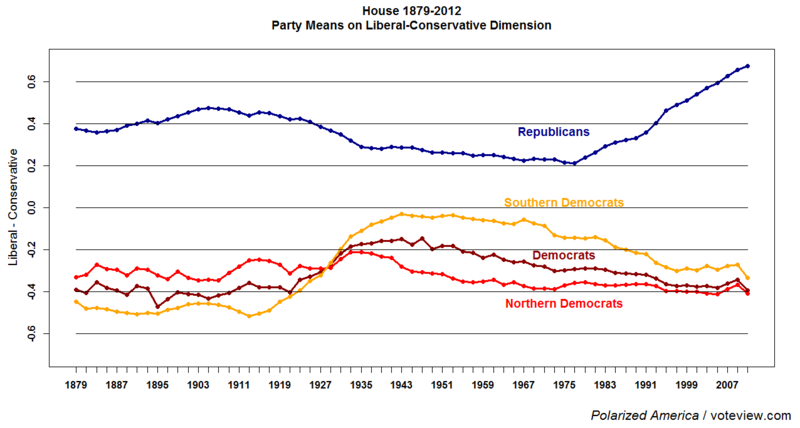
Republican_House

Vote View tracks the Republican lurch to the right:

We have previously written about asymmetric polarization, arguing that the primary driver of contemporary partisan polarization has been the steady movement of congressional Republicans to the right. This trend appears to have continued through the 112th congress. House Republicans – despite a large majority earned in the 2010 midterm elections – have continued their rightward drift, adding more conservative members than moderate members. Senate Republicans also became a more conservative group in the 112th Congress, while Senate Democrats remained mostly ideologically static.

Broadband For All? Ctd

Readers take issue with the claim that “the only time latency becomes an issue is for a gamer.” A professor of computer networking who “co-authored one of the standards used in voice over Internet communications” writes:

The article you quoted by Jon Brodkin on satellite broadband is flat out wrong. It is not only gamers who suffer from half-second latency. 150 milliseconds is the maximum delay that you want for voice over Internet. Anything over that is definitely noticeable and anything over 400 milliseconds is flat-out unacceptable. With half-second delays, meaning 500 milliseconds, each speaker has to wait to be sure the other has heard, people talk over each other, it is a mess. There really is no debate on this in the scientific or telecommunications communities.

Another cites issues with latency and virtual private networks (VPNs):

Another gotcha on the latency issues affects telecommuters and other remote workers seeking to use a corporate VPN. Many corporate VPNs can’t tolerate the latency, so folks (like me) who work from (our) rural homes can’t use satellite services to connect to our offices.

Another gets pissed:

While I imagine most Dishheads would click through and give the Ars Technica article you linked to a close read, and would have thus seen some of the caveats raised in both the article itself and in the top comments on it, looking to satellite Internet as a panacea for our sluggish broadband penetration rate — as your post seemed to me to do, intentionally or not — is folly. The forums and user reviews at DSLReports for satellite ISPs are rife with complaints about punitive data caps and/or metering schemes, terrible customer service, outrageous pricing, and unreliable connectivity. See here for ViaSat, mentioned in the Ars post; here for HughesNet; and here for WildBlue.

I could rant on and on about the myriad disgraces of our nation’s telecommunications service providers, but I’m channeling my frustrations toward them into finding a job where I can help, in some way, to bring affordable, fast, uncapped broadband to everyone in the country. (As a recent college graduate [and “digital native”] living at home with a 1.5Mbps up/768Kbps DSL connection, you could say I’m triply motivated to find such a career.) It’s about time more of us started getting pissed off about our dismal standing in global broadband penetration and speed rankings – and letting our legislators know it.