The Real Parameters Of The Global Warming Debate

One way to think about climate change:

Elsewhere, Mark Boslough pushes back on the idea that "the science is settled" on the question of climate change, citing the need to "recognize the difference between a scientific debate and other forms of disagreement":

The calculation of the mass of CO2 produced from burning a gallon of gasoline was the subject of a vigorous debate on the Albuquerque Journal letters page a couple years ago. This is a question that a decent high school chemistry student should be able to answer, but the highly-opinionated letter writers were not able to resolve their differences–despite the fact that reaction stoichiometry is indeed settled science. Likewise, a competent high school physics student understands how the greenhouse effect works, which is based on the first law of thermodynamics (conservation of energy). This is also settled science.

He continues:

What is not settled is the degree of climate change.

In the peer-reviewed scientific literature there is a healthy, open, honest, and vigorous scientific debate. The best scientific estimate of the amount of warming (when CO2 levels double, which is likely to happen this century) is about 6 ºF. There are those who disagree, and have published the basis for their disagreement. The most useful assessments are not limited to the best estimate, but include quantification of the uncertainty, which is one of the hallmarks of honesty in science. There is a broad range of possibility, from below 4 ºF to greater than 11 ºF.

The Second Amendment Goes South

Charles Kenny looks at how lax American gun laws impact Mexico:

Mexico provides a case study of what happens when more guns meet weak institutions. In the four years following the lapse of America’s assault weapons ban in 2004, 60,000 illegal firearms seized in Mexico were traced back to the U.S. Luke Chicoine, an economist at the University of Notre Dame, estimates that the expiration of the federal assault weapons ban led to at least 2,684 additional homicides in Mexico. Similarly, a study from New York University researchers found that homicides spiked in Mexican border towns after 2004, particularly those most involved in narcotics trafficking. The spike was far less dramatic in towns that bordered California, which had a state-level assault weapon ban that remained in place after the U.S. ban lapsed. A survey of court cases reported in their paper found that 3 percent of trafficked guns came from California, vs. 29 percent from Arizona and 50 percent from Texas.

Maybe In America

Tumblr_m6naca21Ew1rncagco1_500

The Alliance of American Manufacturing, a lobbying group, tried to furnish their office only with appliances manufactured in the US. It proved harder than they thought:

Trash cans, light switches, and even furniture were all readily available from well-known domestic companies. But if you want a U.S. dishwasher compliant with the Americans with Disabilities Act, you’ve got one choice: a single model from a line that German-based Bosch manufactures in North Carolina. It cost AAM $1190. Need computers, televisions or phones for your home or office? A coffee maker or a compact fluorescent light bulb? No such luck. Those products simply aren’t manufactured stateside, [the group’s executive director Scott Paul] said.

“We Are Confused And Absolutely Terrified”

Molly Davies pens a letter to the president arguing that her husband Matt Davies, a California dispensary owner indicted last year for cultivating marijuana, is not the "bigger fish to fry" in the war on drugs:

[M]y husband is not a criminal and shouldn't be treated like one. Matt is not a drug dealer or trafficker. He's not driving around in a fancy car and living in some plush mansion–trust me. My husband is a regular guy, and we're a regular, middle-class family. Yet even though Matt took great pains to follow state and local law, he is currently facing a severe prison sentence. This all seems so surreal. …To protect his family, Matt spent thousands of dollars on lawyers who would ensure that he complied with every part of state law. When I saw how careful he was, I eventually became comfortable with what Matt was doing. He felt like he was offering a valuable service to people in need, many of whom are vulnerable and terminally ill. Matt truly believed that he was doing a good thing.

Matt Welch wonders where it ends:

As (former pot smoker) John Kerry gets ready for his confirmation hearings to be the next secretary of state, let's rephrase his most famous quote: Who will be the last law-abiding father to die behind bars for this mistaken war?

Reading With Big Brother

Ebooks can track how, and sometimes where, you read. Martyn Daniels explores the ways these technologies are being used:

Eli Horowitz has developed a story app ‘The Silent History’, which is about a generation of unusual children born without the ability to create or comprehend language but who have other skills. The work is released in daily episodes like a Japanese Keitai novel. For readers who wish to explore more, Horowitz has created hundreds of GPS locked ‘Field Reports’ that can only be read when the reader takes their device to the specified place. The location-based stories can be accessed across the U.S. and around the world.

The Climate Clock Keeps Ticking

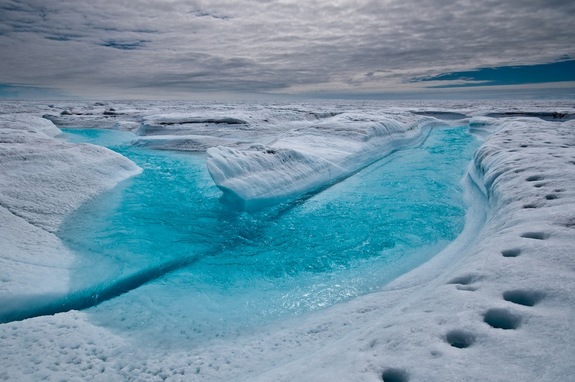
Melt-pond-121129

Bill McKibben explains why climate change isn't like other political issues:

Physics couldn't care less if precipitous action raises gas prices, or damages the coal industry in swing states. It could care less whether putting a price on carbon slowed the pace of development in China, or made agribusiness less profitable. … And unlike other problems, the less you do, the worse it gets. Do nothing and you soon have a nightmare on your hands.

We could postpone healthcare reform a decade, and the cost would be terrible — all the suffering not responded to over those 10 years. But when we returned to it, the problem would be about the same size. With climate change, unless we act fairly soon in response to the timetable set by physics, there’s not much reason to act at all.

Recent Dish on McKibben's "Do The Math" tour here and his "Ask Anything" videos here.

(Photo: "A stream of meltwater flows across the ice surface in Greenland" by Ian Joughin via LiveScience)

How Hyperlocal Was Overhyped

Tim De Chant urges newspapers "to concentrate on a particular topic instead of a geographic region":

I was flipping through the Houston Chronicle when I noticed the paper had branded their energy coverage, FuelFix. Not the best name, but it’s a sound idea. Houston is a major hub for the oil and gas industry, and Chronicle reporters have spent years, even decades reporting on it. Who else would be so positioned to cover the industry?

The Chronicle isn’t the first paper to experiment with trade-specific coverage. The New York Times has done the same thing with financial firms and DealBook, to much success. By providing consistent, nearly obsessive coverage of an industry, both papers attract new readers and new advertisers interested in reaching a targeted audience.

Relatedly, after three years editing the hyperlocal news site Center Square Journal (covering neighborhoods on the north side in Chicago), Mike Fourcher reflects on the lessons learned.

The Daily Wrap

6a00d83451c45669e2017c35b77c33970b-800wi

Today on the Dish, Andrew denounced the undue viciousness of Aaron Swartz’s prosecutor at DOJ, and wondered whether academic literature could be made a public good. He applauded Matt Stone and Trey Parker breaking free of Hollywood studios and called out Jodie Foster on her narcissistic coming-out speech at the Golden Globes. He chided Dreher and Frum on their arguments to shield the poor from pot, continued to ruminate on the legacy of Richard Nixon and sang the praises of DC bear culture. Elsewhere he urged popular opposition to the GOP’s ongoing economic terrorism, which will likely earn them the scorn­ of the public.

In political coverage, we questioned whether or not guns are a safeguard against Big Brother and circled back to Drum’s original evidence connecting lead and crime. We juxtaposed two quotes in which a former member of the Knesset sighed at Israel’s swing to the right while an American senator called Israel our hands-down greatest ally. Seth Masket joked about Obama’s vulnerability on intergalactic defense, readers sounded off on Anne Lowrey’s unkind portrait of the nation’s capital, and we revisited the data about movies and violence in light of Tarantino’s recent outburst on the subject.

In assorted coverage, we compared the hazards of driving drunk to driving stoned, got a taste of the power of tea in Pakistan, and revealed the one word that will burn Brits’ grits. We remained diligent about flu vaccination, and kept up with the debate over the benefits of bare feet while running. Jane Shilling argued that power of the Internet would make Socrates glow, while Geoffrey Nunberg saw Amazon users’ book annotations as a window into their collective consciousness.

Meanwhile, we rounded up some more insightful reader reax to impending Dish independence, followed a famed photographer duo as they scouted locations via Twitter, all as the great showdown between mutant ducks and tiny horses raged on. An old MHB received an update from a talented music class, while we gazed over the red rooftops of Malacca, Malaysia in the VFYW and watched the doors of a health clinic close on the Face of the Day.

– B.J.

The Examined Life

Jane Shilling contemplates it:

The writer and philosopher Julian Baggini has argued that the Socratic maxim about the examined life is profoundly elitist. "The bulk of humankind, today and in history,” he writes, "has been far too busy struggling for survival to engage in lengthy philosophical analyses. So if an examined life is one in which more than just a little investigation takes place, by implication, huge swaths of humanity are ignorant beasts."

How that has changed:

[A]nyone with access to the internet (and that is a vast number of even the otherwise most severely impoverished members of the world’s population) can indulge in public acts of self-examination, whether blogging clandestinely from a country in the grip of a tyrannical political regime, or soliciting sympathy on Facebook for what might once have been an anxiety or grief too intimate to mention to any but the closest of friends, or tweeting updates on one’s changing frame of mind. Self-examination has become one of the most democratic of all activities.