The Most Underlined Passages

Geoffrey Nunberg considers how technology tracks them:

Think of the tens of thousands of used copies of Pride and Prejudice still in circulation with "It is a truth universally acknowledged …" highlighted or underlined and "IRONY" written in the margin, as readers affirm that they're in on the game. … The opening sentence of Pride and Prejudice comes in second place [on Amazon's list of the most highlighted passages ever], just behind one from The Hunger Games, whose selections occupy 13 of the top 15 slots. As Ann Blair has said, the annotations made by ordinary readers have always been useful windows on shared patterns of thought, and those of us anxious about the fate of literary culture can take some comfort in knowing that Austen can still claim so high a place in Amazon's collective florilegium. Still, you might wonder if it's possible to grasp the irony of her sentence without undermining one's faith in the wisdom of crowds.

When Lightning Strikes A Million Times

Kevin Kelly ruminates on YouTube's love of improbable events:

Superlatives were once rare — by definition — but now we see multiple videos of superlatives all day long, and they seem normal. Humans have always treasured drawings and photos of the weird extremes of humanity (early National Geographics), but there is an intimacy about watching these extremities on video on our phones while we wait at the dentist. They are now much realer, and they fill our heads.

His fear:

What happens if we spend all day exposed to the extremes of life, to a steady stream of the most improbable events, and try to run ordinary lives in a background hum of superlatives? What happens when the extraordinary becomes ordinary?

Running Pains, Ctd

Katherine Harmon highlights new research contradicting the conventional wisdom about "habitually barefoot runners," those who "grew up running sans footwear":

"The Daasanach people grow up without shoes and continue to spend most of their lives barefoot," Kevin Hatala, a graduate research in Hominid Paleobiology at George Washington University and co-author on the new paper, said in a prepared statement. Nevertheless, these people, it seems, land farther back on the foot when they run. "We were surprised to see that the majority of Daasanach people ran by landing on their heels first," Hatala noted. "This contradicts the hypothesis that a forefoot strike characterizes the ‘typical’ running gait of habitually barefoot people."

Not everyone is jumping on the barefoot bandwagon. After a recently diagnosed stress fracture in his foot, The Running Moron is giving up minimalist shoes:

It goes against the hype I know, but I've come to the belief there is just a certain type of foot and/or body that should not forego the protection of a well cushioned shoe and I'm wondering if my feet and/or body belongs in that group. Maybe it's our natural disposition to walk around barefoot like our caveman ancestors, but back then not only did a caveman die from simple viruses that are rendered relatively harmless now with antibiotics, but there was no way to correct any problems cavemen experienced with age. 

Previous Dish on barefoot running here, here and here.

Face Of The Day

159501174

People react in front of the local healthcare centre that closed at 8pm tonight its emergency hours along with 21 other centres in the region of Castilla-La Mancha, following budget cuts and privatisations in Spanish health services, in Tembleque, near Toledo on January 14, 2013. By Pedro Armestre/AFP/Getty Images.

Can Guns Really Protect Us From Tyranny?

Joshua Keating gathers evidence that widespread gun ownership doesn't translate into successful uprisings against oppressive government:

[T]he country ranked last on the [Small Arms Survey] — with only 0.1 guns per 100 people — is Tunisia, which as you'll recall was still able to overthrow a longtime dictator in 2011. With only 3.5 guns per 100 people, the Egyptian population that overthrew Hosni Mubarak was hardly well armed either. On the other hand, Bahrain, where a popular revolution failed to unseat the country's monarchy, has 24.8 guns per 100 people, putting it in the top 20 worldwide. A relatively high rate of 10.7 guns per 100 people in Venezuela hasn't stopped the deterioration of democracy under Hugo Chávez.

Michael Moynihan recently dismantled the myth pushed by gun activists that Hitler's rise was aided by gun control laws.

The Best Way To Fight The Flu

Flu_Vaccine

Michael Specter urges everyone to get a flu shot:

Even if you think you are invincible, your elderly neighbors and infant children are not. People with weakened immune systems—those undergoing cancer treatments, for example—are not. Your parents and grandparents are not. The flu vaccine is not perfect, but it’s what we have. It’s available at drug-store chains and malls, big-box superstores and, naturally, at your doctor’s office. Get one today.

Lisa Beyer worries about shortages:

Should a severe flu push demand for vaccines higher than the planned supply, manufacturers would be unable to respond. That's because flu vaccine production — an antiquated system using chicken eggs that has remained basically unchanged since the 1940s — is a six-month long process. That's why it's best to get the vaccine as soon as it's available, in September usually, when supplies are plentiful, before flu season begins.

And Sarah Kliff explains why flu vaccination rates are relatively low:

Lori Uscher-Pines, a policy researcher at the RAND Corp., estimates that part of the issue has to do with no consequences for not getting vaccinated (well, except for coming down with the flu). Unlike childhood vaccines, which are generally required to start a school year, employers don’t stop their workers’ from coming to work if they cannot prove flu immunization.

(Photo: Dr. Sassan Naderi holds a vile of flu vacination at the Premier Care walk-in health clinic which administers flu shots on January 10, 2013 in New York City. By Spencer Platt/Getty Images)

Will Voters Punish House Republicans?

Maybe:

The particular problem for House Republicans is this: when Congress is unpopular, voters don’t punish all House incumbents. Instead, they direct their dissatisfaction primarily at majority-party House incumbents. So argue political scientists David Jones and Monika McDermott in their book (see also this article). In the article, Jones finds that a 10-point decrease in approval costs majority-party House incumbents 4 points at the poll.  This effect is larger in swing districts and has been getting larger over time, as the parties have polarized.

The Question Obama Ducked, Ctd

Screen shot 2013-01-11 at 9.51.16 PM

A reader reframes the question:

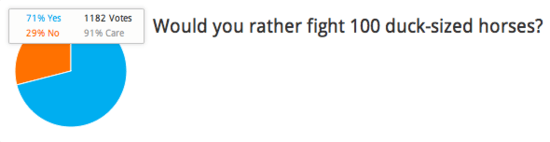
Would you rather fight 100 hoarse ducks or a horse that ducks?

Another disagrees with 71% of readers who participated in our Urtak poll (snapshot seen above):

From a physics standpoint, pick the horse-sized duck. The square-cube law would certainly render it incapable of flight and more than likely incapable of much locomotion. There is a reason why most birds aren’t the size of horses: they quickly become too heavy to fly. A duck is already at, or very close to, its optimal size.

Horses reduced in size don’t fare much better, losing much of their strength with their reduced size. But they will still have agility, locomotion and numbers to aid them in the fight.

Another would take on the tiny horses:

As having raised/butchered ducks for a few years, I feel uniquely qualified to chime in on this one. I have a favorite story I tell my friends when they ask me about Motherduckerbutchering ducks, and the first full-sized male I attempted beat the shit out of me with its wings and claws (yes, some duck breeds have nails). It is 10x more difficult than a chicken and seems to have a strong instinct to survive when it’s time for the dinner plate. When my wife came out to check on me after being gone so long to prep the duck, she found me covered in blood, sweating, exhausted, and my clothes ripped. I fought this damn duck for 20 minutes and was only able to finally put him down with a tire iron, smashing it to death in a fit of rage. I wish I could have given it a more humane death, but I learned to never underestimate a duck’s unusual strength and will to live.

Another reader with first-hand experience agrees:

Let me just say that anyone who chooses a horse-sized duck is fooling themselves.

Fowl may seem calm and pretty, but they can be mean, nasty, and aggressive. I have much experience fighting fowl from my days doing research on Guinea Fowl, basically small chicken-like birds (long story).  Let me tell you, even the tiny Guinea Fowl were nasty fighters.  They are smart, assessing you and watching for a moment of weakness. They use their wings to burst and lunge, and fight with their beaks, feet, and wings. The Guinea Fowl had a favorite move which I can only describe as a two-foot flying dropkick with a simultaneous bite.  If you want to get an idea, take a look at this video.

A horse-sized duck simply won’t be defeated.  It will not back down.  And how do you think you can get to it?  Birds are fast and agile and as soon as you try to get to the body or head it will use its wings to keep you at bay or dodge.  They have quick and powerful necks which can make the beak a deadly weapon, and the feet and wings would be nasty secondary weapons.

On the flip side, a hundred duck-sized horses is a daunting task.  However, horses are not nearly as multi-faceted as birds, generally relying on backwards kicks or rearing that has a limit of a second or so or else they lose their balance.  They are not able to turn as quickly and even though they are good jumpers, a jumping horse is not the same as a bird with wings.  If you fought a hundred duck-sized horses you may be able to defeat them one by one as long as you are able to keep your balance and stay on your feet.  It would end up being an endurance task as long as you stay upright.  A horse-sized duck?  You would go down in a minute, is my guess.  And if you were able to dodge and weave, you will never outlast a bird’s endurance.

In fact, I would say with strong conviction that I would rather fight a hundred duck-sized horses than a hundred normal ducks.  Fowl are not to be messed with.

Another considers the spoils:

I discussed the duck/horse question with my wife, who is French, and our kids, who are half-French.  They unanimously favor fighting the horse-sized duck, pointing out that the White House staff and your commentators (so far) appear to be ignoring the all-important culinary considerations.  Fighting a horse-sized duck may be more difficult than a hundred duck-sized horses, but the rewards for success are much greater.  Yes, you can eat horsemeat, but duck is much tastier and works with a wider variety of preparations.

For best results, try to fight a horse-sized duck with an artifically enlarged liver.  (But not in California.)

Driving While Stoned, Ctd

A reader writes:

Just reading your response to Frum's scaremongering on legalized weed.  When it comes to driving while high, I completely agree that there needs to be legal enforcement in place similar to drunk driving.  I don't want anyone on the road to be inebriated in any way.  But I'm willing to bet that the threat of hordes of stoned drivers as a result of legalization is misplaced.  People drive drunk because they're out for drinks and need to get home.  The majority of those who get caught DUI likely aren't plastered.  Sometimes they probably just don't want to pay for a cab and don't want the hassle of coming back to get their car the next day or whatever, so they decide to run the gauntlet and get caught. And good, because I don't want drunk drivers on the road.  

But as we all know, booze and pot aren't the same.  When people smoke pot, they're usually doing it at home.  They're not out at bars or out at live sports or wherever.  They are, like me, sitting in their own living room or back yard, enjoying a joint, listening to some music, then watching some Breaking Bad and going to bed. They're far less likely to be in a position to make the poor choice to get behind the wheel because in many cases they're probably already home.

Frum writes as someone who has clearly never gotten high once in his life.  And it's sad that these people are driving public policy on drug use.  It's no different from old white men deciding what women get to do with their bodies.

Previous Dish on stoned driving here and here.